
“The past was erased, the erasure was forgotten, the lie became the
truth.” —George Orwell, Nineteen Eighty-Four
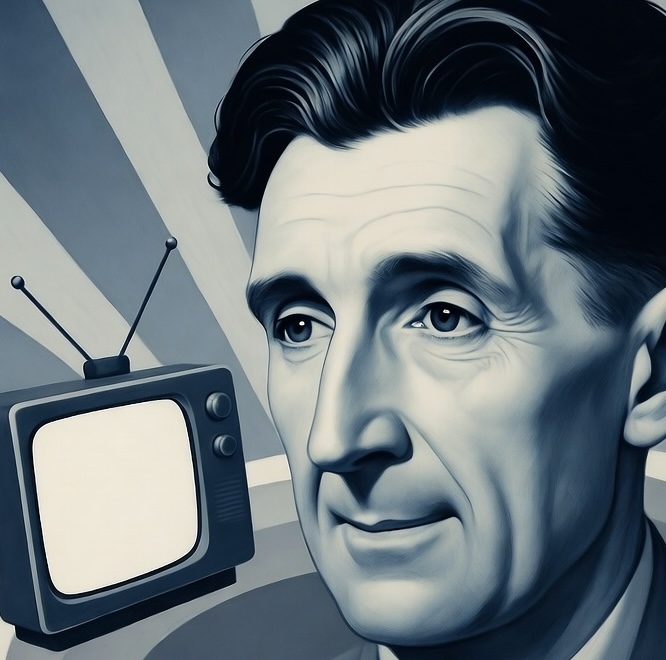
Orwell, in Nineteen Eighty-Four, imagined “memory holes,” literal chutes used to destroy documents that contradicted the Party’s official narrative. Once an item was dropped into the memory hole, it was burned, and its existence denied—allowing the regime to maintain the illusion that it had always been right. Thus, “memory holing” refers to the deliberate alteration, erasure, and suppression of inconvenient events, facts, or records—so that they are effectively disappeared from public consciousness.
Earlier today, I wrote the following:
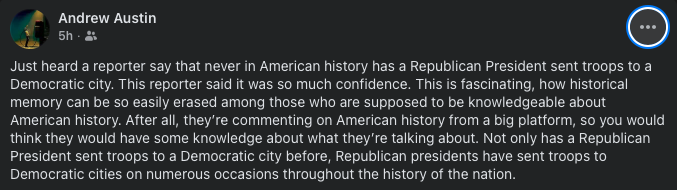
It is indeed a striking thing to watch someone speak with total confidence about a claim that is demonstrably false. The reporter (I was listening to the news in the background, so I don’t know which one) declared that “never before has a Republican president sent troops to a Democratic city.” The statement was delivered with such certainty as if it were a self-evident truth. Yet anyone with even a cursory knowledge of American history could recall counterexamples. In 1957, President Eisenhower—a Republican—sent federal troops to Little Rock, Arkansas, then a Democratic state, to enforce desegregation. More dramatically, Abraham Lincoln, another Republican President, sent troops into states governed by Democrats.
Even Democratic presidents have sent military troops into Democratic cities. In 1962, President Kennedy deployed the Guard and federal marshals to the University of Mississippi to enforce the enrollment of James Meredith, the university’s first black student. Meredith’s admission had been blocked by state officials. As violent riots erupted on campus in Oxford, Kennedy ordered federal troops and the Mississippi National Guard to restore order and ensure Meredith’s safety. This decisive action marked a critical moment in the Civil Rights Movement, demonstrating the federal government’s commitment to upholding court-ordered desegregation and the constitutional rights of all citizens.
The history of the federal government deploying military forces to ensure civil rights and impose order on disorder is neither obscure nor hidden. It is woven into the American story. It is, moreover, entirely permitted by the Constitution (see Our Constitution and the Federal Authority to Quell Rebellion; Concerning the Powers of the US Constitution—And Those Defying Them; Posse Comitatus and the Ghosts of Redemption). How could any of this be lost on any reasonably informed American? Whatever the reason, it is certainly helpful to Democrats making the case that President Trump is behaving in an unprecedented fashion for people to forget history. All the more important, then, to examine how this happens.
What is so striking about the inability to recall American history is not merely the factual error, but the psychological process behind it. Charitably, the reporter was not lying deliberately. Instead, she appeared to genuinely believe what she was saying. This kind of mental blind spot is an example of what psychologists call motivated reasoning—a cognitive bias in which people selectively recall, interpret, or even “forget” facts when those facts conflict with their ideological commitments or the narrative frameworks they have internalized. When a person’s worldview is strongly shaped by partisan or moral commitments, inconvenient historical facts can become inaccessible, not because they were never learned but because retrieving them threatens the coherence of the person’s narrative about reality.
There is also an element of cognitive dissonance here (see Living with Difficult Truths is Hard. How to Avoid the Error of Cognitive Dissonance). As Leon Festinger taught us, when information does not fit with our beliefs or expectations, our minds experience tension. One way to resolve that tension is to adjust our beliefs (ideal); another is to simply exclude the conflicting information from awareness. This can produce what looks like a stunning ignorance of the obvious. A person may literally “not see” what is right in front of them because their interpretive lens filters it out before it reaches conscious evaluation.
In public discourse, this phenomenon can be especially powerful because authority and platform reinforce the illusion of certainty. When someone on television speaks confidently, the audience may assume that the speaker’s memory and reasoning are sound. How could a newsreader not be an informed person? Yet confidence is not the same as accuracy. What we are witnessing in such moments is not merely an individual’s lapse but the collision of human cognition with ideology, resulting in blindness to the obvious—a blindness that can seem astonishing to those who are not under its spell.
Behind this psychological phenomenon lies something larger than individual bias, however: the workings of power itself. As Michael Parenti observed, the media’s primary function is not so much to tell us what to think as to tell us what to think about. This selective framing serves the interests of those who benefit from the existing order. Antonio Gramsci called the intellectuals who carry and reproduce the worldview of the ruling class “organic intellectuals”—figures like academics, journalists, newsreaders, and pundits who, often unconsciously, circulate elite perspectives as common sense. As Noam Chomsky observed, those performing this role have to be the most deeply indoctrinated.
This is the essence of hegemony: the subtle shaping of consciousness so that certain assumptions appear natural and others unthinkable. Within this ideological bubble, or epistemic enclosure, even the possibility of questioning dominant narratives is foreclosed. The result is not simply misinformation but a managed field of perception in which truth itself becomes subordinate to power.
This is a real problem. Millions of Americans get their information from talking heads who are themselves unable to see the disinformation they daily transmit to the masses. The result is a culture in which illusion passes for insight and repetition substitutes for truth. These figures are not so much deceivers as the deceived, reproducing elite ideology without recognizing it as such, their platforms amplifying the false narrative until it becomes the common sense of the nation. What emerges is not merely a misinformed public but a managed consciousness—one that mistakes propaganda. In such an environment, the boundaries of thought are policed not by censorship but by belief itself; what cannot be questioned cannot be changed, and what cannot be imagined cannot be questioned. The belief itself does the work of the censor.
In modern contexts, memory holing doesn’t require the physical destruction of documents or a totalitarian state. It happens through more subtle means: algorithmic invisibility, collective forgetfulness, or selective reporting produced by media cycles that move too fast for reflection. When a powerful institution or political party finds a narrative inconvenient, it can bury it—not necessarily censor it, but drown it in noise, ignore it, or reframe it until its original meaning is negated.
This phenomenon connects directly to ideas of hegemony and motivated reasoning discussed earlier in this essay. When those in power shape what is thinkable, they also shape what is remembered. The public’s memory becomes curated—structured by omission as much as by inclusion. In this way, memory holing is not just about forgetting the past; it’s about controlling the future by controlling what the collective mind is allowed to remember.

 freedom and reason