Today’s NPR headline: “Trump says he’ll send troops to Portland, Ore., to handle ‘domestic terrorists.’” Why does domestic terrorism appear with scare quotes around it? That’s not what it is? Of course, that’s what it is. Antifa is a domestic terrorist organization. Designating Antifa as such does not conjure domestic terrorism into existence. It simply acknowledges what Antifa is. (See my most recent essays on Antifa: Charlie Kirk’s Killer is in Custody and the Specter of Antifa; The Fool Has Come Down Off The Hill. But Who Called on Antifa to Terrorize the Village? For earlier essays, see the embedded links in the last essay.)
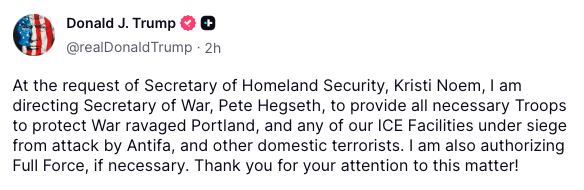
President Donald Trump announced on Saturday that he plans to deploy troops to Portland, Oregon, saying he is prepared to use “Full Force, if necessary” against Antifa and related tendencies as he broadens his strategy of sending federal forces to US cities. In a message posted on social media, Trump said he has instructed the Department of Defense to “provide all necessary troops to protect war-ravaged Portland.” The move is necessary, he contends, to safeguard US Immigration and Customs Enforcement facilities, which are under siege from Antifa and other domestic terrorists. Trump is acting decisively to quell rebellion.
This development has set on fire the hair (figuratively speaking) of libertarians like Radley Balko. (Balko, a defender of the Redemptionist Posse Comitatus Act, has a long association with pro-corporate outlets like the open-borders thinktank Cato Institute and Reason magazine.) In a Facebook post, Balko writes, “Sure seems like the president just authorized the military to use lethal force against US citizens.” So? Where in the Constitution is this forbidden? Nowhere. Quite the contrary: the main reason the Constitution was written was to permit the federal government to deploy troops to suppress insurrection and rebellion in the various states. (See Concerning the Powers of the US Constitution—And Those Defying Them; Posse Comitatus and the Ghosts of Redemption.)
A little history is in order. The Philadelphia Convention of 1787 that produced the Constitution cannot be understood apart from the well-justified anxieties that swept the young republic in the wake of Shays’ Rebellion. In 1786 and 1787, farmers in Massachusetts organized armed resistance to courts and tax collectors. Although the state militia eventually suppressed the rebellion, the episode alarmed political leaders throughout the United States. The new nation needed not only to defend territory from foreign invasion, but from violent threats from within.
The uprising revealed a dangerous truth: under the Articles of Confederation, the national government lacked the executive authority, resources, and standing army to intervene if unrest spiraled beyond a single state’s control. The Annapolis Convention of 1786 failing to resolve the serious issues facing the new nation, delegates arrived in Philadelphia in 1787 determined to craft a stronger framework that could prevent domestic instability. Indeed, they scrapped the Articles of Confederation altogether and drafted an entirely new document, one that established the American Republic with a strong executive authority, the chief element missing from the Articles.
Debates at the Convention repeatedly returned to the theme of order and republican limits on democracy. Participants warned of the “excesses of democracy,” by which they meant the ease with which local majorities (or in the case of Antifa today, aggressive minorities) could mobilize against established law or property rights. In other words: mob rule. The framers concluded that the federal government must be given explicit power to restore order when states proved unable or unwilling to do so. Such is the case in Oregon, where the Portland government has signaled that it has no real intention of protecting ICE agents operating there. At least Portland authorities have been unable to deal with Antifa and other anti-government forces.
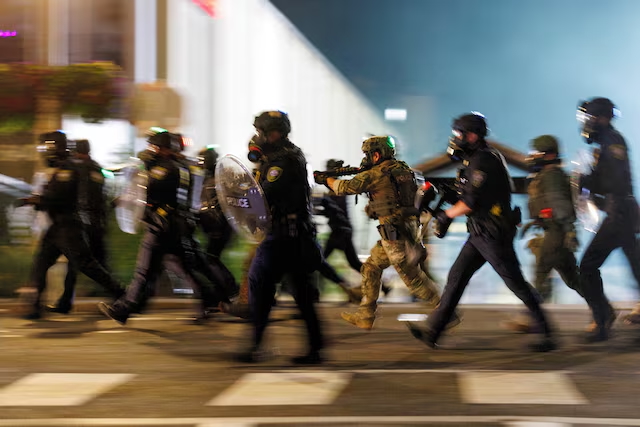
Recent attacks on ICE facilities have escalated tensions nationwide. In Portland, anti-ICE protests have led to violent confrontations. On June 14, 2025, a large-scale demonstration escalated into a riot outside the ICE facility in South Portland, resulting in multiple arrests and injuries. Protesters threw fireworks, knives, and rocks at law enforcement officers, and federal agents deployed tear gas and flashbangs to disperse the crowd.
But the violence is not contained to Oregon. In June 2025, President Trump ordered the federalization of California’s National Guard (placing them under Title 10 status) and deployed approximately 4,000 National Guard soldiers, along with 700 US Marines, to Los Angeles. On September 24, 2025, a sniper opened fire from a rooftop at an ICE field office in Dallas, Texas, targeting federal agents (but killing two detainees and critically injuring another). This incident follows a series of similar attacks, including the July 4 ambush at the Prairieland ICE facility in Alvarado, Texas, where approximately twelve individuals coordinated a shooting attack, resulting in the injury of an officer.
In response to these escalating threats, the US Attorney General has ordered the deployment of Justice Department agents to ICE facilities nationwide and directed Joint Terrorism Task Forces to investigate and disrupt individuals or groups involved in domestic terrorism targeting federal agents. On September 22, 2025, President Trump signed an executive order designating Antifa as a “domestic terrorist organization.” And now he is deploying federal troops to Portland.
(It’s sad that it took the assassination of Charlie Kirk for a President of the United States to declare Antifa a domestic terrorist organization. If the government had been on this case for years, it might have had the intelligence to know what Tyler Robinson was planning to do and possibly prevent that event. As Freedom and Reason will testify, I’ve been warning folks about Antifa for years. It’s not like we didn’t know what Antifa was and is. If I can know this, others can.)

Having the foresight to anticipate an ongoing problem with insurrection and rebellion, the Founders crafted some of the Constitution’s most enduring provisions, which Trump now has at his disposal. Article I, Section 8 grants Congress authority to call forth the militia not only to repel foreign invasions but also to “suppress insurrections” and enforce federal laws. Likewise, Article IV, Section 4, known as the Guarantee Clause, commits the United States to defend each state against both foreign invasion and domestic violence. These clauses formalized the federal government’s responsibility to preserve internal peace and tranquility.
Although foreign threats loomed then, as they do now, the more immediate danger in 1787 was internal. Today, we find ourselves in a similar situation. Shays’ Rebellion remained fresh in the delegates’ minds as a vivid example of how quickly unrest could erupt. But even vivid examples fade with time—and are clouded by partisan ideology.
But the reality that the Founders anticipated remain—there will be those who rebel against the Republic—and they bequeathed to posterity a muscular state that could respond; for if one state descended into rebellion, the weakness of the Confederation would allow disorder to spread across the Union, undermining commerce, the general welfare, and legitimacy; by embedding protections against insurrection in the Constitution, the framers secured a fragile republic against the kinds of domestic upheaval that had so recently shaken Massachusetts.
The kind of domestic upheavals that shake the republic today. Rebellion shook cities across America only a scant five years ago. The “Summer of Love” was a wake-up call. The specter of domestic violence is rearing its head once more. Trump should have taken much more aggressive action against the rebellion of 2020. It appears he won’t be flinching this time. (For context, see On the Road to Civil War: The Democratic Party’s Regression into Neoconfederacy; The Struggle for Western Civilization on the Modern Political Landscape.)

 freedom and reason