
“Once upon a time a valiant fellow had the idea that men were drowned in water only because they were possessed with the idea of gravity. If they were to knock this notion out of their heads, say, by stating it to be a superstition, a religious concept, they would be sublimely proof against any danger from water. His whole life long he fought against the illusion of gravity, of whose harmful results all statistics brought him new and manifold evidence.” —Karl Marx, The German Ideology (1845)
Jurupa Valley High School has been desperately trying to find volleyball opponents this season. Eight schools have refused to play the team until Jurupa Valley removes AB Hernandez, a male athlete, from the court. The victims of Jurupa Valley’s decision to prioritize the feelings of a male over the desire of females to play volleyball against other females are not limited to the schools forfeiting games to uphold the integrity of women’s sports. The girls on Jurupa Valley’s own volleyball team are also victims of Hernandez and of those who enable his delusion that he is female. It is not only the humiliation of having to compete with a ringer on the team; Jurupa Valley is now facing lawsuits from current and former teammates alleging traumatic experiences sharing a locker room with a male who pretends to be female.
Karl Marx, in The German Ideology (1840s), offers readers a short satirical allegory that exposes the folly of philosophical idealism—the postmodernism of his day. He asks readers to imagine a man who believes that drowning occurs not because of water or gravity, but because people hold the idea of drowning and gravity in their heads. If only they could banish this superstition, the deluded man claims, they would become immune to drowning. Thus, the man spends his life battling the “illusion” of gravity, ignoring the persistent and measurable evidence of its effects.
This allegory concludes the preface of the manuscript, setting the thematic foundation for Marx’s critique of philosophical idealism. It illustrates with absurd clarity the danger of believing that material facts depend on mental constructs. Just as water and gravity do not vanish because someone declares them social constructions because we use ideas to describe them, so biological realities do not cease to exist simply because they are reclassified as oppressive categories. Yet contemporary postmodern frameworks—whether in the doctrine of gender identity or in critical race theory—repeat this mistake. They treat stubborn realities as illusions to be dissolved by rhetoric.
Words can either illuminate truth or distort or conceal it. Postmodern jargon is of the latter sort—distorting truths and fabricating fictions. Marx’s allegory captures perfectly the ideology that imagines gender to be an illusion, one that, if banished from our minds, would free some men from the “fate” of being men. The same could be said for the “illusion” of age. Why can’t a man be a boy forever—or a girl, for that matter? Why does he have to be human at all? Why can’t he be a dog or a horse? Or a god? If gender is merely a concept imposed by an oppressive society, why should it stop at that oppression? Once we accept that facts are illusions sustained only by oppressive belief, no boundary remains secure against redefinition.
Marx’s allegory anticipates the epistemic corruption of postmodernism: privileging ideology over reality. Postmodernist constructs—whether in critical race theory, gender identity ideology, or related doctrines—are not scientific discoveries but evasions of science, rationalizations to maneuver around inconvenient truths. They cater to the wishes of those who would prefer reality to bend to their desires, who mistake subjective convenience for objective fact. But this is not merely a matter of personal delusion. Once elevated to doctrine, these evasions are weaponized by activists and political movements, particularly on the left, where postmodernist notions provide the rhetorical scaffolding for campaigns to reshape culture, law, and policy. Once institutionalized in academia, law, and policy, these evasions compel society to live within the fiction.
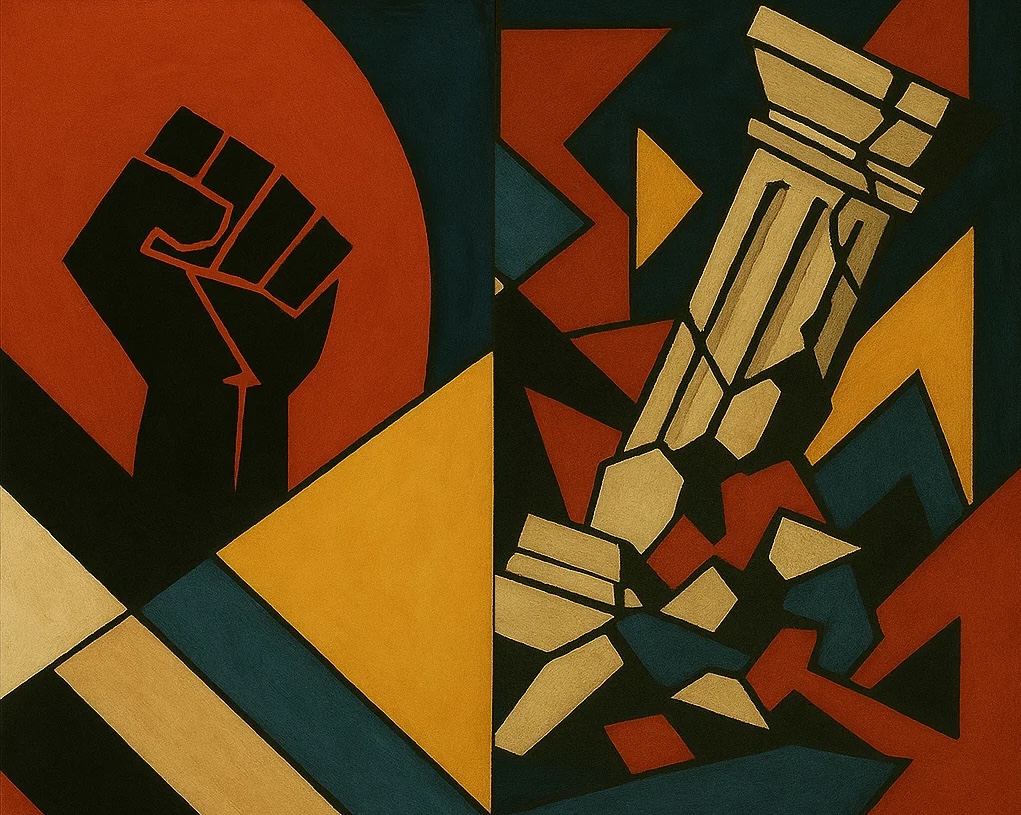
If you demand that life be organized around reality, then you risk being called a bigot, fascist, phobic, racist, and so on. But acknowledging the fact of gender is not fascism, nor phobia, nor the product of religious-like dogma. It is simply an acknowledgment of reality. But to those who believe that truths can be dissolved by jargon, acknowledging reality becomes heresy. When postmodernism colonizes science and society, truth itself is forced to yield to narrative. Once narrative becomes sovereign over fact, the consequences are as predictable as a man jumping from the top of a skyscraper without a parachute or some other device that allows him to safely float to the ground below him. (Remember the scene in The Matrix where Neo believes in gravity and meets pavement? Have you checked up on the Wachowskis lately? They seem to have abandoned the desert of the real.)
I get asked on social media, “What do you care whether a man presents as a woman?” This isn’t the right question. The question is why we should care whether society is compelled to believe that a man is or can be a woman. We should care because the societal-wide denial of reality will be the death of freedom and reason.
In recent years, activists advancing the doctrine of gender identity—often in tandem with Antifa or kindred misfits and Cluster B types—have claimed Marx as an intellectual ally. Their rhetoric is framed in the vocabulary of oppression, struggle, and liberation, with Marx cast as the revolutionary patron saint of resistance against all social hierarchy. Anybody who has considerable time with the literature—and has the capacity to grasp what he is reading—knows this gets Marx and his materialist method wildly wrong. The doctrine of gender identity does not emerge from the German materialist tradition, but from French postmodern philosophy. The attempt to enlist Marx’s authority in its service requires a twisting of his thought so radically that it undermines the very foundations of historical materialism.
Marx does not deny biological reality. He locates gender relations in material conditions, above all in the division of labor and the economic structures that shaped the family. His comrade, Friedrich Engels, is even more explicit. In The Origin of the Family, Private Property and the State (1884), Engels traces women’s subordination to the rise of private property and male control of inheritance. Neither Marx nor Engels suggests that gender itself is a mere social construct, nor that men and women are categories sustained only by ideology. For them, gender is objective, binary, and immutable. What can change are the social and economic arrangements built on that reality. (Note: In scientific literature, before the post-1950s ideological repurposing of the word, one will find such phrases as “peculiar to the female gender” or “diseases of the opposite gender.” Gender is a synonym for sex, which Engels uses in his book.)
So how has Marx come to be invoked in defense of theories that deny the reality of gender? The answer lies not in Marx but in later reinterpretations of his legacy. Beginning with the Frankfurt School, cultural Marxism shifted attention away from the base of society (the political economic foundation, comprised of the forces and social relations of production) and toward the superstructure of culture, ideology, and identity. This move loosened the anchoring of Marxist analysis in material conditions, making it easier for later theorists to treat cultural categories as arenas of struggle in their own right.
It is not that critique of the superstructure lies outside the Marxist frame of analysis (see Antonio Gramsci); rather, its risks treating the superstructure as the deeper reality. If one treats the world as determined by ideas, rather than ideas representing reality, one stands truth on its head. This is the inverse of Marx’s method, which sets truth on its feet. Critical theory is a return to the German idealist Georg Hegel, the teacher against whom the student who picked the lock that inevitably led to the materialist conception of history, Ludwig Feuerbach, rebelled.
In Capital, Volume One, in the Afterword to the Second German Edition (1873), Marx writes, “My dialectic method is not only different from the Hegelian, but is its direct opposite. To Hegel, the life-process of the human brain, i.e., the process of thinking, which, under the name of ‘the Idea,’ he even transforms into an independent subject, is the demiurgos of the real world, and the real world is only the external, phenomenal form of ‘the Idea.’ With me, on the contrary, the ideal is nothing else than the material world reflected by the human mind, and translated into forms of thought.” Marx continues, “In Hegel, the dialectical process is standing on its head. It must be turned right side up again, if you would discover the rational kernel within the mystical shell.” This is the scientific epistemic. Returning the dialectical process to its previous upside-down posture corrupts science.
Carrying critical theory to its logical conclusion, and adding additional distortions, poststructuralist/postmodernist thinkers—Foucault, Derrida, Butler—manufactured an epistemology that is profoundly anti-materialist. In their work, they emphasize discourse, power/knowledge, and performativity, arguing that categories such as gender are not rooted in biology but constructed through language and the persistence of “oppressive norms.” Though these ideas are alien to Marx’s framework, activists have merged them with Marxist rhetoric. The language of “false consciousness,” “ideological domination,” and “revolutionary struggle” is applied not to class exploitation but to the gender binary itself. In this warp, a man overcomes the ideological domination that made him falsely conscious of his gender, and the revolutionary struggle against the gender binary becomes an act of “liberation”—and those around him, if not his allies who affirm his delusion, become reactionaries. They become fascists, a smear that habitually falls from the face of the trans activist.
Distortion of historical materialism is the source of the modern activist claim to Marxism. It appears Marxist in form—invoking struggle, liberation from oppression, and revolutionary overthrow. But it is postmodern in content—asserting that gender is discursive, fluid, and mutable. Marx’s name lends the project revolutionary authority, but his substance is discarded.
The contradiction could not be starker: Marx’s materialism insists on confronting reality as it is, not as one wishes it to be. His allegory in The German Ideology mocks the man who denies gravity as a mere superstition, illustrating the danger of philosophical idealism. To deny the permanency of gender is to repeat the same folly: a war against reality fought with words, while the facts remain as immovable as gravity. Passing off rebellion against reality as Marxist does not extend the logic of historical materialism but betrays it.
Karl Marx never published a systematic theory of gender in the way later feminist or postmodern theorists have attempted. His central focus remained on class, labor, and material conditions. But he was working out a theory of gender relations towards the end of his life. Engels’ Origin of the Family, Private Property and the State was written in the wake of Marx’s death and rests heavily on Marx’s engagement with Lewis Henry Morgan’s Ancient Society (1877). Marx had studied Morgan closely, filling the margins of his copy with extensive notes and reflections that connected Morgan’s anthropology to the materialist conception of history. Engels drew on these notes as the foundation for his own synthesis, and in the Preface he acknowledges this debt, describing the work as “in substance the outcome of Marx’s researches.” Thus, Origin, shaped by Engels’ hand, is deeply rooted in Marx’s theoretical legacy, mediated through Morgan’s ethnological findings.
Taken in its totality, Marx and Engels’ work ties gender to material relations of production. Marx—and more explicitly Engels in Origin—understood the subordination of women as historically contingent, rooted in the rise of private property and the division of labor. For them, patriarchy is not eternal or natural. It emerges when men gain control over surplus resources and inheritance systems, reorganizing family life and social structures around property ownership. However, neither Marx nor Engels denies the existence of biological differences between men and women. They never suggest that male and female are “illusions” or “social constructs.” Biology—and Charles Darwin’s theory of natural selection—is taken as reality. What can change—and what they sought to explain—were the ways societies organized around these facts. Women’s subordination is explained not in terms of discursive categories or identities, but in terms of material-economic structures.
In Capital and related writings, Marx observes how industrial capitalism increasingly draws women into wage labor. This shift disrupts older patriarchal household structures, but it also exposes women to new forms of exploitation. Marx recognizes the dual character of this development: women are both exploited more directly under capitalism and also brought into the broader sphere of class struggle. In that sense, wage labor is not only a site of oppression but a possible path toward emancipation. Marx and Engels consistently treat the bourgeois family not as a purely cultural or moral unit but as an economic one. The family is, in their analysis, depending on the mode of production, a mechanism for the transmission of property, the reproduction of labor power, and the maintenance of class structure. Gender roles within it are shaped by economic necessity, rather than by an autonomous “gender ideology.”
In sum, then, Marx locates gender oppression not in “identity” or cultural categories but in material arrangements. He sees the potential for emancipation in the reorganization of labor and the abolition of private property, not in an ideology that encourages people to take leave of their senses, to drown in the waters of illusion. For Marx, as for Engels, gender inequality is inseparable from the broader struggle against class exploitation. Imagining oneself to be the other gender—or no gender at all—allows escape from inequality. Indeed, it only perpetuates it, as we see in the Jurupa Valley High School case. Allowing AP Hernanez to compete against women is profoundly misogynistic. How this isn’t obvious to everybody testifies to the corruption of popular consciousness by the postmodernist epistemic.
Thus, the betrayal of Marx’s materialist conception of history and social relations is not merely an intellectual error—it’s an expression of bourgeois ideology. By severing identity politics from the material critique of capitalism, postmodernism disarms the working class. It shifts the struggle away from corporate domination, exploitation of labor, and the accumulation of profit, and redirects it toward endless disputes over language, identity, and subjective “recognition.” In doing so, it fragments collective resistance and redirects revolutionary energy into cultural quarrels that pose no real threat to capital—indeed, that advance corporate power and profit.
This is why corporations have eagerly embraced this inversion. Gender identity ideology and related postmodern constructs provide cover for monopolies and financial elites. By championing “inclusion” and “diversity,” corporations rebrand themselves as “progressive” while continuing to extract surplus value, suppress wages, and consolidate power. They also use the doctrine of gender identity to extract billions from its victims via the medical-industrial complex. Postmodernism thus becomes an instrument of bourgeois hegemony and profit-generation: it erodes material analysis, masks exploitation, and manufactures consent for corporate rule.
What the appropriation of Marx by gender identity ideology reveals is not the consistency of their framework but the poverty of it. Postmodernism borrows Marx’s revolutionary fire while extinguishing his materialist core. The result is a doctrine that speaks in Marxist cadences but cannot withstand a Marxist critique. Far from being Marxist, gender identity theory represents the very kind of philosophical idealism Marx spent his career dismantling. The postmodernist doctrine of gender identity is a betrayal of Marx’s lifework. The denial of reality masquerading as liberation serves as an enabler of capital. It diverts the struggle against exploitation into battles over subjective self-definition, leaving intact the structures of profit and power—even advancing them. What is presented as Marxism is, in truth, the opposite: a bourgeois ideology that protects the very system Marx sought to overthrow.
To put this in a way the progressive will understand: Keep Marx’s name out of your damn mouth.

 freedom and reason