
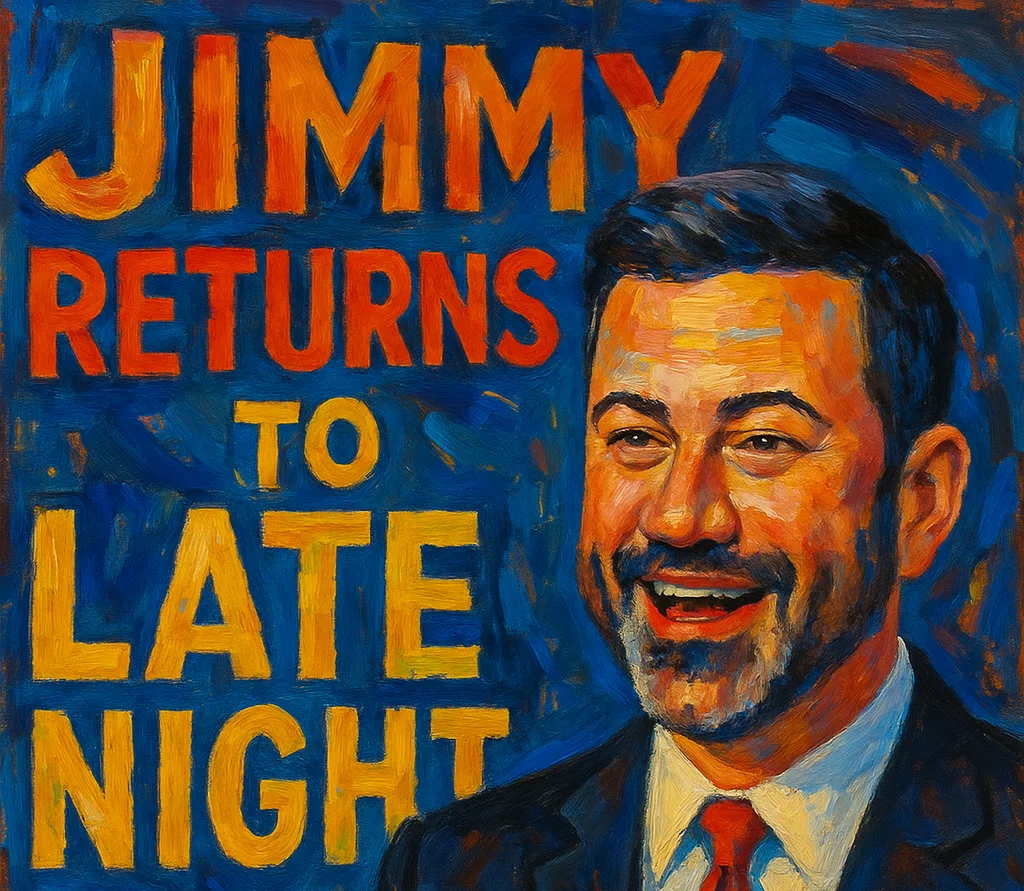
Upon his return to late-night television, Jimmy Kimmel quipped, “I don’t want to make this about me because—and I know this is what people say when they make things about them.” (Cue the laugh and applause signs.) Moments earlier, he had said: “I don’t think what I have to say is gonna make much of a difference. If you like me, you like me. If you don’t, you don’t.”
But this isn’t about whether people “like” Kimmel. It’s about what he said—and the fact that a massive media corporation gave him a platform to say it. By framing the issue as one of likability, Kimmel deflected attention from his actual words. That matters because what he communicated was a signal: that if political violence comes from the left, he will help obscure its motive. (See Jimmy Kimmel’s Return and the Persistence of Late Night Talk Shows.)
He reinforced the point when he insisted: “I don’t think the murderer who shot Charlie Kirk represents anyone.” This is false. Kimmel knows exactly who and what Tyler Robinson represents. It’s what he tried to obscure in the monologue that got his show suspended. The assassin represents the millions who cheer Kirk’s murder and who celebrate the attempted assassinations of Donald Trump.
Kimmel also asked his audience to consider this: “Should the government be allowed to regulate which podcasts the cell phone companies and Wi-Fi providers are allowed to let you download to make sure they serve the public interest?”
First, this is a false equivalency. FCC regulation of the broadcast spectrum is not the same as government regulation of podcasts or cell phone communications. Traditional broadcast media rely on limited public airwaves—part of the commons, belonging to all of us—which justifies oversight to ensure the public interest. That mandate is literally written into the FCC charter. (See Progressives Flipping Like Flags on a Pole: The Cancellation of Jimmy Kimmel and the Real Threat to Free Speech; Ted Cruz Compares the FCC to the Mob—But Who’s the Real Mob?)
Second, the government does have a legitimate interest in policing podcasts, cell phones, and other digital platforms when they are used to transmit terroristic threats or coordinate acts of political violence.
Kimmel and Disney ABC refuse to take responsibility for his statements. By casting the issue as a censorship debate—as though it were interchangeable with addressing political terrorism—Kimmel trivializes the seriousness of the moment. The stakes are not remotely the same, and framing them as parallel only muddies the issue. Disney ABC has positioned Kimmel as a martyr in the supposed struggle against “Trump’s fascism,” while obscuring the real sources of political violence. Kimmel continues to serve as a propagandist for the progressive left.
Fascism is frightening, to be sure—which is why I’ve devoted so many words to the subject over the years on this platform. But what’s also frightening is when millions of people believe they’re living under Hitler-style fascism when they’re not. Moral panics take populations to dark places and obscure the real situation. Today, we see a large segment of the US population interpreting the legitimate exercise of constitutional powers as national socialism—while simultaneously defending corporatism as a desirable political-economic system and rationalizing political violence in the streets.
So what would fascism look like in the present day? Much like what we saw in 2020: censorship, fear campaigns, rebellion, rigged elections, the installation of a senile man as president. We witnessed a color revolution and a coup carried out by the deep state and powerful corporate actors, while the corporate media refused to call it for what it was. In fact, the media projected the opposite narrative. That’s why I raised the alarm about the New Fascism on Freedom and Reason. And while the situation has improved somewhat, we’re not out of the woods.
The alarm to raise now—Jimmy Kimmel’s return being just one piece of the puzzle—is that so many people have come to believe that reclaiming democracy from corporate control and street-level authoritarianism is itself a form of fascism. Perception has been flipped. Millions of people are living in a camera obscura, going to extremes to preserve the illusion.
What we see in the media and on the streets is easy to mock because it’s so over-the-top. We’re told that regulating media conglomerates in the public interest is fascistic, when in fact it’s the opposite. We’re told political violence is antifascist, when in reality it is its antithesis. This upside-down portrayal of the present moment poses a real threat to the work Americans must do to preserve and defend the Republic. And those who buy into the illusion remain impervious to reason.
Just yesterday in Green Bay, I saw a woman standing in front of a local television station with a sign that read, “Protect free speech.” She was so proud of herself. Her husband, standing behind her, was equally proud. I felt sorry for her. It’s tragic, I said to myself while driving by, that those who shape mass perception led her to believe she was standing up for freedom by defending the power of corporations to propagandize her. Only a few years ago, she likely believed corporate media control over public perception was a terrible thing. Now she stands on a street corner defending it.

 freedom and reason