
Recent polling conducted by Mark Mitchell of Rasmussen (presented yesterday on Steve Bannon’s War Room) reveals a striking reality: a vast majority of Americans are concerned about the rise of political violence. Their concern is not unfounded. Across the Western world—from the United Kingdom to continental Europe and the United States—citizens who value their cultural traditions, historical norms, and the legacy of Western civilization are increasingly defending those principles. Yet they face determined resistance from ideological and political movements on the left, which have become ever more desperate in perpetuating what is at heart an elitist transnational corporate effort to dismantle the West.
In the United States, this resistance is visible in blue states led by governors such as JB Pritzker and Gavin Newsom, who have adopted a neoconfederate approach (see On the Road to Civil War: The Democratic Party’s Regression into Neoconfederacy; Concerning the Powers of The US Constitution—And Those Defying Them; Posse Comitatus and the Ghosts of Redemption). These leaders defy the federal government while advancing radical cultural and political agendas within their states. Part of their strategy is to allow Antifa and other violent actors to openly fight law enforcement on the streets of American cities.
While activists on the left resort to political violence, much of the public remains patient, placing hope in Donald Trump and the MAGA movement to restore stability. Yet the challenges to democratic republicanism may exceed the capacity of any single leader to resolve. I confess a concern for civil war.
A similar dynamic is unfolding in Europe, where governments often suppress nationalist parties and voices seeking to defend Western identity and traditions. In both Europe and the United States, powerful institutions—the administrative state, mass media, academia, and the culture industry—actively oppose popular efforts to restore traditional norms.
These institutions resist any return to the center, to normalcy: a revival of values rooted in individual rights, constitutional government, and the Enlightenment principles that made Western civilization unique—tolerant, forward-thinking, science-driven, and dedicated to life, liberty, and the pursuit of happiness.
In America, the Democratic Party and the technocracy it represents play a central role in progressive resistance to the return to democracy. Despite declining popularity among broad segments of the electorate, Democrats continue—with the support of allied elites in key institutions—to resist shifts back toward centrist, liberal, and traditional values.
From a pragmatic standpoint, this resistance seems irrational. Embracing moderation could strengthen not only the nation but also the Democratic Party’s own long-term prospects. Yet its rigidity is better explained by the deeper forces shaping progressive ideology—specifically, the influence of transnational corporate power. These global elites seek to weaken Western civilization in pursuit of a globalized, hi-tech quasi-feudal order.
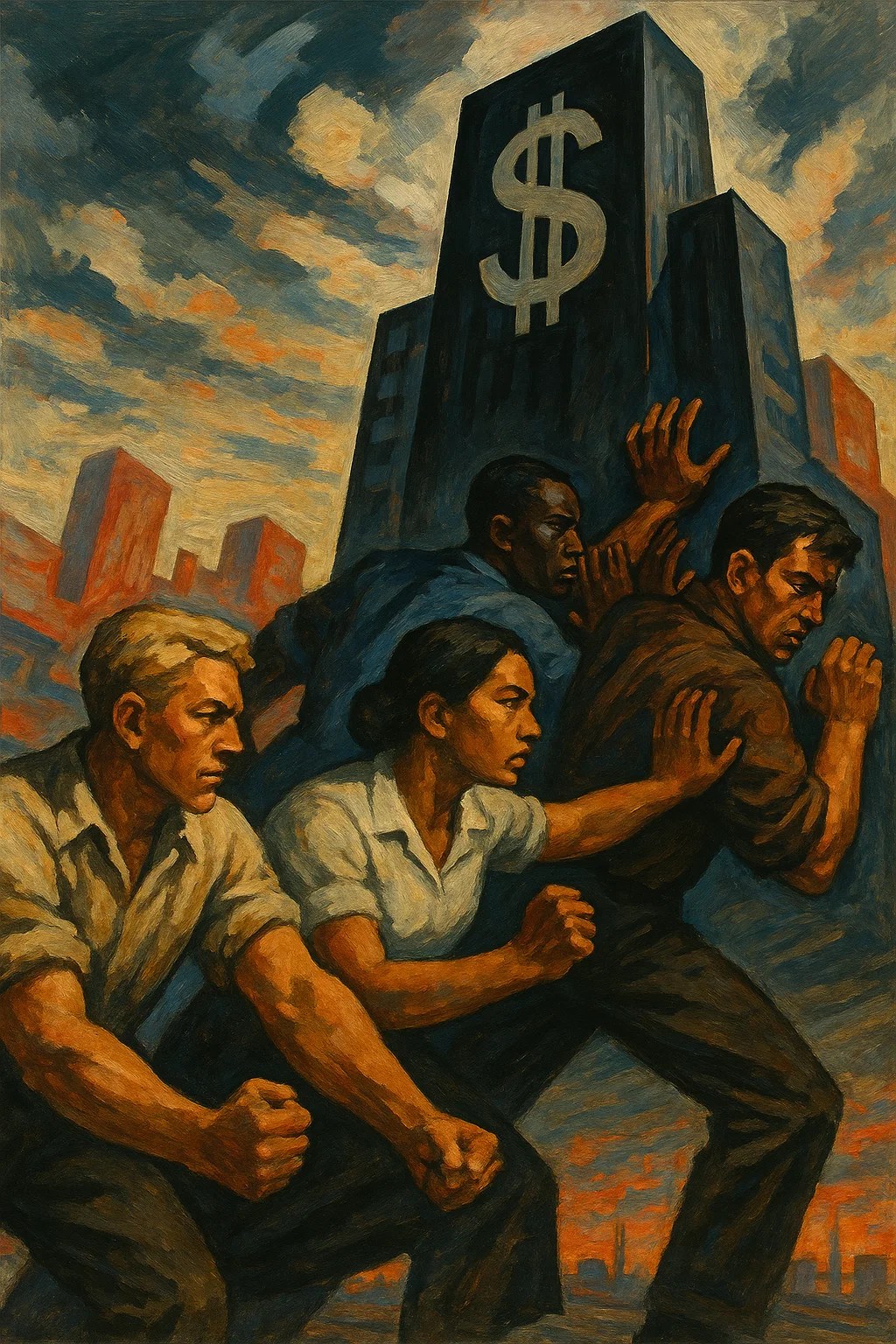
The conflict, then, is neither merely partisan nor national. It is a global struggle between ordinary people—often caricatured by the left as “fascist”—and a transnational corporate order. Progressive movements, including those centered on “social justice,” serve as instruments of that order, obstructing national restoration and cultural renewal.
Even if many Americans do not fully understand the political-economic underpinnings of this struggle, they feel its consequences. Cultural dislocation, political violence, and social instability are not isolated incidents; they are symptoms of a larger battle. The purpose of this platform is to raise consciousness about this situation.
Mass immigration has become one of the clearest flashpoints. The large-scale influx of migrants from the developing world has disrupted traditional social norms and strained local resources in many Western communities. To many citizens, this illustrates elite disregard for the well-being of native-born populations. Growing support for mass deportation reflects that frustration.
More Americans are beginning to see that defending democracy and freedom requires concrete government action—for example, designating extremist groups like Antifa as domestic terrorist organizations and investigating their ties to transnational power structures. Leaders such as Donald Trump can play a crucial role in this effort, but only if they adopt a more assertive posture.
Trump’s announcement this morning that he is designating the far-left “anti-fascism” movement Antifa as a terrorist organization on his Truth Social platform is a promising start. Objections by mainstream media propagandists following the President’s announcement adumbrate the elite forces that stand behind domestic terrorism.
Crucially, restoring Western civilization requires action at the local level: reclaiming city councils, school boards, and other institutions from ideological capture. It demands direct confrontation with radical movements and the intellectual frameworks that legitimize them—whether Black Lives Matter, transgender activism, Antifa, or the academic doctrines of critical race theory, queer theory, and postcolonial studies. Citizens must speak out against these crackpot ideas. Parents must demand that public schools quit indoctrination and return to education.
Mark Mitchell’s analysis of digital platforms such as Reddit and Discord, also presented on the War Room yesterday, highlights the urgency of this fight. Controlled by elites and worth billions of dollars, these platforms have been deliberately designed to radicalize young Americans—to foster alienation and self-hatred. They exemplify the cultural battlegrounds that any future administration committed to national renewal must directly confront. They must, of course, do this in a way that does not compromise the free speech rights of any American, but they have to take decisive action.
Today’s political crisis is not simply a matter of partisan rivalry or cultural disputes. It is part of a broader confrontation between the people of the West and transnational forces seeking to reshape the global order. While polling shows many remain hopeful—especially through the leadership of figures like Trump—the persistence of political violence underscores the depth of the struggle. Only through both strong national leadership and grassroots engagement can Western civilization defend its heritage and secure its future as a free and sovereign community of democratic republics.

 freedom and reason