
Trump’s executive order making US flag desecration a criminal offense is specific about the context in which such an act would be adjudicated as such, namely, incitement. He is trying to skirt Supreme Court precedent.
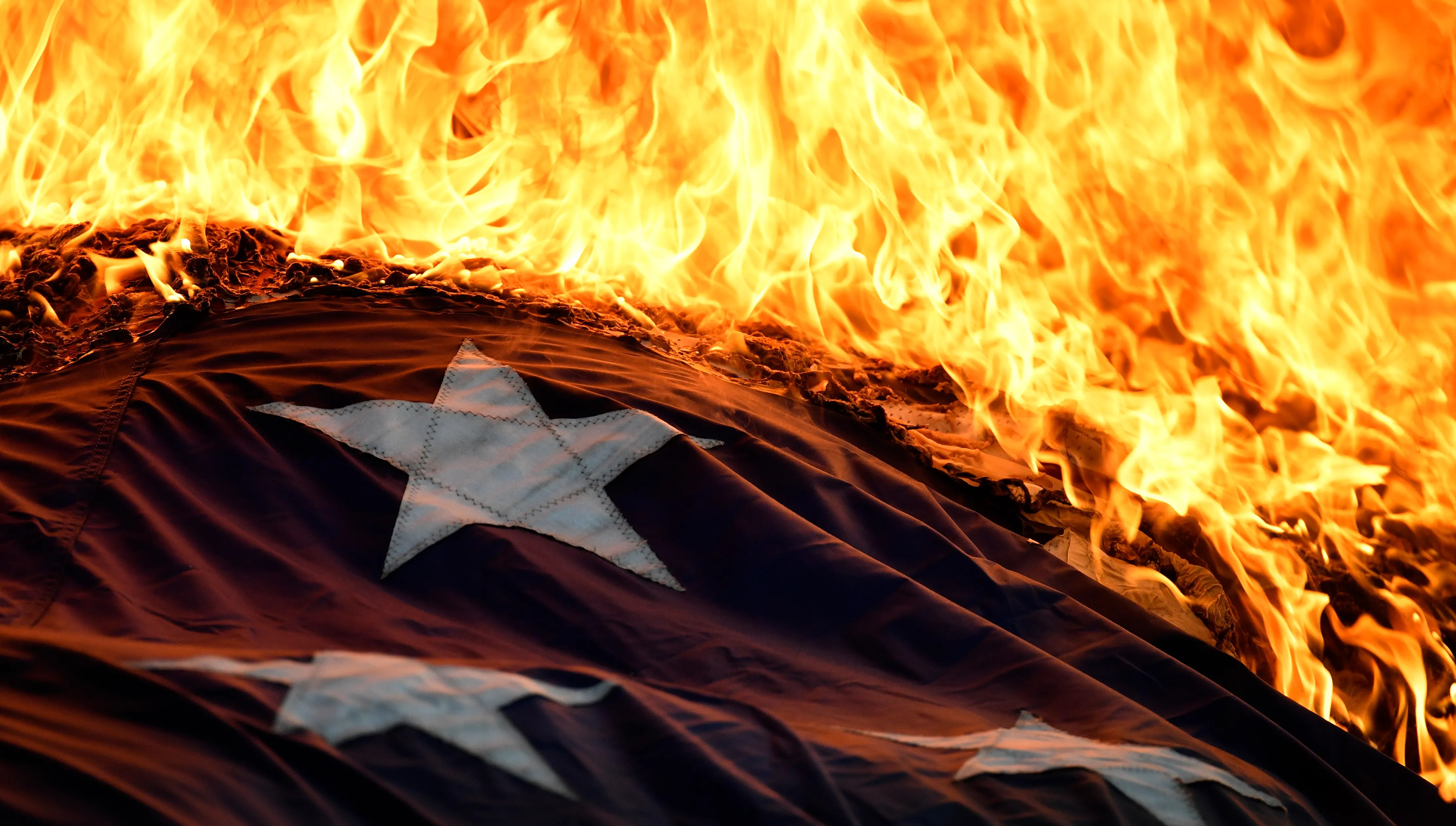
That said, I have always opposed making flag desecration criminal, seeing it as a free speech matter. I should be able to burn a US flag that I purchased or that somebody gives me. Burning someone else’s flag without permission is wrong, of course, but that falls under theft and property destruction. Moreover, those burning flags should be mindful of the danger that burning anything presents.
This was my position when Hillary Clinton cosponsored legislation criminalizing flag desecration in 2005. She was a New York Senator at the time, and the bill was called the “Flag Protection Act.” It would have made it a crime to desecrate the US flag with the intent to incite violence or disturb the peace. It stopped short of advocating a constitutional amendment (which would be necessary to get around the Court precedent).
Given the freak out over Trump’s EO, I am reminded of how little was made of Clinton’s advocacy for exactly what Trump is being condemned for. Like Trump, Clinton framed the proposal as a way to balance respect for the flag with free speech protections, particularly after the Court’s 1989 Texas v Johnson decision, which held that flag burning is protected under the First Amendment.
Clinton’s bill didn’t pass. It’s highly unlikely that Trump’s EO can pass constitutional muster. Let’s hope it doesn’t.
For the record, I have never had a double standard on this matter. I disagree with Trump now just as I disagreed with Clinton then. I would never burn a flag, but I defend the right of others to do so. Same with the New Testament or the Koran. Or a Pride Progress flag. And so on. Again, as long as it’s your property, it falls under the First Amendment. Nothing is so sacred that it stands above the right of the individual to express an opinion. (I wrote a short essay on this in 2009: The Strange Case of the Upside-Down Flag.)
Decades ago, in an argument with somebody about flag desecration on a listserv, I asked whether eating a flag cake was desecration. No, was the reply. I then asked whether, if I should crap a flag after having eaten one (on chance, highly improbable but not zero, albeit much closer to zero than Trump’s EO overturning precedent), it was okay to flush it. I didn’t get a response. I thought it’d make an interesting title for the essay. So now you know.
* * *
For those who view the US flag as a sacred symbol, there is a flag burning case that is sure to get provoke anger. There was some attention to this case when it happened, but even a concerned civil rights observer like yours truly, this was a case that, at the time, that escaped mine. This is the case of Adolfo Martinez, a 30-year-old resident of Ames, Iowa, who, in June 2019, stole a Pride flag from the United Church of Christ and set it on fire outside a bar.
Martinez told local reporters that he opposed homosexuality and burned the flag to express that opinion. In December 2019, he was sentenced to sixteen years in prison. Fifteen of those years were for an act of arson classified as a hate crime. The hate-crime designation was applied because his actions targeted the LGBTQ community. His sentencing was enhanced—tripled—due to his status as a “habitual offender.” Martinez had two prior felony convictions. Additionally, he got one year for reckless use of fire and 30 days for harassment.
What were the offenses that triggered Iowa’s habitual offender law? They were unrelated to the flag burning. Records show past charges for driving under the influence, possession of marijuana, and driving with a suspended license. These prior offenses were nonviolent (and rather trivial, in my view), but they met the statutory threshold to drastically increase the potential sentence for his arson charge, raising the maximum from five years to fifteen years. That means, even without the enhancement, he was still facing five years for burning a flag.
Supporters of the ruling predictably argued that the act was a dangerous hate crime, targeting a marginalized community and thus warranting a strong legal response. LGBTQ activists emphasized the importance of sending a clear message that hate-motivated crimes would not be tolerated, particularly when such acts risk inciting further violence.
Is burning a flag an act of violence? He received a year for reckless use of fire (which seems excessive). That should have covered any violence prosecutors might ascribe to his actions.
As the foregoing suggests, my view is that the very concept of hate crime legislation raises First Amendment concerns. The Constitution protects even hateful or offensive speech, including symbolic expression such as flag burning. This was established in the aforementioned Texas v Johnson ruling.
The standard rationalization is that hate crime laws do not criminalize the belief or speech itself; instead, they enhance penalties for criminal conduct—such as arson, assault, or vandalism—when motivated by bias against a “protected group.”
In the case of arson and particularly assault, this can and should be considered violence, or at least potentially harmful interpersonal action, as in the case of arson. But there is still the specter of thought crime. I can understand the question of motive in physical violence against persons, but in damage to property? Who decides what hate one can express? What if I burn a Confederate or a Nazi flag? That is motivated by hate. I can’t hate Nazis? To be sure, I cannot freely assault a Nazi, but I can’t express my hatred of his beliefs and practices?
Whatever justification hate crime enhancement we can think of, rationally speaking, such an enhancement is punishing thought or viewpoint, which requires some entity to define what is an unacceptable expression of hate (since an object of hate is in principle limitless), and thus requires the government to endorse a viewpoint while selectively protecting some groups and not others, thereby effectively criminalizing a belief or ideology rather than just action, which is all the law is supposed to reach—if it is to avoid establishing the totalitarian construct of thought crime. The notion that such laws are constitutional because they address the impact of bias-motivated crimes on targeted communities, not the speech alone, strikes me as a rationalization.
Why I raise this case today is because, yesterday, in Lafayette Square, directly across from the White House, a man—who identified himself as a 20-year Army combat veteran—set fire to an US flag in protest of Trump’s EO. You can watch the video here. In the video the veteran denounces the order as unlawful, asserting it violated First Amendment protections. Law enforcement agents, including Secret Service and US Park Police, quickly extinguished the flames and arrested him—not for flag burning per se—but for violating federal regulations banning fires in national parks.
I get the protest. He is expressing a viewpoint. He is not doing this out of hatred of a protected class of people but rather out of his love of the First Amendment. At the same time, there is a problem with lighting fires in public spaces—whatever one is burning. Are there fire pits or grills in this space? That’d be one thing. But on the sidewalk? Accelerant. Fumes. Folks can’t light fires just anywhere.
Should he spend years in prison? No. Not even a year. Is it possible that some will view his actions as hatred of America? Yes. Was his action a hate crime? Who ultimately decides? Who shall we appoint to serve as commissar? I can’t think of a person or a group of persons I’d trust with a job that shouldn’t even exist.
Finally, if you agree with Iowa regarding the burning of a Pride flag, then you have no valid reason to oppose Trump’s EO. The double standard makes you a hypocrite.

 freedom and reason