
In May of this year, Montana Governor Greg Gianforte signed House Bill 819 into law, restricting the display of flags representing political standpoints on government property, including public schools and state buildings. The law prohibits flags expressing a “political viewpoint, race, sexual orientation, gender, or political ideology.” As a result, Pride and related flags are now banned from display on or within public school campuses and government facilities. Montana’s actions reaffirm the true spirit of the First Amendment.
As visitors to my platform know, I have long advocated for such action (see Civic Spaces and the Illiberal Desire to Subvert Them; City of Green Bay Violates the First Amendment; Flying Pride Again—Or Are They?). The public square should not be a space where movement politics enjoys the privilege of government endorsement. In a free society, government institutions must remain politically neutral, fostering an environment where citizens can express their views freely, without fear of implicit favoritism (see Public Spaces Are Supposed to Be Ideologically Neutral Spaces—and We Must Make Them So).
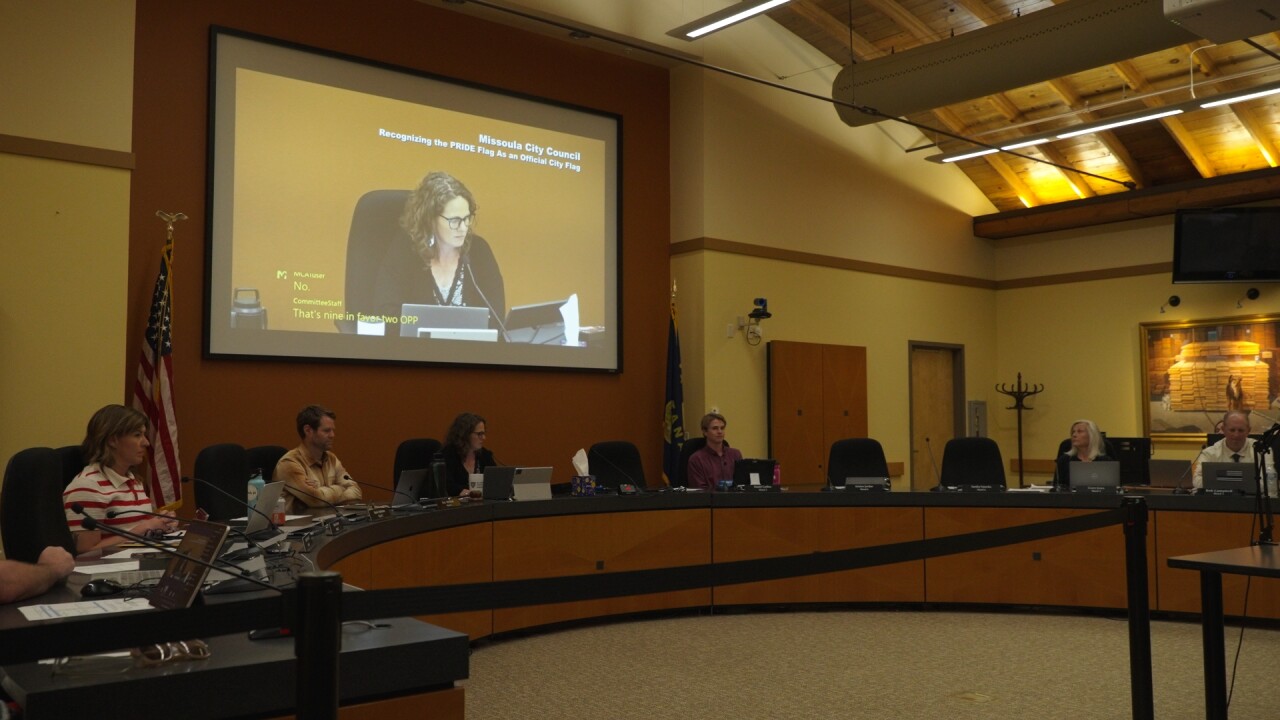
Unfortunately, not all politicians in Montana treat the First Amendment as sacrosanct. In what some have called a “creative workaround,” the Missoula City Council voted in June 2025 to designate the Pride flag as an official city flag, attempting to sidestep the state law. Missoula’s tactic is not unique. Cities in Idaho and Utah have attempted similar maneuvers in response to laws restricting political symbols on public property.
In Idaho, lawmakers passed House Bill 96 in April 2025, prohibiting government buildings from flying “non-official” flags. The law limits displays to the U.S. flag, military flags, official university banners, and other approved government flags. Despite the restriction, Boise city officials kept the Pride flag flying at City Hall even after the law went into effect. In early May, the Boise City Council voted 5–1 to designate the Pride flag as an official city flag, making its display legal under the law’s exemption for city-approved banners. State Attorney General Raul Labrador has warned lawmakers that stronger enforcement mechanisms may be introduced in the next legislative session to close the loophole.
In Utah, a similar conflict unfolded. In March 2025, Utah became the first state to impose a comprehensive ban on Pride and other “unsanctioned” flags on government property and public school grounds. Under the law, which took effect in May, violators face fines of up to $500 per day. Only a narrow set of flags—such as the U.S., state, military, tribal, Olympic, and city or county flags—are permitted. In response, Salt Lake City officials unanimously voted in May to adopt three new official city flags: the Sego Belonging Flag (rainbow colors) and the Sego Visibility Flag(transgender colors). The council thus legally sidestepped the state ban by making these banners official city symbols.
Like Missoula, Boise and Salt Lake City have employed this “creative workaround” to preserve Pride symbolism and maintain their commitments to “diversity and inclusion.” Supporters argue these moves affirm local values, while Republican lawmakers in these states have criticized the tactic as political theater and warned of potential legal or legislative pushback. These disputes highlight the tension between state-level efforts to enforce strict neutrality on public property and cities’ attempts—as proponents of such flags put it—to reflect the values of their local communities.
There should be no such tension. Officials should ask themselves: Is every resident of the city they represent a member of the LGBTQ+ community? Does every resident embrace radical gender ideology? Of course not. What about gays and lesbians who do not see themselves as part of a broader community that includes transgender-identifying individuals and others? What if they reject the tenets of queer politics (as many homosexuals do, since it politicizes their sex lives)? Yet city governments have chosen to elevate one political symbol above others, effectively telling dissenting citizens that their views do not matter. Moreover, even if every resident did identify with the community as imagined by queer activists, the First Amendment does not permit the tyranny of the majority on matters of political expression.
And that is what this is: ideological tyranny. Ideological tyranny is a condition in which a particular belief system or ideology is imposed on others, suppressing freedom of choice, expression, and thought. It occurs when a dominant group—whether or not it represents a majority—uses cultural, economic, legal, political, or social power to coerce conformity or marginalize dissenting viewpoints. It reflects a concentration of control over discourse and policy, coupled with a sense of moral absolutism that treats the dominant ideology as an unquestionable truth. In such environments, individuals risk professional consequences or social stigma for expressing alternative perspectives. This phenomenon not only applies to overtly authoritarian regimes but also to subtler contexts where dominant narratives silence dissent.
In response to Missoula’s move, Representative Braxton Mitchell, the sponsor of HB 819, announced that lawmakers plan to amend the legislation in the next session to prevent municipalities from adopting political symbols as “official” flags. Idaho’s Attorney General Labrador has likewise suggested that the 2026 legislative session may add enforcement mechanisms; currently, the law lacks penalties, allowing the flags to remain in place for now. In Utah, Governor Spencer Cox criticized the situation, dismissing the new flags as “dumb,” but no legal or legislative action has been taken to override Salt Lake City’s workaround as of mid-2025.
Pursuing legal action or clarifying legislation would be the correct course. The US Constitution guarantees every state a republican form of government (see Article IV, Section 4 of the US Constitution, known as the “Guarantee Clause”), and the Supreme Court has affirmed that the First Amendment applies across all levels of government in every state. The foundational case establishing this was Gitlow v New York (1925), in which the Court held that the First Amendment’s free speech protections limit state government power. Subsequent cases further incorporated other First Amendment rights: Near v Minnesota (1931) incorporated freedom of the press; Cantwell v Connecticut (1940), the Free Exercise Clause; and Everson v Board of Education (1947), the Establishment Clause. States not only have the authority to restrict these symbols but also the responsibility to prevent cities from trampling on the rights of their residents. Municipalities should be required to remove Pride flags and restore displays that represent all residents equally—in a neutral manner. That is, governments should not endorse any particular ideological viewpoint.
If there were ever a need for clear evidence that progressive activists prioritize ideology over constitutional principles, the situations in these cities provide it in spades. These officials don’t care about neutrality or the civil rights of all citizens—they care only about enforcing movement politics through government platforms. The residents of those cities may want their officials to do this, but it is not up to them. The United States is not founded on majoritarianism. It is a constitutional republic with a Bill of Rights designed to protect the liberty of all citizens from majoritarian desire—or the desire of a powerful minority. Each state’s constitution must uphold the same principle.
The claim that removing Pride flags is “anti-LGBTQ+” is profoundly mistaken. Not flying the Pride flag simply means that the government has correctly decided not to endorse a particular political standpoint. The desire for government endorsement of an ideological position should be anathema to anyone who values a free and open society—because it is, at its core, an authoritarian impulse.
Bottom line: When a government entity displays a flag or other symbol tied to a political movement, it sends a message of endorsement—chilling the expression and speech of those who disagree. Because the government represents all citizens, only official symbols of the state and the United States should be displayed on government property.

 freedom and reason