
I’m an atheist, but I recognize that not all religions are the same. Some are far more harmful than others. But we are told that religion is relative to a culture and that it’s wrong to judge another’s culture. We’re called bigots and xenophobes if we do.
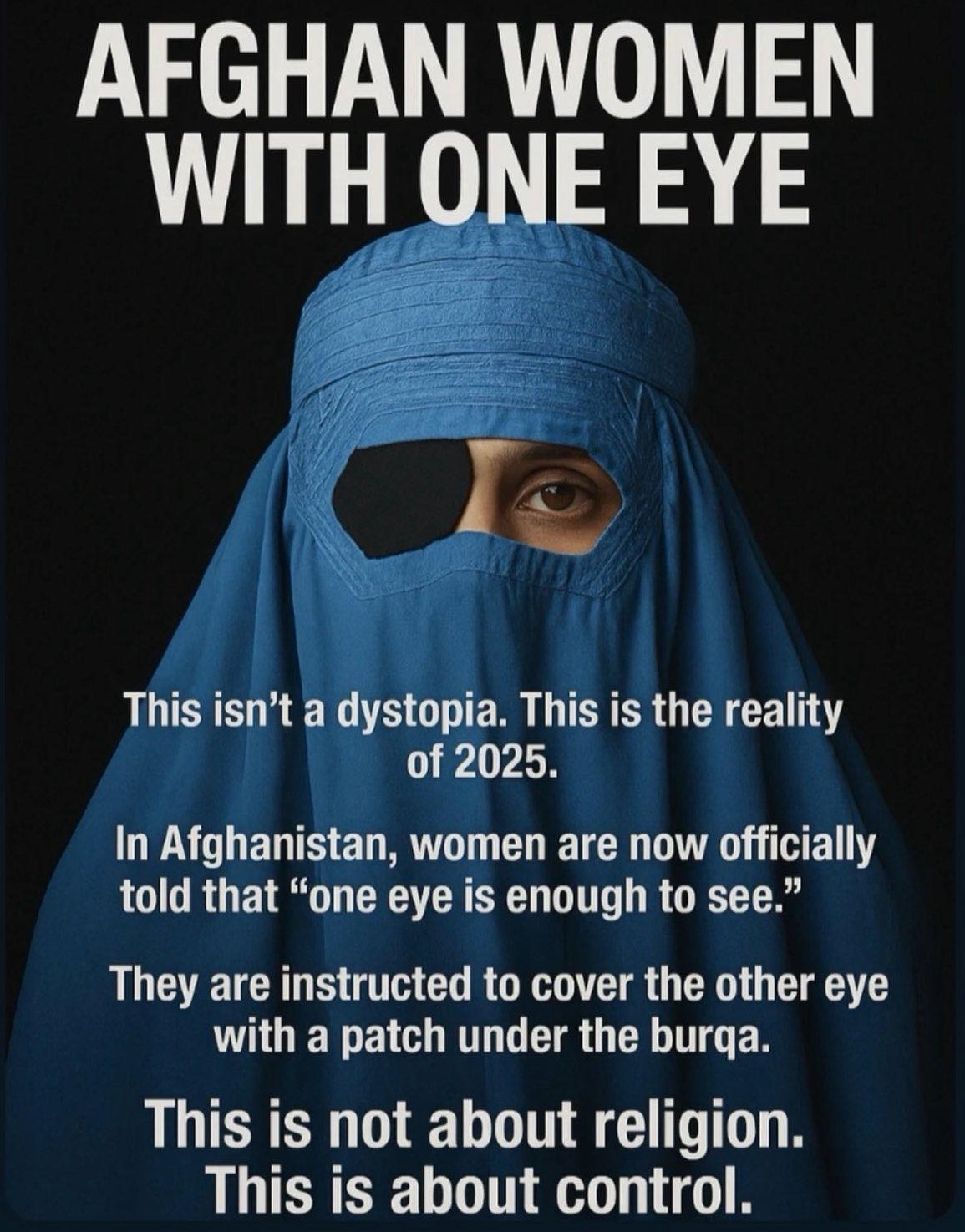
Have you seen the meme below? It’s the blunt truth. But there is an error. What one sees here is indeed about control. But it is also about religion. The religion of Islam. If you see this image and have trouble bringing yourself to judge that religion, then you must do better. What’s holding you back is some degree of cultural relativism.
The doctrine of cultural relativism has been one of the worst ideas to ever emerge from big heads in Western civilization. It’s a concept that has shielded barbaric practices from critique and placed oppressive traditions beyond the reach of morality and reason.
To clarify, cultural relativism is the idea that the beliefs, practices, and values of others should be understood based on their culture rather than judged by the standards of another. On the surface, this seems reasonable. But the problem arises when understanding becomes an excuse for moral abdication.
Should we judge the culture of Nazi Germany based on the standards of National Socialism? It doesn’t take very long to see how reckless the demands of cultural relativism truly are. By the same logic, we could excuse slavery in the American South, foot-binding in China, or apartheid in South Africa simply because those societies once endorsed them.
This idea of cultural relativism is basic to anthropology and sociology, two disciplines in which I was professionally socialized (I teach in a sociology and anthropology program at a state university). Every introductory sociology text aims to condition students to believe in the inherent goodness of cultural relativism. Students are trained to think that the suspension of moral judgment is not just intellectually sophisticated but also morally virtuous. It does this while constantly dragging the West. My conservative students object. I am not a conservative, but I agree with them.
What I am conveying in these remarks is heresy in my profession. But I have never been comfortable with the doctrine of cultural relativism. And, as you may have picked up on, I am instinctively a heretic.
More broadly, we were all taught—and today’s youth still are—to believe and promote intercultural and interfaith tolerance (the spirit of ecumenicalism) and avoid the sin of ethnocentrism (or chauvinism), defined as the tendency to see one’s own culture as superior or as the default. This moral reflex—to recoil from judgment—is so strong that even when faced with clear injustice, many people will remain silent for fear of being labeled intolerant.
To further clarify the matter, there are two main types of cultural relativism.
Descriptive cultural relativism refers to the observation that different cultures have different moral codes and social norms. This is obvious and unproblematic. Who wouldn’t acknowledge the fact that, in the Islamic realm, women are subjects of male domination? Women wear burqas, their bodies and movements controlled, their voices silenced. They are second-class citizens by design.
If you asked some of these women whether they approve of this arrangement, many would likely say yes. But their affirmation cannot be taken at face value. They have been socialized from birth to see obedience as virtue, and fear of reprisal makes dissent dangerous. The deeper question, the objective question, is whether such subjugation is good or justifiable. Whether an individual says yes or no does not determine the objective moral status of the practice.
This observation necessarily takes us to the second type: moral or normative relativism. This is the belief that no culture’s morality or values are inherently superior to another’s. In other words, right and wrong are culturally dependent. (There is an inherent racism suggested here, but I will leave that to the side for now.) The upshot: We’re taught that, if a society considers a practice moral, then it is moral within that society.
See the problem? If we accept the premise of universal human rights, scientifically determinable on a close examination of species-being (and science—uncorrupted by ideology—is universal), then some cultures are, in fact, superior by default. We can put it this way: if normative systems meet Abraham Maslow’s hierarchy of needs, then they are superior. By the same token, if they don’t, they are inferior.
Consider the example of female genital mutilation (FGM). In many patriarchal societies, the clitoris is removed, depriving women of sexual pleasure. The cultural rationale is that women should be chaste, obedient, and free of sexual desire. Men, of course, have also been subject to genital mutilation through circumcision, which in some dulls sexual pleasure to some extent. But every man knows that sexual desire is not entirely under conscious control. Erections happen, sometimes involuntarily, because we are animals with biological drives. And while societies have long tried to suppress this “animality,” the biological fact remains: pleasure is part of our evolutionary design.
That is why science—empirical, objective, and universal—provides a standard by which we can judge these practices. Evolutionary biology tells us that sexual pleasure is not purposeless. It serves a function. Pleasure reinforces the behaviors necessary for reproduction and the propagation of the species. Practices that mutilate or repress this function violate something deeply rooted in human nature.
Perhaps this example is more persuasive than the one about women’s rights in general. The first example, about women in burqas, is too easily dismissed by those who have internalized cultural relativism. They may rationalize women’s subjugation as a “different but equal” arrangement. But when confronted with the physical mutilation of a child’s body—when confronted with irreversible harm—the relativist dodge becomes harder to sustain.
And yet, even this example reveals something troubling: the legacy of patriarchy in our own culture. The resistance to recognizing women’s freedom as an objective good suggests that many still unconsciously accept a hierarchy where women’s suffering can be rationalized as culturally legitimate.
And there’s this: The example of female genital mutilation, and male genital mutilation, leads naturally to contemporary debates about transgenderism and so-called “gender-affirming care” (GAC). Here we see how a superior culture’s moral order can be corrupted by ideology and, in our case, by greed as well. Children are put on puberty blockers, cross-sex hormones, or undergo surgeries with lifelong consequences, all in the name of affirmation. We are told that questioning this is hateful. It’s hateful to ask whether permanently altering a child’s body, often before full cognitive maturity, meets any objective moral or biological standard?
The moral paralysis of relativism is at work in this case, as well. Those of us who oppose genital mutilation are accused of imposing our morality on others. But it is not our morality we are imposing. It’s the morality of universal human rights. It is wrong to mutilate the genitalia of children, to sterilize them, to rob them of their ability to act as sexual beings. We object to acts of dehumanization. We are criticized for describing the barbaric acts of GAC as mutilation.
Yet GAC is no different than FGM—except that it’s framed as a compassionate act in Western societies. FGM is practiced mainly in parts of Africa, the Middle East, and Asia, but it also occurs in immigrant and diaspora communities around the world, including in Europe, North America, and Australia. In Africa, FGM is most common in countries across East Africa (Eritrea, Ethiopia, Kenya, Somalia, Sudan); West Africa (Gambia, Mali, Nigeria, Sierra Leone); and parts of North Africa, such as Egypt and Djibouti. In the Middle East, the practice is found in countries like Iraq (particularly in the Kurdistan region), Oman, Yemen, and in some communities within the United Arab Emirates. In Asia, FGM is reported in countries such as India (especially among Bohra Muslim communities), Indonesia, Malaysia, Pakistan, and parts of Thailand. Due to migration, cases are also found in many Western countries, including the United States, Canada, the United Kingdom, Australia, and across Europe.
According to UNICEF and the World Health Organization (WHO), more than 230 million girls and women worldwide have undergone FGM, and an estimated 4.3 million girls are at risk of being subjected to the practice each year. Most procedures are carried out on girls between infancy and the age of 15, often before they reach puberty, making it a major global health and human rights concern.
There was a great outcry over this many years ago, but over the past several years, media coverage of FGM has noticeably diminished. This decline reflects broader cultural and political shifts. In the 1990s and early 2000s, FGM was more frequently covered in mainstream outlets, often framed as a clear-cut human rights issue. Since then, cultural relativism and a deepening of multiculturalism have encouraged more cautious discussions around practices associated with specific cultural or religious communities.
Increasing sensitivity toward Muslim communities, particularly in the post-9/11 era (why sympathy for Islam followed 9/11 is a curious phenomenon), has made public discourse around issues perceived as tied to Islam more delicate. Fear of fueling stereotypes, Islamophobia, or xenophobia has led media outlets and commentators to downplay or avoid extensive coverage of the issue, especially when cases emerge in immigrant communities. Readers may recall the 2017 case in Michigan, where members of the Muslim community were prosecuted for performing FGM on girls—the first federal prosecution of its kind. Since then, discussions around FGM in the US have been more confined to advocacy, healthcare, and policy circles.
But the cultural relativism of the progressives who downplay the problem of FGM—and one suspects it has a great deal to do with normalizing genital mutilation associated with GAC—is not apparent in criticisms of American culture, which is condemned for being transphobic and white supremacist.
Ever been told that an “ought” doesn’t follow from an “is”? Nonsense. Acorns ought to become oaks under optimal conditions. Just as children thrive when their needs are met. And so they ought to. How will the species propagate otherwise? Why would any man with a conscience and a basic grasp of human development tolerate children with small brains and low IQs? (Yet, men do.)
There are things one ought not to do, and this isn’t a matter of opinion. When I was in high school, I remember some of my classmates proclaiming that morality is personal. No, it’s not, I would respond. Humans exist in moral orders, and some are better than others. Just ask a woman in Afghanistan under Taliban rule. Or don’t. She may feel compelled to lie to you. Better to just see what you see.
Given the descriptive definition, cultural relativism has some merit, such as encouraging cross-cultural understanding when the beliefs and practices are not harmful, for example, in one’s tastes in food or music. You can still not like it or partake in it, but such things usually don’t harm you.
However, beyond cuisine and aesthetic sensibilities (rather trivial matters, I think, although some of it is quite tasty and pleasing), cultural relativism can lead to moral paralysis, where harmful practices like heterosexism, misogyny, and slavery cannot be condemned because such condemnations are ethnocentric.
Obviously, taken whole cloth, the concept of cultural relativism complicates arguments for universal ethical standards and human rights. This is to put the matter mildly. In fact, at its core, the demand from cultural relativists that we eschew moral and normative standards, which we must do if we are to be nonjudgmental and inclusive, is nihilistic. Put another way, then, cultural relativism, in its full sense, is suicidal.
Consider that Muslims don’t practice cultural relativism (why would they?). And they like it very much that Westerners do, since it allows Islam to colonize the West while demanding we adhere to the value of cultural relativism. Does that mean that we should be intolerant like Muslims? Sure. But our culture is superior.
Have you noted the weird paradox in all this? If we should not draw an “ought” from an “is,” then why is there an ethical prescription that we shouldn’t judge the adequacy of other cultures (or subcultures)? On what grounds ought we not make determinations about moral and normative adequacy?
Cultural relativism sounds like a political project designed to morally paralyze us, doesn’t it? And the fact that the doctrine is arbitrarily applied makes that possibility all the more likely. Yeah, I think we’ve been conned. I know we have.
What about judging individuals as such? We can’t. Humans are culture bearers. That is, they bring their cultures with them. If they’re prepared to denounce their faith, then we can welcome them into the community of equals. But if they cling to their barbaric practices, then we can’t tolerate their presence. Not without sacrificing our moral integrity.

 freedom and reason