
The “Four Kings”—Roberto Durán, Marvin Hagler, Thomas Hearns, and Ray Leonard—became immortal in boxing history because of the way their careers intertwined and because each became household names. They all faced each other during the 1980s and 1990s in a series of high-stakes bouts. Yet some fans and historians have long argued that there was a fifth king: Puerto Rican prodigy Wilfred Benítez. After all, Benítez was a three-division world champion, the youngest ever to win a title at just 17, and shared the ring with Leonard, Hearns, and Durán—beating Durán in 1982 and pushing both Leonard and Hearns in competitive fights.
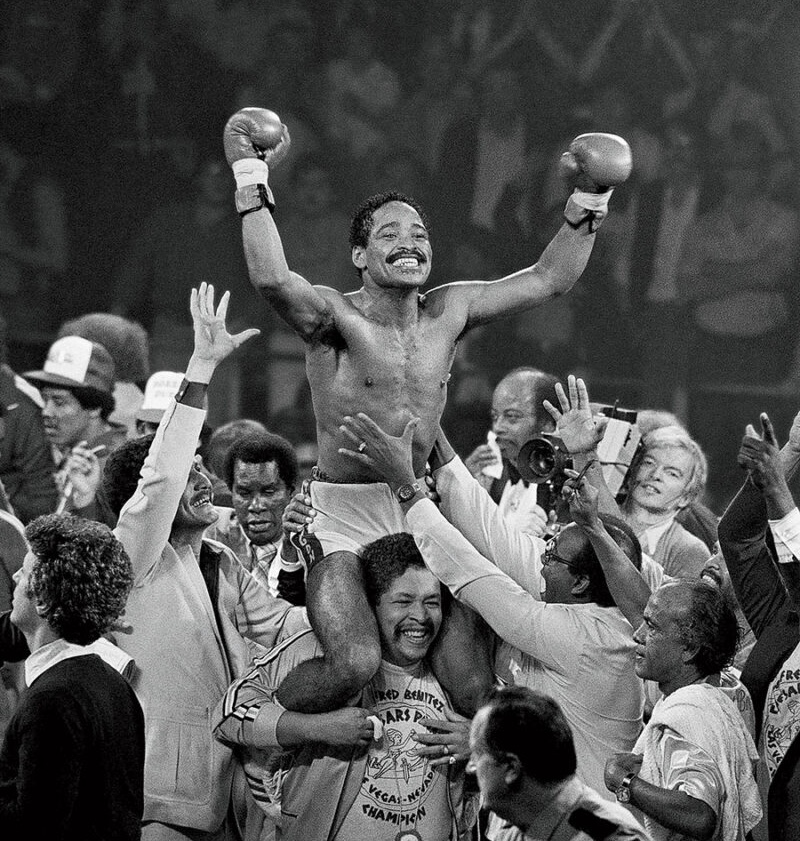
The reason Benítez is usually left outside the “Four Kings” mythology perhaps has less to do with his ability than with narrative. He never fought Hagler (despite competing at middleweight), his prime was shorter than the others’, and he lacked the same US mainstream profile that made Durán, Hagler, Hearns, and Leonard legendary names in the public mind. By the mid-1980s, the Puerto Rican’s reflexes had declined, while the other four were still at their peaks, engaging in their legendary round-robin of rivalries. Still, many in the boxing world—Steve Farhood among them—have called Benítez “the forgotten King.”
In this essay, I will consider whether Benítez should be reckoned among the fighters tagged the “Four Kings.” I will chart the paths of these fighters in chronological order, beginning with the Panamanian great Robert Durán, whom I place in my top five greatest fighters of all time, alongside Sugar Ray Robinson, Henry Armstrong, Willie Pep (sometimes including Sandy Saddler, since their four matches are etched in history), and the great Mexican fighter Julio Cesar Chavez.
Debuting in the late 1960s, Durán beat Scotland’s Ken Buchanan in 1972 to win the lineal lightweight title. Durán met Puerto Rican Esteban DeJesús that year in a non-title fight and lost for the first time. Knocked down in the first round, Durán couldn’t impose his will on DeJesús, and DeJesús was awarded a 10-round decision. This set up a title fight in 1974 in which, after being knocked down again in the first round, Durán clawed his way back into the fight and dominated the later rounds, stopping DeJesús in the 11th round.
In 1975, De Jesús challenged Panamanian Antonio “Kid Pambelé” Cervantes for the WBA light-welterweight title. Cervantes dropped De Jesús three times en route to a 15-round unanimous decision. The next year, Durán was stripped of the WBC lightweight title, which De Jesús claimed, defeating Japan’s Guts Ishimatsu by unanimous decision. De Jesús would successfully defend the WBC title twice, establishing himself as the next best fighter in the division after Durán.
In 1976, Puerto Rican Wilfred Benítez defeated Cervantes for the WBA light-welterweight title, successfully defending the title three times: Tony Petronelli, by unanimous decision; Emilio Valdés, by knockout in round 15; and Carmelo Negrón, by unanimous decision. Benítez would move up in weight in 1979 and capture the WBC welterweight championship on a split-decision over American Carlos Palomino.
In 1978, Durán and De Jesús met for a third time to unify the lightweight title. Durán dominated and stopped De Jesús in the 12th round. It was Durán’s final title fight at lightweight, having successfully defended his championship twelve times, with only one of these bouts going the distance. (A few months later, De Jesús would attempt to win the light welterweight title again, but Saoul Mamby stopped him in the 13th round, effectively ending De Jesús’s career.) Durán retired the lightweight title in 1979 and moved to the welterweight division.
As noted, having also moved to the welterweight division, Benítez defeated Palomino for the WBC title in 1979 on a split decision. Palomino, who had held the title since 1976, had seven title defenses under his belt and was highly regarded. The fight was close, and Palomino remained a top contender. Benítez defended the welterweight title successfully against Harold Weston Jr., a fighter with whom he had drawn in 1977, before accepting the challenge of Ray Leonard. Leonard was ahead on points on all three scorecards when referee Carlos Padilla stopped the fight with seconds to go in the 15th and final round, handing Benetiz his first loss.
The 1979 fight between Benítez and Leonard was a doubleheader, preceded by the controversial world middleweight championship fight between Italy’s Vita Antuofermo and American Marvin Hagler. The fight ended in a 15-round draw. Most observers favored Hagler (as I did) based on his dominance over the first ten rounds of the fight. However, Antuofermo’s tenacity impressed the judges and he retained his title.
The next year, in 1980, Hagler finally reached the summit of the middleweight division, stopping Brit Alan Minter (who had defeated Antuofermo) in three rounds in Minter’s home country. Not leaving it to the judges this time, Hagler dispatched Minter in brutal fashion. Wembley Area erupted in violence, and Hagler had to be hastily ushered to his dressing room, robbing him of his moment to celebrate his victory in the ring.
A few weeks before that bout, Durán won a convincing 10-round decision over Palomino, dropping the former champion in the sixth round, thus setting the stage for the first Leonard-Durán clash. Leonard and Durán would meet in Montreal in 1980. Leonard had a successful title defense under his belt, a spectacular 4th-round knockout of Dave “Boy” Green of Britain. Durán had proved he was a legitimate welterweight with his commanding victory over Palomino. Durán was the aggressor throughout his bout with Leonard, winning a close but unanimous decision. Five months later, Leonard regained his title when Durán quit in the eighth round.
That same year, Thomas Hearns knocked out Mexico’s Pipino Cuevas in two rounds to win the WBA version of the welterweight title. Hearns would successfully defend his title three times—knocking out Luis Primera, Randy Shields, and Pablo Baez—before facing Leonard in 1981 in a title unification bout. Leonard prevailed in a come-from-behind 14th-round stoppage. Leonard had picked up the WBA light middleweight title a few months earlier by knocking out Ayub Kalule. Leonard defended his welterweight title for a fourth time (against Larry Bonds) before retiring due to a detached retina. Anticipating a big-money fight, Leonard’s retirement left Hagler crestfallen.
Meanwhile, Benítez had won the WBC light middleweight title in 1981 by knocking out the Brit Maurice Hope. Benítez would successfully defend his title twice with 15-round decisions over Carlos Santos and Durán, before losing the title in 1982 on a majority decision to Thomas Hearns. Benítez continued to fight on, but never regained his form, suffering losses to Mustafa Hamsho, Davey Moore, and Matthew Hilteon, among others. He retired in 1990 with a record of 53-8-1 (32). He lives in Chicago under constant care from post-traumatic encephalitis.
Hearns would successfully defend his light middleweight title four times over the next several years. One of those defenses was against Durán, who was coming off a 15-round defeat to Hagler for the middleweight title in 1983. Durán had worked his way back into contention after his defeat to Benítez by stopping Cuevas in four rounds and brutalizing Davey Moore over eight rounds to win the WBA light middleweight title, both bouts also in 1983. Hearns and Durán met in 1984, and Hearns knocked the Panamanian out in two rounds. Hearns’ other title defense came against Luigi Minchillo, Fred Hutchings, and Mark Medal.
In 1985, Hearns challenged Hagler for the middleweight championship, losing on a third-round knockout. Going into that fight, Hagler had defended his title ten times, knocking out or stopping Fulgencio Obelmajias (twice), Antuofermo, Hamsho (twice), Caveman Lee, Tony Sibson, Wilfred Scypion, and Juan Roldan, as well as decisioning Durán. That next year, on the same card, Hearns knocked out American James Schuler in the first round, while Hagler defended his title for the twelfth time against Ugandan John Mugabi, knocking him out in the 11th, setting up a rematch between Hagler and Hearns.
However, that fight Hagler-Hearns rematch would never occur. In 1987, Hagler would lose the middleweight title in a controversial 12-round split decision to a returning Ray Leonard. It would be Hagler’s final fight, retiring with a record of 62-3-2 (52), with twelve successful title defenses, putting him on Durán’s level in terms of dominating a weight class. Hagler had sought a rematch with Leonard, but Leonard declined and, with his hopes of surpassing Carlos Monzon’s record of fourteen uninterrupted title defenses having been dashed, Hagler walked away from the sport. Hagler died in March of 2021 from natural causes.
In 1987, Hearns would defeat Roldan (whom Hagler had defeated in a title fight in 1984) on a 4th-round knockout, winning the vacant WBC middleweight title. Just prior to that fight, Hearns had won the WBC light heavyweight title, knocking out Brit Dennis Andries in the 10th round. Hearns vacated the light heavyweight title shortly afterwards, and Hearns would lose the middleweight title on a 3rd-round knockout to American Iran Barkley in 1988. A few months later, Leonard would stop Canadian Donnie LaLonde, winning the WBC super middleweight and the WBC light heavyweight titles.
Barkley would lose the middleweight title in his first title defense in 1989 to Durán, who had clawed his way back into contention. Flooring Barkley in the 11th round, Durán won a split decision. This set up a rubber match with Leonard, who outpointed Durán over twelve rounds for Leonard’s WBC super middleweight title. Just prior to this match, Leonard had drawn over twelve rounds in a long-awaited rematch with Hearns, also for Leonard’s WBC super middleweight title. The draw was controversial, with most observers (including Leonard) believing Hearns deserved the nod.
Durán would fight on with considerable success. However, he lost in a bid for the WBA middleweight title in 1998 against American William Joppy and retired in 2001 with a record of 103-16 (70).
Leonard and Hearns would fight on. Leonard would fight two more times, first in a failed attempt to win the WBC light middleweight title against American Terry Norris in 1991, losing by decision, In 1997, in an ill-advised comeback against Puerto Rican Hector Camacho in a minor middleweight title fight in 1997. Camacho, having outpointed Durán nine months prior, stopped Leonard in the fifth round. Leonard retired that year with a record of 36-3-1 (25).
Hearns continued to have success, shocking the world with a unanimous decision over long-reigning WBA light heavyweight champion Virgil Hill in 1991. Hearns would lose the title in 1992 to Barkley in a hard-fought 12-round split decision. Hearns moved up the cruiserweight division (winning a minor title) before finally retiring in 2006 with a record of 61-5-1 (48).
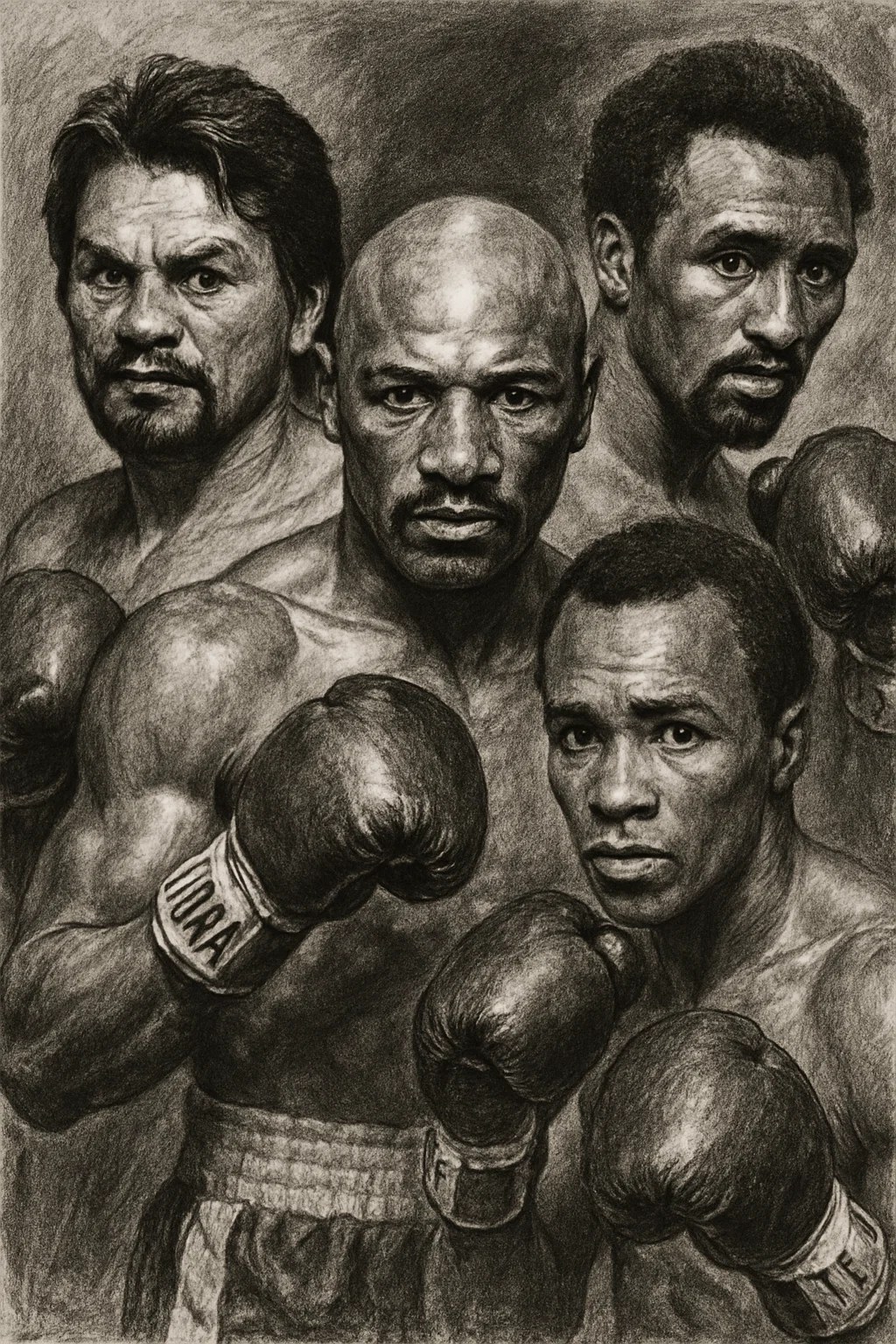
An argument can be made that Benítez should stand with the other four in terms of his record and quality of opposition. Benítez won the WBA light welterweight title and successfully defended it three times, relinquishing the title undefeated after winning the welterweight title. He successfully defended that title before losing to Leonard in a close contest (unfairly, in my eyes, stopped by the referee with seconds to go in the match). He then won the WBC light middleweight title, successfully defended it twice, including a 15-round unanimous decision over Durán, before losing to Hearns on a majority decision.
Let’s compare that record to those of the others.
Durán was world lightweight champion (unifying the WBA and WBC titles after being stipped of the latter), the WBC welterweight champion, WBA light middleweight champion, and WBC middleweight champion. While he never successfully defended these later titles, he did successfully defend his lightweight title twelve times, which puts him in an elite class. Durán would lose the WBC welterweight title, twice in attempts to win the WBC light middleweight titles, in challening for the middleweight and WBC supermiddleweight title.
Leonard twice won the WBC welterweight title, added the WBA welterweight title in a unification match, won the WBA light welterweight title, won the world middleweight, WBC super middleweight, and WBC light heavyweight titles. He successfully defended his welterweight title four times and his WBC super middleweight title twice. He only lost one title in the ring, his WBC welterweight title to Durán (although, reckoned in lineal terms, an argument could be made that he lost his middleweight title to Norris, but that requires a complex examination that is beyond the scope of this essay).
Hagler was not a weight jumper (although world light heavyweight champion Michael Spinks challenged Hagler to a fight at the catchweight of 168 lbs in 1983). Hagler was a solid middleweight throughout his career, posting twelve successful title defenses across seven years in a deep field. He held wins over Durán and Hearns, and, many will argue (including me), over Leonard, as well. Hagler has the distinction of never being knocked down (no, Roldan did not knock down Hagler in their match) or stopped in 67 fights. Hagler may be the best middleweight in boxing history and is in my list of the ten best boxers of all time.
Hearns held the WBA welterweight title, the WBC light middleweight title, the WBC light heavyweight title, the WBC middleweight title, and the WBA light heavyweight title. Hearns would defend his welterweight title three times and his light middleweight title four times. Had Hearns had better whiskers and stamina, he might have very well been the best fighter of his era. But his knockout losses to Hagler and Barkley, and his gassing out in the later rounds against Leonard keep him from that status.
The “Four Kings” era is rightly remembered as a golden age. Benítez stands just outside its pantheon. Benítez had the talent and résumé to bring him close to that circle. He did beat Durán, but not having faced Hagler is significant. Moreover, his short prime goes against him. Part of what matters in these assessments is longevity.
As for how the “Four Kings” rank in my estimation, I have the order: Durán, Hagler, Hearns, and Leonard. Readers may wonder why Leonard is fourth given his wins over the other three (as well as Benítez). The reason for this is that Hearns was beating him rather easily in their first match before gassing out, and Hearns deserved the nod in the rematch, dropping Leonard twice in the fight. Despite losing to Leonard twice afterwards, Durán dominated Leonard in their first match. Hagler deserved the nod against Leonard. Excluding Durán’s reign as lightweight champion, the order changes, but I am assessing each fighters entire career.

 freedom and reason