
“To exercise exclusive Legislation in all Cases whatsoever, over such District (not exceeding ten Miles square) as may, by Cession of particular States, and the Acceptance of Congress, become the Seat of the Government of the United States, and to exercise like Authority over all Places purchased by the Consent of the Legislature of the State in which the Same shall be, for the Erection of Forts, Magazines, Arsenals, dock-Yards and other needful Buildings.” —Article I, Section 8 of the United States Constitution
The latest counter to Donald Trump’s push to reestablish law and order in the Capitol is the renewed demand for DC statehood. This demand isn’t new—I’ve heard it my entire life, more loudly in the 1980s. It fades from time to time. It most recently remerged in 2023 in Congress. Now it’s back.
Before making the case against DC statehood (which won’t take long), a brief timeline of Congressional moves made to give DC more power. In 1961, the Twenty-Third Amendment to the US Constitution was ratified, granting the District of Columbia three electoral votes in presidential elections. This measure gave DC residents a voice in selecting the President and Vice President for the first time, yet it stopped short of offering them any voting representation in Congress. The amendment addressed only one aspect of DC’s political disenfranchisement, according to proponents, ignoring the plain text of the Constitution, leaving unresolved the broader question of the city’s role in the federal system.
A further step toward local self-governance came in 1973, when Congress enacted the District of Columbia Home Rule Act. This legislation created an elected local government consisting of a mayor and a city council, with members chosen both at-large and by ward. While Home Rule allowed DC to manage many of its internal affairs, not a particularly objectionable move, Congress retained the authority to review and override the city’s laws and budget, ensuring that the federal government maintained ultimate control over the nation’s capital. This piece is crucial.
The debate over DC’s political status continues into the present day. In 2023, the Senate reintroduced the Washington, DC Admission Act, which would transform most of the District into the nation’s 51st state—called Washington, Douglass Commonwealth (so it can keep the acronym)—while preserving a small federal district around core government institutions. Supporters argue that statehood would end “taxation without representation” for hundreds of thousands of residents, while opponents contend it would violate constitutional principles and upset the balance of power envisioned by the Founders. I am with the opponents.
Indeed, it would be refreshing if DC Mayor Muriel Bowser and proponents of DC statehood would sit down and read the United States Constitution and the Federalist Papers—or, if they struggle with comprehension, have someone explain it to them. In truth, I suspect Bowser and others around her have read these documents and do understand them. But they operate under the cynical assumption that most Americans haven’t, and can’t, so they work to mislead the public into thinking the federal government is “taking over” something it already has exclusive control of.
Even Trump, during his first term, may not have fully grasped the constitutional arrangement. Many in his administration—some actively working at cross purposes with him—certainly weren’t going to help him figure it out. Ironically, Democrats may come to regret giving Trump four years between presidencies to study how government works and assemble a more loyal, informed team. One aspect of Trump’s second term is that he has assembled a team much more loyal to the will of the People.
As the above quote indicates, the US Constitution designates the District of Columbia as a federal district, not a state. Making it a state would require a constitutional amendment—an amendment that would undermine the Founders’ intent and embed the Capitol within a single state’s jurisdiction. Why did the Founders avoid statehood for DC in the first place? To ensure the nation’s capital remained under direct federal control, free from the influence of any one state. They wanted the capital to be politically neutral, preventing one state from gaining disproportionate power over the federal government. A separate federal district ensures that Congress can maintain security and stability without interference from state politics—a safeguard for effective, unbiased governance.
DC statehood would shatter this balance. Since DC voters (no longer a chocolate city, DC is still around 45 percent black) lean heavily Democratic, granting it statehood would guarantee two additional Democratic senators and a shift in congressional power. We don’t need another Democrat-controlled state flooding Congress with more bad ideas. The state of DC itself is proof enough: decades of Democratic rule have left residents—and visitors—wading through crime, mismanagement, and urban decay. You want more of that in national politics? No thanks.
The ripple effects would be significant. If DC is granted statehood, other US territories will demand the same, further altering the political landscape and diluting the union. This would derail populist efforts to restore the Republic and move away from the destructive policies of the Democratic Party. (For perspective: this is the same reason I opposed adding Canada to the United States. The progressivism up there would make America look like—well—Canada: a woke hellscape.)
Let’s be clear: DC already has representation—however poor that representation may be. Statehood won’t fix the city’s problems. Establishing law and order is the first step, but real improvement will require a change in leadership and political culture. That will be a challenge for a city whose voters once saw their mayor (Marion Barry, DC’s four-term mayor, who spent six months in federal prison on drug possession) on video smoking crack with prostitutes—and reelected him anyway. Half a century of Democratic control has yielded misery as its primary fruit. We should not reward that record with statehood.
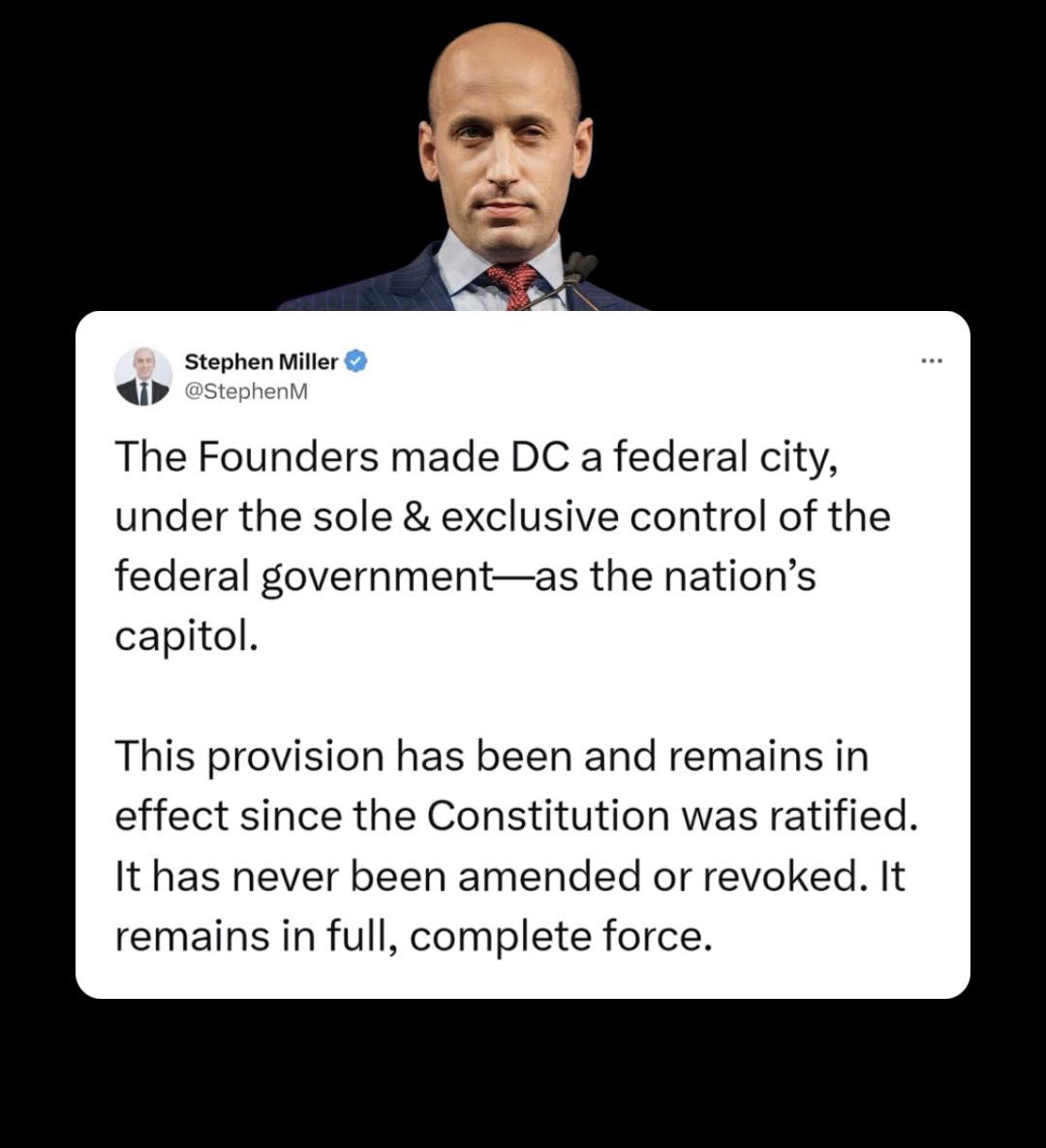
This is very important for everybody to socialize. The controversy Democrats are trying to manufacture about DC is yet another attempt to revise American history. History matters, and if we arm ourselves with the facts we can win the arguments that advance the project to reclaim our beloved republic.
Remember, it’s not so much who you are arguing with that matters. I’m sure you know full well that those working from partisan standpoints are typically incapable of being persuaded. What matters most is the audience. Our goal is to expand the parameters of mutual knowledge. For every progressive one encounters, there are many others open to changing their mind. Many people are not as dug in as progressives, since they have not articulated a position they feel compelled to defend to remain loyal to the tribe.

 freedom and reason
I believe Democrats prefer high crime to keep middle and working class white families out as they might vote Republican. Better to have a high-low mix of insulated wealthy liberals and various ethnic poors.
What would the Marxist analysis?
Marxists argue that racism is a structural tool of capitalism, functional to the reproduction of capital. By dividing workers along racial lines, the ruling class prevents multiracial worker solidarity that might challenge capitalist exploitation. Ghettos thus serve to socially and spatially isolate black workers, making it easier to exploit them as a reserve army of labor, drawn into low-wage jobs when needed, discarded when not. In late capitalism, offshoring and mass immigration have created a situation where the black proletariat has become permanent dependents on the government. Outside the labor system, they are demoralized, and crime and disorder result.
I agree that the ghetto is a strategy to generate votes for Democrats. Not working for a living, ghetto dwellers vote for a living. Their interests lie in keeping their dependency. Thus we have generations of idled people who provide a mass of votes for Democrats when elections roll around.