
I just saw a meme on Threads a little while ago noting that, while the truth can never have enough facts in its favor, the lie is believed with no facts at all. There’s something to that. But often the lie is believed when all the facts that betray it are known by everybody with eyes to see and ears to hear. That’s a much deeper problem.
Remember Hans Christian Andersen’s fairytale “The Emperor’s New Clothes”? He wrote that as a commentary on how the fear of appearing stupid can become a stronger force than the desire to speak the truth or be an independent thinker. The story captures a dynamic common to real-world behavior, especially among those who value being seen as intelligent and virtuous. (This is not my first essay using Andersen’s parable. See The Emperor is Naked: The Problems of Mutual Knowledge and Free Feelings.)
We’re all familiar with the story, but some specific details are important to recall. In the parable, the clothes worn by the emperor are invisible to those who are hopelessly stupid or unfit for their position. Even the emperor convinces himself he is clothed, when in fact he is buck naked (not in his underwear as depicted in our children’s books). The emperor must believe this because he sees himself as intelligent and regards his status is legitimate. His position requires this of him.
Swindlers posing as master weavers pretended to weave on empty looms and fabricated their progress only to provide the emperor and his subjects the opportunity to lie to themselves. The con men represent manipulators of public opinion who exploit fear and vanity to profit from the situation, much like ideologues and propagandists who introduce unquestionable ideas with significant social costs to those who question them.
The swindlers are metaphors for experts and institutions whose authority becomes unquestionable not due to merit but because doubting them is politically dangerous and socially ostracizing. In contemporary terms, the “weavers” are akin to figures who set the terms of cultural discourse—academics, activists, corporate leaders, media personalities—who introduce new “fabrics” of belief that people are afraid to challenge for fear of being labeled as bigoted, ignorant, or otherwise unfit. Their real power stems not from truth, but from everyone’s fear of speaking the truth.
The emperor and his loyal subjects engage in what sociologist Erving Goffman called “civil inattention,” where people deliberately ignore what’s plainly visible out of politeness or social pressure. The subjects deny the obvious to appear intelligent, loyal, and worthy. When image, reputation, or status are perceived to be on the line, those with weak egos choose conformity and silence over honesty—even in the face of obvious falsehoods. The risk of being thought ignorant outweighs the discomfort of going along with something they privately question. The reader knows that the subjects know that the emperor is naked.
Trans ideology is the invisible clothing of our time. We all know trans women are not women. Only someone deeply confused—or pressured into believing—would genuinely think otherwise. At small gatherings, when everyone is relaxed and lets down their guard, those who publicly repeat the slogans will often, albeit in hushed tones, admit the truth. But they’re afraid to say so openly because rejecting radical gender ideology would make them appear backward or bigoted to the elite circles whose approval they crave or need. They know trans women are men, but they’re unsure whether others will admit it, so they either endorse an obvious falsehood or remain silent.
In the pursuit of appearing smart and maintaining tribal affinity, people abandon the very traits—honestly observing the world and reasoning clearly—that define genuine intelligence. Intelligent people become stupid out of a desire to appear smart and be admired. This is the heart of Andersen’s parable: a critique of those who prize pride, vanity, and social approval over courage and honesty.
This is the mechanism that lies behind virtue signaling. It plays out across a range of cultural flashpoints—not just gender ideology, but vaccines (those who call skeptics “anti-vax” typically can’t rationally explain their pro-vaccine stance), the cause of Palestine (and the increasingly unsubtle loathing of Jews), or public shows of solidarity with Ukraine. Social media amplifies the rewards for public alignment and the penalties for dissent, but the underlying dynamic is ancient. Blackened profile photos, digital flags for Mexico or Pride Month, pronouns in bios—these are all current-day markers of moral posturing.
In each case, the dominant narrative becomes less about truth and more about signaling—saying the right words, striking the right pose, demonstrating that one is on the “correct” side, that they are “good” and “noble.” The slogans proliferate: “I stand with Ukraine,” “Silence is violence.” They are not invitations to honest debate but loyalty tests—expressions of the desire to belong, look good, and sound smart. Much of what we know as Trump Derangement Syndrome is driven by the desire for affirmation from other members of the tribe. To be a good progressive is to despise the President and to say so publicly and loudly.
The public square, contaminated by ideology, pride, resentment, and many other things, is shaped less by logic or shared inquiry than by performance. To question the prevailing orthodoxy—on gender, geopolitics, medicine—is to risk being cast out of polite society. So cowards and the self-absorbed play along. They wear the ideological garments they’re told are beautiful, even if they suspect—or know—they don’t exist. Like the emperor’s subjects, they avert their gaze from the obvious or nod and even applaud the falsehood. Those who speak the truth are cast as the foolish child in Andersen’s tale—not because they’re wrong, but because they’ve shattered the illusion and turned private doubt into public awareness.
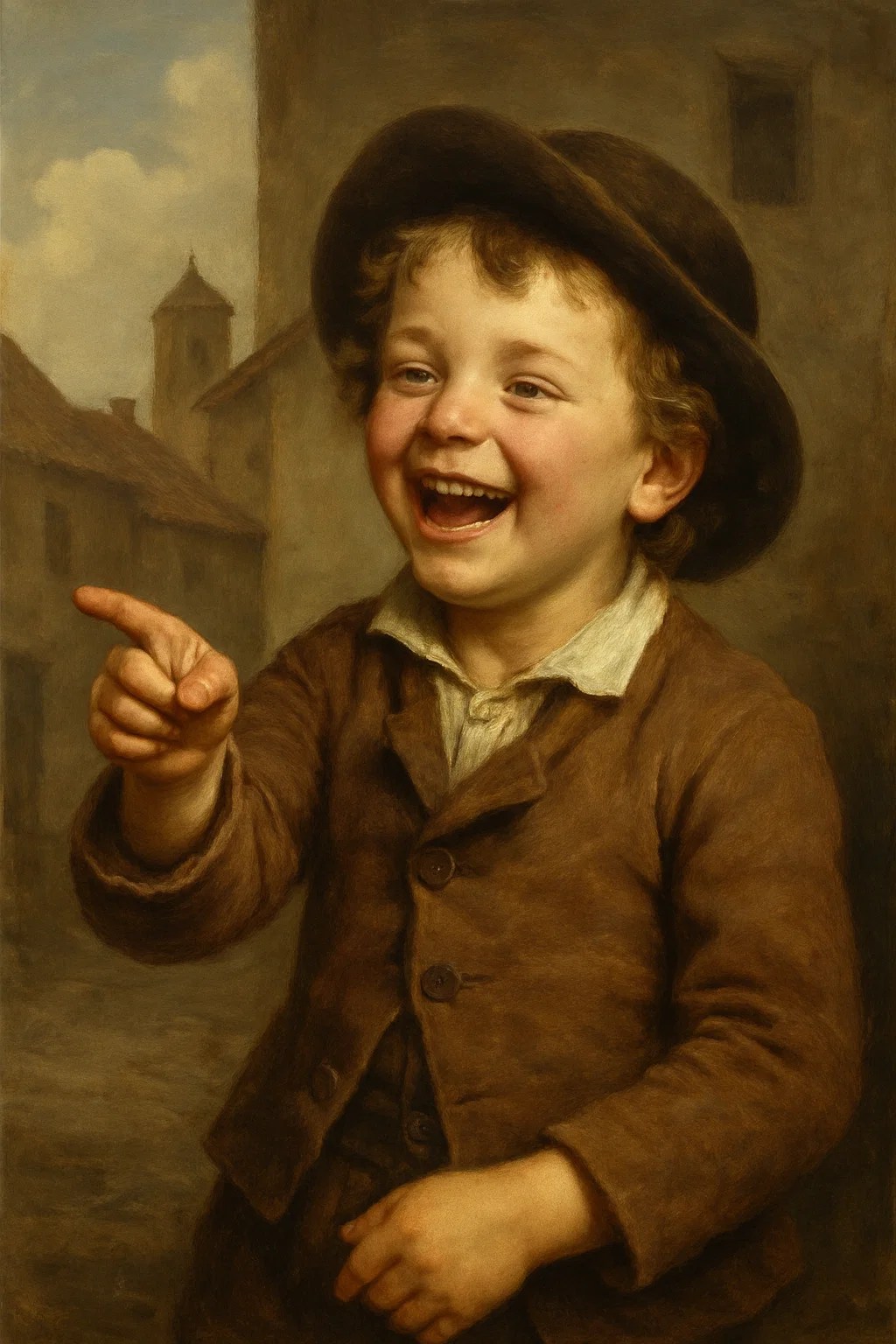
But the child in Andersen’s parable is not cast as foolish. The child is the embodiment of courage and truth. By bringing mutual knowledge to the subjects—that the emperor is naked and everybody knows it—the child, not yet indoctrinated in the ideology that holds the others back, shakes the subjects out of their commitment to civil inattention. The thing that made them uphold the illusion turns them against it: they don’t want to be fools.
Andersen’s parable endures because the mechanism it describes is timeless. When reputational risk outweighs the cost of falsehood, civil inattention becomes a defense mechanism, and mass self-deception is sustained not by the powerful, but by the silence of those who know better. “The Emperor’s New Clothes” is not just a children’s fable—it’s a mirror held up to every age where fear eclipses truth and where being thought wise is valued more than being wise at all. And tragically, though we all learn the story as children, too many take nothing from it. Too many live their lives like loyal subjects in the presence of a naked emperor. And those who escape ideology, or those who were never totally consumed by it, and who are courageous enough to speak the truth, are smeared as backwards and bigoted.
As many of you know, I have taught college for thirty years. So many of the ideas that prevail in academia are like invisible clothing—people believe ideas handed down from on high because they want to appear smart. There is a lot of pressure on administrators, staff, and teachers—and students—to see what’s not there, to dress truths in fictions. It is a powerful milieu, one that, in more than a few ways, affected me. Critical race theory concealed just societal arrangements. Radical gender ideology obscured hard natural facts. At the same time, I never allowed misplaced humanitarianism to dissimulate class warfare. I was never completely taken in by postmodernist notions. How I was able to escape false doctrine or for the most part avoid it altogether was thanks to the atheist child in me.
But there’s an irony here, if irony is the right word. There are those for whom beliefs I could never accept provide protection from indoctrination. So many of my Christian friends could never be persuaded to accept CRT or queer theory. I am missing that strength. Myths aside, the Judeo-Christian tradition carries inherent in it the power of rational perception. There’s a reason sociologist Max Weber observed in The Protestant Ethic and the Spirit of Capitalism that the Enlightenment is Protestantism’s heir.
In Matthew 13:16-17, after explaining to his disciplines why he speaks to the crowds in parables, Jesus says to them: “But blessed are your eyes, for they see, and your ears, for they hear. For truly, I say to you, many prophets and righteous people longed to see what you see and did not see it, and to hear what you hear and did not hear it.”
I can never be a Christian. But if anything can save the West from the perils of self-deception, it will be Christianity. Through its emphasis on the individual’s direct relationship with God, Christianity laid the groundwork for individualism and modernity. By asserting that each person has inherent worth and moral responsibility—independent of tribe or social status—Christianity challenged ancient collectivist norms.
Protestantism in particular intensified this by encouraging private conscience and a vocation-centered life, promoting autonomy and self-discipline. It was these religious beliefs that gave rise to ideas central to modernity: the dignity of the individual, moral agency, rational self-examination, and the value of work. To be sure, over time these theological roots were secularized, but their structure remains foundational to capitalism, civil rights, and liberal thought.
As I finish up here, a phrase comes to mind: “Speak truth to power.” This is from a 1955 pamphlet published by the American Friends Service Committee (AFSC), a Quaker organization. Quakers are committed to moral integrity and the belief that truth has the power to challenge unjust authority. The line may be attributable to Bayard Rustin, who coauthored the pamphlet. Rustin’s ideas ran parallel to George Orwell’s—both were anti-authoritarian and anti-communist. Both believed communism—and by extension collectivism—was incompatible with democracy and civil liberties.
Rustin’s rationalism put him in conflict with the New Left. So does mine. The New Left played a major role in creating the detrimental circumstances—and all the virtue signaling—that confronts us today. New Left ideas are ubiquitous in the academia and the culture industry. These are the ideas that run through woke progressivism. We hear woke progressives using AFSC’s phrase. But speaking truth to power presupposes seeing and hearing it. The left has become subjects who admire the emperor’s new clothes. The left doesn’t speak truth to power, but rather seeks power to clothe the truth in lies.

 freedom and reason