
On September 28, 1820, penned a letter to Thomas Jefferson to William Charles Jarvis. Jarvis was a public official from Massachusetts. He was part of the generation that came after the American Revolution and was concerned with preserving the values of republican government in the young United States.Jarvis wrote a book called A Republican Looking Glass for the Use of the New Generation of Republicans, wherein he expressed concern about political instability and emphasized the role of institutions—especially the judiciary—in preserving constitutional government.
“I feel an urgency to note what I deem an error in it, the more requiring notice as your opinion is strengthened by that of many others,” Jefferson writes. He takes issue with Jarvis’ argument that one should “consider the judges as the ultimate arbiters of all constitutional questions,” which he calls a “very dangerous doctrine.” How dangerous? If taken to heart it “one which would place us under the despotism of an Oligarchy.” Jefferson notes that “our judges are as honest as other men, and not more so.” As such, “they have, with others, the same passions for party, for power, and the privileges of their corps.” He recalled the maxim: boni judicis est ampliare jurisdictionem, which translates to “It is the duty of a good judge to enlarge his jurisdiction.” Jefferson notes that “their power the more dangerous as they are in office for life, and not responsible, as the other functionaries are, to the elective control.”
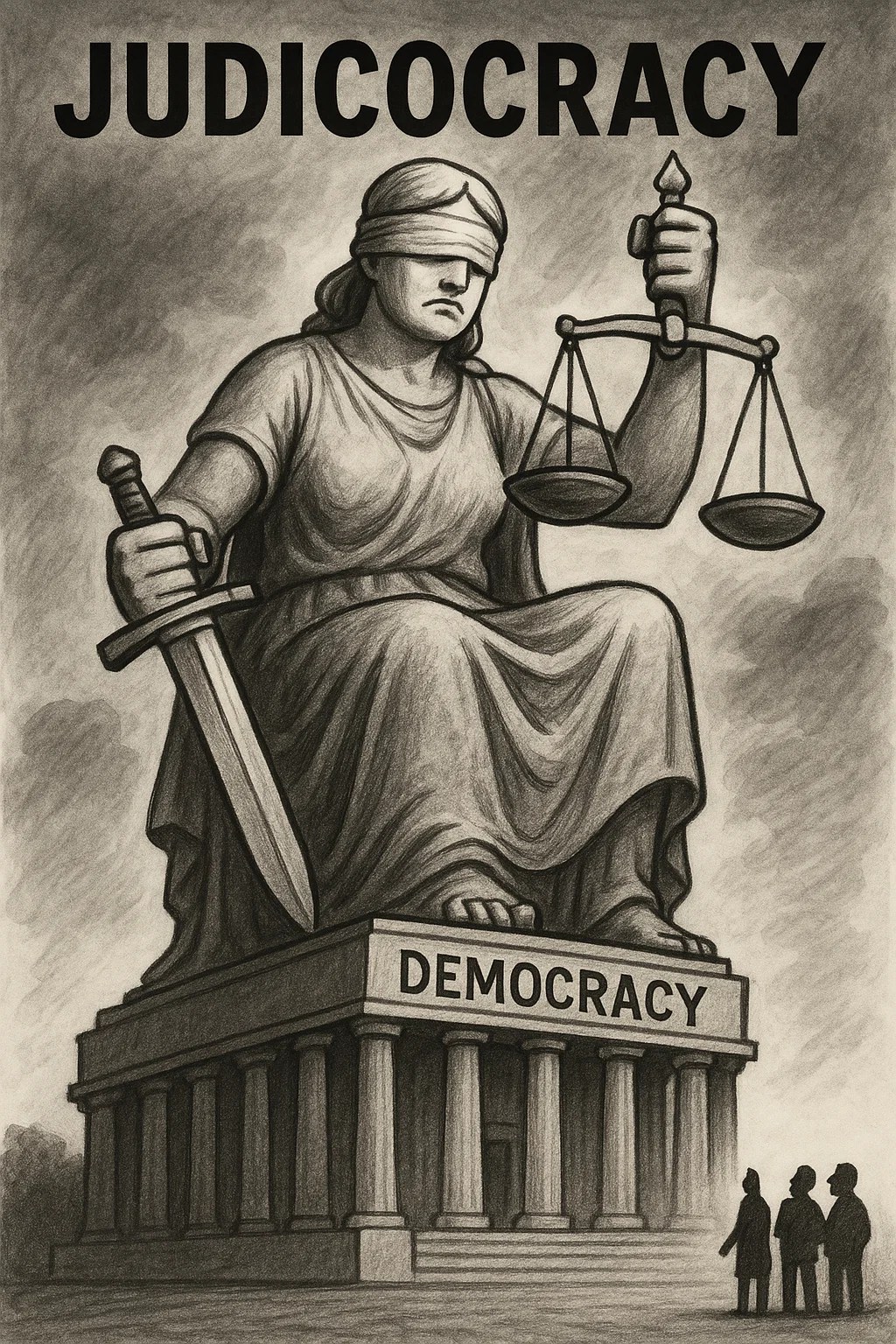
Jefferson’s argument resonates with my recent essay on the peril of judicocracy (see The Judicocracy Problematic; The Judicial Usurpation of Article II Powers and the Rise of the Universal Injunction). Jefferson is arguing that a government run by judges would basically put the nation under the control of a small group of elites who would subvert the popular will.
Jefferson goes on to argue that the Constitution didn’t create a single group to rule over everything. The Founders knew that if too much power were put in one place, even with good intentions, it would eventually become oppressive. Instead, they designed the three branches of government—legislative, executive, and judicial—to be equal and independent. He then gives examples: If Congress doesn’t pass laws it’s supposed to—like holding a census or creating a militia—the courts can’t force them to do it. If the President doesn’t appoint judges or sign commissions, the courts can’t order him to act either. Similarly, the President and Congress can’t order judges around. Each branch has its own job and can’t interfere with the others.
American judges, he argues, have overstepped their boundaries and tried to direct executive officials in their duties. But under our Constitution, each branch must stay in its own lane. Consider the currently onslaught of judicial actions against Trump’s handling of administrative affairs and immigration policy. The President is not obligated to observe the various injunctions imposed by a rogue judiciary. They have only the power to impose injunction—they have no power to impose them. Moreover, Congress has the power to limit the scope of their use—and even to dissolve courts, effectively removing judges (Lawfare Against the People Continues. When is Congress Going to Act?).
Jefferson admits that judges deal with constitutional issues more often because that’s part of their job, especially when it comes to contract and criminal law. But if the President or Congress acts unconstitutionally, they are held accountable by the voters—not by judges. To give judges the power to hold the President or Congress accountable gives the judiciary too much unchecked power.
Ultimately, Jefferson believes that the people themselves are the only safe guardians of power in a free society. If elites think they aren’t wise enough to make good decisions, the answer isn’t to take away their power but to educate them. That’s the real solution to abuses of constitutional authority.
Jefferson closes the letter with a observation about the future of the Republic, since this is Jarvis’ concern: “if the three powers maintain their mutual independence on each other, it may last long: but not so if either can assume the authorities of the other.”
Jefferson was hardly alone on this point. In this X post, Newt Gingrich lays out the sentiment of democrats and republicans. The speech was delivered at the Values Voters Summit on October 7, 2011. It describes in detail the ninth point in the 21st Century Contract with America, which states its objective as “Restoring the proper role of the judicial branch by using the clearly delineated powers available to the president and Congress to correct, limit, or replace judges who violate the Constitution.”

 freedom and reason