
Protest is a vital part of a free society. But when protesters block roads, surround vehicles, and threaten public order, it crosses the line from expression into coercion. At that point, it stops being protected speech and becomes an infringement on the rights and safety of others.
The police need to take proactive steps to address this problem. The role of the police is not to enable those engaged in lawless action, but to protect those subject to it. We cannot normalize the blocking of public roads by civilians, no matter how passionate their cause. But will the police act? Are citizens supposed to depend entirely on the police to protect their rights? Or are citizens entitled to take action in the absence or inaction of the police? Isn’t self-defense also a right?
The right to self-defense in the United States allows individuals to use reasonable force to protect themselves from imminent harm. Rooted in English common law, which heavily influenced American legal principles, this right permits force proportional to the threat, including deadly force when faced with a threat of death or serious bodily injury. In the US, self-defense is recognized as a legal justification for actions that would otherwise be criminal, with “castle doctrine” and “stand your ground” laws that expand the right to use force without a duty to retreat.
Peaceful expression is protected; physically obstructing critical infrastructure is not. Blocking roads interferes with a fundamental right in civil society: the right to travel freely and without interference. This isn’t merely a matter of convenience—it can be a matter of life and death. Someone may be trying to reach a hospital, get to work to support their family, or say goodbye to a dying parent. No protest—no matter how convinced protestors are of their righteousness—has the right to force innocent bystanders into unwilling participation by trapping them on the road.
Recall these words from the Declaration of Independence: “We hold these truths to be self-evident, that all men are created equal, that they are endowed by their Creator with certain unalienable Rights, that among these are Life, Liberty and the pursuit of Happiness.” The rights to self-defense and to travel unmolested by other civilians falls within these rights.
When protesters aggressively surround vehicles—yelling, pounding on hoods, refusing to let drivers pass—it creates an environment of fear and potential violence. This behavior is not harmless or mere symbolic acts. To the driver, it may feel indistinguishable from the beginning of an assault. The madness and unpredictability of crowds amplifies the threat: people have been pulled from vehicles before, as I will discuss below. Drivers caught in these situations cannot be expected to perfectly interpret the intentions of a chaotic, hostile crowd—the crowds can’t perfectly know what will be the results of their actions. There is the madness of crowds. Motorist may feel they have no option but to escape—even if that means driving forward.

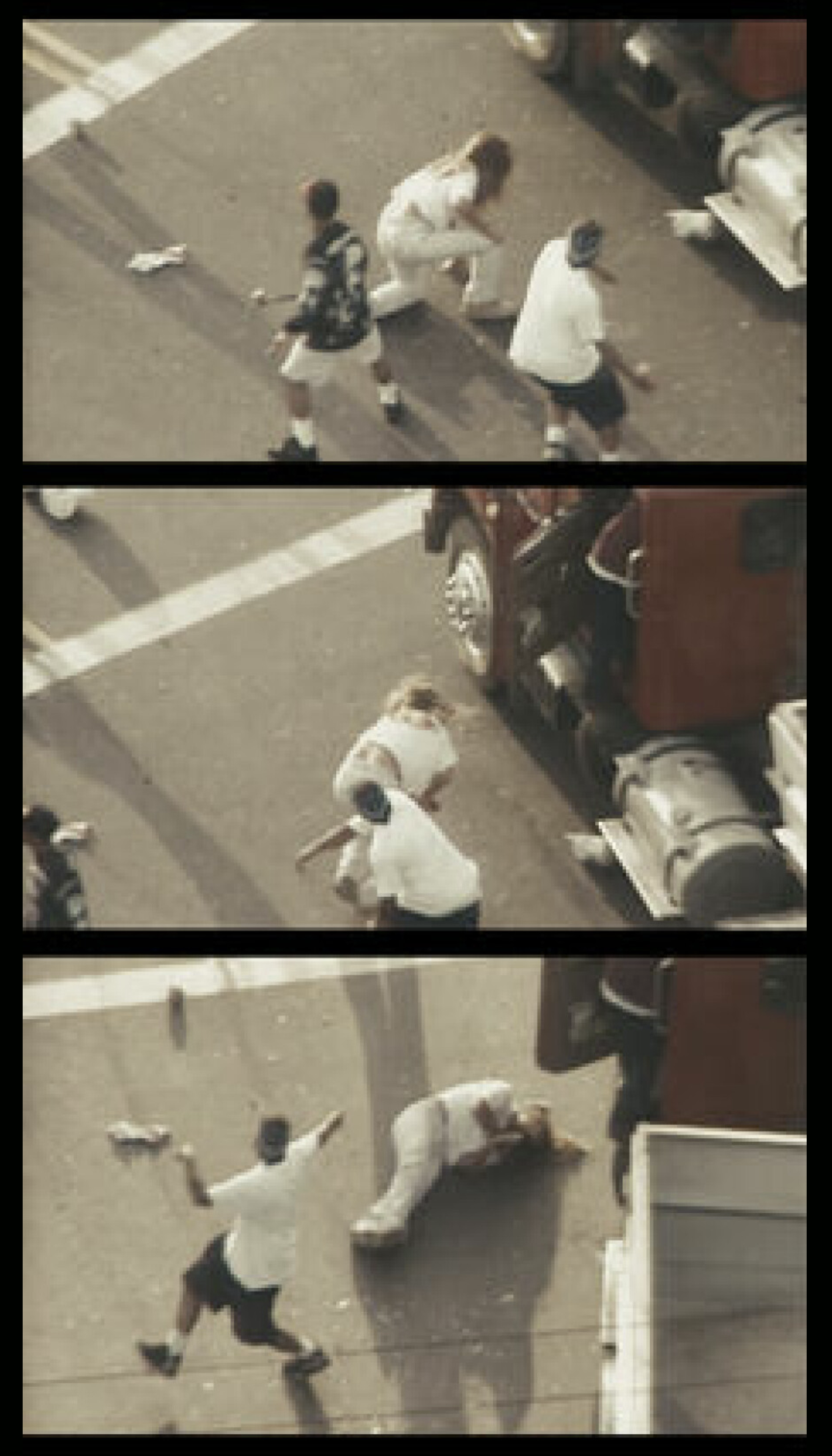
Remember Reginald Denny, a truck driver who was viciously attacked by a mob during the 1992 Los Angeles riots? On April 29, while driving through South Central Los Angeles, Denny was pulled from his truck at the intersection of Florence and Normandie by a group of rioters. He was beaten severely—kicked, punched, and struck in the head with a cinder block—causing a fractured skull and permanent brain damage.
The attack was captured on live television and became one of the most infamous moments of the riots, symbolizing the breakdown of public order. Several assailants were later arrested and prosecuted, with Damian “Football” Williams receiving a conviction for mayhem. A lot of good that did Denny. He survived, but the attack left lasting physical and emotional scars.
Why didn’t Denny keep driving? Reginald Denny likely didn’t keep driving because he was unaware of the danger he was entering, stopped at a red light as any law-abiding driver would, and hesitated out of confusion or fear when suddenly surrounded. Reports suggest he was listening to music and not following the news, so he may not have known the riots had erupted. Once his truck was surrounded at the Florence and Normandie intersection, he may have feared harming someone by trying to drive through the crowd. In moments of high stress and uncertainty, hesitation is common—and tragically, that pause gave the mob time to drag him from the truck and beat him unconscious. Imagine if Denny had plowed through the murderous mob? His life would be very different—and those who sought to hurt them would have paid the price for actions.
Forgetting Denny, those who defend the tactic of standing in the road will say, “But no one had actually attacked the driver.” They did in Denny’s case! And that’s not the only example. But that’s beside the point. Self-defense law does not require a person to wait until they are physically harmed to act. It requires that their perception of imminent harm be reasonable. And in situations where a person is trapped by a hostile group, shouting and blocking their path, that perception is not only reasonable—it’s entirely rational.
On June 2, 2020 a truck driver named Bogdan Vechirko was briefly jailed on assault charges after he nearly drove an 18-wheeler into a large group of protesters in Minneapolis. He was released a few days later without charges. No one was killed or seriously injured. But the video showed that Vechirko did not slow down his truck until he was far into the crowd of demonstrators. He’s lucky he did not wind up like Denny.
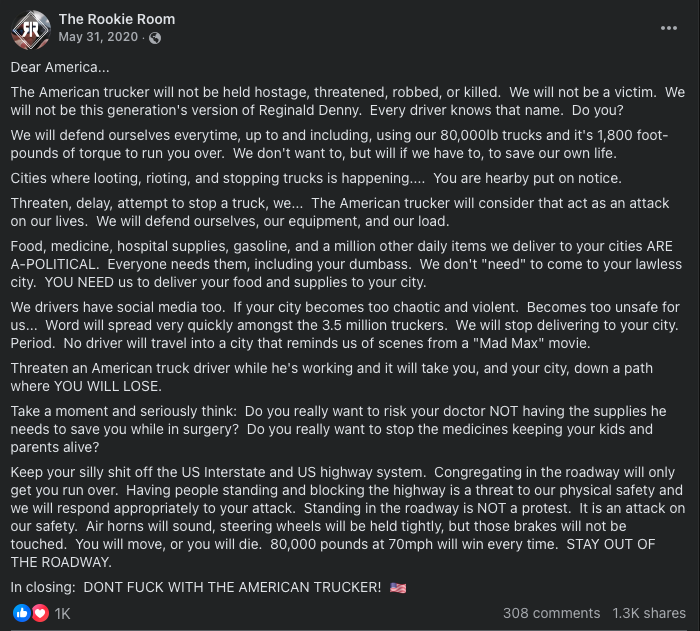
Only designated public officials—namely law enforcement—should have the legal authority to direct or halt vehicles on public roads. Allowing private citizens to take control of public space through intimidation or obstruction undermines the rule of law and endangers lives. Protesters are free to march, to chant, to speak—but they are not entitled to control the movements of others or endanger them in the process.
If a mob surrounds a vehicle, aggressively prevents it from moving, and the driver—fearing for their safety—continues driving to escape, the legal and moral responsibility for any injuries that occur lies first with those who created the threatening situation. Just as we teach children not to play in traffic, we should hold adults accountable for knowingly placing themselves and others in danger by occupying roadways. And, unlike children, adults know what they’re doing. The protestors know what they’re doing—until mob mentality dispossesses them of the capacity of reason, which does not mean they are not responsible for their actions.
There is a straightforward analogy here: if a man is walking down a sidewalk and is surrounded by others shouting at him, blocking his path, and refusing to let him leave, he is not obligated to guess their intent. He is being unlawfully detained and harassed. He had a reasonable belief that his life is in danger. If he defends himself or pushes through, most would agree he had a right to do so—at least they should, because his actions are rational and rooted in his unalienable rights. The same principle applies when a driver is encircled by an angry crowd. Threats don’t need to be acted upon to be real—and the right to defend oneself does not disappear simply because the aggressors claim political motives.
Protest is a right. Coercion, intimidation, and obstruction are not. Self-defense is a right. The state must draw that line clearly—before more people are endangered, and before citizens are forced to make life-or-death decisions without legal clarity or police protection. But must we wait for the state to defend us? How can we when political leaders and big money elites are construction, enabling, and encouraging the rabble? If only Denny had punched it he could have saved himself from a fractured skull and a life-long impairment of his speech and ability to walk. He’s lucky to be alive. The mob intended to kill him.
I close with the great Bill Hicks: https://www.youtube.com/watch?v=klYeCeYIAQQ (for some reason, YouTube will not let me embed any version of Hick’s bit on Denny).

 freedom and reason