
“We the People of the United States, in Order to form a more perfect Union, establish Justice, insure domestic Tranquility, provide for the common defense, promote the general Welfare, and secure the Blessings of Liberty to ourselves and our Posterity, do ordain and establish this Constitution for the United States of America.” —Preamble to the United States Constitution
I want to make clear from the outset—those who regularly read Freedom and Reason already know this—that I am deeply committed to the First Amendment and the fundamental freedoms of association, peaceful assembly, and speech and writing that are the lifeblood of American democracy. The right to express dissent, to organize for change, and to gather in protest is essential, and I support lawful, nonviolent efforts to advocate for policy reforms even when I disagree with dissenters, protestors, and reformers.
The Vietnam War protests of the 1960s-1970s were a powerful expression of moral conviction, driven by a growing sense of injustice surrounding the war’s purpose, methods, and human cost. Protesters questioned the ethical legitimacy of US involvement in a distant conflict that claimed millions of lives, disproportionately affected the poor and marginalized, and was often justified with unclear or misleading government narratives. The moral righteousness of the protestors lay in their demand for accountability, peace, and challenging the notion that patriotism required blind support for war. The protests were an affirmation of democratic responsibility and of human dignity.
However, these rights that governed the actions of Vietnam War or any other protestors do not extend to actions that violate the law, obstruct lawful enforcement, or threaten the safety and sovereignty of the nation. Respecting the First Amendment means upholding both the right to protest and the rule of law—a balance that protects our democratic society from chaos and preserves the integrity of the Constitution itself.
Indeed, we must protect our democratic society from chaos and preserve the integrity of the Constitution itself; the only reason we enjoy the freedoms of speech, association, and peaceful assembly is because we exist in a democratic republic with a constitution and a bill of rights. Other countries don’t enjoy these rights—and we won’t either if we let Democrats and their minions prevail in their current defiance of the Constitution and the popular will. The protests seek more than an end to ICE raids. They seek revolution. Indeed, these are not really protests but rebellion against the American Republic.
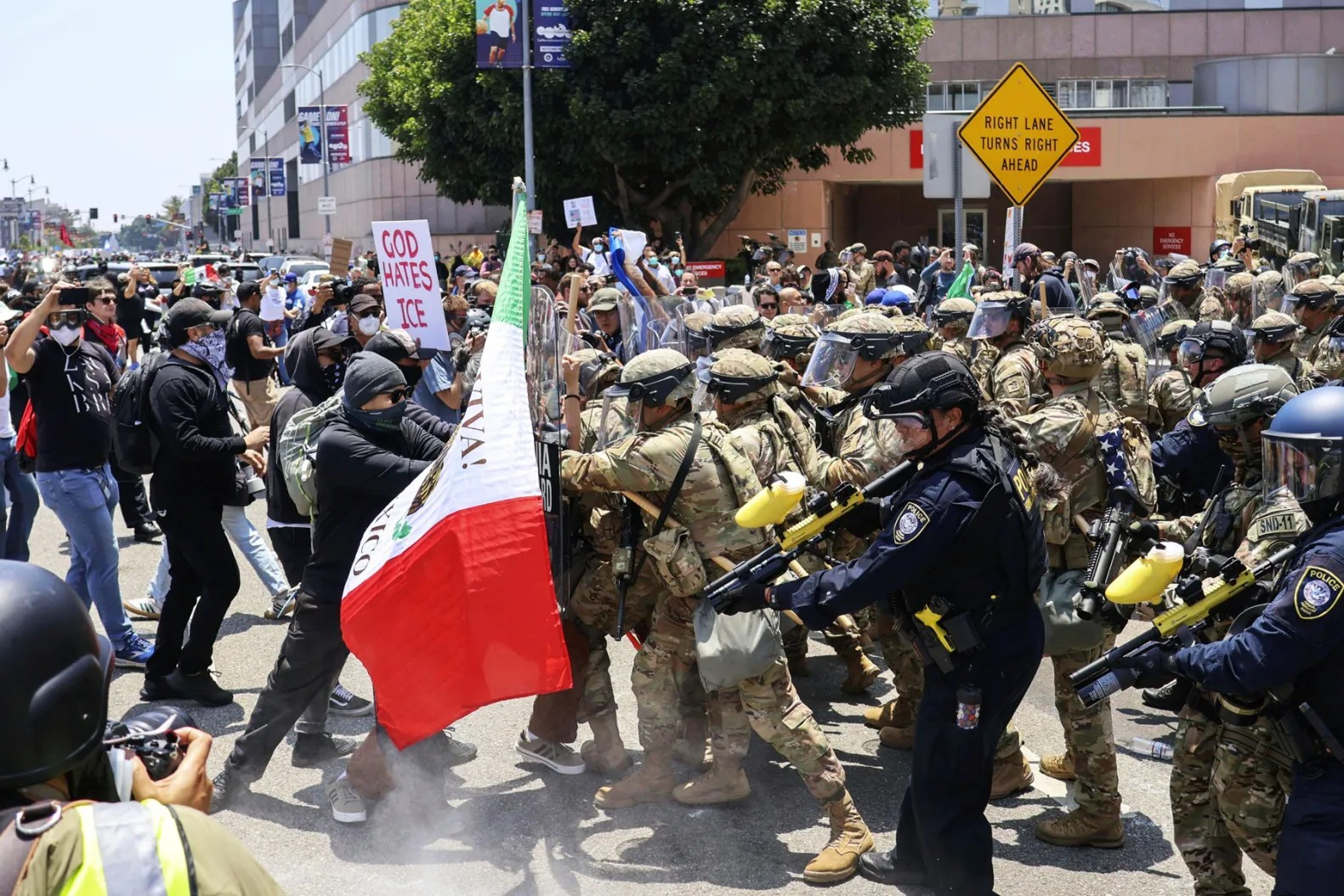
One of the central reasons the US Constitution was drafted to replace the Articles of Confederation was to address the federal government’s inability to respond effectively to internal unrest and maintain order—most notably demonstrated by Shays’ Rebellion in 1786–87. Under the Articles, the government lacked the power to enforce laws domestically. This exposed a fatal flaw: central authority was too weak to preserve domestic peace, enforce federal law, or suppress insurrection—all essential functions of a sovereign state.
The urgent need for a more effective national structure is what led to the Constitutional Convention of 1787, held in Philadelphia, Pennsylvania. Figures like Alexander Hamilton, James Madison, and George Washington advocated a stronger federal government precisely to “ensure domestic tranquility,” as declared in the Constitution’s Preamble. Article I, Section 8 grants Congress the authority to call forth the militia to suppress insurrections, and the Insurrection Act of 1792 further codifies the power of the federal government to use military force to respond to domestic uprisings. (See my recent essay Quelling the Rebellion.)
After the Constitutional Convention, a woman asked Benjamin Franklin what kind of government the delegates had created. He famously replied: “A republic, if you can keep it.” Keeping the republic demands civic responsibility from the citizens and defense of the nation from threats external and internal.
Today, we are witnessing what amounts to an insurrection both in the common understanding of armed rebellion and in the deliberate obstruction of federal authority. Deliberate obstruction is not often thought of as insurrection, but when city and state governments declare themselves “sanctuary jurisdictions,” refusing to cooperate with federal immigration authorities and shielding individuals who are in the country unlawfully, they are not simply offering moral dissent—they are actively nullifying federal law. This undermines the rule of law, compromises national sovereignty, and constitutes a constitutional crisis. The Democratic Party today is not only fomenting rebellion—several of its leaders are actively engaged in insurrection. We may accurately describe Democrats as neo-confederates.
In a way, the appeal to states’ rights is in the DNA of the Democratic Party, and today, just as in the past, Democrats make this appeal to protect the split-labor market and advance globalization. The labor of undocumented migrants in today’s US economy, for example in sectors like California’s agricultural industry, bears striking similarities to the forced labor of enslaved people in the antebellum South. While the contexts differ—most notably that migrants often come voluntarily, while enslaved Africans were forcibly taken (which is why it made no sense to deport them)—the economic function they serve within a capitalist system reveals a persistent pattern. Both systems rely on a subordinated labor class, stripped of full legal protections, to maximize profits for those who own the means of production.
In both historical and contemporary cases, the subordinate labor force performs the physically demanding, low wage (or in slavery’s case, unpaid) work that others “refuse to do”: picking strawberries or cotton, cleaning houses, caring for children, maintaining landscapes, and performing other undervalued agricultural and domestic labor. Their marginalized legal status—slaves as property with no rights, migrants working without documentation or secure legal standing—renders them exploitable and keeps wages suppressed. This dynamic ensures that a vast amount of essential labor remains cheap and excluded from the full protections of labor law.
This continuity reveals how capitalism, particularly in its most exploitative forms, depends on a tiered labor structure—where the most vulnerable perform the hardest work under the harshest conditions. While the systems of slavery and migrant labor are not identical, they are linked by their function: to create and maintain a workforce that exists outside the full boundaries of economic and legal inclusion, thus allowing capital to extract maximum value at minimum cost. The legacy of slavery haunts the fields and homes of today’s economy, a structural echo that continues to shape who labors, under what conditions, and for whose benefit.
Moreover, in both slavery and the exploitation of undocumented migrant labor, the presence of a hyper-exploited labor class exerts downward pressure on wages and working conditions for other workers, particularly those at the lower end of the labor market. This happens because employers use the availability of cheap labor to avoid paying higher wages or offering better conditions to native-born or legally protected workers. The very existence of a labor pool willing (or forced) to work under extreme conditions drives down wages, undermines collective bargaining, and weakens labor solidarity. The split-labor market is not only an economic strategy but a political tactic.
During slavery, free white laborers in the South often found themselves unable to compete with slave labor, which distorted local labor markets and contributed to long-standing divisions in the American working class. In the modern context, illegal aliens play a similar role. Migrants, often unable to report abuses or demand fair wages due to the threat of deportation, provide a convenient tool for employers to resist unionization, sidestep regulations, and fragment worker power. Thus, both systems not only provide cheap labor to capital, but also work to discipline and weaken the broader labor force by creating a class of workers who could be paid less, treated worse, and used as leverage against demands for better wages and conditions from others. This is a structural feature, not a side effect, of these labor regimes. The Democratic Party exists to maintain this political economic structure.
So we have faced this kind of internal crisis before. At its core, the Civil War was a confrontation over the limits of federal authority and the right of states to defy national laws. Southern Democrats sought to preserve their way of life, which depended on slavery, claiming the right to nullify federal mandates and ultimately to secede from the Union, insisting that their local sovereignty took precedence over the Constitution’s national framework. President Lincoln rejected that claim unequivocally, asserting that the Union was perpetual and that rebellion against federal authority was not merely dissent, but insurrection. The war was fought not just over slavery, but over the very idea of a unified, sovereign nation bound by a common Constitution.

Today’s sanctuary policies and defiance of federal immigration law echo those same dangerous arguments for selective obedience to national authority—and for a similar reason: to preserve a way of life that depends on cheap labor. The question, “Who will pick the cotton?” has its parallel in the question, “Who will pick the strawberries?” Democrats say this unflinchingly, believing that nobody will note the parallel. However, as in the 1860s, we are once again confronted with the question of whether the United States is a nation of laws—or a patchwork of jurisdictions that obey only the laws they like.
To understand the gravity of the current moment, it is useful to contrast today’s protests against immigration enforcement with those of an earlier era—specifically, the Vietnam War protests, which I mentioned earlier. These two movements differ fundamentally in both principle and consequence. The Vietnam-era demonstrations targeted US involvement in a foreign conflict. While they were emotionally charged and politically polarizing, their effect—even if they helped bring about withdrawal from Vietnam—did not threaten the structural coherence of the American state. On the contrary, ending an unpopular and morally ambiguous war could be seen as reaffirming American values. I accompanied my parents to these protests—and my son accompanied me when I protested the Second Gulf War.

Today’s protests are of an entirely different nature. They target the internal operations of the state—most critically, the nation’s ability to regulate its borders and control who enters or resides within its territory. The protests are not just about immigration policy; it’s about national self-determination and the fundamental capacity of the United States to exercise sovereignty. If the government capitulates to demands that undermine or nullify immigration laws, it risks eroding the very framework that allows the state to govern at all. With that framework go all our immunities and privileges.
Both eras of protest faced accusations of foreign influence. During the Cold War, some charged that antiwar protestors were tools of communist regimes like the Soviet Union or North Vietnam. Today, protest movements—against immigration control, Israel’s actions in Gaza, etc.—are supported by foreign NGOs, international advocacy networks, and philanthropic organizations with globalist leanings that benefit from lax immigration enforcement. Whether or not these claims are exaggerated (and they aren’t in the case of the current protests), the key distinction lies in consequence—even if both movements stem from deeply held convictions, the outcome of today’s immigration protests carries existential weight: weakening the republic’s ability to enforce immigration laws amounts to weakening the republic itself.
One of the explicit goals of the current resistance to immigration enforcement is to raise the cost of federal action by creating zones of defiance where the government’s laws are openly ignored or obstructed. For example, the mayor of Los Angeles, Karen Bass, has stated bluntly that violent resistance against federal government’s actions will stop when the federal government stops enforcing the law in her city. This is a direct threat from a state official against the federal government—a challenge that uses the threat of escalating civil unrest and violence to deter lawful federal activity.
Such defiance echoes the rhetoric and spirit of neoconfederate arguments, which champion local or state sovereignty over national unity and federal law. Mayor Bass and Governor Gavin Newsom’s stances assert regional power in opposition to constitutional authority. This politicization of law enforcement by Democrats not only undermines the rule of law but fuels a constitutional crisis by encouraging the selective obedience of laws based on partisan or ideological preferences.
This is why the role of the US military—particularly its domestic presence—remains essential in keeping domestic order and suppressing insurrection. Critics of the military used in this way tell the public to worry about the militarization of American society and the erosion of civil liberties. The reason for this is not due to any real concern for the deployment of the military domestically. It’s rhetoric designed to generate public opposition to the federal governments duty to “ensure domestic tranquility.” Democrats don’t believe in the Constitution and they want the public to forget why the Constitution was established and the scope of its authority.
Expect to hear at some point about the Posse Comitatus Act, passed in 1878, a federal law that prohibits the use of the US Army to execute domestic laws unless expressly authorized by the Constitution or an act of Congress. Here’s the kicker: the law was enacted in the aftermath of Reconstruction, as Southern states pushed back against the continued use of federal troops in civilian governance. Democrats sought to draw a sharp line between military power and civil law enforcement for the sake of Redemption, i.e., reinstalling white supremacy as the normal order of things. As long as the federal government, including the military, was deeply involved in enforcing new civil rights laws and maintaining order in the South, Democrats could not reconstitute the racist system they had developed during the antebellum period. Federal troops were stationed throughout the region to protect newly freed blacks and to uphold the authority of the federal government against hostile local governments and terrorist groups like the Ku Klux Klan. Simply put, Posse Comitatus sought to make federal action difficult.
I want to be very clear about this: it was the same states’ right sentiment that led the Civil War that also produced federal law limiting the use of the military in the suppression of insurrection and rebellions. White Southerners fiercely resisted federal military presence, viewing it as an occupation and an infringement on states’ rights and local control. They sought to prevent the federal military from being used to enforce laws domestically, especially in the South, where many wanted to reassert local control without interference from the federal government. But the Constitution is the supreme law of the land. The Articles of Confederation were superseded by the Constitution.
Wouldn’t deploying the military against civilians be dangerous? Any act of force comes with risks. Deploying the police against civilians is dangerous. But consider a counterintuitive yet important argument from civil libertarian journalist Radley Balko, a fierce critic of police militarization. (I am a fierce critic of police militarization, as well. I lecture on this problem in my criminal justice courses, and I have in the past assigned Balko’s book The Warrior Cop to my students.) However, Balko argues that soldiers—particularly combat veterans—often make better law enforcement officers than traditional police. His reasoning is grounded not in a call for more militarization, but in the cultural and training differences between the two institutions.
Military personnel are trained under strict rules of engagement, a clear chain of command, and a heavy emphasis on restraint and de-escalation. They are conditioned to distinguish between civilians and combatants, often in hostile environments, while maintaining discipline under pressure. In contrast, many police departments have adopted the superficial aesthetics of militarization—armored vehicles, tactical gear—without the corresponding training in accountability, discipline, and judgment.
Balko contends that combat veterans are often less prone to panic, more likely to remain composed under stress, and more respectful of civilian lives and rights. They understand the seriousness of force and the importance of mission clarity. Many see their service as a form of public stewardship, not power projection. This is not an argument for expanding military authority or blending it with policing. Rather, it is a call to recognize that constitutionally grounded, lawful, and restrained enforcement of the law—especially in response to domestic threats—requires personnel who are serious about the Constitution, not just about control. In the current situation, deployment of the military is appropriate.
This next piece is crucial (and this is why Kent State is such a bad analogy). Normally, civilians are protected under the laws of domestic governance and the principles of criminal justice. However, when a group rises in armed rebellion against the state (and arms are not just guns and grenades), those actively participating in the insurrection effectively assume the role of combatants opposing lawful authority. Under US law, insurrectionists can be treated as unlawful combatants or rebels because they are using force to resist or overthrow the government. This designation removes the usual civilian protections and justifies a military or law enforcement response to suppress the rebellion. This does not mean all citizens in a protesting population automatically become combatants—only those who engage in violence or armed resistance do.
The oath sworn by members of the US military is not merely ceremonial—it is a solemn vow to “support and defend the Constitution of the United States against all enemies, foreign and domestic.” This reflects a foundational commitment to lawful authority and constitutional governance. Soldiers are bound not to ideology, individual leaders, or party, but to the enduring principles enshrined in the Constitution. That oath demands a response to domestic threats to the republic, and it implicates not only individuals rioting in the streets, but also political leaders who institutionalize defiance of federal law.
Importantly, the government retains the authority to distinguish between lawful protestors exercising their First Amendment rights and those who cross the line into insurrectionary acts—such as attempts to nullify federal authority, obstruction of law enforcement, and violence. This distinction is critical to maintaining constitutional order and ensuring that force is used judiciously and lawfully. The military are particularly suited for such situations. This is why the Constitution was established and why Article I and Article II give Congress and the President the power to call in the military to quash rebellion.
Trump’s actions are a response not merely to unrest and rioting, but by civilians engaged in rebellion and the deliberate refusal by California authorities to enforce federal law—particularly around immigration and public order. Rather than a failure or lapse in governance, the inaction of local officials reflects an ideological alignment with the protesters and a broader resistance to federal immigration enforcement, including efforts to prevent the deportation of illegal aliens (see The Resistance™ and Transnationalism). In this context, Trump’s deployment of federal agents is positioned as a necessary assertion of federal authority in the face of open defiance.
But get ready for it. Regardless of intent, progressives will frame Trump’s moves as authoritarian, using the presence of federal force as visual and political ammunition to support that narrative. Patriots will have to resist the emotional pull of the progressive framing. Suppressing an insurrection is always ugly. But if the ugliness of military action keeps the people from acting to preserve the republic, then the progressives will win, and America will fall. This is what progressives want. The Vietnam War protests were about making America a better nation. The rebellion in our streets today and the resistance by members of the Democratic Party are about making America go away. Thus, it behooves us to remember Franklin’s words and act with the force of conviction.

 freedom and reason