
In Los Angeles and across the country (Chicago, Denver, New York, and Seattle), anti-American sovereign agitators have taken to the streets to block Immigration and Customs Enforcement (ICE) actions—surrounding federal facilities, physically obstructing agents and interfering with detainment efforts, erecting barricades, throwing rocks, and setting fires—to stop the removal of illegal aliens.
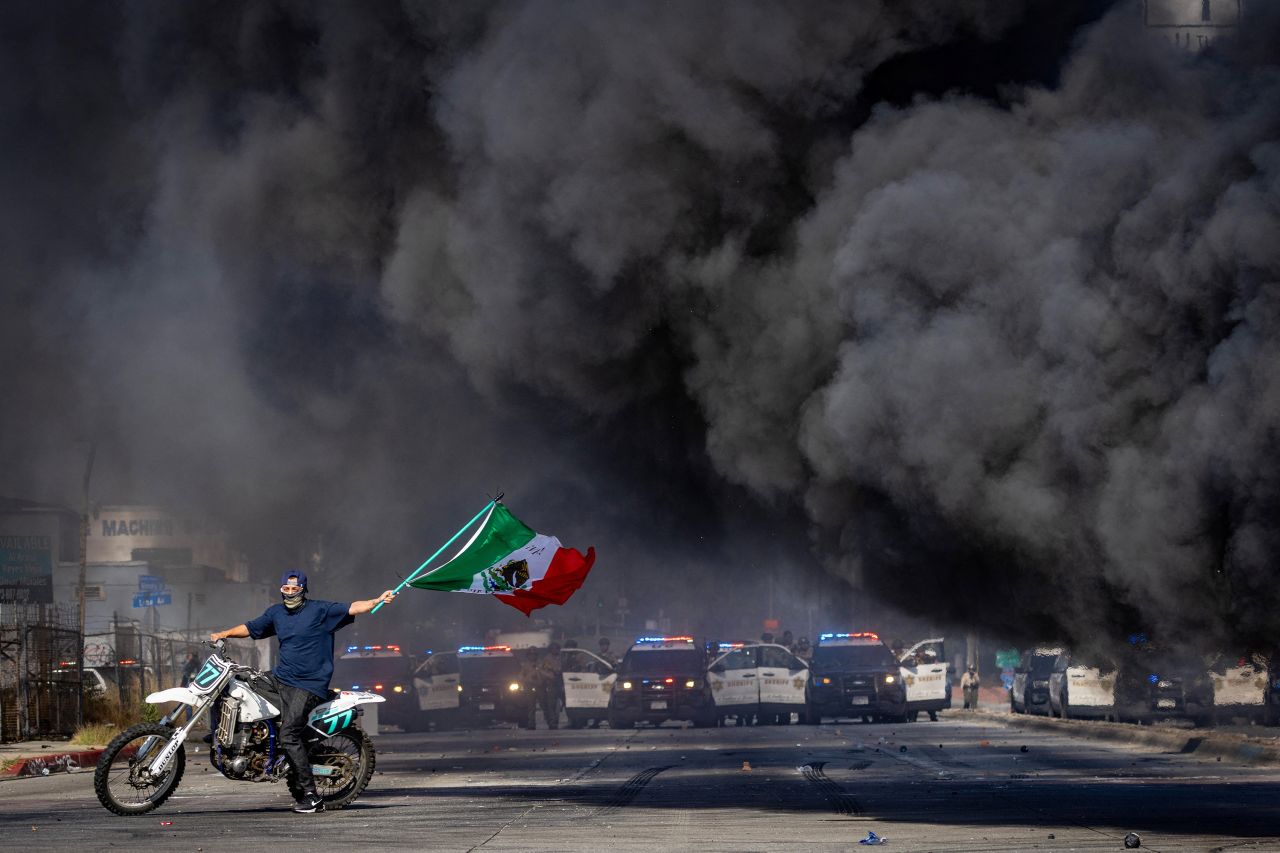
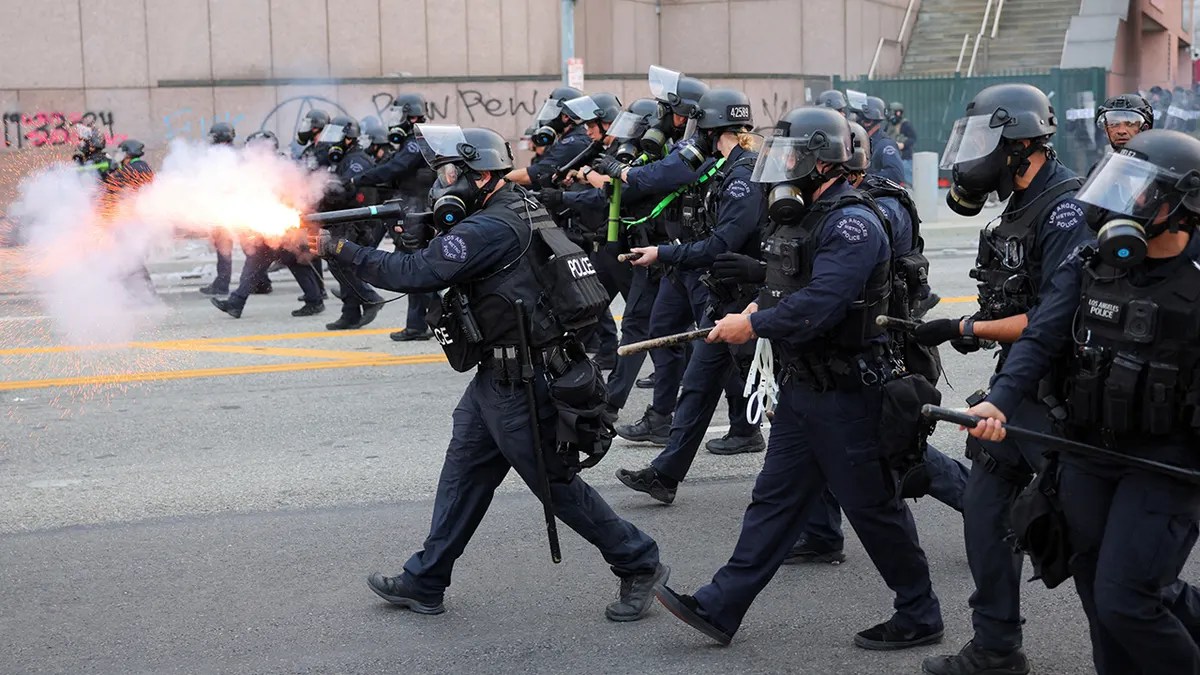
Federal agents have responded with riot police tactics—flash-bangs, rubber bullets, and tear gas—and made dozens of arrests. Officials have rightly labeled the actions of demonstrators as a rebellion against lawful authority. President Trump has deployed National Guard troops under federal Title 10 authority to support ICE operations. Federal officials warned that anyone assaulting officers or obstructing enforcement would face prosecution. The Department of Homeland Security has confirmed that it’s tracking organized efforts on social media and through activist networks.
California’s Democratic governor Gavin Newsom and Los Angeles’ mayor Karen Bass have criticized the raids as sowing chaos and terror in immigrant communities. However, rebellion and insurrection are not permitted under the Constitution—nor is the failure or refusal of state authorities to act in accordance with federal law. Newsom and Bass have failed to follow the law. They’ve made themselves obstacles to the popular will. Worse, they’re encouraging the anti-American sovereignty movement.
As a civil libertarian and Constitutionalist, I value both individual freedom and the legal framework that preserves it. The US Constitution is not merely a historical document; it’s a system of government designed to outlast the passions of any single generation. In this essay, I explain Article II powers with respect to the current uprising by anti-American forces. I also clarify the concept of insurrection.
Is there a right to use violence in the pursuit of justice—even to overthrow a government? It depends. The righteousness of revolution is situational, and enforcement of America’s immigration laws is not a situation that justifies rebellion. Moreover, there is no right to expect that because one believes he has a righteous cause that the government shouldn’t intervene to stop him from breaking the law. Call it civil disobedience if you wish; civil disobedience comes with consequences.
A constitutional republic embeds structural safeguards against both centralized despotism and mob rule. The Founders, notably James Madison, designed a system that checks impulses for abrupt upheaval through deliberative processes, enumerated powers, and judicial review (the latter presuming the judiciary respects Article I and Article II powers).
It is in this context that we understand the federal government’s role in preserving a well-ordered society—particularly through Article II powers that allow the President to use force, including federalizing the National Guard, and even to use other branches of the military, to suppress insurrection and rebellion. These powers are not arbitrary; they are constrained and defined by the Constitution and statutory law to uphold the rule of law in moments when it is most at risk. Open defiance of federal agents engaged in law enforcement tells us that we reached this point.
Article II, Section 3 of the Constitution obligates the President to “take Care that the Laws be faithfully executed.” This clause, in combination with the role of the President as Commander-in-Chief under Article II, Section 2, provides the constitutional foundation for the federal executive to use military force, including federalizing the National Guard, to ensure the enforcement of federal laws and maintain civil order.
Article I, Section 8, Clauses 15–16: Gives Congress the power “to provide for calling forth the Militia to execute the Laws of the Union, suppress Insurrections and repel Invasions” and to provide for the organization and regulation of the militia, which supports the executive’s use of state militias (now the National Guard) under federal command. Article II, Section 2 states: “[The President] shall be Commander in Chief of the Army and Navy of the United States, and of the Militia of the several States, when called into the actual Service of the United States.” Trump has now called them into service.
The Insurrection Act of 1807 (10 USC §§ 251–255) is the primary statutory mechanism by which the President federalizes the National Guard or uses the Armed Forces domestically in response to insurrection, rebellion, or obstruction of federal law. Under 18 USC § 2383: “Whoever incites, sets on foot, assists, or engages in any rebellion or insurrection against the authority of the United States or the laws thereof, or gives aid or comfort thereto, shall be fined under this title or imprisoned not more than ten years, or both; and shall be incapable of holding any office under the United States.”
What is an insurrection? It’s a violent uprising against an authority or government, especially with the aim of overthrowing or obstructing lawful governance. The elements of insurrection are violence, involving physical acts such as attacking officials, obstructing law enforcement through force or intimidation, or rioting. Action must be directed against the authority of the United States or its laws—not just a protest, but an attempt to defy or dismantle legitimate governmental authority. It may involve organized groups or conspiracies to resist the execution of law. The present circumstances meet all the elements of insurrection.
I expect some will cite 10 USC. § 251, the “State Request” clause, to suggest that the President may only deploy troops when requested by a state legislature or governor if the state is unable to suppress an insurrection. Crucially, the President can federalize the National Guard short of an insurrection—and he doesn’t need the permission of legislature or governor. In 1957, Dwight D. Eisenhower federalized the Arkansas National Guard and deployed the 101st Airborne Division to Little Rock, Arkansas to enforce the desegregation of Central High School.
Eisenhower’s action came in response to Governor Orval Faubus’ defiance of the Supreme Court’s ruling in Brown v. Board of Education (1954), which declared racial segregation in public schools unconstitutional. Faubus had initially used the state’s National Guard to block the “Little Rock Nine” from entering the school. Citing his constitutional duty to ensure that federal law was faithfully executed, Eisenhower issued Executive Order 10730 to place the National Guard under federal control and restore order.
Eisenhower’s actions demonstrate the power of the federal government to act decisively to uphold the Constitution against resistance from state authorities. Trump is exercising the same authority. This power is clearly spelled out in the 10 USC § 252, “Enforcement of Federal Law” clause: “Whenever the President considers that unlawful obstructions, combinations, or assemblages, or rebellion against the authority of the United States, make it impracticable to enforce the laws of the United States in any State by the ordinary course of judicial proceedings, he may call into Federal service such of the militia of any State, and use such of the armed forces, as he considers necessary to enforce those laws or to suppress the rebellion.” Moreover, 10 USC § 253 states that the President may act without a request from a state if insurrection or domestic violence deprives any portion of the population of constitutional rights, and the state fails to protect those rights.
While civil libertarians are rightly skeptical of federal overreach, the Constitution recognizes that liberty requires order and that lawful force may, at times, be necessary to preserve constitutional government. The Insurrection Act is not a license for executive despotism; it is a tool of last resort, designed to preserve the civil and constitutional fabric of the nation. We are at the moment of last resort. If the rebellion is not quelled, it will only grow larger and more aggressive. Trump must intervene with military force.
What explains the violence of the anti-American sovereignty movement? Like a spoiled child, the left lashes out when it doesn’t get its way. The left lost the 2024 election in part because Americans want immigration control. Surveys by Gallup, Pew Research, and Rasmussen Reports over the past decade show that most Americans support strengthening border security, including the use of physical barriers and increased funding for enforcement agencies. There is strong bipartisan support for prioritizing deportation of illegal aliens who commit crimes. Most Americans oppose cities or states that obstruct federal immigration enforcement. They do not support open borders or the suspension of deportation. In other words, the left is out of step with the populace. So the left is attempting to achieve through violence what it failed to achieve at the ballot box: continuing the policy of open borders.
As I have explained, this is an odd position for the left to take in light of the pretense that those participating in the rebellion support the working class. The ongoing protests against the deportation of illegal aliens function to serve the interests of transnational corporations that benefit from open borders and mass migration. These corporations rely on a steady supply of cheap, easily exploitable labor to suppress wages and displace native-born workers, a strategy that aligns with their offshoring of manufacturing to low-wage countries.
It is deeply ironic that the political left—traditionally aligned with labor—now mobilizes to protect mechanisms that erode the bargaining power, job security, and standard of living of American workers. This movement is not grassroots activism; it is a coordinated effort by powerful elites and ideologically driven NGOs who seek to dissolve national boundaries for economic and political gain. What we are witnessing is not the will of the people, but an attempt to establish a tyranny of the minority—a campaign led by wealthy individuals and a vocal cadre of activists trained in anti-American, post-national ideologies, working to undermine lawful governance and national cohesion under the guise of humanitarianism.
Crucially, the protests and violence are not only over immigration. Trans activist factions have mobilized aggressively, often targeting public institutions and private businesses they view as complicit in policies they oppose. The vandalism of companies like Tesla reflects a growing hostility among ostensibly anti-corporate radicals toward high-profile entrepreneurs; in reality it targets those aligning with politically disfavored figures and movement, i.e., populists and the America First campaign. The pro-Palestine agenda demands an end to US support for Israel, calling for a ceasefire in Gaza, advocating for what they describe as Palestinian liberation, often framed in terms that reject the legitimacy of the Israeli state.
These disparate movements are unified more by a shared opposition to America—and more broadly the West—than by a cohesive policy vision, which makes them useful towards transnationalist ends seeking to use confrontation and disruption as a means of forcing political and social change outside the democratic process. The disordered personalities on the street are pawns of globalists busy dismantling the international system and replacing it with world government under the thumb of transnational corporate power.
I also expect—and have seen as much on social media—those defending insurrection to raise the matter of the January 6, 2021 Capitol riots. One might ask for consistency from the left, but this presumes that January 6 was an insurrection. From a civil libertarian and constitutionalist perspective, there is a credible argument that what occurred at the Capitol is more accurately described a police riot—an event in which law enforcement provoked, escalated, and mishandled a political protest to such a degree that they bear primary responsibility for the breakdown of order and the violence that ensued.
I have written about this before. The evidence I (and many others) have provided includes footage showing Capitol Police removing barricades, in some cases allowing protesters to move past checkpoints with minimal resistance. Rather than preparing for a large, publicly announced demonstration, law enforcement appeared under-resourced and disorganized—this despite the Trump Administration’s request for the presence of more law enforcement and National Guard troops (which was denied). Crucially, protesters were met with force—flash-bangs and chemical agents—before engaging in any physical confrontation.
Presuming that January 6 was an insurrection, one might point to the disparate treatment of political protests. During the 2020 BLM uprising, rebels were treated to a soft prosecutorial approach by local authorities. In contrast, January 6 defendants faced unprecedented federal charges and prolonged pretrial detention. Selective enforcement was based on political beliefs, not individual conduct. Indeed, the BLM demonstrations come far closely to meeting the terms of insurrection than the January 6 riot. In fact, none of the January 6 protestors were charged with insurrection.
To be sure, labeling January 6 as a police riot does not absolve individual lawbreakers of accountability. Rather it calls into question the integrity of the state’s response. For those committed to upholding the Constitution and civil liberties, it raises a crucial question: was January 6 a rebellion by citizens—or a moment when the state exploited chaos to expand its power? The question of whether what is unfolding on the streets of America today is a rebellion or a police riot is easily answered: this is an insurrection. The federal government needs to crush the anti-American sovereignty movement.
When Orval Faubus refused to allow nine black students from entering a high school in Little Rock, Arkansas, President Dwight D Eisenhower federalized the National Guard to ensure that those students could enter the building. If I’d been alive in 1957 I would’ve been 100 percent on the side of Eisenhower. We cannot allow states to defy the Constitution and the rule of law. Trump needs to be far more aggressive in confronting the governor of California and the mayor of Los Angeles. They are entirely out of line.
We’re seeing is a rebellion against the United States. Trump needs to sign an executive order asserting the Insurrection Act and send the National Guard in full force into California. I wouldn’t rule out sending other military as well— as did Eisenhower, for the record. We cannot continue this way. The Democrats are driving us towards another civil war. Nip it in the bud. Trump should’ve done more in 2020. He’s far too patient. He needs to fully assert his Article II powers. Now. Big league.

 freedom and reason