
Pride Month is here. I see on the news that the City of Green Bay kicked off the affair with a community-wide celebration on Sunday, featuring a Progress Pride flag-raising ceremony and a resource fair at Leicht Park in Downtown Green Bay. I have criticized the city in the past for raising the flag above City Hall, which should be reserved for the US and state flags (City of Green Bay Violates the First Amendment). I haven’t been out and about today so I don’t know whether it’s flying there now. But it is flying at Leicht Park, which is public grounds.
“As some of you might know, when I was elected, our score on the Municipal Equality Index, which is something that the Human Rights Campaign put together, was a lowly 28,” Mayor Eric Genrich told the crowd gathered in Leicht Park. “Now we are very proud to say that we have a 100. A perfect score for the City of Green Bay.” The Human Rights Campaign (HRC) is the largest and one of the most influential LGBTQ+ advocacy organizations in the United States. Founded in 1980, its stated mission is to promote and protect the civil rights of lesbian, gay, bisexual, transgender, and queer people through education, litigation, lobbying, and public campaigns. Why is the mayor obsessed with getting a perfect score from an organization that has harmed so many people in the United States?
Green Bay Common Council Member Joey Prestley said at Leicht Park that it’s important to him to have a city that is supportive of the community and all its members. “The next thing I want to do, I want to see our city ban conversion therapy,” told a local reporter. “If Ryan (Spaude) and Amaad (Rivera-Wagner) can’t get it done at the state level, we’re going to do it here!” To be sure, conversion therapy is wrong with respect to gays and lesbians, since homosexuality is a natural thing; but it’s an odd demand with respect to trans-identifying individuals given that gender affirming care (GAC) is conversion therapy. Presumably Prestley was lumping gays and lesbians in with trans-identifying persons. After all, he did say all members.
Those who know me know that I have for decades supported the gay and lesbian struggle for equal rights (my whole life, in fact), even if I don’t partake in the symbology of the moment. Frankly, I’m not a fan of taking pride in immutable characteristics, though that’s separate from recognizing the legitimacy of the struggle (largely won at this point). “Black pride” is as objectionable as “white pride.” Both smack of racism. That said, I want to use the moment of Pride to underscore my support for gays and lesbians and my opposition to gender ideology. In other words, the “T” does not belong with the first three letters of the LGBT acronym.
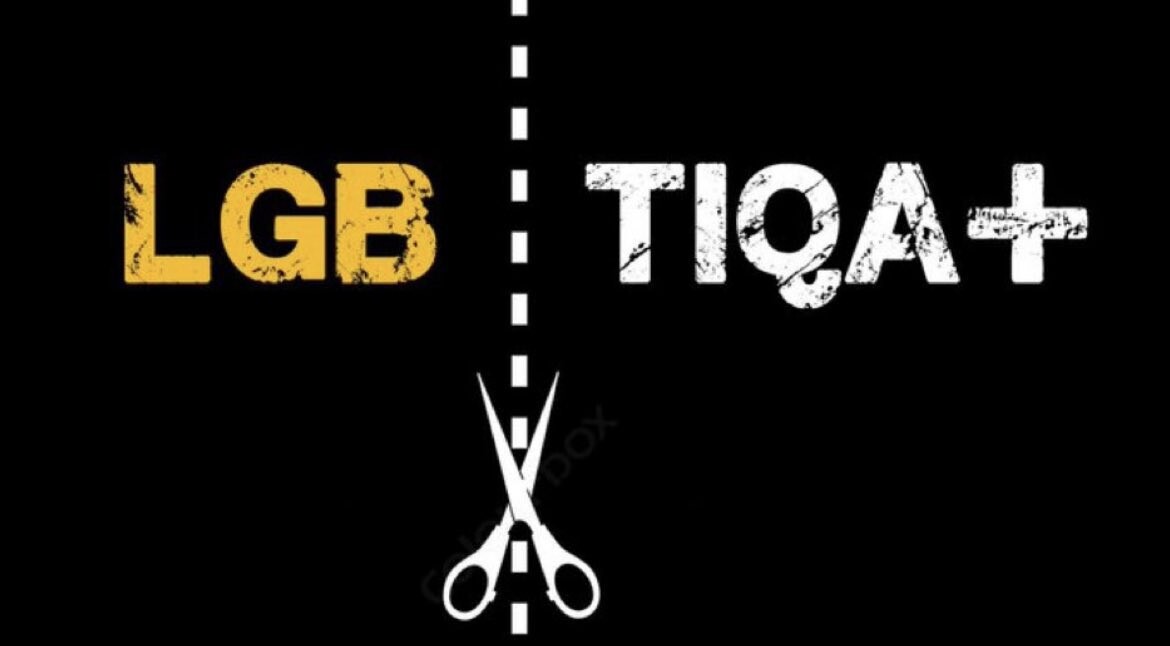
First, on the matter of affinity, a video currently circulating on social media draws an analogy between the LGBT movement and the black civil rights movement. The comparison is apt when it comes to gay and lesbian equality. Both movements confront systems that irrationally deny equal citizenship based on immutable traits. Just as there is natural variation in phenotypic traits, same-sex attraction is a naturally occurring feature of our species—and of many other species as well. However, the push to put access to gender-specific opportunities and spaces, as well as access to medical care, under the banners of “equality” and “justice” is not analogous to the gay and lesbian civil rights struggle.
In the cases of gay rights and racial equality, the injustice lies in the enforcement of second-class status through legal and social mechanisms—such as segregation, denial of marriage rights, lack of employment protections, or social exclusion. “Separate but equal” fails in these cases because there are no countervailing group rights being infringed. Heterosexuals and white individuals are not harmed by the inclusion of gays or black Americans in public spaces or institutions. Today, the United States highly recognizes interracial and same-sex marriages acknowledging that there is no coherent moral or rational basis to treat gay and lesbian individuals as lesser citizens. Sexual orientation, like race—that is, the natural clustering of phenotypic traits—bears no rational relation to principles of group rights or equitable treatment. The pursuit of legal and social parity for homosexual individuals is a direct extension of the universalist ideals that animated the civil rights movement. Members of both groups should be treated as individuals, not as representatives of identity groups.
However, this analogy breaks down when applied to trans-identifying individuals. Unlike sexual orientation or race, gender identity is not an immutable, biologically rooted trait. Rather, it asserts a subjective sense of self that may conflict with the material realities of sexed bodies. This is a fundamental and qualitative difference. While males and females exhibit overlapping distributions across many traits—such as empathy, intelligence, and physical strength—certain sex-based differences are both statistically significant and biologically meaningful. These differences are not merely matters of degree; they reflect sexual dimorphism, which produces distinct physiological and psychological profiles between the sexes. Male and female are not simply two points on a spectrum but qualitatively distinct and exclusive biological categories. This typological distinction has important implications: in contexts where physical safety, fairness, or privacy are relevant—such as sports, prisons, or bathrooms—these differences matter.
If scientific truth is to be the basis for law and policy, this must be acknowledged. Objective criteria, not ideological or subjective self-conceptions, must guide the governance of sex-segregated spaces. Because biological sex remains relevant in various legal, medical, and social contexts, the pursuit of gender equity requires differential treatment between the sexes—not the erasure of sex altogether. Equity, in this framework, does not mean erasing gender distinctions, but rather acknowledging them to ensure fairness and safety in areas such as healthcare, privacy, and sports. Therefore, while gay and black civil rights movements rightly call for removal of irrational barriers to full inclusion, the transgender demand for the same raises distinct philosophical and policy questions that cannot be resolved by appeals to sameness. This distinction and standards derived therefrom are being elided across the United States, as seen, for example, in the encroachment of boys and men on opportunities and spaces reserved for women.
The trespass of males on female spaces is a major reason for Pride fatigue. What is Pride fatigue? The month is young, but if it feels like Pride Month 2025 is more subdued compared to previous years, your feelings are not betraying you. Broader cultural, economic, and political dynamics are influencing how Pride is celebrated and supported across the US. There is a noticeable retreat of corporate sponsorships. Major events like San Francisco Pride have experienced substantial funding losses, with companies such as Anheuser-Busch, Comcast, and Diageo withdrawing support. This trend isn’t isolated to San Francisco (though most surprising there). There is national pattern of reduced corporate backing for Pride events. Nationally, a Axios survey revealed that nearly forty percent of companies planned to scale back Pride-related engagement in 2025—with none intending to increase it. Because corporations support Pride for business reasons, the rollback of spending on the month indicates a general awareness of fatigue.
Pride fatigue is not merely a consequence of antipathy towards gays and lesbians among the general population. Really it is more the consequence of trans activists and various paraphilia normalization factions hijacking the gay and lesbian struggle to push their own agendas, agendas that works at cross-purposes with the struggle for equality in same-sex attraction, as well as the rights of women to expect gender segregation for opportunity, privacy, and safety. Many gay and lesbian individuals have voiced concern over the presence of overt kink and fetish displays at Pride events, especially when those events are promoted as family-friendly. While Pride began as a radical assertion of dignity and visibility in the face of oppression, some within the community feel that it has drifted toward exhibitionism that misrepresents the broader aims of the movement.
For the record, I first voiced concerns about this in the early 1990s. If gays and lesbians aimed to homosexuality as merely a sexual preference and not a perversion, why would they tolerate leather freaks and open sexual displays in front of children? That goes for Drag Queen Story Hour, as well. Trans activists and their allies tell us that this is a tired debate. They get angry over it the same way they get angry when you ask about Rachael Dolezal.
But the reality is that inclusion of paraphilias and sexualized displays in public celebrations reinforces harmful stereotypes about gay people as inherently deviant or hypersexual, undermining the decades-long effort to secure equal rights and social acceptance. Such imagery is incompatible with environments intended to be inclusive of families, and that it alienates potential allies—particularly those who support equal rights but are uncomfortable with the blending of adult sexual expression and child-oriented public space. It looks like grooming. This critique doesn’t deny the importance of sexual liberation in history but rather calls for context-appropriate boundaries, particularly when Pride is positioned as a civic, educational, or family-oriented event.

Finally, to return to the matter of conversion therapy, since gender is synonymous with sex, what is commonly called gender-affirming care (GAC) within the trans movement and medical establishment does not, in fact, affirm gender, but rather attempts to simulate it through medical intervention. Ranging from hormone treatments to surgeries, GAC attempts to reshape the body to conform to an internal subjective identity, making it a form of conversion therapy not an affirming practice. Trans advocates thus stand reality on its head when they label efforts to align gender identity with birth sex as conversion therapy. Genuine gender-affirming care would involve medical intervention to support an individual’s natural sexual development—such as treating a boy with insufficient androgen production to ensure typical male development—not interventions aimed at suppressing naturally occurring sex characteristics. The current practices of the medical industry with respect to gender dysphoria are
Using the opportunity of the Pride to raise awareness of the contradiction between homosexuality and gender identity and the harm the latter causes to children, women, and truth has become a necessity. The exploitation of Pride by transactivists to push for the same equality that gays and lesbians must be called out. While I do not like the rhetoric of allyship in this space, I feel compelled to advance the position many gays and lesbians have taken that “T” must be separated from the LGBT acronym in order to return to a politics of respectability, as well as prevent the harms of GAC, the actual practice of conversion therapy.

 freedom and reason