
I woke up today to a voicemail from the telephone number (920) 918-1710: “Resign, you racist fuck.” Since this is all the message, I am uncertain to what the caller was reacting. Obviously it was in reaction to something I had written, but what? Was it my defense of Israel’s war with clerical fascism that has caught civilians in Gaza in the crossfire and my criticism of the anti-Israel protests occurring across Europe and in the United States? Was it my defense of the principle of cultural integrity in the Westphalian system of sovereign nation-states organized around ethnicity, i.e., common history and shared language? I recently defended the right of the English, and by extension of Americans, Swedes, etc., to resist colonization by foreign cultures by restricting immigration and deporting illegal aliens. Or could it be my criticism of anti-white belief and practice prevailing in South Africa and my support for Trump’s policy of providing refuge for Afrikaners fleeing racial persecution?
I do know what it could not have been: any actual racism in my writing. I have on this platform carefully explained why the views I espouse are not racist (indeed they are anti-racist in any real meaning of that term). Racism, or racialism, in its strictest sense, is the belief that the human species can be divided into distinct phenotypic types that possess inherent differences in traits such as behavior, intelligence, and morality and that these differences justify the hierarchical ranking of groups as superior or inferior. On that definition, which is standard, conflating race with culture, ethnicity, nation, or religion is fallacious. Ironically, such conflation is itself an expression of racism, since it suggests that ethnicity and nation, etc., are the projection of racial differences.
Why do I say that this conflation is itself racist? Because the argument assumes that ethnic or national identities (really the same things in this argument) are fundamentally rooted in race—that is, that what defines a people or a nation is a set of inherent, biological characteristics rather than cultural, historical, or linguistic factors. By reducing ethnicity or nationality to racial essence, which one does by labeling the defense of nationalism “racist,” imports the core assumption of racism: that meaningful human groupings are defined by immutable biological traits. But opposition to the mass migration of black and brown people into Europe, for the vast majority of those seeking to preserve their cultures and nations, has nothing to do with the skin color of the new arrivals, but ethnic differences and the shared experience of stubborn refusal to assimilate with the culture of the host country.
Put another way, when so-called anti-racists label the preservation of ethnic or national identity as inherently racist, they reveal their own assumption that such identities are racial in nature. This is itself a racialist view, as it treats race as the underlying basis of culture or nationhood and erases the complex, non-biological foundations of those identities.
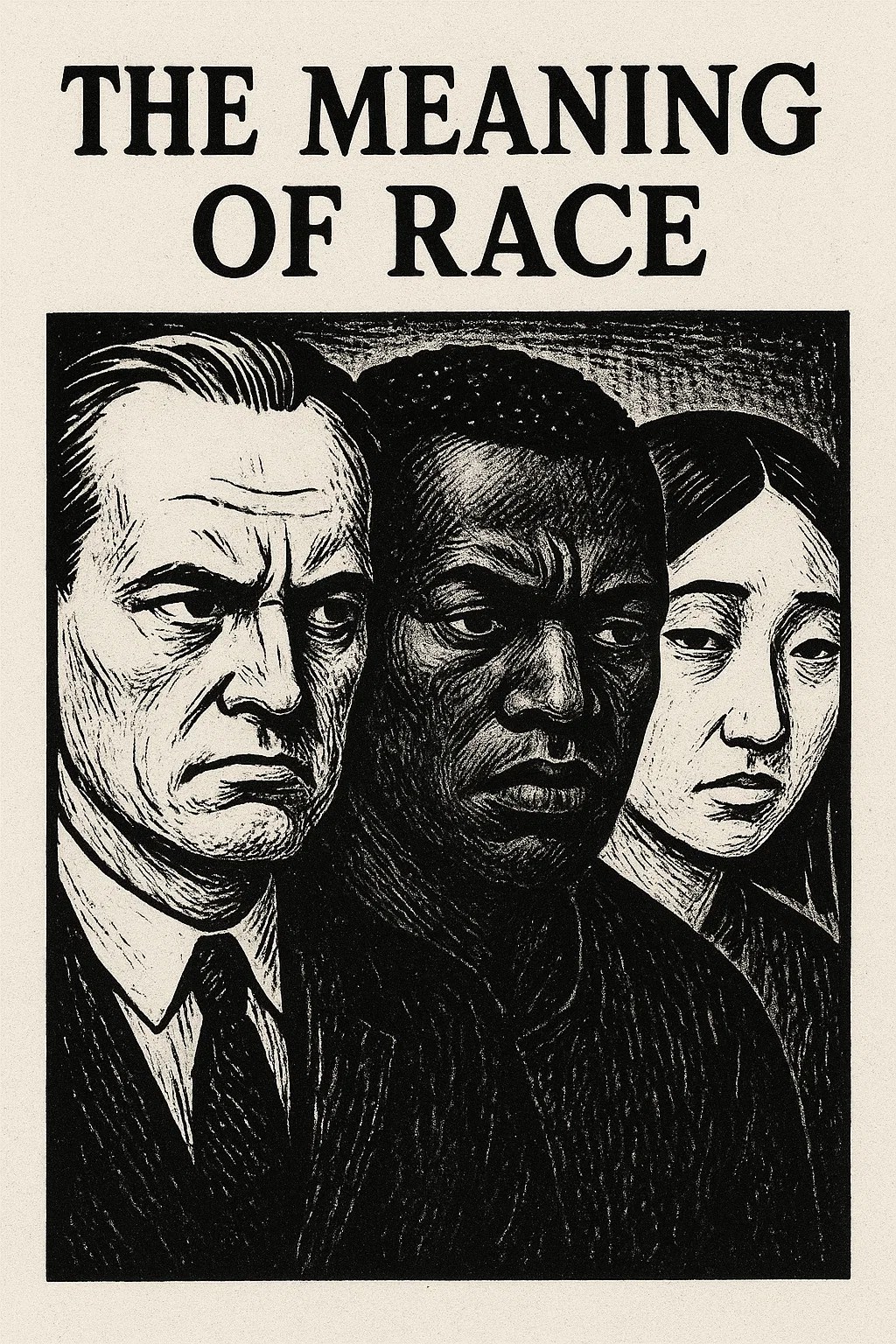
This is why I prefaced an October 2021 essay, Multiracialism Versus Multiculturalism, on the difference between multiracialism, which I see as the mark of a tolerant society, and multiculturalism, or cultural pluralism, which I have judged to be destructive to national integrity, with this observation: “Culture and race are not the same things. Culture refers to a social system of beliefs, ideas, norms, and values. Race refers to supposed genetic or otherwise essential variation in our species claimed to be meaningfully organized into types that exhibit concomitant variability in behavioral proclivity, cognitive capacity, and moral integrity. Culture is a real thing. Race is not.” (If I had written this today I would have said more precisely that the idea of race as constructed by racism is not real thing, since there is evidence that the large groupings humans have intuited for centuries as racial differences do have a basis in nature, but there is no evidence that race determines behavior, intelligence, or morality, or that there are superior and inferior races.)
I noted in that essay that extremists on both sides of the political-ideological spectrum conflate culture and race. I do not. I’m a humanist and individualist. I’m thus a universalist in that I work from a human rights standpoint in which all individuals, regardless of gender, race, religion, etc., are seen as entitled to the same regard, this because rights inhere in species-being. I am here drawing upon Marx’s concept of Gattungswesen, which captures the essential nature of human beings as conscious, creative, and social creatures who express themselves through purposeful, transformative labor and collective action more broadly. Put simple, we are all members of the same species and thus share a common nature, therefore we all have the same rights.
Unlike animals, Marx argues, humans do not merely react to their environment but actively shape it, and in doing so, realize their potential. This creative capacity is central to what it means to be human. Crucially, as social animals, humans do this through collective action. Under capitalism, Marx argues in his theory of alienation, workers become estranged from their species-being because their labor is no longer an expression of their humanity but a means of survival controlled by others. This suggests a solution: the abolition of social class and the de-alienation of species-being. But in the here and now, enlightened humans organize governments and national communities to protect the rights of all citizens with the understanding that not all collectivities share this understanding of human nature.
It’s a plain fact that not every group of humans possess a founding document that states plainly: “We hold these truths to be self-evident, that all men are created equal, that they are endowed by their Creator with certain unalienable Rights, that among these are Life, Liberty and the pursuit of Happiness.” The American Declaration of Independence from which that statement derives also asserts that “to secure these rights, Governments are instituted among Men, deriving their just powers from the consent of the governed.” Thus is established a republican form of government that makes possible a rule of law based on a recognition of human rights, as well as national borders that protect citizens from those who would undermine the principles for which such a government was instituted to protect and defend.
What of the Marxist project? The vision of a future world society in which people are no longer alienated from their labor and can freely develop their human capacities in cooperation with others, thus reclaiming their true nature as species-beings, may be, theoretically, a desirable thing (albeit it hasn’t worked out in practice). However, in a world where cultures and ideologies, particularly Islam, reject the basis of universal human rights, and reshape those societies to which they migrate, whether intentionally and unintentionally, such a world is unattainable for the foreseeable future. Therefore we must guard against the degradation of Western culture.
Keep in mind that, in 1990, the Organization of Islamic Cooperation (OIC) adopted the Cairo Declaration on Human Rights in Islam (CDHRI) as an alternative framework to the UN’s 1948 Universal Declaration of Human Rights, adopted in the aftermath of WWII. While the Cairo Declaration ostensibly affirms many human rights principles, it does so within an explicitly Islamic framework, stating that all rights and freedoms are subject to Sharia law. In other words, the position of the Muslim world is that universal human rights do not exist—until all peoples of the world are assumed by Islamic doctrine. There is a paradox here: Since Islam is a totalitarian doctrine, the moment everybody is subjected to it universal human rights are negated for everybody.
I have written extensively about this, but it might be helpful for readers if I summarize the meaning of race as constructed by racism, which is based on well-established history and scientific knowledge. The concept of race emerged prominently during European colonial expansion from the sixteenth century onward, when early pseudo-scientific theories were used to rationalize conquest, colonialism, and slavery. It was not the sole basis of rationalization, but it was a major part of it. In the eighteenth and nineteenth centuries, thinkers like Carl Linnaeus and later proponents of “scientific racism” such as Arthur de Gobineau and others attempted to codify these ideas into racial taxonomies, often placing white Europeans at the top.
The terms “racism” and “racialism” did not come into common usage until the early twentieth century, even though, as history records, the ideas and practices associated with them existed much earlier. The word “racialism” appears to have been used by English speakers by the late nineteenth century, often in a somewhat neutral or descriptive sense to refer to belief in racial distinctions. Prior to these terms being coined, the same hierarchical beliefs about human differences were described using other language—such as “race science,” “racial superiority/inferiority,” or simply ideas of civilization and barbarism tied to physical traits. So while the terminology is relatively modern, the underlying ideology has a much longer and deeply entrenched history.
It was not until the 1920s and 1930s that the more charged and politically significant term “racism” gained wider currency, particularly in response to the rise of Nazi ideology and other forms of race nationalism. Race nationalism is typically misdescribed as ethnonationalism, a term complicated by redundancy, in that ethnicity and nation are synonyms, if a nation is organized by common history and shared culture and language, as integral nation-state are. National socialism does more than this: it roots ethnic differences in race pseudoscience and segregates society on this basis. This is very different that the assimilationism of free nation-states, which demand that those who wish to become part of the citizenry adopt the culture of the host country in order to preserve the basis upon which individual liberty is sustained.
Racialist praxis and the Westphalian system of sovereign nation-states are in contradiction. So are the practices of colonialism, imperialism, and identity politics. History is messy, and so contradictions exist and persist. These ideologies became embedded in Western institutions and policies, influencing everything from slavery and segregation to apartheid and eugenics. Though modern genetics has discredited the biological basis of race, the legacy of this hierarchical framework continues to shape social structures and inequalities globally. However, one does not resolve the contradiction by promoting multiculturalism; instead one demands assimilation to Western Enlightenment values, which are superior, not because they emerge from white-majority European society, but because they are, in recognizing the objective fact of species-being, universal in character.
In a June 2019 essay, Race, Ethnicity, Religion, and the Problem of Conceptual Conflation and Inflation, I wrote the following: “That populations share genes with greater or lesser frequency is explained by a mundane fact: people tend to mate with people they live around. As a result, their offspring will generally look more like them than they will the parents of unrelated or less related offspring. The further apart the families, the more dissimilar the offspring will appear.” I noted further that, “even in migration, people tend to reproduce with those who look like the people from the places they left. Because of this, the appearance of so-called racial types enjoys stability over time and space. The same is true with language and dialect. People who live around each other will tend to sound like each other. They will also carry themselves similarly. And so on. But that does not mean they are a racial type.” I wrote these words to highlight the problem of conflation: people have come to confuse national integrity with racism. They are very different things.
I reference in that piece an earlier essay, also from June 2019, Kenan Malik: Assimilation, Multiculturalism, and Immigration, in which I discuss Malik’s 1996 book The Meaning of Race (1996), in which the author critically examines the historical and ideological development of the concept of race, arguing that it is not a fixed biological reality but a social and political construct shaped by modernity. Malik traces in much greater detail than I do above how scientific racism and colonial expansion contributed to the formation and entrenchment of racial categories. Malik explains that ideas of race evolved alongside changing conceptions of human difference, identity, and power, particularly in Western societies.
Across his work, Malik highlights the dangers of both racism and cultural relativism. Ultimately, The Meaning of Race calls for a humanist, universalist perspective to counter racial thinking and promote genuine equality. Malik does not argue for an end to nation-states, however. Readers will benefit from his arguments, which are not identical to mind, but which support the argument I am making with respect to the history and function of racism and the problem of multiculturalism.
I raise Malik’s work in the present essay because I find the above conversation between Kenan Malik and Coleman Hughes useful for understanding the cross-currents that threaten to disorganize Western society. One of those cross-currents is multiculturalism, which, while recognizing that people bring elements of their culture with them when they migrate—language, religion, traditions, and ways of life—think of these as, if you will, fixed packages that should be preserved rather seeing individuals as adaptive, and evolving as they interact with new environments.
Malik challenges the idea that migrants are simply “culture-bearers” in the sense of carrying a pure, unchanging tradition. He argues that treating migrants this way actually limits their agency. Instead of being seen as individuals who can reshape and question their own traditions—like anyone else—they’re boxed into representing a supposedly singular cultural identity. This perspective stifles integration and reinforce stereotypes rather than promotes freedom and individualism.
Thus, the problems of immigration and multiculturalism, both of which are championed by the progressive left, promote the importation of culture-bearers who are resistant to assimilation—and more than this, often mean to change the culture to which they immigrate—and domestic political forces that insist culture-bearers not integrate with the host country, decrying the demand that they do as racist, which, as I have established, is a fallacious deployment of that concept.
The effect of this is the Balkanization of the West, a development that sees the emergence of ethnic enclaves, the ghettoization of modern society, where cultural and religious rules are asserted over the universalist practice of the rule of law in which people are treated as individuals not as groups. This is the problem of identitarianism, and while versions of it appears on the left and right, it is leftwing identitarianism that has become the far more destructive force in the West.
One of the ways leftwing identitarianism proceeds is by conflating culture and race and haranguing those who don’t with accusations of racism.

 freedom and reason