
X users shared a graduation speech by NYU student Logan Rozos, who took his golden moment to declare a genocide in Gaza and condemn the state of Israeli. Here’s the speech:
I responded (both in the above comment and then in my own feed sharing the post): “It so brave to get up on stage and defend Nazi Germany while condemning the United States and the other countries trying to free the world from the grip of fascist tyranny and terrorism. Also, I just have to say, it’s heartening to see so many young Americans stand and applaud Nazism. I don’t know [if] it will save the Nazi project to exterminate the Jews, but here’s to trying. Good job Logan Rozos. History will always remember your bravery and eloquent defense of the project to free the region from the terrible presence of such an evil force.”
I had thought the point I was making was obvious, and it appears some people grasped it, but others did not, thinking I was claiming that Rozos supported the Nazis. I do need to remind myself periodically that not every adult progresses to the optimal level in childhood development. Some become stuck at an early phase. In Jean Piaget’s theory of cognitive development, children in the Preoperational Stage—which spans roughly from ages 2 to 7—typically take language literally and struggle to understand analogies and metaphors. During this stage, children are developing symbolic thinking but have not yet acquired the ability to perform logical operations and are thus typically incapable of abstract reasoning. As a result, they interpret words and ideas concretely rather than figuratively. Literal thinking is linked to egocentrism, which is when a person has difficulty seeing perspectives other than his own. It is only in the next stage, the Concrete Operational Stage (around ages 7 to 11), that children begin to grasp analogies and metaphors as they develop more logical thinking skills. There are X users who got stuck at the Preoperational Stage.
Rather than waste my time explaining an obvious analogy, other than remarking upon the arrested development of those who cannot grasp a simple analogy, I thought I would use this platform to explain the analogy, presuming there are others who don’t understand the moral point of it. Charitably, the reason why an X user might take what I said literally is because they have the moral equation inverted in their mind. This has rendered them so blind as to not grasp the point of the analogy. So I thought an essay might serve a more useful purpose.
Of course, many of them are not victims of arrested development. The power of egocentrism across the life-course, and the phenomenon of antisemitism rampant in Western culture, makes reasonably intelligent people dumb and incapable of proper moral reasoning. Much has been said about the morality of Israel’s response to the Hamas-led massacre of Israeli civilians on October, 2023, with some voices going so far as to liken Israel to the Nazis. This analogy is not only false but dangerously inverted. The accurate historical parallel lies in the opposite direction: Hamas, not Israel, represents the genocidal ideology of the Nazi regime, and in the historical parallel Israel stands in the place of the Allied powers who had the moral obligation to crush that ideology utterly and reconstruct the society from which it emerged.

So, to clarify, my analogy draws from the broader narrative of the twentieth-century global conflicts. World War I serves as a precursor in this framing, with a series of Arab-Israeli wars—particularly the 1948, 1967, and 1973 conflicts—analogous to the buildup of nationalist resentment and militaristic posturing that preceded World War II. Just as Germany invaded France in World War I and again in World War II in pursuit of regional domination, so too have Arab coalitions launched successive military attempts to destroy the Jewish state. Hamas is the genocidal analog to Nazi Germany, both regimes obsessed with eliminating the Jews—from Europe with Hitler; from the Middle East with the Palestinians.
The genesis of Hamas fits this pattern. As an antisemitic, Islamist, and theocratic movement, Hamas’s 1988 charter openly calls for the destruction of Israel and the extermination of Jews. This genocidal objective is not incidental; it’s ideological, foundational, and non-negotiable—just as Nazi Germany’s goals were. The October 7, 2023 attack was not merely a military operation; it was a barbaric massacre aimed at terrorizing and erasing Jewish life. That act of brutality mirrors, in spirit and purpose, the pogroms and atrocities committed by Nazi forces in Eastern Europe. It is a continuation of the effort in the Arab world to eliminate Jews from the region.
Historically, antisemitism in the Arab world has manifested in both rhetoric and policy. After the establishment of Israel, nearly a million Jews were expelled or fled from Arab countries, with their communities—many centuries old—being reduced to a fraction of their original size. Properties were seized, rights revoked, and populations scattered. This ethnic cleansing, though less discussed (for ideological reasons), forms part of the backdrop to the persistent hostility toward Israel. Readers may be unaware of the fact that the elimination of Jews from the Middle East (except for Israel, of course) has reduced the Jewish population there by approximately 97 percent. There is no other way to describe this history but as ethnic cleansing.
The goal of eliminating Jews from the Arab world is a longstanding one. And it is not happenstance. Even before the Jewish homeland was recognized a nation-state, during World War II, Nazi Germany met with representatives of Palestinian Arab leadership. Amin al-Husseini, the Grand Mufti of Jerusalem, met with Adolf Hitler in November 1941 seeking support from the Nazis for Arab independence, expressing the view that the Nazis and Palestinians shared a common enemy in the Jewish people. He expressed solidarity with Nazi Germany’s goal of annihilating the Jewish population in Europe and encouraged Arab resistance against the Jewish communities in Palestine.
The proposed collaboration between the Palestinians and Nazi Germany symbolized a dark convergence of antisemitic ideologies, linking the genocidal aims of the Nazis with Palestinian nationalism. The Mufti’s alliance with Hitler remains a historical fact that underscores the deadly roots of the ideologies still present today.
It’s important for readers to remember (or learn) that, in the third and final war between the Jewish people and the Roman Empire, after crushing the Jewish Bar Kokhba revolt in 135 CE in Judea, the Roman Emperor Hadrian renamed the region “Syria Palaestina.” This was intentional, intended to minimize Jewish identification with the land by invoking the ancient Philistines—historical enemies of the Israelites—thereby erasing Jewish ties to the territory. Unfortunately, the name stuck and was used through various empires, including the Byzantine, Islamic Caliphates, Ottoman Empire, and the British Mandate period.
Before the twentieth century, the inhabitants of the region—Jews, along with Arabs, Christians, Druze—primarily identified with their local villages, clans, religious groups, or as part of the broader Arab world rather than a distinct “Palestinian” national identity. The term “Palestinian” was a geographic designation used by outsiders, including the British Mandate authorities (1917–1948), to describe all inhabitants of the territory regardless of ethnicity. The distinct Palestinian Arab national identity began to crystallize in the twentieth century during and after the British Mandate period, largely in response to growing Jewish immigration and Zionist claims.
Crucially, Palestine was not devoid of Jews during that time. The Jewish connection to the land—historically known as Judea, Samaria, and later Palestine—dates back thousands of years, with continuous Jewish presence despite periods of exile and foreign rule. Indeed, Jews are the indigenous people of that territory. Arabs first appear in recorded history around the 1st millennium BCE in the Arabian Peninsula. Arabs are not indigenous to the Levant. They migrated there. And now they threaten the existence of the Jewish state.
Archaeological sites, religious texts, and historical records confirm that Jewish communities lived in the region from ancient times through Roman, Byzantine, Islamic, Ottoman, and British rule. Even after the Roman expulsions and various diasporas, Jewish populations remained in cities like Hebron, Jerusalem, Safed, and Tiberias continuously. Jewish religious, cultural, and national identity has been historically intertwined with this land, which forms the foundation for modern Zionism and Israel’s claim to the territory as their ancestral homeland.
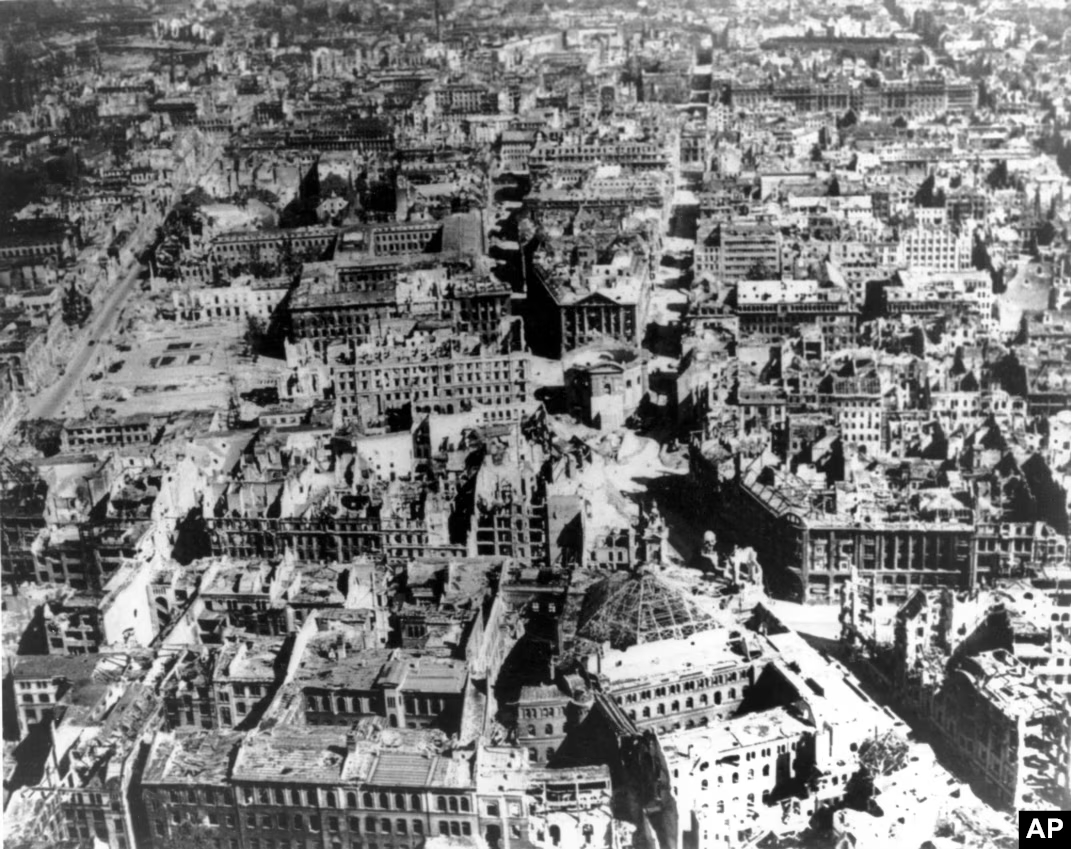
In light of these realities, Israel’s military campaign in Gaza should not be viewed through the narrow lens of proportionality alone. Rather, it is akin to the Allied invasion of Nazi Germany—a response not just to aggression but to an existential threat. The Allies did not merely repel Nazi advances; they leveled German cities, toppled the regime, and embarked on a comprehensive project of denazification. They understood that the Nazi ideology could not be appeased or contained. It had to be eradicated.
So too with Hamas. Israel is not merely fighting a militant group—it is confronting an ideology that glorifies death, martyrdom, and the annihilation of Jews. Just as Hitler sought to bring all of Europe under Nazi rule, Hamas seeks an Arab nation established on the Jewish homeland, thus expanding Arab—and Islamic—hegemony over the entire region. Just as the Allies bore the moral burden of wartime devastation in order to secure a future free from fascism, so too does Israel now shoulder the moral responsibility of rooting out a death cult that threatens not only its people but the broader values of civilization.
This is not to deny the suffering of Palestinian civilians any more than one denied the suffering of German and Japanese civilians during WWII. Civilian casualties are a tragedy, as they were in Berlin, Dresden, and Tokyo. But the source of that tragedy lies not in the defenders, but in the aggressors who embed themselves among civilians while proclaiming genocidal aims. The path forward must include, as it did in postwar Germany, a full ideological and structural transformation—a denazification of Gaza. And before that objective can be realized, there must be total annihilation of Hamas and Gaza occupied until the transformation is complete.
We live in a time where historical analogies are often abused or flattened into caricatures. But if history is to have any moral utility, it must guide us in recognizing evil where it arises, and support those who take the burden of confronting it. In this light, Israel’s war against Hamas is not only justified—it is necessary, and, like the Allied war effort against the Nazis, morally urgent.
The widespread pro-Palestinian protests in the United States and Europe reveal a striking disconnect from the complex historical realities on the ground, bordering on the absurd when they equate Israel with Nazi Germany or ignore Hamas’s genocidal ideology. Their moral reasoning corrupted by the postcolonial studies standpoint, these protests represent a reductive and inverted narrative of colonial oppression that fails to account for the historical circumstances of Israel’s founding and survival amid existential threats.
While postcolonial theory can be useful for critiquing imperialism and advocating for oppressed peoples (I am being generous here), its application in this case (as well as others, such the South African situation) is fallacious, framing the Israeli-Palestinian conflict purely through a misapplied colonial lens and thus obscuring history and existential threat posed not only to Israel but the West more broadly by Islamism. Reductionism and historical revisionism distort public understanding and obscure the moral clarity required to confront a movement like Hamas, whose objectives align with total annihilation of a native people.
This is not a case of postcolonial liberation—at least not for Palestinians. The Palestinians are not colonial subjects. They are colonizers. The leftwing protests on Western campuses and streets are performative gestures rooted in global identity politics shaped by postmodernist irrationalities. Many of the protestors were taught these irrationalities at the university they attend. The West needs to reclaim its sense-making institutions and point them back towards truth-seeking. Higher education needs a big reset.

 freedom and reason