
The Rasmussen Reports daily Presidential Tracking Poll for Thursday (today) shows that 50 percent of likely US voter approve of President Trump’s job performance. Must be frustrating to hammer away at something and get the opposite results.
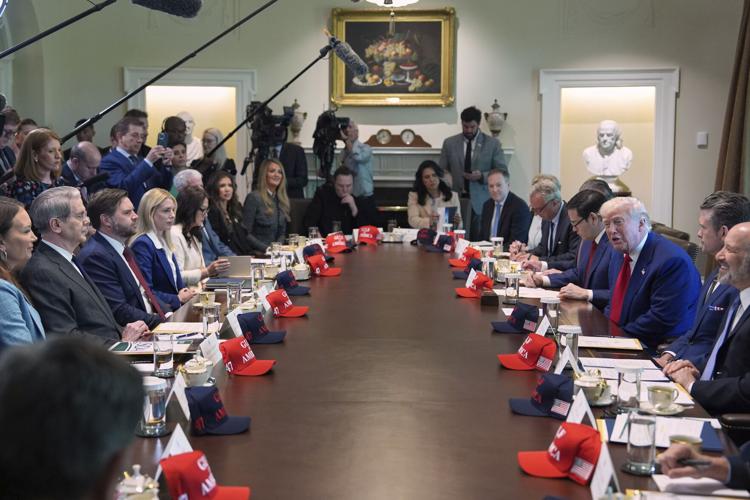
Yesterday morning on Freedom and Reason, I reflected on Trump’s first 100 days of the second term. I said that there would be a lot that I’d leave out. Listening to Trump’s cabinet meetings later that morning, there was indeed a lot of things that I could have reported. If you can find video of that meeting—which was open to the press—you would benefit from the reports.
Last night, I spent several hours reviewing the economic data in light of the first quarter GDP (gross domestic product) report (Q1 2025). As reported in the media, GDP contracted 0.3 percent in Q1 2025. I’d rather not have seen that. I’m hopeful about things. But I’m a realist. I’m also curious—and have expertise in political economy. So I dug into the details to understand what happened. I share with you this morning what I found.
Before I do that, I don’t know how much you know about how GDP is measured, but it’s important to grasp the inputs to get a fuller understanding of the matter. A single number makes headlines flashy but, like crosstabs in polling data (Trump’s approval rating would be much higher if but for a single intersecting demographic), there’s more to this than a single number—maybe there’s even a little good news.
GDP is calculated as consumption + investment + government spending + (exports – imports). Imports are subtracted from GDP because they represent spending on foreign goods rather than domestic production. Perhaps obvious given the name of the measure, I know, but worth noting anyway.
Pay attention to government spending going forward. Budget cutting—necessary because of the massive deficits accumulated under the Biden regime—will negatively affect GDP. It’s hard to suss out how much expectations of budget cuts affect GDP (and Trump’s budget is months away from passing—and even then we will have months more to see its effects), but anticipatory concerns could have knock on effects across other measures.
More directly, even without a budget, federal government spending fell by just over 5 percent in Q1 2025, with estimates finding that this shaved about a third of a percentage point off GDP. This was the result of actions taken by the Department of Government Efficiency (DOGE). Musk did find considerable savings in his audit during this period, around 150 billion dollars—not the trillion he’d hope, but not insubstantial.
That’s what we voted for. And a lot more budget cutting needs to be done. At the cabinet meeting today, Trump suggested more coming for DOGE, perhaps as much as three times that amount. As I said months ago, there will be pain. But if we don’t get our fiscal house in order, the specter of a sovereign debt crisis grows ever larger.
Consumer spending, which accounts for about 70 percent of GDP, grew at a weaker 1.8 percent in Q1 2025, down from 4 percent in Q4 2024. The public is cautious. At the same time, consumer spending is usually strong at years-end (Christmas and all that), so the economy’s underlying strength may be exaggerated. On the plus side, private domestic investment rose by nearly 22 percent, driven by a surge in equipment spending. That’s promising for the midterm.
Imports can have a big impact on GDP. And boy did they. In Q1 2025—which covers the period January 1 to March 31—imports surged by more than 41 percent, driven by a more than 50 percent increase in goods. That’s the largest rise since 1974. This subtracted over 5 percentage points from GDP, making it the primary driver of the contraction. There’s most of the answer for the contraction—if we accept the preliminary number. Economists had expected a modest gain of around 0.4 percent, but a surge in imports (attributed to businesses stockpiling goods perhaps ahead of President Trump’s tariff policies) drove the decline.
Peter Navarro (a chief economic adviser to Trump) notes that removing the effects of imports and inventories reveals a core GDP growth rate of around 3 percent, which exceeds expectations (by quite a bit, actually). Core GDP is defined as final sales to private domestic purchasers, which grew at just under 4 percent. This metric excludes volatile components like inventories and trade. This shows solid underlying demand, so that good news.
One might consider this calculation a rationalization, but Navarro is not alone. Indeed, economist Jason Furman (economics professor at the Harvard Kennedy School and the Department of Economics at Harvard University) calculated a similar 3 percent annualized growth rate for core GDP. Furthermore, Furman cautions observers to keep in mind that the Q1 2025 GDP number, as it always is, will be revised many times in the coming years with better source data. There’s a significant chance that the overall number will be revised upward, he argues, putting it in positive territory—so, if a contraction next quarter, still no recession.
Tariffs weren’t in effect in Q1, so it is difficult to say what role this played in the contraction. Navarro says it didn’t any. But it’s possible, as noted above, that Trump’s campaign promises created economic uncertainty, which could have led to a behavioral shift, with companies building inventories to avoid future costs.
Consumer spending could also have been affected by Trump’s tariff promise, with consumers withholding purchases collectively not fully understanding the timeline. Moreover, the import situation could also have been a consequence of Trump’s promise to raise tariffs. We have evidence that importers began front-loading purchases, which would explain the record surge in imports.
A few points to consider or keep in mind.
– Navarro argues the GDP drop was due to a Biden overhang. But GDP growth was rather substantial in Q1 2024, at least compared to the average GDP during Biden’s term (around 3 percent). It is possible that Q1 2025 under Biden or Harris would have been sluggish, but that would be speculating.
– The 0.3 percent contraction doesn’t indicate a recession. A recession requires two consecutive negative quarters. The press will be waiting with bated breath for the Q2 report. They’re pining for a recession; all the negative press intends this outcome. But, again, as Furman points out, Q1 2025 GPD could be revised upwards.
– We’ll hear a lot of rhetoric tying slow growth to tariffs. Remember what tariffs do. Tariffs protect domestic industries by making imported goods more expensive, encouraging businesses and consumers to buy locally produced products. As I wrote about recently on Freedom and Reason, this boosts US manufacturing, preserves jobs in vulnerable sectors, and strengthen national economic security by reducing reliance on foreign supply chains. For example, tariffs on aluminum and steel imposed during Trump’s first term helped revitalize US mills (which is why Biden kept Trump’s tariffs in place).
– It will take a while for Trump’s economic plans to play out. Since the Senate couldn’t strip Trump’s tariff authority yesterday, we will see what those effects will be. I’m happy to see the experiment run.
– Remember that Trump put a 90-day pause on certain reciprocal tariffs for most countries, while maintaining a 10 percent baseline tariff on imports from nearly all nations and escalating tariffs on China. So with the return of the initial tariff structure (if it returns) and the budget, which won’t impact Q2 2025, the effects won’t likely be known until late this year.
– One might wonder whether spending cuts will hamper growth. Perhaps. There will be tax cuts. But these will largely be the continuation of Trump’s tax cut from the first term (which Biden continued). There will be new tax cuts—no taxes on tips, overtime, and Social Security—but I don’t know whether these will have modest or robust effects on consumption. I am hoping they will raise taxes on the top income earners, which is being discussed, but this might put a drag on things. At the same time, it may, along with budget cuts, help reduce the deficit. I’m also hopeful that external revenue generation from tariffs will reduce the deficit. I’m all for tariffs and eager to see what their effect will be in the long run across a range of metrics.
– I recognize that budget cuts will negative impact GDP growth, but I’m worried Congress won’t cut enough. To reiterate what I said earlier, we really need to tackle the budget deficit. We can’t keep adding 2 trillion dollars to the nation debt every year. (I wish they weren’t proposing an increase in the defense budget, but that will contribute to GDP growth.)
– Note that I have said nothing about Wall Street. Wall Street is a casino. I’ve never considered Wall Street to be the most significant metric of economic health. I focus on the fundamentals. Admittedly, I have only scratched the surface here.
My understanding is that we really haven’t had a new budget in decades. I would like to see Congress pass a “new generation” budget structure—a multi-decade plan rooted in economic nationalism that would contribute mightily to a restructuring of the world economy. That would give investors confidence about the direction of the nation’s economy. All this uncertainty is having a negative impact on optimism. And mass psychology plays a significant role in economic dynamics.

 freedom and reason