
Requiring photo ID to vote in Wisconsin is now enshrined in its state constitution, making it much harder for Democrats to rescind this crucial piece of election integrity. Given the outcome of the Supreme Court race, putting this requirement in its constitution was an absolute must. Susan Crawford blew out Brad Schimel last night. Crawford’s victory is unfortunate on many levels (as I explain in an article two days ago, The Fate of Wisconsin’s Supreme Court and Election Integrity are on the Ballot Tomorrow), but had voters not wrapped the constitution around voter ID, it could have been much worse. Crawford has a documented history of opposing Wisconsin’s voter ID law.
As a private attorney, Crawford represented the League of Women Voters in a 2011 lawsuit challenging the state’s voter ID requirement. Her argument was absurd: that the law was akin to a “poll tax,” that is, that verifying a voter is who he says he is imposes an unfair burden akin to a literacy test during Jim Crow segregation. In 2012, Crawford lauded a temporary injunction on the voter ID law as “a great day for the citizens of Wisconsin.” In a 2018 column in the Capital Times (when she was running for Dane County judge), Crawford described the voter ID law as “draconian.” (Is it draconian to require a motorist to provide a police officer with a photo ID during a traffic stop? Or for a bank to see a photo ID before dispensing money?)
Crawford avoided questions about this during the campaign with the standard “I don’t take positions on issues that might come before the court.” But her past actions and statements clearly make her a threat to election integrity. Still, Wisconsin voters put her on the court, which is now 4-3 progressives. As I wrote in that article, this does not bode well for future Republican representation in Congress. But at least now voter ID is beyond her grasp.
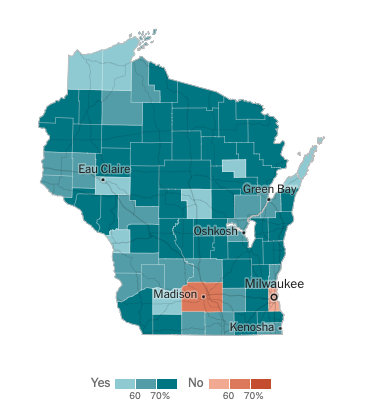
All the media attention today is not on voter ID, of course, but on Crawford’s resounding victory, which I will address in a moment. But I think there is a matter with respect to voter ID than needs more attention drawn to it—which counties voted against Question 1. Only two of Wisconsin’s 72 counties voted against putting election integrity in the state constitution: Dane and Milwaukee. Dane is home to Madison, our capital, and the flagship university of the UW System. Milwaukee is a near-chocolate city. Both Madison and Milwaukee are blue cities. The progressives who run those cities reach powerfully into the suburbs.
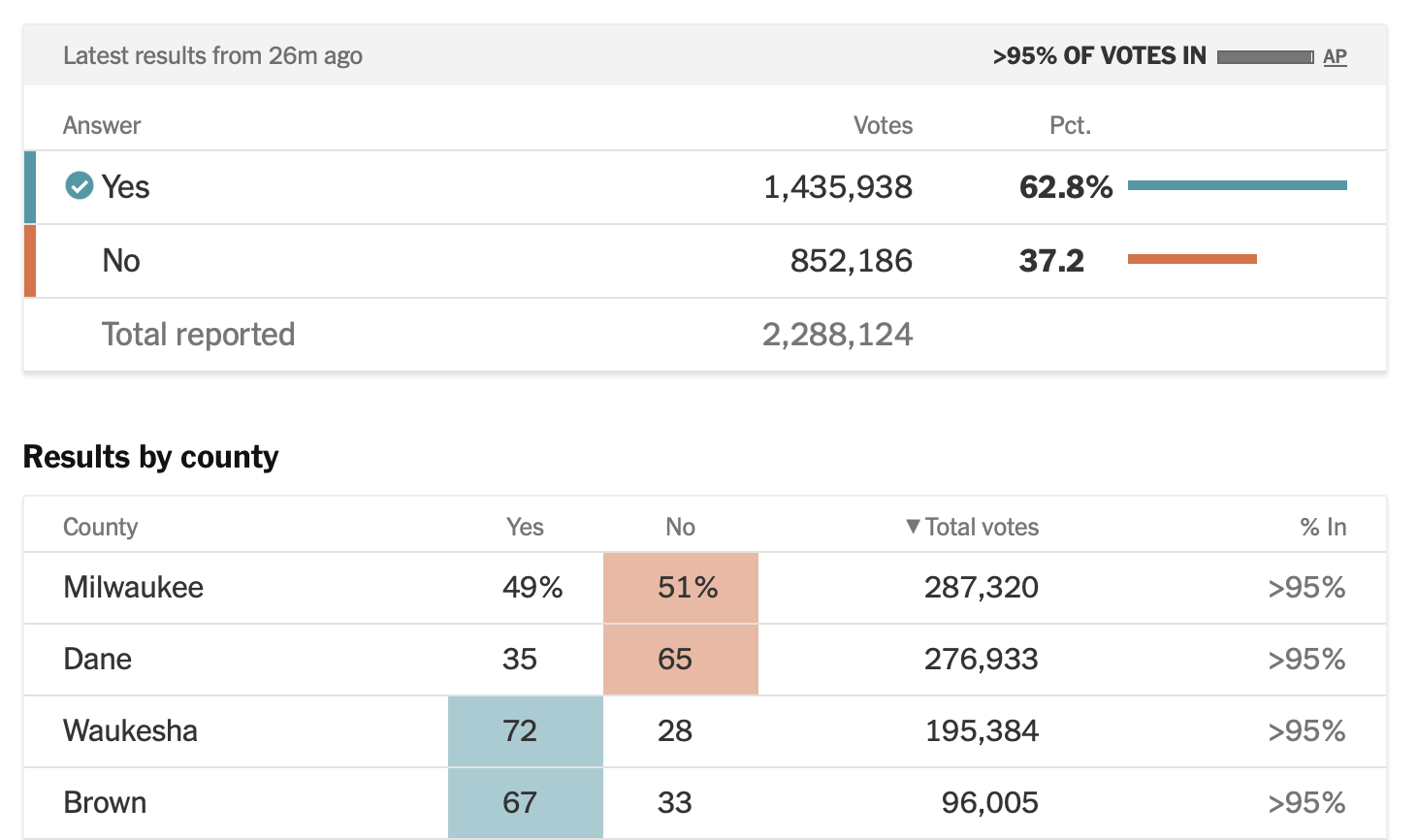
This highlights the divide between Republicans and Democrats on the matter of voter integrity, especially along the populist and progressive divide. The attitude against voter ID is especially pronounced among progressive intellectuals and cosmopolitan urban types who have considerable influence over discursive formation and access to the means of ideological production.
Perhaps it will not surprise you to learn that lax election rules greatly favor Democrats. The November 5, 2024 election bears this out. Kamala Harris only won 19 of 50 states, yet she won more popular votes than Trump did in 2020 even though Trump increased his popular vote total in 2020 over 2016 by some 11 million votes. No states shifted towards blue in 2024. They either shifted red or were status quo. Yet Trump won less than 50 percent of the popular vote. Of the states with strict photo ID, Trump won all 9. Of the state with strict non-photo ID, Trump won all 3. Of the states where photo ID is requested, Trump won 11 of 12. However, where ID is requested and photo not required, Trump won 6 of 12. And in states where no document required to vote in person, Trump won only 2 of 14.
I can imagine a world in which a theory for why Republicans run up their votes in white-majority rural areas (supposing this claim) is because of fraud, which would then be a reason for Democrats campaigning for strict voter ID rules. I can’t imagine a world in which Republicans would argue that white rural voters (much of Wisconsin’s populace) face barriers to voting and therefore voter IDs are discriminatory. One party has a monopoly on racialist thinking and uses arguments hailing from that standpoint for electoral advantage. Then again, given Democrat voters, maybe the party would be happy with a free-for-all all around. But I digress.
So why did Brad Schimel lose? I’m not going to do a thorough postmortem, but I think part of it is this narrative about the pernicious influence of oligarchs in American democracy. While the media drew massive attention to Elon Musk’s efforts in Wisconsin (as they did in last year’s national election), it downplayed the role played by billionaire venture capitalists George Soros and Reid Hoffman, as well as the super wealthy Illinois Governor J.B. Pritzker in promoting Crawford’s candidacy. The perception progressives have manufactured is that the influence of oligarchs on our politics is exclusively on the Republican side.
The reality is Democrats have outspent Republicans in recent election cycles—and much of that money comes from the oligarchy. Democrats are, after all, the party of the corporate state. In the 2024 presidential election cycle, data from AdImpact and other sources shows Democrats significantly outspent Republicans in advertising and overall campaign spending. For instance, between March 5 and October 7, 2024, Democrats spent 1.3 billion dollars compared to 768 million dollars spent by Republicans—a gap of over 500 million dollars. Across all federal races—presidential, congressional, and down-ballot—Democrats spent around 4.5 billion dollars compared to 3.5 billion dollars for Republicans (according to AdImpact).
This pattern isn’t limited to 2024. In the 2022 midterms, data from OpenSecrets indicates Democrats spent more on media and staff than Republicans. And even while Republicans focused heavily on fundraising, the party trailed in total expenditures. The sad fact is that Democrats have a stronger fundraising machine, which leverages the massive stores of money accumulated by corporations (big tech, medical groups) and private and public sector unions, as well as affluent professionals and cultural managers (academic, celebrities). Republicans have not been able to consistently match this spending. Despite this, Republicans have remained competitive recently—if there are tight rules governing the administration of elections. One equalizer is that Democrats are deeply unpopular among average American voters. But this only matters if Republicans go to the polls.
However, the advantages Democrat hold over Republicans prevailed in Wisconsin yesterday. Given the mediated and selectively channeled hysteria over the matter of moneyed power, many voters rebelled against what they perceive as one-sided elite interference in their elections. The outcome is a win for the power of the corporate state propaganda machine, demonstrating its efficacy in drawing attention away from a candidate whose politics and record are antithetical to the interests of the majority by marshaling and channeling emotional energy into the symbolic striking down of a boogyman, in this case an entrepreneur named Elon Musk. Meanwhile, Soros, Hoffman, and Pritzker lurked in the shadows.
There’s a crucial matter to be addressed here—the failure of low-information and low-propensity voters to turn out for Republicans when Trump is not on the ballot. Republicans are going to have to figure this out before the midterms in 2026. The rank and file need to see Trump not as a cult of personality but as the leader of a movement that has reformed the Republican Party, turning it from a major component of the neoliberal and neoconservative Uniparty and to steer it back to the Party of Lincoln (see History as Ideology: The Myth that the Democrats Became the Party of Lincoln).
We will see major confirmation of this return to the Grand Old Party today with the imposition of tariffs, a major component in the economic nationalism that established America as an industrial powerhouse (Alexander Hamilton’s American System) by protecting American industries and jobs from unfair foreign competition. This strategy will in turn spark the reshoring of production and services to states across America (we are already seeing this happening). We have to deal with the trade deficit if we are going to have an America conducive to thriving families and communities. (See Protectionism in the Face of Transnationalism: The Necessity of Tariffs in the Era of Capital Mobility.)
It needs to be explained to the rank and file Republican that the America First agenda will be severely hobbled if Wisconsin Democrats can gerrymander the state’s electoral map in their favor and send two Democrats to the House in place of the two Republicans presently there. I tried to explain this in Monday’s essays. I wasn’t the only one, of course. With all the noise, the signal didn’t penetrate. Republicans must make it a priority to teach the rank and file how to increase the signal-to-noise ratio in special and midterm elections. They need to stress the importance of supporting the party and not just the man, and to turn out in droves in all elections, since all elections have consequences.

 freedom and reason