
In an X post yesterday, Vermont Senator Bernie Sanders, presently touring college campuses wearing a populist mask to obscure his subservience to the corporate state, pushed his plan for Medicare for All by citing statistics on life expectancy in a number of advanced Western societies. Here’s the chart:
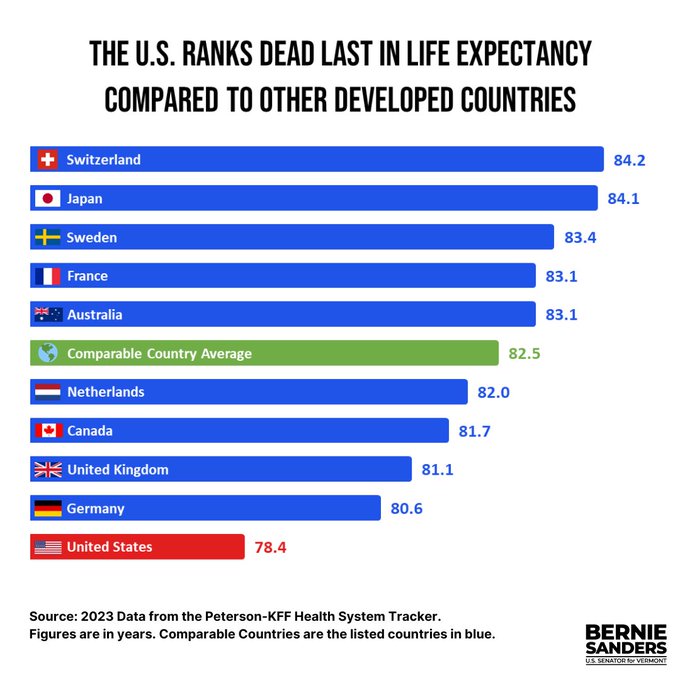
Characteristics of Sanders’ sledgehammer style of rhetoric, arguing the case using the relative lower life expectancy of Americans compared to selected Western countries at best oversimplifies the matter, while obscuring the many downsides of socialized medicine.
It is fallacious to pin lower life expectancy on health care delivery models. The US ranks lower in life expectancy among advanced nations due in major part to lifestyle factors and violence—not just or even for the most part healthcare access. In fact, on pure healthcare outcomes (e.g., acute care, cancer survival), the US often outperforms its peers.
To be sure, Medicare for All will help close coverage gaps, but without tackling obesity, violence, and other societal issues, life expectancy won’t significantly improve for America. So while inequities in access are indeed a problem, Sanders drastically overstates the role of access disparities in the broader statistic.
Moreover, Sanders omits the downsides of socialized medicine from his pitch—e.g., bureaucracy, delays, lack of choice and flexibility, and rationing. The US outperforms other nations in innovation, responsiveness, and speed. Sanders’ focus on life expectancy thus obscures not only the other factors affecting the relative ranking of nations, but also the advantages of the US model. In attempting to address the problem of life expectancy through Medicare for All, Sanders’ plan risks those advantages.
It is also crucial to recognize that the US healthcare model, whatever its flaws, plays a critical role in supporting socialized systems globally via dynamic, market-driven innovation in medical technology, pharmaceuticals, and research. The US is the engine for the healthcare advancements that other populations enjoy. By keeping healthcare largely free market in the US, America enables the world to enjoy better medical care, making their health care outcomes better despite their socialized models.
Socializing medicine in the United States, by stifling innovation, will likely lead to stagnation in medical breakthroughs, reduced access to cutting-edge treatments, and slower advancements in life-saving technologies, hurting those other populations in addition to our own. In the long run, Sanders’ plan could result in fewer cures, less effective therapies, and diminished hope for patients worldwide.
Finally, supposing we were to implement Sanders’ plan, the cost to taxpayers would be staggering, requiring from taxpayers tens of trillions of dollars over the decade following its implementation. It would also expand the corporate state apparatus, concentrating even more power and wealth in the hands of a relatively small number of large corporations, while enlarging the strata of bureaucrats and technocrats who serve their interests.
Bottomline: Sanders’ pitch drastically oversimplifies life expectancy, while ignoring the myriad of downsides of the corporate state medical model he pushes.

 freedom and reason