
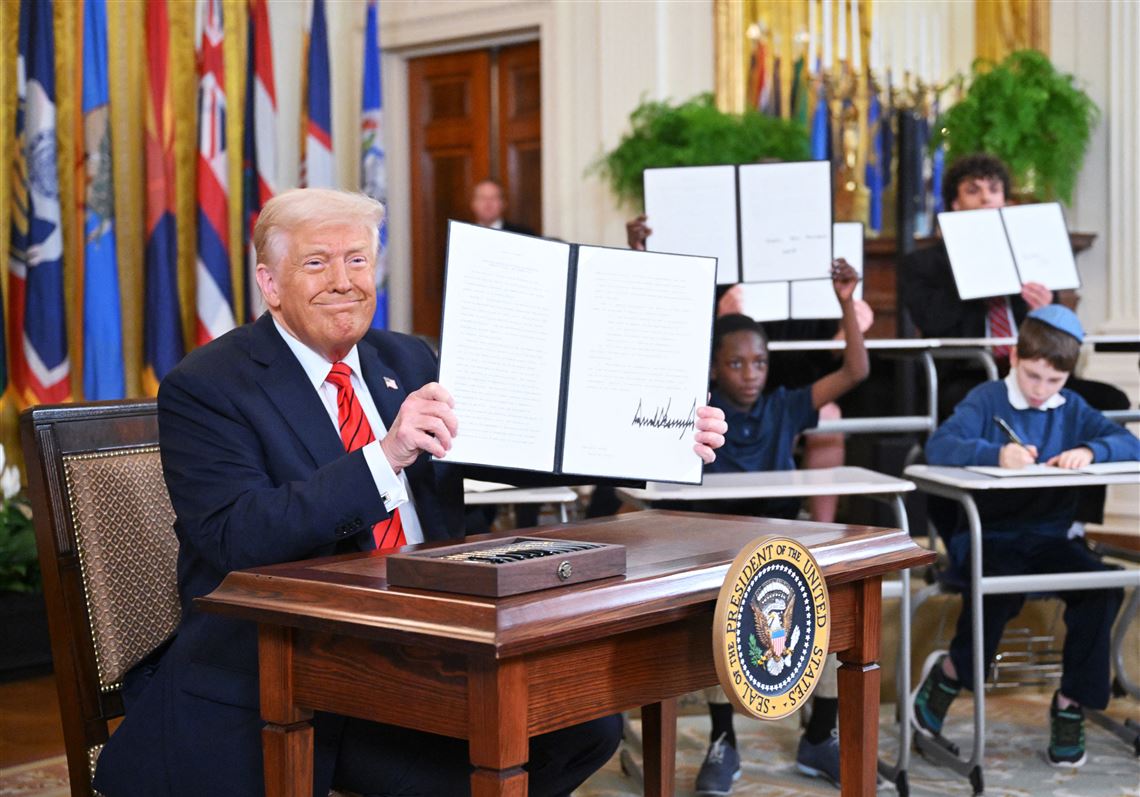
Donald Trump followed through on his promise to abolish the Department of Education (DoE) yesterday. He signed the executive order Improving Education Outcomes by Empowering Parents, States, and Communities. He will need Congress to act to make his promise a reality; since the DoE was established by an act of Congress in 1979, dismantling it necessitates the passage of new legislation to repeal or significantly amend the existing law. The good news is that Trump will need a simple majority to accomplish this.
If the Department of Education is abolished, blue cities and states will continue indoctrinating America’s youth in public schools with critical race theory (CRT), queer theory, and other anti-Western ideologies. Moreover, the emphasis on social and emotional learning (SEL) will persist in undermining academic outcomes—either by diverting time away from core subjects like English, math, and science or by infusing these subjects with ideological content. This presents a challenge for those already brainwashed by progressive ideology—if they are ever capable of recognizing their indoctrination.
However, abolishing federal control over education in red cities, towns, and states would allow citizens in those areas to escape the influence of the credentialed class. The imposition of woke progressive ideology is largely inorganic to these communities. Without federal overreach, they could refocus on the true task of educating America’s youth.
To grasp the significance of liberating these communities from the dictates of a federal ministry of education consider that, of the 3,143 counties or county-equivalents in the US, Donald Trump won 2,588, while Kamala Harris secured only 555. Currently, the credentialed class shapes curricular and programmatic design—dictating progressive ideology—even to counties that would otherwise prioritize instruction in English, math, science, and appropriate social studies (civics, geography, and history) over woke programming.
While the county-level electoral map is not a perfect metric—since many schools are run by cities, independent districts, or mixed systems—public schools still exist within counties. Thus, Trump’s county-level success reflects the preferences of many families whose children attend public schools.
Advocates of woke progressive education argue that these frameworks offer essential perspectives on identity, power, and social justice, encouraging students to, in the language of that ideology, “critically engage” with issues of gender, race, and sexuality. Of course, the goal is not genuine critical engagement but rather the uncritical adoption of the progressive worldview on these topics—a worldview corrupted by corporatist and postmodernist ideas. These so-called “theories” infiltrate subjects like English, history, social studies, and even science, injecting warped interpretations, revising history to align with ideological goals, and degrading scientific norms and understandings.
The inclusion of such content in public education not only detracts from traditional subjects (which is damaging enough) and undermines academic rigor and essential skill development—it also implants in impressionable minds an ideology that is neither organic to their communities nor advantageous to their future prospects or rational civic participation.

When this issue is acknowledged at all, it is often misframed as a debate about the role of education in shaping students’ values and preparing them for higher education and the workforce. In other words, the situation facing American families is cast as a dilemma: balancing the demands of progressive curricula with the traditional goals of fostering academic proficiency. However, this way of putting the matter misrepresents the problem—it presumes that public education should universally assume the role of parents and communities in shaping children’s values. It positions public schools as the primary vehicle for instilling progressive ideals, while rejecting family and community values as backward and bigoted.
Progressives believe they know better than families and communities about the values children should hold. However, especially since the pandemic, tens of millions of Americans have rejected this premise (many had already rejected the premise). They increasingly recognize that progressive curricula and programming aim not at developing critical, independent thinkers or autonomous citizens who make decisions for the betterment of themselves and their communities, but rather at producing obedient corporate subjects and reliable Democratic voters.
The practical reality is that, since the establishment of the Department of Education (DoE), the introduction of SEL and other programming has shifted focus away from core academic subjects like literacy, math, and science. This shift has blunted the development of critical thinking, knowledge acquisition, and essential skills. The redistribution of time and attention has reduced instructional hours dedicated to academic rigor, negatively impacting test scores and overall educational outcomes. Teachers and administrators feel pressured to balance SEL with meeting academic standards, resulting in less effective delivery of both. The political reality is that SEL—and similar ideological initiatives—should be purged from public education not only because it interferes with the goals of education, but on principled grounds: public schools should not be an instrument for pressing ideology into the public mind.
There is also the problem of bureaucratic bloat and the burden on taxpayers. Since the DoE’s creation in 1979, the teacher-to-administrator ratio in US public schools has shifted significantly. Before the department’s formation, schools were teacher-heavy, with relatively few administrators and minimal support staff. Most schools operated with a principal, perhaps a vice-principal, and a small central office team. In the decades following the DoE’s establishment, the number of non-teaching staff has grown at a much faster rate than the number of teachers.
While several factors contribute to this trend, one key driver is the expanding federal regulatory apparatus and its mandates on public education. The result is that, despite significant increases in education spending, much of the additional funding has gone toward administrative costs rather than directly benefiting classroom instruction. This regulatory imposition has created a vast bureaucratic structure, ostensibly to meet students’ needs and comply with federal mandates.
Returning to the ideological problem, some will recognize in the plan of action articulated by Rudi Dutschke, a German student activist and leader of the 1960s socialist movement, who described it as “the long march through the institutions.” His inspiration came from the work of Italian communist Antonio Gramsci and the concept of “cultural hegemony,” which I have explored in several essays on Freedom and Reason.
Dutschke’s phrase is useful—it captures the essence of a strategy aimed at achieving cultural and political change by gradually infiltrating and transforming society’s key institutions, such as education, government agencies and departments, mass media, and the institutions of cultural production—in other words, the organizations that shape public perception and policy.
For Gramsci, cultural hegemony was essential for maintaining capitalist power; therefore, the left needed to challenge and reshape cultural norms through institutional influence. However, what we see today is not the left in either the liberal or Marxist sense, but rather a faux-left manufactured by the corporate class—progressivism—designed to mislead those who genuinely value social justice.
This is how the corporate class has secured hegemonic control over society over the last several decades: by disguising corporate aims in the language of democracy and justice. In other words, the accumulation of political power in the administrative state and technocratic apparatus entrenches a social logic that ultimately benefits corporate interests. Thus, the very concept of social justice has been transformed into its opposite. What moves under the appeal of social justice is totalitarian desire.
With schools now offering an ever-widening range of services beyond traditional instruction, the introduction of SEL and other pursuits has added yet another layer to an already overcrowded curriculum—one driven by the ideological objectives of the credentialed class rather than the academic needs of students. At a time when greater emphasis on literacy, math, science, and civics (untainted by anti-American and anti-Western sentiment) is more critical than ever, public education has instead been burdened with ideological programming that undermines its core mission.
Ideological programming does not align well with the traditional goals of academic education, such as mastering subject-specific content and skill development, not because there is resistance to it by the ordinary citizen, but because ideological programming is not appropriate to the goals of education, which should focus on education not indoctrination.
However, for progressives, the goal is not education but indoctrination. The goal of creating obedient corporate subjects requires technocratic control of the centralized administrative apparatus, the enlargement of the bureaucracy, the retrenchment of this regime, and generations of voters who support the agenda. Therefore, the project to reclaim our democratic republic is advanced by the dissolution of the Department of Education. It is now up to Congress.

 freedom and reason