
I am seeing on legacy and social media hysteria being whipped up about Trump assuming dictatorial powers in the United States and establishing a totalitarian fascist state. I don’t see it I see the opposite), but supposing this was his ambition, could fascism happen here in America?
First, here’s an example of the hysteria:
In both Italy and Germany’s parliamentary systems during the rise of fascism, the head of government (Prime Minister in Italy, Chancellor in Germany) could not unilaterally dissolve parliament. However, the structure of these systems allowed leaders like Mussolini and Hitler to consolidate power and effectively control the dissolution process. Once Mussolini was appointed Prime Minister in 1922, through the Acerbo Law (1923) and later changes, he manipulated elections to ensure his Fascist Party dominated parliament. By 1925, Mussolini had effectively sidelined the legislature, making it a rubber-stamp body for his dictatorship. In Weimar Germany, the Chancellor did not have the direct power to dissolve the parliament. However, under Article 48 of the Weimar Constitution, the President (Paul von Hindenburg at the time) had the authority to rule by emergency decree and dissolve the parliament. Article 48 was exploited by Hitler after he was appointed Chancellor in 1933 to establish a totalitarian state.
The US system does not allow the President to dissolve Congress. Even in emergencies, the President cannot bypass or dismiss the legislative branch, ensuring that executive power remains checked. Indeed, the structure of the US government, rooted in the Constitution, federalism, and the separation of powers, offers several protective mechanisms against the rise of fascism or authoritarian rule. These safeguards prevent the centralization of power in a single leader, and make it difficult for one party to establish hegemony over the nation, helping ensure that democratic institutions remain resilient even in times of crisis.
Unlike Italy and Germany, where parliamentary systems allowed authoritarian leaders to consolidate power quickly, the US government distributes authority among three coequal branches: executive, legislative, and judicial. Each branch can check the actions of the others, making it difficult for any one branch to dominate. Congress, particularly the Senate, can act as a roadblock against executive overreach, and the judiciary serves as a check on unconstitutional actions, preserving democratic republican governance. Moreover, the US benefits from a fixed presidential term system, which prevents indefinite rule by one leader. Unlike parliamentary systems where governments can fall and be replaced rapidly, US presidents serve fixed four-year terms, ensuring stability and regular electoral transitions.
The Bill of Rights safeguards individual liberties, including freedom of speech, press, and assembly—rights, albeit much less robust in Italy and Germany than in the United States, that those authoritarian regimes quickly suppressed. A strong, independent judiciary, especially the Supreme Court, ensures that these rights are upheld against government overreach. Federalism further reinforces these protections by decentralizing power between the national and state governments. This division makes it more difficult for an authoritarian movement to take full control, as states maintain legal and political authority separate from the federal government. Elections, law enforcement, and policy implementation are largely handled at the state level, creating multiple layers of governance that prevent rapid, sweeping changes to the system. Moreover, the military’s subordination to civilian leadership also serves as a crucial barrier to authoritarianism. The US Constitution ensures that the armed forces remain under civilian control, reducing the risk of military-backed takeovers.
Thus, unlike the fragile democracies of interwar period Italy and Germany, the US benefits from long-established democratic-republican traditions and an active civil society. So, while no system is entirely immune to political extremism, the US Constitution and governmental framework make an authoritarian takeover significantly more difficult.

However, totalitarianism can be achieved another way, and this is the way Trump’s actions are circumventing—just in the nick of time. I have written before about Sheldon Wolin and his concept of “inverted totalitarianism,” which contrasts with classical totalitarianism as seen in Fascist Italy and Nazi Germany. Instead of a single leader or party openly seizing absolute power, Wolin argues inverted totalitarianism emerges more subtly within democratic structures, where bureaucratic and corporate interests dominate governance without direct oppression.
One of the key mechanisms of inverted totalitarianism is the administrative state—a sprawling, unelected bureaucracy that controls much of the policy-making process. While traditional totalitarian regimes rely on direct state control over the economy and society (with corporate power at the state’s back), inverted totalitarianism functions through a highly specialized and opaque network of agencies and departments, regulatory bodies, and technocratic decision-makers. These institutions, though ostensibly part of a democratic government, operate independently of public oversight, making it difficult for citizens to hold them accountable. Policies are driven less by electoral mandates and more by entrenched bureaucratic structures that serve elite interests.
A defining feature of the phenomenon in American history after the Civil War is the corporate-state arrangement, where large corporations exert significant influence over government decision-making. Corporations shape policies through campaign financing, lobbying, and regulatory capture, ensuring that the state primarily serves their interests rather than those of the public. Moreover, the structure of the administrative states reflects the social logic of corporate power. This dynamic leads to what Wolin calls “managed democracy,” where elections continue to exist, but political outcomes are largely controlled by elite financial and corporate forces.
This has been know for many years. In 2014, in “Testing Theories of American Politics: Elites, Interest Groups, and Average Citizens,” published in Perspectives on Politics, Martin Gilens and Benjamin Page showed found: “Multivariate analysis indicates that economic elites and organized groups representing business interests have substantial independent impacts on US government policy, while average citizens and mass-based interest groups have little or no independent influence. The results provide substantial support for theories of Economic-Elite Domination and for theories of Biased Pluralism, but not for theories of Majoritarian Electoral Democracy or Majoritarian Pluralism.”
Ultimately, inverted totalitarianism erodes genuine democratic participation by replacing public engagement with media manipulation, passive consumerism, and technocratic governance. Citizens are not openly repressed but are instead politically disengaged, distracted by spectacle, and conditioned to accept decisions made by elite institutions. This is what Antonio Gramsci called “ideological hegemony.” This creates a system where effective authoritarian control is exercised through administrative and economic dominance rather than overt coercion, making resistance more difficult and less obvious.
This is the style of totalitarianism sought by the Democratic Party, and for years the Republican Party, as well. The reason Democrats and progressives are fomenting hysteria is that Trump’s agenda of deconstructing the administrative threatens the elaboration of the inverted totalitarianism they seek and have substantially established, as everybody is finding out in real time. As noted at the outset, Trump is thus doing the opposite of establishing a fascist dictatorship; he is accomplishing this by dismantling the administrative state and the technocratic apparatus—that is big, intrusive, and paternalistic government. With DOGE, Trump is bringing back transparency to government, exposing waste, fraud, and abuse by federal agencies and departments.
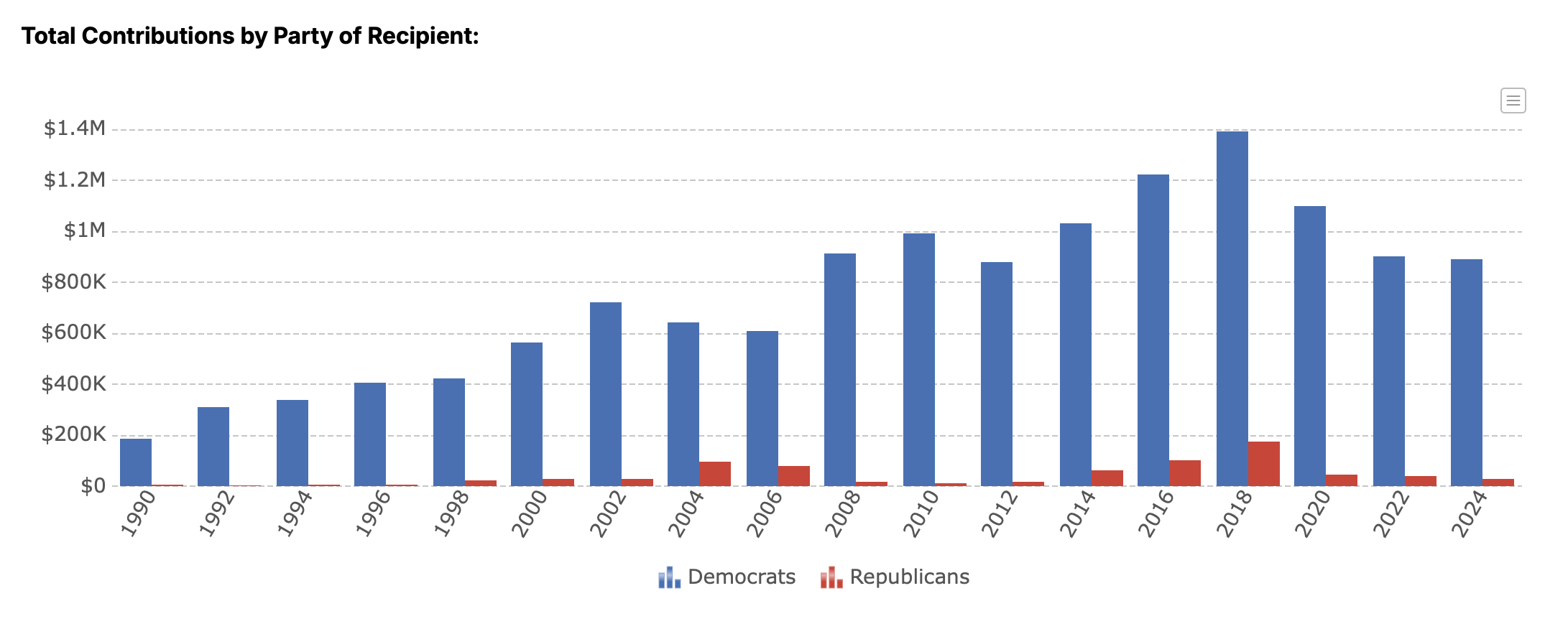
Deconstructing the administrative state involves raising consciousness about the ideology that has captured technocratic apparatus. Who constitutes the permanent political class in the federal government? What is their party affiliation? The above chart documenting contributions to political parties by American Federation of Government Employees (AFGE) is provided by Open Secrets, an independent and nonprofit group whose mission is to provide information on the role of money in American politics. Who is AFGE? According to their website, “AFGE proudly represents 800,000 federal and D.C. government workers across the United States and the world. Members of the American Federation of Government Employees (AFGE) can be found in almost every federal agency and every function of government.”
Federal workers are represented by other employee unions, as well. For example, the National Treasury Employees Union (NTEU) represents around 150,000 employees across 34 federal agencies, including the IRS, Customs and Border Protection, and the Securities and Exchange Commission. According to Open Secrets, in 2021-2022, almost 99 percent of NTEU political contributions went to House Democrats. During that same period over 93 percent of contributions made by NTEU were to Senate Democrats. As of January 2025, the federal government employed approximately three million civilian workers. Although the majority of federal employees work outside of Washington DC, federal employees constitute over 43 percent of the District of Columbia’s workforce. The District is overwhelming progressive Democrat.
I urge you to follow @DataRepublican on X. Watch the interview above to get a taste of what she does. This is her website: DataRepublican. She has a Substack, as well. The work of DataRepublican shows that corruption in the federal government is enormous. It’s a rigged system, and the rigging will be further exposed by DOGE, which has already exposed a great deal of it. DataRepublican documents that members of Congress pass laws that enrich their families. They depend on the administrative state to push out these appropriations to themselves via non-governmental organizations (NGOs). It’s a massive money laundering scheme. And it’s your money. The elite is terrified at the unraveling of the scheme, which is a key part of inverted totalitarianism. This panic is what lies behind the manufacture of hysteria.
The efforts by the administrative state and the Democratic Party (Trump has fundamentally changed the Republican Party) are contrary to the will of the people. A recent poll by Harvard CAPS-Harris finds that the majority of the country backs Trump’s agenda. Below are selected items. In addition to these items, 60 percent of those surveyed support direct US negotiations with Russia to end the war in Ukraine. The people are taking back their government thanks to the populist-nationalist movement. The movement is spreading to Europe, as well, where, for example in Germany, the Eurosceptic Alternative for Germany placed second in the 2025 election, exceeding twenty percent of the electorate.


 freedom and reason