
As most of you know, I am a sociologist. I teach subject courses in one of my areas of specialization (criminology), but I also teach foundational social science courses—social theory and research methods. In the later, I begin the semester by reviewing the inventory of cognitive errors and fallacies in logic and argumentation. One important sociological concept (central to symbolic interactionism, social constructionism, and related approaches) is what we call the “Thomas theorem.” The Thomas theorem bears on a serious problem in science: confirmation bias.
I have shared my thoughts on the Thomas theorem before on Freedom and Reason (see, e.g., The Definition of the Situation: Elon Musk and the Gesture; A Fact-Proof Screen: Black Lives Matter and Hoffer’s True Believer; Why Aren’t We Talking More About Social Contagion? The Field of Dreams of Childhood Trauma; On the Pains of Testing and Contact Tracing. It’s Worse than Folly), but I want to expand on my thoughts and explicitly connect the Thomas theorem to confirmation bias. I then want to apply the comparison to the real-world problem of progressives seeing Nazi salutes when conservatives and liberals make incidental gestures superficially resembling the salute but not seeing it when progressives make these gestures. I have discussed the hysteria about these gestures before (see the essay on Musk), as well, but here I want to illustrate how sociology can explain biased interpretation of signs and symbols with a longer treatment of these concepts.
The Thomas theorem and confirmation bias both relate to the way perception shapes reality, but they operate in different ways. The Thomas theorem states that “If men define situations as real, they are real in their consequences,” emphasizing how (inter)subjective interpretations of reality influence responses. The concept highlights the power of belief in shaping behavior and social dynamics. Confirmation bias is the tendency to seek, interpret, and remember information in a way that confirms preexisting beliefs, often leading to distorted reasoning and resistance to evidence that disconfirms prior belief.
While the Thomas theorem focuses on how subjective definitions of reality create real-world effects (what sociologists sometimes refer to a “societal reaction”), confirmation bias explains how individuals reinforce their existing perspectives, potentially leading to self-fulfilling prophecies that align with the Thomas theorem’s premise.
When conservatives make an ambiguous gesture that resembles a Nazi salute, those who already associate conservatism (and liberalism) with authoritarianism or extremism (itself a false association) often define the action as intentional, leading to real political and social consequences such as public backlash or deplatforming.
We are seeing this error play out routinely these days. Elon Musk, and more recently Steve Bannon, are only the latest causalities of progressive panic (remember what the authoritarians did to Laura Ingram in 2016?). In contrast, when a progressive makes a similar gesture, it is not interpreted in the same way, because progressives are generally not perceived as having Nazi sympathies. Nobody interpreted AOC’s recent gestures resembling the salute as indicating Nazi sympathies. Everybody knows AOC is not a Nazi.
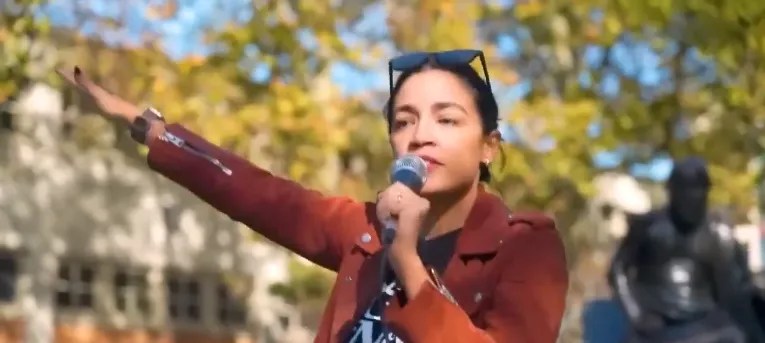
This difference in interpretation is reinforced by confirmation bias, which causes people to selectively perceive and remember information that aligns with their existing beliefs. Because progressives believe Bannon is a Nazi, his incidental gestures confirm prior belief.
For the record, Bannon is a democratic republican with classical liberal commitments (albeit held in tandem with his Christian faith). His heroes are George Washington and Abraham Lincoln. On the anniversaries of key battles in the European theater in which American forces defeated those of the Nazis, the War Room becomes special commemorative programs in which Nazis are portrayed as one of the greatest existential threats to free and open societies. But for those who see conservatism as inherently linked to extremism, these facts are eclipsed by bias. Progressives are thus more likely to view an ambiguous gesture by a conservative as intentional. (They are also prone to believe that condemnations of Nazi sympathies are made to hide Nazi sympathies. “That’s what they want you to think.”)
It’s important to note that, for many progressives, the facts I provided regarding Bannon’s politics and content on the War Room are unknown to them. They have never bothered to find out what Bannon believes. They never watch the War Room.

The War Room is on four hours every weekday (split into a morning and afternoon show) and two hours on Saturday morning. I have watched or listened to thousands of hours of the War Room since the winter of 2020 (it’s a graduate seminar in international political economy). I have also listened to many of Bannon’s speeches. I have been criticized for this, in fact. “Who would listen to a Nazi?” For some, listening to Bannon is what turned me into a right-winger (which I am not). Those who think Bannon is a Nazi either ignore disconfirmatory evidence or practice what I have called “cerebral hygiene.”
As for the latter, self-imposed ignorance (with assistance from those who shame people for watching the War Room), is a mix of what is called “poisoning the well” and “begging the question” (or circular reasoning). Poisoning the well occurs when a person preemptively dismisses a perspective by labeling it as bad or evil, stopping himself from engaging with its actual content.
This type of thinking is circular because the man assumes the perspective is wrong without examining it, thus reinforcing belief without questioning. As such, this is a form of thought-stopping or dogmatism, where rigid beliefs prevent critical self-examination. As a result, the person abstains from learning about the perspective not because of its content, but because of an a priori assumption that it is inherently bad and therefore should not be watched.
George Orwell called this “crimestop” in Nineteen Eighty-Four. Here’s how he put it: “Crimestop means the faculty of stopping short, as though by instinct, at the threshold of any dangerous thought. It includes the power of not grasping analogies, of failing to perceive logical errors, of misunderstanding the simplest arguments if they are inimical to Ingsoc [Ingsoc is the socialist government of Airstrip One, a fictional city in Orwell’s dystopian nightmare world], and of being bored or repelled by any train of thought which is capable of leading in a heretical direction. Crimestop, in short, means protective stupidity.” This is the practice of cerebral hygiene.
While there are conservatives who practice cerebral hygiene, the problem is far worse among progressives. By Leagues. Indeed, a lot of conservatives engage with progressive content—which is hard to avoid because progressivism is hegemonic in academia, culture, and media—and criticize that content based on its ideas and advocacies.
Libs of TikTok is a good example of an information center for conservatives (but hardly the only one). Libs of TikTok is run by Chaya Raichik. The account, which started on Twitter, amplifies content from social media platforms, often content focusing on LGBTQ+ issues, education, and progressive politics. (Last spring, when I was accused of transphobia and racism, part of the case against me was my practice of sharing Libs of TikTok videos on X, which is ironic since it’s progressive content; you’d think they appreciate others amplifying their ideas.) Raichik does not usually critique the content but more often simply shares progressive content so that the public is exposed to that worldview. Libs of TikTok thus builds mutual knowledge.

Meanwhile, progressives want censorship of conservative content and urge the deplatforming of those who provide it. Unlike Libs of TikTok and similar content, which conservatives push out on social media, progressives don’t want to see—and they don’t want others to see—conservative (or liberal) content (and really they don’t want others to see their content since it’s so cracked).
One obvious exception is showing images and video clips of prominent conservatives and liberals making incidental gestures that progressives portray and interpret as indicating Nazi sympathies. It’s a tick with them.
In this way, the progressive reflex mirrors the Islamic reflex. While media hailing from the Islamic point of view spreads cartoons depicting Jews as demonic (antisemitism is rampant in the Islamic world), Muslims don’t tolerate cartoons in which Muhammad is cast in an unfavorable light. Muslims take to the streets to protest books, cartoons, and documentaries critical of Islam and mocking (even simply depicting) their prophet, sometimes resorting to violence against those who produce this content. Some European governments join in, punishing those critical of Islam. (Islamization is not merely the zealot’s desire.)
Remember Charlie Hebdo, the French satirical magazine with a long history of publishing controversial content, particularly caricatures of religious figures, including the Muhammad? Recall that, in 2015, Muslims attacked its offices in Paris, killing a dozen people, including cartoonists and editors. The attack was in response to the magazine’s publication of caricatures of Muhammad. Despite the attack, Charlie Hebdo continued publishing and reaffirmed its commitment to free speech. Yet you won’t see their cartoons carried in mainstream media on either side of the Atlantic. Even an academic book on the topic did not publish the cartoons at issue. The reader had to imagine them. Charitably, this is self-censorship (although I think the motivation is even darker than this).

Or recall Theo van Gogh, the Dutch filmmaker who was assassinated in 2004 by a Muslim for his film Submission, which criticized the treatment of women in Islam. The filmmaker was shot and stabbed on an Amsterdam street, the killer leaving a note threatening others, including the film’s scriptwriter, Ayaan Hirsi Ali. These are only the more extreme expressions of the desire to suppress content critical of ideology. (In an act of bravery, I gave a talk on clerical fascism in a sociology of religion session at a professional conference several years ago. The anxiety in the room was palpable. After I finished, there were no questions. I, too, was nervous.)
Progressives are notorious for engaging in and promoting the practice of deplatforming, doxing, and censoring content critical of Critical Race Theory (CRT), DEI, transgender ideology, vaccine skepticism, etc., justifying these actions as necessary to combat harmful rhetoric, hate speech, and misinformation. They use doxing—the public release of private information—to intimidate individuals with opposing views (this how we learned that Chaya Raichik was behind Libs of TikTok). (The more extreme form of this is swatting, which involves calling the police to falsely report violence occurring at the address where an enemy resides).
Deplatforming involves removing individuals or groups from academic institutions (I have been a casualty of this on more than one occasion), employment, and social media to limit their influence. Censorship can take the form of content moderation, demonetization, or outright bans on platforms that view certain ideas as violating community guidelines (before Musk bought Twitter, its internal Trust and Safety group kicked the president of the United States off the platform). These are the desires of authoritarians.
As with acts of Islamic terrorism, and state action punishing Islam’s critics, these progressive tactics suppress free expression, create and entrench ideological echo chambers, and prevent open debate on complex issues. Progressives maintain that restricting what they judge to be harmful speech helps protect marginalized communities and prevents the spread of misinformation. In fact, what they seek is the entrenchment of progressive dogma by excluding content that delegitimizes progressive ideology. Resist it while you can.

 freedom and reason