
One of the abilities of a genius intellect is the ability to think about phenomena and problems in an abstract and global sense and then to use this understanding of systems and the interconnections among elements to make predictions, a practice closely linked to that of explanation, to see how things will work out based on first principles or initial states. Put another way, the ability to think abstractly, recognize deep interconnections, and predict outcomes based on first principles are hallmarks of genius. Both Albert Einstein and Elon Musk exemplify this trait, albeit in different ways, which I will come to later in this essay.
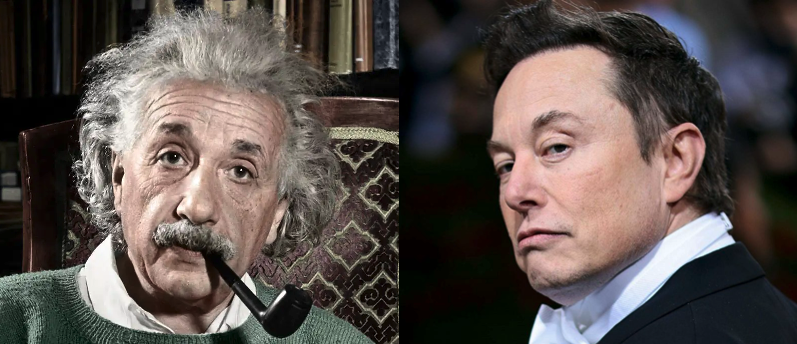
But before I get the traits that mark Einstein and Musk as geniuses, I want to expand on the point that, in a deep and fundamental way, prediction and explanation are closely linked; one might even argue that they are two sides of the same coin. Both involve understanding the underlying structure of a system, recognizing patterns, and applying that knowledge to either anticipate future events (prediction) or clarify past or present phenomena (explanation). That prediction runs in both directions is crucial to recognize; we can test hypotheses about future and past causes and correlations.
Today’s essay concerns this matter because progressives are fond of creating boogeymen of those who contradict claims made in the service of their agenda, which is changing the world to fit their ideology, attributing to their enemies low intellect to make their own pronouncements appear in contrast the work of high intellect. This tactic is central to legitimizing the presence and practices of progressivism in technocratic governance, since the practice of elevating technocracy over democracy depends on the widespread assumption that common man just isn’t up to self-government. Like Trump, portraying Musk as having low intellect is a paradigm of this progressive tactic. Such portrayal was certain once Trump and Musk were drawn into politics, as their presence in government threatens progressive hegemony. Before then, they were admired, even celebrated.
In science, inference is central to the predictive power of theories. A good scientific theory not only explains why things happen but also predicts what will happen under different conditions. For example, Einstein’s theory of general relativity explained why Mercury’s orbit deviated slightly from Newtonian predictions, but it also predicted the bending of light around massive objects—something later confirmed during a 1919 solar eclipse. The fact that a theory successfully predicts outcomes is strong evidence that its explanations are fundamentally correct. Einstein had the ability to know phenomena or things existed without seeing them. He could determine the outcome of a process before it was set in motion because he grasped the nature of the initial state.
We see this in artificial intelligence and machine learning. Models that can accurately predict outcomes often have implicit explanatory power. This is why AI is such a powerful tool beyond computational speed. If a neural network can predict stock market trends based on certain inputs, it suggests that those inputs are meaningfully connected to market movements, even if the mechanism isn’t fully understood. Musk, in his engineering-driven mindset, often speaks about first principles thinking, which is essentially a method of both explanation and prediction. By understanding the nature of systems, Musk can predict the outcomes of changed system states. Crucially, something doesn’t have to have already happened to know what will happen if the system is changed and I want to spend a moment on that matter, as denying or obscuring this truth is a tactic progressives use to deny or obscure the deleterious effects of their policies.
Those who wish to advance ideological-political agendas are fond of saying in the face of pushback that the future states imagined by their opponents have not happened, or are infrequent, and that therefore their concerns are unfounded. When concerns were raised about males identifying as girls or women in female sports, those advocating allowing males into female sports dismissed those concerns by claiming that there was no or little evidence of negative effects, therefore the desire to exclude such males was an expression of prejudice against trans identifying males. However, scientific facts about the advantages males have over females, recognition of those differences and an explanation for them, accurately predicts that males would dominate females in female sports.
Similar predictions were made with respect to such males in female prisons. Rape and pregnancies were predicted, and these things subsequently happened. While these outcomes were expected, those who push the queer agenda denied them. At the same time, they wanted these outcomes, which is obvious in the way that men succeeding in women’s domains are celebrated by progressives. These outcomes are celebrated because progressives have changed the system via power derived from having colonized society’s sense-making and policy-making institutions. Thus, the claim that something undesirable will not happen is a lie; progressives desire the undesirable.
Leaving subterfuge to the side (ideology makes smart people stupid, so a lot of those pushing the agenda come by their fallacies honestly), a person pushing the queer agenda while denying or obscure its deleterious impact on girls and women is committing the fallacy argument from ignorance (argumentum ad ignorantiam). The argument from ignorance fallacy occurs when someone claims that a statement is true (or false) simply because it has not been proven otherwise. It’s an error in reasoning that relies on a lack of evidence as proof of something, rather than offering direct evidence to support the claim. Put another way, an argument from ignorance occurs when one assumes that because something has never happened or isn’t happening that it cannot or will not happen.
In the case of males in women’s sports, dismissing the predicted advantage in sports due to the relative absence of males assumes that because the condition (males being allowed) hasn’t been met, the predicted outcome (advantage) cannot or will not occur. This reasoning incorrectly assumes that the lack of evidence disconfirms the prediction. However, the advantage still exists if males were allowed to participate; the absence of that condition doesn’t prove the outcome won’t occur. We expect the outcome because of our knowledge of the facts, which are denied by the queer activist because the agenda seeks validation of the false claim that men who say they are women are women. Thus the progressive ostensibly rejects predictions based on the assumption that a lack of immediate or concrete evidence means the issue won’t materialize in the future.
This dismissive stance ignores the underlying factors, essentially focusing on the absence of past instances rather than on the rational prediction that can be made from known principles. The scientific facts about male and female physiology (such as physical strength, muscle mass, and hormonal differences) lead to logical predictions that males have physical advantages in certain sports, and similar reasoning about social and psychological factors can predict challenges in environments like female prisons. If these predictions are based on well-established principles, facts, or theories, the person dismissing them is overlooking the importance of reasoning from facts and the predictive power that comes with understanding initial conditions.
This dismissal is a failure (often intentional) to acknowledge the validity of predictions based on established knowledge and exposes the person as eschewing logical reasoning—in the case of queer theory to advance an ideological agenda; the denial of the potential consequences is based on an appeal a lack of direct evidence in the short term, instead of considering broader principles that logically lead to these predictions. Predictive thinking relies on a systems understanding—recognizing patterns and anticipating future outcomes based on those patterns, which are grounded in scientific facts. Ideology disorders the capacity to think in a logical way. We have thus allowed fallacious thinking to command our institutions, and the consequences of having allowed this have been consequential and widespread.
Here’s another example. Supposing there is at present no evidence that affirmative action or the lowering of standards with the objective to change race and ethnic proportionalities will increase the number of unqualified people in critical fields of endeavor, such as medicine, and that therefore such concerns that it is or will reflect not the predictive power of the person making the objection but instead reflect the objector’s race or ethnic bias. The claim is that his opposition is not based on an understanding of the nature of the situation but on an ideology that predisposes him to imagine such outcomes to thwart progress in the project to achieve race and ethnic equity.
In this way, the rational thinker is portrayed as an irrational one, driven by race and ethnic bias, which adds to the mix another fallacy, the ad hominem fallacy. But it is obvious that lowering the standards in medicine will increase the likelihood of incompetent doctors, which will result in poorer and even lethal outcomes. Why wait for these deleterious outcomes to manifest to abandon or prevent the initiation of policies that will lead to them? Setting aside the fact that determining the fate of individuals based on group membership is discriminatory (committing yet another fallacy, that of misplaced concreteness) and therefore should be stopped or disallowed for that reason, affirmative action leads to negative outcomes. Resort to name calling will not in the end obscure the results.
As with the problem of males in female sports, the person denying the predictions is dismissing concerns about the potential negative consequences of affirmative action (including discrimination on the basis of race and ethnicity obvious at inception) on the grounds that there is no immediate or concrete evidence to support them, assuming the absence of proof in the short term means the issue won’t arise in the future. This reasoning fails to consider the broader principles, historical patterns, and existing research that predict future outcomes, focusing instead on the lack of current evidence to dismiss possible long-term effects. The predictive power of established facts and theories about human behavior, socioeconomic trends, and systemic dynamics is ignored. This failure to recognize the validity of logical predictions, grounded in knowledge and reasoning, exposes the person as relying on a narrow, short-term perspective rather than considering broader, more reliable frameworks for anticipating outcomes.
There is a video widely shared on the Internet of a dialogue between Elon Musk and Don Lemon in which Lemon challenges Musk on the latter’s opposition to affirmative action and DEI on the grounds that it will increase incompetence in the field of surgery. Lemon asks Musk for evidence that this has happened. In the clip I provide above, Lemon denies that standards are being lowered. Musk contradicts Lemon’s claim by citing the case of Duke University. As Dave Rubin points out in his commentary (also in the clip) we know this happening across the nations in our universities and our high schools, thus providing a superb example of how to avoid the fallacy of argument from ignorance.
I shared that clip because of what Rubin adds to it, but it does not fully convey Lemon’s resort to ignorance. Below I provide a longer clip that shows Lemon engaging in the fallacy of argument from ignorance thereby providing a paradigm of the tactic progressives use to deny the consequences of the policies they foist upon the public. They deploy the fallacy as a “gotcha” device, that if you cannot identify a negative consequences then the policy must be a sound one. It is not a particularly clever rhetorical trick, frankly, but it can catch an opponent flat-footed if he doesn’t know about the fallacy. Logic and critical thinking is not typically included in public school curricula. For the progressive, whether he knows it is a fallacy or not is unimportant; he has been socialized to reflexively use it in debate. Progressives are well conditioned in the art of sophistry. Lemon engages in another logical error when he claims that because white doctors make mistakes, that Musk doesn’t have a concern. But this only provides Musk with an opportunity to demonstrate the logical way to think about the problem, avoiding the fallacy Lemon commits. (Lemon’s note about Tuskegee is absurd. The National Medical Association supported the Tuskegee Syphilis Study during its duration.)
I stress the point that without evidence of outcome incompetence is the predictable consequence of lowering standards. But the role of ideology here must also be stressed. Musk says what he does because he understands the situation. Musk is a logical thinker. Lemon cannot grasp Musk’s point because he believes, like other progressives, that blacks are underrepresented in the field of surgery because of racism and this belief derails whatever natural capacity he might have to understand. What is this ideology? That of critical race theory, or CRT. In his book, How to Be an Antiracist, Ibram X. Kendi argues that disparities are not indicative of the inherent abilities of different racial groups but are the result of racist policies and ideas. It is either one or the other, he insists, and so you can either only be an antiracist or a racist. Kendi emphasizes that acknowledging these disparities is crucial for identifying and dismantling the racist structures that perpetuate them. But this is a fallacious argument, and it’s part of the reasons Lemon can’t grasp Musk’s point.
The underrepresentation of blacks in fields like medicine need not be attributed to racial disparities in inherent abilities but can be attributed instead to a variety of factors, including cultural variation in attitudes towards learning and work, historical and systemic barriers to education, access to resources, and so forth. These barriers have created disparities in academic achievement and professional qualifications, making it more difficult for blacks on average to meet the high standards required in fields such as medicine, which is why they are underrepresented in those fields. Progressives must acknowledge this fact since they go to the heart of their claim that racism remains a problem. They take the fact of disparity as proof of its cause, but in doing so admit to the disparity. They are in a bind; whatever the explanation for these facts, efforts to change standards to increase representation will carry the same effect as if the differences in ability are innate; there will be an increase in incompetence which will in turn lead to negative outcomes, which in this case can be debilitating and lethal. Medicine is already dangerous enough without increasing the number of incompetent practitioners. Lower standards may lead to greater representation of blacks in medicine. But it will also lead to a greater number of incompetent doctors. Since medicine is about competency in practice, DEI goals have no place.
Progressives are fond of policies based on demographic abstractions, so the counterargument that not all black individuals are incompetent provides no refuge. Of course not all black individuals are incompetent. Dr. Ben Carson, a world-renowned brain surgeon, is black. But Carson did not earn his lofty reputation because he is black, rather because he is talented and dedicated to his craft. However, not all black men vying to be brain surgeons come with the same level of judgment, talent, and dedication to the art. Thus, while changes to standards may be seen as an attempt to address the effects of these inequities and provide more opportunities for underrepresented groups to succeed, the negative consequences of reducing standards are predictable. Why are there high standards in medicine in the first place if not to exclude incompetent practitioners and thereby reduce the likelihood of harmful consequences for patients? That’s common sense.
This is crucial to understand because the ability to predict future events based on known facts, such as the advantages males may have in physical sport, is itself explaining the dynamics of the situation. There is symmetry here; it works the other way around. When those predictions come true, it reinforces the original explanation. Denying such predictions would be ignoring both systemic reasoning and empirical observation and failing to consider how these explanations provide a framework for anticipating future events based on current knowledge. This ignorance allows people to assert in a self-satisfied way that, not only will the worst not occur if the state of the system is changed, but that because it has not occurred (at least to their knowledge), that the outcome will a good one. Thus, via fallacious reasons, progressives make their agenda appear desirable. Ultimately, whether we are explaining the past or predicting the future, we are engaging in the same intellectual process: recognizing patterns, identifying causes, and applying logical reasoning to understand the world. Progressives only recognize the patterns they wish to, and these are almost always in the service of their agenda.
All that said, let’s return to the matter of genius, since in deciding on which cognitive style to adopt, we should be looking to those who possess it, not to ideological hacks who only seek to advance an agenda. Presuming nobody would deny he was one, Einstein used first principles thinking to develop his theories of relativity, redefining our understanding of space, time, and gravity. Instead of accepting existing Newtonian mechanics as immutable, he questioned its foundational assumptions and built a new framework based on simple yet profound insights, such as the constancy of the speed of light. His ability to conceptualize the universe abstractly—through thought experiments rather than direct experimentation—demonstrates a deep systemic understanding of reality. Einstein is thus a ready exemplar of a rational cognitive style.
Musk, while not a theoretical physicist, applies similar principles in engineering and business. He has repeatedly stated that he solves problems by breaking them down to their fundamental truths and reasoning upward, rather than relying on conventional wisdom, and you can see this in how he works and what he has accomplished. His cognitive style has allowed him to revolutionize industries. For example, he saw that traditional rocket manufacturing was inefficient and vertically integrated SpaceX. His ability to foresee long-term trends, such as the importance of sustainable energy and space colonization, is rooted in this systems-level, predictive thinking.
Both Einstein and Musk demonstrate that genius is not just about knowledge but about seeing the invisible connections between things, predicting future possibilities, and reshaping the world according to reasonable ideas. Don Lemon is no genius. He could not see what Musk was saying. Based on the popularity of a version of that video clip circulating among and shared by those harboring great antipathy towards Musk, Lemon is not alone. The rank and file ensconced in the progressive worldview are rendered incapable of using the superior cognitive style. Those who steer them exploit the inferior cognitive style to organize popular support for their various projects.
There has been considerable speculation that Einstein may have been on the autism spectrum, though the diagnosis did not exist during his lifetime. We might point to traits such as his delayed speech development (not speaking fluently until around four years old), intense focus on his work, and a preference for solitude as possible indicators. Einstein also exhibited rigid behaviors, such as wearing the same type of clothing daily, and had an unconventional way of thinking, often disregarding societal norms. Additionally, some accounts suggest he struggled with social interactions and forming close relationships. To be sure, Einstein was also known to be engaging and humorous in the right settings (so is Musk). While Einstein’s neurological profile remains a topic of debate, the debate highlights the emerging conversation about neurodiversity and how historical figures might fit into modern frameworks of cognition and behavior.
Musk, on the other hand, has publicly stated that he is on the autism spectrum. During his Saturday Night Live (SNL) appearance in 2021, he revealed that he has Asperger’s syndrome, which is now classified under autism spectrum disorder (ASD). Musk displays some of the typical traits of autism, such as intense focus on specific interests, social difficulties, and a unique way of thinking. His awkward social interactions, literal communication style, and deep obsession with technology—all align with ASD characteristics. At the same time, Musk has shown adaptability, entrepreneurial skill, and strong leadership—all which demonstrate that neurodiversity can be a strength. (This brings into question whether psychiatry’s conflation of Aspergers and autism generally was a valid move.)
The attitude of progressives towards Musk’s neurodiversity considering their celebration of difference and diversity betrays their profound sense of elitism—whatever their position in the status hierarchy. If one has spent any time on social media, or watched corporate news outlets, the way progressives mock with extraordinary derision the physical appearance, speech, and behavior of those with whom they disagree is obvious. Accusing people of fatphobia while mocking Trump for being overweight is just one of a myriad examples one could provide. It is for this reason that I often say that progressives strike me as adult versions of the mean girls’ table in high school. I’m not saying that progressives aren’t smart. Progressives are some of the most intelligent people I have met. It is not much different here than it is for the religious faithful, who also believe in impossible things. It is also the case that people of average intelligence, if they adopt the superior cognitive style I am describing, can accurately explain and predict outcomes. This is why the average person knew that allowing men in women’s spaces will have deleterious effects, or why it is a bad idea to lower the standards in critical fields of endeavor. Again, it’s common sense.
Einstein’s exact IQ is unknown because he was never formally tested. However, various estimates place it somewhere north of 160, this based on his intellectual achievements and problem-solving abilities. For comparison, a score of 130 and above is typically considered “gifted,” whereas IQ scores of 160 and above are indicative of “exceptional” intelligence. Einstein’s groundbreaking contributions to physics suggest he was well within the exceptional range. To be sure, IQ may not always the best measure of genius, as creativity, insight, and perseverance also play crucial roles in groundbreaking discoveries, but the score is nonetheless widely recognized as a hallmark of genius. Musk’s exact IQ is unknown because he has never taken a publicly available IQ test. However, estimates place it in Einstein’s range based on his problem-solving abilities, technical knowledge, and success in multiple industries.
Einstein and Musk are thus both widely regarded as geniuses even while excelling in different domains with distinct intellectual approaches that nonetheless adopt the cognitive style I have described. Einstein’s intellectual strength lay in deep theoretical reasoning, often working in solitude to develop abstract mathematical models of reality. He valued contemplation and imagination, conducting thought experiments to explore the nature of space and time (his book The Theory of Relativity: And Other Essays, which I read as a child, had a profound impact on my thinking, and I will forever be grateful for the rich intellectual environment with which my parents provided me that included this and other great works). The practical applications of general relativity are found everywhere, from atomic energy to satellite communications.
Musk’s genius lies more in practical application, moving effortlessly between deductive and inductive reasoning, evidenced by his exceptional engineering skills and entrepreneurial prowess, with his focus on applying scientific and technological advancements to real-world industries. Tesla, SpaceX, Neuralink, and other ventures are revolutionizing transportation, space travel, and artificial intelligence. Nonetheless, while he is not a scientist in the traditional sense, Musk’s ability to integrate business strategy, engineering, and physics has allowed him to push the limits of innovation in multiple industries and demonstrate a cognitive style worth wide adoption. There is a reason Musk is the richest man in the world, and we would do well to emulate his approach. To be sure, that requires setting aside ideological concerns, but we would do well to do this, too.
Finally, I hasten to clarify that while IQ measures certain types of cognitive abilities, like pattern recognition, logical reasoning, and abstract thinking, success in fields like business or politics also involves a wide range of other qualities, such as emotional intelligence, strategic thinking, leadership, negotiation skills, and resilience—all of which can be just as crucial to achieving success as raw intellectual ability. Trump’s ability to build a business empire, run a presidential campaign, and win the presidency despite being a political outsider can be seen as indicative of his strong strategic thinking and unconventional problem-solving skills. Trump’s success suggests that he possesses a high level of intelligence, though it may not be captured fully by a traditional IQ test. I am closing with Trump because, as noted at the outset, progressives hold him in as much contempt as Musk since both have turned their talents to saving the American Republic, a project inimical to the corporate project of managed decline in order to prepare the masses for the big and intrusive technocratic world government progressives seek.

 freedom and reason
One thought on “Albert Einstein, Elon Musk, and the Cognitive Style of Geniuses”