“In this moment, all sides should give one another a bit of grace, perhaps even the benefit of the doubt, and take a breath. This is a new beginning.” —Anti-Defamation League
Democrats and others who see Nazis everywhere insist that Elon Musk gave a Nazi salute (the “Sieg Heil”) during a speech celebrating the inauguration of Donald Trump on Monday. Musk thanked the crowd for “making it happen,” before placing his right hand over his heart and then thrusting it out into air. He then turned to those sitting behind him and repeated the gesture. He then turned back to crowd and put his hand on his heart, thanking everybody for the support of Trump and the populist movement. This has generated the latest moral panic from the left. If it keeps going, we may see full-blown mass formation psychosis in the near future.

I wouldn’t be commenting on the matter if it weren’t for story having legs. It’s so very silly. But the left won’t let it go, despite the ADL tweeting on X, “It seems that @elonmusk made an awkward gesture in a moment of enthusiasm, not a Nazi salute.” For his part, Musk said, “Frankly, they need better dirty tricks. The ‘everyone is Hitler’ attack is sooo tired.” Musk mocked the accusation on X using references to prominent Nazi figures, which did finally draw the ire of the ADL.

The image above is demonstration of the Bellamy salute. You can find lots of photographs of children giving the Bellamy salute on the Internet and in history books. James Upham developed the Bellamy salute in 1892 to accompany Pledge of Allegiance, written by Francis Bellamy. Bellamy was a socialist who advocated for worker rights and the equal distribution of economic resources, which he insisted were ideas intrinsic to the teachings of Jesus. The Bellamy salute was the way to address the US flag until 1942. The flag code was changed to avoid identification with the Nazis. Our monuments still retain the fasces, however (see the adornments in the House of Representatives or the Lincoln Memorial).
The Bellamy salute wasn’t the only symbol the Nazis appropriated. The swastika is another one. Originating in Eurasia, but found in many parts of the world, the swastika is one of mankind’s most ancient symbols, dating back thousands of years. It’s strikes me as odd when a people who win a war change the meaning of symbols or alter traditions because the people they defeated appropriated their elements. But then I think about the politics behind the manufacture of moral outrage and it makes sense.
You may remember a moral panic many years concerning handbags manufactured by an India supplier and sold by Spanish fashion chain Zara (owned by the world’s second largest fashion retailed Inditex) decorated with swastikas. The swastika is commonly used Hindu symbol conveying “well-being.” The customer complained. A British anti-fascism group claimed the bags were an attempt to legitimize fascism and the Daily Star ran a picture of Adolf Hitler next to its story headlined, “Fury over Nazi Fashion Bags.” Does anybody believe that nobody caught up in the panic didn’t know that the symbol carried no Nazi intent? I don’t. But truth doesn’t matter to anti-fascists—their goal is to panic the public to gain political advantage. Zara retired the handbags.
Recall the German phrase “Arbeit macht frei,” which translates to “Work sets you free,” was appropriated and used by the Nazis during their regime. The phrase is most famously associated with its appearance on the gates of several Nazi concentration camps, including Auschwitz and Dachau (the latter where the surgeon who pioneered vaginoplasty, Dr. Erwin Gohrbandt, carried out medical experiments on prisoners). The phrase was around long before then, originating in a 1872 novel by Lorenz Diefenbach, a German nationalist. Labor reform movements in German-speaking countries and territories advocating work-ethic principles adopted the phrase to promote the idea of self-reliance and redemption through honest labor. The phrase thus conveys a sentiment similar to that of the Protestant work ethic. Say it today and risk being condemned for insensitivity.
The pairing of Nazis with liberal and right-wing politics progressives and social democrats seek to delegitimize is commonplace today, and are articulated by elites at the highest levels of government. A day after Musk’s hand gesture, German Chancellor Olaf Scholz, speaking at the World Economic Forum, a gathering of transhumanists and transnationalists, said on Tuesday that Germany respects free speech but does not support freedom of speech when used to support extreme-right views. “We have the freedom of speech in Europe and in Germany. Everyone can say what he wants, even if he is a billionaire. And what we do not accept is if this is supporting extreme-right positions,” he said.
The paradox of his statement is rather obvious. You can say anything you want but you can’t saying everything you want. Why would Scholz say this? Because Alternative for Germany, or AfD, a right-wing populist political party that is Eurosceptic and opposes immigration into Germany, especially Muslim migrants, is more popular than Scholz’s Social Democratic Party (SPD). The power elite must find away to censor and delegitimize the AfD to advance the European project of transnational corporate statism. Scholz is the same man who urged the construction of a firewall against the right after the AfD had a tremendous showing in Thuringia and Saxony. Just as with speech, Germans can have their politics in Germany as long as it’s the politics chosen by the establishment.

Alice Weidel, the leader of the AfD, an economist by training (having worked for Allianz Global Investors and Goldman Sachs), holding a doctorate in international development, is openly lesbian, living with her partner, Sarah Bossard, a Swiss filmmaker and producers, and their two sons (it is unclear whether they are legally married, as Switzerland only legalized same-sex marriage in 2022). Apparently her extremism is evidenced by her advocacy for mass deportations and dismantling wind farms. Surely it cannot be that, in a conversation with Elon Musk on X, she emphasized the importance of protecting Jewish communities from antisemitism, which attributed to immigration from Muslim-majority countries and said has become prevalent on the political left in Europe.
Weidel is correct, and one doesn’t have to work hard to see why presents a problem for the corporate state. Antisemitism is a central feature of the alignment of left-wing political groups (anti-colonial, progressive, and socialist) and Muslim organizations, particularly those supporting pro-Palestinian causes, and we see it not only in Germany, but in the United Kingdom and the United States. It’s the glue that holds the movement together—than and loathing of Western civilization. This is speech Chancellor Scholz is not seeking to restrict. Moreover, it sounds to me like Weidel is extreme because corporations who depend on what is effectively indentured servitude stand to lose profit if they can’t super-exploit immigrant labor and drive down the wages for native workers—and because she opposes the Islamization project and the crime it brings to Europe (rape has skyrocketed).
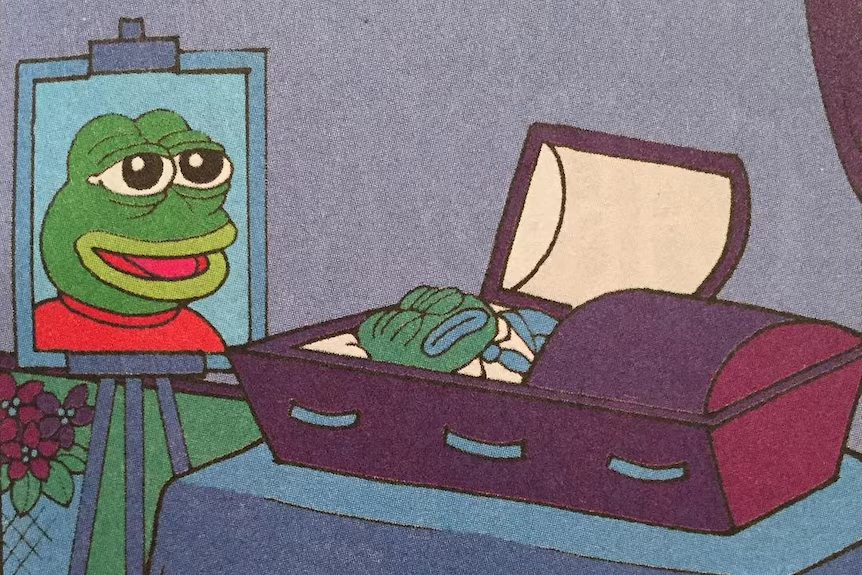
No symbol is immune from the project to delegitimize liberal and rightwing politics. You may remember Pepe the Frog, a cartoon character created by artist Matt Furie in 2005 for his comic series Boy’s Club. Pepe gained widespread popularity as an internet meme. By the mid-2010s, Pepe was appropriated by alt-right groups, and thus, in a media campaign and resulting moral panic, associated with hate speech and right-wing political propaganda. The ADL classified Pepe as a hate symbol. Furie launched efforts to reclaim Pepe’s original meaning, but to no avail. Today, a cartoon frog is forever associated with fascism. Again, it is very silly. But also serious.
When were Nazis allowed to spoil everything? It coincides with the ramping up of the corporatist transnationalist project to turn populism and nationalism into right wing fascist ideas to delegitimize opponents to the globalist agenda to erase nation states. Those of you who are my age (I am 62) remember that things were very different when we were kids. Gestures and symbols appropriated by the Nazis were not condemned in the same way as they are today. The punk movement used such symbology as a sign of their rejection of authority. We saw this as well in industrial music—and heavy metal, too. It was the same spirit that metal bands used Satanic imagery to convey a sense of evil (there was moral panic over that, as well). Skits with performers wearing Nazi uniforms were not deemed offensive but send-ups of the pomposity of authoritarian regimes. We even watched a TV show growing up that humanized Nazis, Hogan’s Heroes. You can still catch that show on some rerun channels, but can you imagine a reboot? I can’t.
I also find it curious that sporting a swastika is deemed today as horribly offensive, but waving the hammer and sickle is not generally seen as a problem, even though the Soviet Union was one of the most authoritarian and brutal regimes in world history, killing millions of their own citizens and sending millions more to the Gulag. Moreover, the hammer and sickle convey a similar sentiment to the German phrase the Nazis appropriated about freedom through work. A person wearing a Hitler or Mussolini shirt would be immediately suspect (it would likely get a person kicked out of a college classroom), but a Che Guevara shirt? No problem. When I was in Denmark in 1989, I bought such a shirt in Freetown Christiania and used to wear it around Green Bay. When I learned the truth about Che (suffice it to say that he was not a nice guy), I retired it. I still have it in a closet somewhere. But before I retired it, a young person asked me if the image was Charlie Manson. Knowing what I know today, I would have said, “No, worse. Much worse.”
George Orwell was troubled by this double standard long before I was. Orwell was an anti-fascist, but he chose to focus on communism in Animal Farm and Nineteen Eighty-Four not because he overlooked the horrors of fascism or Nazism—he took up arms against Franco’s fascists in the Spanish Civil War—but because he believed that the atrocities of Hitler and Mussolini were already well understood and condemned. He was alarmed by the widespread admiration for Soviet-style communism among Western intellectuals, despite its glaring abuses of power and suppression of liberty. Orwell saw this uncritical support as insidious, cloaking totalitarianism in the guise of justice and progress. His most well-known works are indictments of how authoritarian regimes manipulate ideology to control and oppress the people they claim to serve. Admiration for communism is still palpable on the left today. If I am being honest, I have in the past been guilty of this myself. You can find writings on Freedom and Reason (I started this platform in 2006), that are properly criticized as communist apologetics.
Ever heard of the Thomas theorem? It is also called the “definition of the situation.” It’s related to the concept of “framing.” The theorem goes like this: “If men define situations as real, they are real in“If men define situations as real, they are real in their consequences.” It was developed by sociologists William and Dorothy Thomas. The idea is central to symbolic interactionism. What the couple are saying is that people’s actions are based on their subjective interpretation of a situation not on objective reality. If they define things in a particular way, then they will see them and act towards them as if they are that way. This is how two people can look at the same thing and see it differently—and react to it differently. Here is French President Macron making the exact same gesture. Is Macron a Nazi?
Of course, the thing is one way actually. So the goal of the rational thinker is to see the thing as it really is. That’s hard for humans because they want to believe that the way they see the world is the way the world is. If it’s not, then a lot of other things they think about the world are probably wrong, too. This could lead to a change of frame. A change of frame risks alienating the tribe. Belonging is a powerful human impulse. So people stick with ideology. Ideology makes a man see what he wants to see.
Apparently Tim Walz is a Nazi.

 freedom and reason