
“A well regulated Militia, being necessary to the security of a free State, the right of the people to keep and bear Arms, shall not be infringed.”—Second Amendment to the United States Constitution
“The totalitarian states can do great things, but there is one thing they cannot do; they cannot give the factory-worker a rifle and tell him to take it home and keep it in his bedroom. That rifle on the wall of the laborer’s cottage or working class flat is the symbol of democracy. It is our job to see that it stays there.” —George Orwell, Evening Standard
The Supreme Court’s decision in District of Columbia v. Heller in 2008 is a landmark case liberating the Second Amendment of the United States Constitution from the hands of progressive gun grabbers. The Court valorized the Second Amendment intent to protect the individual’s right to keep and bear arms, unconnected to service in a militia, and struck down provisions of the District of Columbia’s gun control law that effectively banned the possession of handguns in the home and required lawful firearms to be disassembled or bound by a trigger lock.
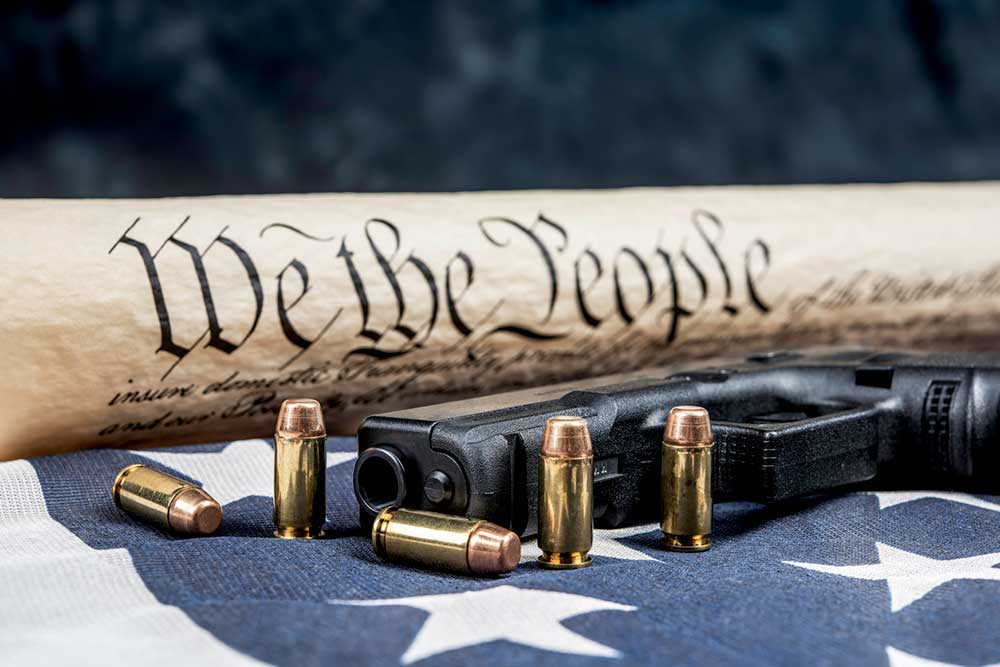
Writing for the majority, Justice Antonin Scalia emphasized the historical and textual analysis of the Second Amendment, stating that its prefatory clause did not limit the operative clause, which guarantees the right to keep and bear Arms. The Court held that this right is rooted in the natural right of self-defense which predates the Constitution. Following the Heller decision, the 2010 ruling in McDonald v. City of Chicago extended the Second Amendment’s protections to the states through the Fourteenth Amendment’s Due Process Clause, solidifying the Court’s interpretation of the Second Amendment as applicable across the United States.
What predates the Constitution is the right to self-defense found in English common law, principles shaped over centuries that became a cornerstone of the legal system in England. At its core, common law recognized that the use of force, including deadly force, is justifiable in circumstances where an individual reasonably believes it is necessary to protect himself, others, and his property from an imminent threat of unlawful violence and usurpation. Thus the right to self-defense is tied to the concept of necessity, emphasizing proportionality and immediacy—that is the force used in self-defense must be proportional to the threat faced, and the danger immediate and unavoidable. This principle reflects the necessity of the individual’s right to safety and the broader need to prevent violence and maintain public order.
By the time of Sir William Blackstone’s Commentaries on the Laws of England in the eighteenth century, self-defense had become firmly established as a lawful justification for the use of force. Blackstone articulated that killing in self-defense is not to be considered murder if the act was necessary and provoked by an unlawful aggressor, provided the defender’s response was proportionate. The evolution of this right, as well as its justification, can be traced through several key legal doctrines. For example, the “castle doctrine,” derived from the idea that a person’s home is his sanctuary, held that individuals were not required to retreat before using force to defend themselves within their own home. And while the law traditionally imposed a duty to retreat when outside the home, if safe to do so, before resorting to deadly force, over time, some states have modified the duty to retreat, with greater recognition given to the rights of individuals to stand their ground when faced with a threat.
It is paradoxical, then, that gun laws in England are among the most stringent in the world. The focus there is on strict regulation and control of firearm possession and use, with the ostensive overarching goal of minimizing gun violence and ensuring public safety. The laws governing firearms in England are primarily outlined in the Firearms Act 1968 and its subsequent amendments. However, even if the United Kingdom has abandoned its commitment to common law in this area, the principles of self-defense in English common law has had a profound influence on the development of legal doctrines in the United States and other jurisdictions, where the right has been enshrined in constitutional and statutory law. This speaks to the importance of a constitution and a bill of rights that is less subject to the whim of those who would put a false sense of security over the need of the people to defend themselves, their neighbors, and their property.
Reflecting on all this, I recently stirred the shit on Facebook by noting the fact that the choice of cars and trucks as weapons has become common. Only few days before I posted this, an ISIS devotee, Shamsud-Din Jabbar, drove a truck through a crowd in New Orleans, killing more than a dozen people and injuring dozens more. This was not a one off event. Readers will recall that in November 2021, Darrell Edward Brooks Jr. drove a SUV through the annual Christmas parade in Waukesha, Wisconsin, killing six people and injuring 62 others.There’s no constitutional right to a car or truck, I wrote, so why don’t we ban them? One of the progressives who frequently challenges my postings said, “Because the main use of cars and trucks is transportation. The main use of guns is killing.”
I noted that guns are used for hunting and self-defense, all legitimate uses. Bow and arrows, knives, spears, slingshots are used for these purposes, too. If the main use of bow and arrow, crossbow, and the spear are used to kill or otherwise incapacitate a person, should these weapons be banned? “If the number of killings via spears and bows was even remotely close to the number of killings via guns, then it should be considered,” was the response. “They banned Jarts just because there were 3 deaths in the 30+ years they were sold—how many fatal shootings were there in the past 30 years?” I wondered aloud: Why do numbers matter? Isn’t one person killed by a crossbow enough? One, two, a thousand—death is manifest. Is there some number of dead gun grabbers have in mind? If so, how could the number not be arbitrary?
I went on to observe that, if numbers matter, more people are killed by hands and feet every year than rifles. More people are killed by knives every year than rifles. In fact, knives are the second most common instrument used in killing after handguns. What should we do about hands and feet and knives? I noted that lawn darts were never intended to be weapons. They were designed as toys for children. When it was discovered that they punctured skulls and caused other injuries when used correctly, they were banned. Clackers were banned, too, when it was discovered that their action often sent shards of glass flying. There are a lot of products banned or restricted because they cause death and injury when this was not their intended purpose (e.g. alcohol and cigarettes). Cars are a good example.
There is something fallacious about noting that things that can be weapons but intended for other purposes should be banned or restricted in the context of a discussion about the right to keep and bear arms. Admittedly, I risked provoking this fallacy by my sarcasm. But in taking the bait, a red herring was dragged across the thread. Guns, knifes, crossbows, bow and arrow, and many other things are designed to kill and injure animals, including people—and that’s the point of preserving the people’s right to them. Are gun grabbers opposed to defense of self and others? Is a person obligated to stand by while another person murders him or his family, friends, and fellows? Of course not. A gun is as useful for this purpose as a car is for getting to and from work. The question who benefits from taking guns away from citizens. George Orwell answered that question in his 1941 Evening Standard.
Of course, guns are more effective than knives and other weapons for legitimate purposes because they are more likely to deter attackers, and this is why it is paramount to preserve for protection of home and person the deadliest of weapons. The CDC estimates that there are between 60,000 and 2.5 million defensive gun uses in the US each year. The National Crime Victimization Survey (NCVS) estimates that there are about 70,000 defensive gun uses every year. A lot of people are alive today because they had access to a gun and used it to deter or thwart an attack that could have lead to their death or injury or to the death or injury of others.
Rinse and repeat: “The primary purpose for knives, hands, and feet is not killing. The primary purpose for rifles and guns is to kill.” That’s was the response with which I was met. So I made the point as clear as I could by appealing to man’s animality: It’s built into humans to kill. For tens of thousands of years our species used hands and rocks and sticks to acquire food and to defend ourselves from apex predators and other men in other tribes—and in their own. The gun is only a more effective tool for these necessary and natural ends. Animals and plants have evolved and specialized parts to more effectively acquire food and defend themselves from predators. Humans use brains and culture to do this. Humans make better weapons to more effectively effectuate their right to survive and to thrive. Rights aren’t manufactured by states; rights reside in species-being.
“Really? It’s necessary to go into a church or a synagogue or a nightclub or a grocery store or a school and start shooting??? That’s a fucked up attitude.” I had to take this one on with a great deal of charity. There are men who believe this is necessary. But there have been numerous instances where individuals have carried out attacks in crowded places using knives or other bladed weapons instead of firearms. These incidents share characteristics with mass shootings—targeting random or specific groups in public places like stores, schools, churches, or transportation hubs.
Yes, knife attacks have yielded significant body counts. One notable example is the 2014 Kunming Railway Station attack in China. In March 2014, a group of attackers armed with large knives and machetes targeted civilians at the busy railway station in Kunming, Yunnan Province. The coordinated assault resulted in 31 people being killed and over 140 injured. Four attackers were shot dead at the scene, while one was captured and later convicted and sentenced to life in prison. Despite the lack of firearms, the attackers exploited the element of surprise and the vulnerability of unarmed civilians, demonstrating how mass casualty events can occur with weapons other than guns. Those who were being slaughtered had to wait for the police to intervene, since the totalitarian Chinese state does not allow its subjects to go about armed.
The person with whom I am arguing—as do too many others—must assume that guns have agency, that they’re able to get up from the resting place and go out and shoot people. But guns don’t shoot themselves. They’re a tool people use for various activities, some of which good people rightly oppose. The same is true of knives. The knife is a tool used for various activities, sometimes for cutting and killing people. If these activities are not in self-defense or in the defense of others, then the person wielding the knife has likely done a bad thing. But the knife is only the instrument used in carrying out the bad thing. On its own, the knife is incapable of doing anything at all. It possesses no agency. Nobody asks why a knife did something.
Gun control doesn’t change these truths. Norway has strict gun laws, indeed, among the most rigorous in Europe. Yet, in 2011, Anders Breivik carried out the deadliest attack in Norway since World War II. Breivik first detonated a car bomb in Oslo’s government quarter, killing eight people, then traveled to Utøya island, where he opened fire at a Labour Party youth camp, killing 69 people, most of them teenagers. The bomb didn’t make and detonate itself. The firearms Breivik used didn’t shoot themselves. The man built and detonated the bomb. He pulled the trigger while defenseless individuals ran for their lives. Norway’s strict gun laws didn’t prevent the massacre. A determined person will obtain and deploy the tools he needs to manifest his objectives. If he can’t obtain a thing from here, he will obtain it from there; if he cannot obtain one thing, he will obtain another. Nothing could demonstrate this more effectively than the 2014 Kunming Railway Station and Utøya island massacres.
Nor are guns the reasons people kill. It was not guns that moved Omar Mateen to enter the Pulse Nightclub in 2016 and murder 49 people and wound more than 50 others (see Orland and Religion; No Muslim Ever Called Me Faggot and Other Nonsense). It was Islam and the homophobia intrinsic to that ideology that moved him to target a gay nightclub. Mateen would have perpetrated this action whether the United States had Norway’s gun laws or not. (Check out the gun laws in New York City and in Chicago and see if the murder rates are acceptable in those cities.) To be sure, as noted, a gun makes a person potentially more lethal, but that’s a good thing. This is why citizens need access to guns—so they can effectuate their inherent right to self-defense and their moral duty to protect others with greater certainty in the outcome. Had those at the Kumming Railway Station been armed, perhaps so many people would not have been killed and injured.
When I listen to people who speak like this person I have been arguing with (and too many of them do), the Utøya island massacre is not the first thing that comes to my mind. My mind goes to the woman huddled in the corner of her bedroom waiting to be beaten, raped, maimed, or murdered without any means to effectively defend herself against an abusive husband or an intruder. If she had a gun, and knew how to use it, and was willing to use it, she would not only be able to potentially save herself, but, if her aim was true, rid the world of a scumbag. She wouldn’t have to wait for the police—who may not ever come to her rescue. Gun grabbers put misguided dogma over the right of human beings to effectively defend themselves against those who mean to harm them. In the end, and I know this is cliché, but the only people who would be impacted by strict gun laws are those who are inclined to follow the law. They would lose a precious right, a right as fundamental as those of conscience, speech, and publishing.
I confess to putting dogma over the right of human beings to effectively defend themselves against those who mean to harm them in the past. It wasn’t that long ago that I was so misguided. As recently as my 2019 essay, A Truly Awful Commentary on Gun Control and the Value of Life, I wrote, “Given all the facts, how do we combat mass killing in an optimistic era of declining crime and violence? Many of these sources will take a while to diminish or remove. But one of the sources we could ameliorate almost immediately and achieve the greatest effect: remove the means to perpetrate mass death. Comprehensive gun control and bans on most types of weapons and ammo.” I cringe when I read these words today (just as I cringe when I read my past defense of gender ideology), especially when I consider that my past perspectives were built not from facts and logic but from the ideology. I was in my fifties when I reconsidered some of my positions and found them fatally flawed. The upside is that, while I regret my former position, I also benefit from understanding why people adhere to dogma.
* * *
In reviewing the draft of this article, it struck me that the situation in the United Kingdom with respect to weapons is part of a much greater problem the people of that island face today. The effective rejection of the foundation of Article 10 of the European Convention on Human Rights (ECHR), which the UK had embraced, is part and parcel of that islands descent into totalitarianism. “Everyone has the right to freedom of expression” Article 10 begins. “This right shall include freedom to hold opinions and to receive and impart information and ideas without interference by public authority and regardless of frontiers.”
The article should have stopped there. But it was 2013 and, of course, there had to be qualifications: “The exercise of these freedoms, since it carries with it duties and responsibilities, may be subject to such formalities, conditions, restrictions or penalties as are prescribed by law and are necessary in a democratic society, in the interests of national security, territorial integrity or public safety, for the prevention of disorder or crime, for the protection of health or morals, for the protection of the reputation or rights of others, for preventing the disclosure of information received in confidence, or for maintaining the authority and impartiality of the judiciary.”
Thus, while I have you here, it’s worth noting that the abandonment of the right to keep and bear arms in the United Kingdom parallels the abandonment of the right to freely express opinions in speech and writing. This development, like the evolution of gun control, is paradoxical, as well, as the right to free speech is a concept also rooted in English common law. To be sure, there isn’t an explicit right to free speech in the early days of English law, and English law traditionally imposed limitations on free speech, including restrictions on speech that was deemed blasphemous, defamatory, or seditious, but the idea that individuals should be free to express ideas and opinions without fear of punishment gradually nonetheless became an important legal principle. Even in the early days, freedom of speech became particularly important in legal contexts, such as parliamentary debates (see the Bill of Rights 1689 that emerged after the Glorious Revolution). Over time, English common law further expanded the idea of freedom of expression, and the growth of a free press played a key role in the development of modern free speech principles.
In the twentieth and twenty-first centuries, the protection of free speech in the UK became more formalized, particularly through international agreements such as the ECHR. Article 10 enshrines the right to free expression, though, as the reader can see from above, it allows for certain restrictions, such as in cases of national security or protecting the rights of others. Enshrining the right to free expression is in principle a good thing, but the restrictions identified there effectively negate the right when prioritized over the human right itself. Readers familiar with the United Nations Universal Declaration of Human Rights and the International Convenient on Civil and Political Rights, which attach no trammels to the right, might wonder why the ECHR has become the UK standard. They might consider further why the Muslim world rejects those earlier documents and how that could be influencing the choice the UK has made on the matter.
We’re told that the concept of “protecting the rights of others” within the framework of Article 10 is meant to balance free speech with other important rights and societal interests. There is no shortage of videos of police using this language to suppress the speech and writings of the people of that island. This could involve situations where the exercise of one person’s right to free expression could infringe upon the dignity of others. For instance, speech that incites hatred, which is interpreted to includes expressions of ethnic, racial, or religious antipathies that purportedly lead to discrimination or societal harm. Similarly, in cases where speech is said to jeopardize the health or safety of others—such as spreading false medical information that could endanger public health—the police may intervene and actually harm individuals by arrest and imprisonment.
Where the fundamental rights of others include a right to be free from offensive speech or supposed misinformation, then free speech is effectively non-existent, since the purposes of free speech include offending others and being able to utter what the government claims are falsehoods. A free society has no commissar. If an Englishman says, for example, that Islam is condemnable for the harm it encourages against homosexuals, as I did earlier in this essay, and Muslims find this offensive (which they do), then that man risks being found guilty of hate speech and punished for his opinion—and opinion that may save his country if heeded. Indeed, if I say anything that Muslims take offense to then I risk censorship and punishment. There must be some reason why those who work the levels of the British government are doing this.
Americans are truly fortunate to have a bill of rights that enshrines freedom of speech and punishing in its first article. The First Amendment of the US Bill of Rights reads, “Congress shall make no law respecting an establishment of religion, or prohibiting the free exercise thereof; or abridging the freedom of speech, or of the press; or the right of the people peaceably to assemble, and to petition the Government for a redress of grievances.” Like the right to keep and bear arms in the Second Amendment, the rights listed in the First Amendment have been incorporated. Moreover, as with the Second Amendment, there are no limitations on the First Amendment. Trammels on either are left to legislatures subject to judicial review. Some of those identified by the ECHR are not among the limitations. Nor should they be. To be a free society, the United Kingdom must come home to the principles that make a society free. They should put back on the wall of the laborer’s cottage or working class flat the symbols of democracy—guns and free speech. As Orwell told them, tyrants won’t do that sort of thing. That’s a task for the People.

 freedom and reason