
You’ve seen the meme:
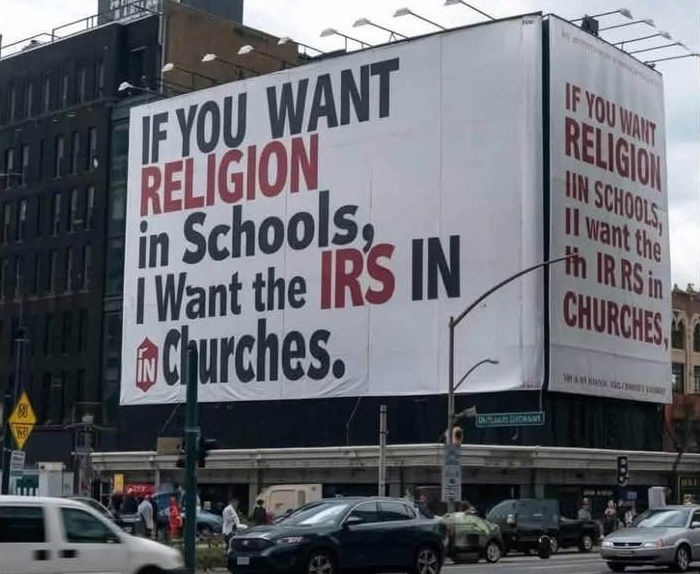
It’s an old argument, one I have heard all my life—and used to make myself long ago. It long ago became cliche. Then I studied the intent of the founders, in particular James Madison who wrote the First Amendment, and came to see the argument as deeply flawed. In this short essay, I explain why the cliche is wrong.
The First Amendment states: “Congress shall make no law respecting an establishment of religion, or prohibiting the free exercise thereof; or abridging the freedom of speech, or of the press; or the right of the people peaceably to assemble, and to petition the Government for a redress of grievances.” The First Amendment has been incorporated, meaning that the protections guaranteed by it have been applied to the states through the Fourteenth Amendment’s Due Process Clause, which states that no state shall “deprive any person of life, liberty, or property, without due process of law.”
Incorporation ensures that state and local governments, not just the federal government, must uphold constitutional rights. In practice, this means that no government body—federal, state and local, public schools, public libraries—can take a position on an establishment of religion. Government institutions are ideologically neutral. At least they’re supposed to be. This is because they belong to the citizenry in all its diversity—religious, etc. The government is not allowed to advocate for a particular religious or ideological viewpoint.
To grasp the importance of this one must understand the distinction between government and individuals. Every individual is entitled to freedom of conscience, speech, publishing, assembly, and association. A citizen does not lose his rights because he is religiously affiliated. A preacher is perfectly free to advocate for a particular political point of view from the pulpit. This does not violate the Separation Clause. What is not allowed is for a tax-exempt organization to fuse its organization with a political campaign. Nor is it allowed to lobby to influence legislation. The congregant remains free to participate in a political campaign or lobby legislators.
School administrators, couches, counselors, paras, staff, and teachers are not permitted to indoctrinate children in whatever ideology to which they subscribe because that would violate the religious liberty of students. But every one of them is allowed to express his beliefs, including religious observances. Students, too, are allowed to express their religious and ideological views. The only restraint on the exercise of religion is time and place, which should be self-evident.
Would it be proper to tell the Muslim teacher that she can’t wear the hijab while teaching? To tell a Christian teacher that she can’t wear her cross? To tell a Jewish student that he can’t wear his Star of David? If the principal of the school doesn’t hang crosses on the school walls or compel the students to pray to Jesus, the Constitution has not been violated if a parent sees hijabs and crosses in their children’s school.
In the high school my kids attended, Muslims pray to Mecca in the building. The school accommodates them by giving them a hall in which to pray. The Somali girls wear the hijab. The Muslim students observe dietary rules. Etcetera. Religious liberty means they have a right to do that. What Muslims do not have the right to is to expect that the high school will require the kafir to adhere to Islamic pray, garb, or dietary rules.
The same is true with gender ideology. A male teacher is free to identify as a female. The school is not permitted to compel students to use the wrong pronouns or festoon their classrooms with trans propaganda. The same is true with neoconfederacy. A man is free to believe this thing. He is not free to require his students to rehearse neoconfederate slogans or hang confederate flags on the walls of his classroom (not as a permanent fixture or as an act of affirmation). Scientologists aren’t allowed to audit the students or make them read Dianetics. Yet Scientologists are in the world practicing their religion.
Religion was never removed from the public square. Because public spaces are for the public, and since the public is religious or not, the public has expressed its various religious and ideological views—or declined to participate in religion—all along. Nobody removed God from the classroom. Those who believe in God go to school. God goes with them. The meme’s premise is a canard.
The reason why church and state are kept separate—and how they are kept separate matters—is as much to keep the state out of religious belief and practices as it is to prevent the state from respecting the establishment of religion. If the churches paid taxes, then they would demand respect, and the churches with the most influence would wield the government to secure their ends over against the citizenry—and that would violates the Constitution.
The idea that tax-exempt organizations are disallowed from political advocacy is to not understand the tax-exempt principle even a little bit. The NAACP is tax-exempt. The organization is engaged in racial politics. The ACLU is political. Tax-exempt. Planned Parenthood is political. The HRC is political. So are the United Farm Workers of America, the American Federation of Teachers, the Chambers of Commerce. All tax-exempt.

 freedom and reason