The Black Panther Party and Black Lives Matter: Revolutionary Rhetoric and the Reracialization of America Politics

On Thursday of last week (October 17, 2024) I presented a section of a developing manuscript on the legacy of the Black Panthers at the conference Social Change and Resistance: Looking Back to Move Forward organized by the Mid-South Sociological Association (their 50th Anniversary as an organization). The published title of my talk “From Civil Rights to Armed Resistance to Community Empowerment: The Rise and Fall of the Black Panther Party.” The subtitle of my talk was meant to communicate the fall and its legacy. As with organized labor, black liberation has been coopted and negated by corporate power. I am sharing here my prepared remarks with some embedded links to relevant sources.

A decade ago, I published a lengthy encyclopedia article on the Black Panthers in Heith Copes and Craig Forsyth’s Encyclopedia of Social Deviance. I am presently expanding that article into a long-form essay or, possibly, a short book, that explores the journey of black liberation from the 1960s to the present day (you can find a version of the initial treatment here: The Black Panthers: Black Radicalism and the New Left).

Today’s talk takes a section of that work in progress, wherein I explore the trajectories of two significant movements in the history of black activism and community organizing in the United States, the Black Panther Party (BPP) and Black Lives Matter (BLM). While both are rooted in a shared discourse of racial justice, differences in ideology, organization, and political engagement reveal a complex shift in how racial issues have been framed and mobilized over time, suggesting that both movements ultimately move from different standpoints. A key part of the analysis concerns the disposition of the state with respect to social movements. 

I argue that to grasp the contrast between these two movements, one must consider the BPP’s history, its theoretical foundations, and the severe repression it faced—subjects covered in my earlier work and forthcoming manuscript—in contrast with the history of BLM and its acceptance by the neoliberal establishment and progressive politics, which have historically been hesitant to embrace militant discourse and praxis.

One interpretation of this acceptance is that social progress has opened the policy ground to critiques of the criminal justice system and more thoroughgoing policy considerations. Another interpretation is that corporate power, and its attendant political apparatus, find ideological advantage in coopting the rhetoric of racial justice. These are not necessarily mutually exclusive.
Source: UCLA News

The BPP was a neo-Marxist movement focused on confronting capitalist exploitation during a time of institutionalized racism and widespread police brutality. The Panthers endured significant state repression, notably through the FBI’s COINTELPRO program, which sought to disrupt and disorganize the BPP through a campaign of disinformation, infiltration, surveillance, and violence, aiming to neutralize the organization by sowing internal discord, undermining its leadership, and bringing disrepute to black liberation movements. J. Edgar Hoover’s description of the BPP as “the greatest threat to the internal security of the country” underscores the extent to which the state viewed the BPP’s Marxist platform as a threat to capitalist stability. There were other targets of COINTELPRO operations, such as the Nation of Islam (NOI). Both the Panthers and NOI, despite significant differences—in particular, the later focused on black separatism—were attempts to build autonomous governance structures from the majority white establishment. 

Founded in 1966 by Huey P. Newton and Bobby Seale, the BPP was a Marxist-Leninist organization committed to revolutionary change, advocating armed self-defense and organizing community programs like affinity-based education, free breakfasts, and health clinics in underserved Black communities. The BPP viewed racial oppression as inseparable from capitalist exploitation. Influenced by thinkers like Frantz Fanon, party theorists saw black communities as internal colonies, dominated by the US ruling class, which exploited black labor and maintained control through poverty and police brutality. This intersection of capitalism and white supremacy justified the BPP’s call for revolutionary socialism and self-defense, positioning them against capitalist and state power.

(For examples of my critiques of Black Power and the New Left, see Frantz Fanon and the Regressive Ethics of the Wretched: Rationalizing Envy and Resentment—and Violent Praxis and The New Left’s War on Imaginary Structures of Oppression in Order to Hide the Real Ones. These contain embedded links to other essays in this vein.)

Perhaps no figure illustrates the depth of state hostility towards the Panthers more than Fred Hampton, the charismatic Chicago leader who was assassinated by the FBI and local law enforcement in 1969 in an operation led by Ed Hanrahan, the State’s Attorney of Cook County. His actions, in coordination with the FBI, resulted in the deaths of Hampton and Mark Clark, leader of the Peoria chapter. Hampton’s murder underscored the state’s fear of a revolutionary black movement capable of challenging capitalist power structures. The BPP’s history is thus one of courageous resistance met with violent state repression. 

To briefly locate this history in the social structural dynamic to draw the contrast of contexts, the milieu in which the Panthers emerged was organized by broader economic shifts driven by the transnationalization project, marked by outsourcing and immigration, developments that eroded job opportunities for black workers, which, combined with Great Society programs that encouraging reliance on public assistance, idled young men and pushed them out of the household, disorganizing further already disorganized urban communities. (This development accompanies the institutionalization of the black civil rights project. See A Note on Desegregation and the Cold War.)

Joblessness, structural inequality, and family disintegration fueled a rise of crime in black-majority inner city neighborhoods, which the Panthers in part moderated through truces negotiated among street gangs and developing and administering on the ground social supports. Indeed, after the destruction of the Panthers, with inner city conditions continuing to deteriorate amid the mounting crisis of late capitalism, gang violence returned and escalated over the next two decades, associated with the vast expansion of the criminal justice apparatus. (See Scaling Up Reaction Formation: The Case of the Ghetto.)

BLM, which gained national prominence in 2013 following the acquittal of George Zimmerman in the killing of Trayvon Martin. BLM gained further momentum after the 2014 shooting of Michael Brown in Ferguson, Missouri, which sparked widespread protests and debates about police brutality and racial inequality. The shooting became a defining moment for BLM, galvanizing a national movement around the idea of systemic racism in law enforcement. (See my recent Ferguson Ten Years Later.)

Founded by Patrisse Cullors, Alicia Garza, and Opal Tometi, BLM positioned itself as the voice of a new generation fighting against police violence and systemic racism. Unlike the BPP, BLM has operated in a political landscape where the ideas of racial justice and reform are more palatable to those in power. The support it has received from corporate entities and its alignment with political figures, particularly within the Democratic Party, represents a stark departure from the antagonistic relationship between the Black Panthers and the state apparatus. Moreover, unlike the BPP, BLM’s arguments and rhetoric regarding criminal justice reforms have become to some degree institutionalized. This has occurred as counterintelligence efforts have shifted attention from populist left movements to populist right movements framed by a narrative of resurgent white supremacy.

In 2020, Zach Goldberg, then a PhD candidate in political science at Georgia State University, argues in the pages of Tablet that, years before Trump’s election, the media significantly increased its coverage of racism and adopted new theories of racial consciousness (“How the Media Led the Great Racial Awakening”). He writes, “In the wake of the protests, riots, and general upheaval sparked by the police killing of George Floyd in Minneapolis, the United States is experiencing a racial reckoning. The response from America’s elite liberal institutions suggests that many have embraced the ideology of the protesters.”

Writing in the moment, Goldberg observes: “Countless articles have been published in recent weeks, often under the guise of straight news reporting, in which journalists take for granted the legitimacy of novel theories about race and identity. Such articles illustrate a prevailing new political morality on questions of race and justice that has taken power at the [New YorkTimes and [WashingtonPost—a worldview sometimes abbreviated as ‘wokeness’ that combines the sensibilities of highly educated and hyperliberal [by which I understand him to mean progressive] white professionals with elements of Black nationalism and academic critical race theory. But the media’s embrace of ‘wokeness’ did not begin in response to the death of George Floyd. This racial ideology first began to take hold at leading liberal media institutions years before the arrival of Donald Trump and, in fact, heavily influenced the journalistic response to the protest movements of recent years and their critique of American society.”

Goldberg proceeds by way of content analysis of several publications, including the Los Angeles Times and Wall Street Journal, in which the jargon taken for granted during the summer of 2020, was rolled out during the Obama presidency, emerging around 2011. Academics terms proliferated—“microaggressions,” “institutional/structural/systemic racism,” “racial disparity(ies)/gap(s)/ inequality(ies)”—as well as increasing frequency of terms such as “white people,” “whiteness,” “white privilege/racial privilege,” “racial hierarchy(ies),” “white supremacy(ism/ists),” and “racism/racists.” These terms were amplified in other print media, in search engines results, and on social media platforms. The drastic rise of racial rhetoric drove public concern across political groups. (They did the same thing with gender. See Gender and the English Language.)

One may argued that the Democratic Party leveraged the perception these terms created to sidestep addressing the deeper economic inequalities affecting both black and white working-class populations, issues that surfaced during Occupy Wall Street in 2011 in response to the 2008 financial crisis and subsequent recession. Occupy Wall Street framed the struggle as between the “1%” and the “99%.” After initially ignoring the movement, coordinated law enforcement crackdowns resulted in arrests and the violent clearing of protest encampments, drawing criticism from civil liberties groups. There was thus a need to pivot from class-based to race-based politics, to obscure the economic focus central to the BPP’s platform. From an elite standpoint, BLM and identity politics provided a timely diversion, fitting the political moment while distracting from broader critiques of economic inequality. (January 2012 speech Theorizing the Moment: Occupy Wall Street.)

Though Cullors and Garza identified as “trained Marxists,” BLM’s focus is on racial justice within existing institutional frameworks rather than the abolition of capitalism. Unlike the BPP, which demanded community control and an end to capitalist exploitation, BLM emphasized narrow reforms, stopping short of a revolutionary challenge to the economic system. The call to defund the police aligns with this more reformist agenda, focusing on restructuring rather than dismantling the institutions that perpetuate inequality and, in turn, drive crime and the need for public safety measures. 

BLM’s integration into mainstream politics has drawn criticism from prominent left figures like Adolph Reed Jr., Cedric Johnson, and Jodi Dean. They argue that BLM’s style of politics emphasizing on identity politics makes it susceptible to absorption into the neoliberal framework. Indeed, BLM’s corporate sponsorship underscores its alignment with the capitalist framework. After George Floyd’s murder, BLM received significant corporate backing, with companies like Amazon, Coca-Cola, Facebook, Google, and Nike pledging billions to racial justice initiatives. Professional sports teams and athletes also became vocal supporters. Leagues like the NBA, NFL, MLB, and MLS incorporated BLM messaging, with players wearing slogans like “Black Lives Matter” and “End Racism,” and kneeling during the national anthem to protest police brutality and systemic racism. These actions are critiqued as performative, leveraging the movement for branding purposes. (See Corporations Own the Left. Black Lives Matter Proves it and What’s Really Going On with #BlackLivesMatter).

Therefore, one possible explanation for corporate and mainstream political support lies in the way BLM’s messaging around racial justice aligned with broader cultural shifts in corporate responsibility and diversity initiatives. From a Gramscian perspective, corporate endorsement of BLM allowed companies to align with a popular social cause without addressing the structural economic inequalities their own practices contribute to. This aligns with what Gramsci described in his Prison Notebooks as a hegemonic project, where opposition isn’t just suppressed but coopted and led. Similarly, for the Democratic Party, BLM’s emphasis on police reform and social justice provided a way to appeal to younger, more progressive voters, positioning the party as a champion of racial equality while sidestepping deeper critiques of capitalist exploitation, which movements like the Black Panthers had prioritized.

* * *

The BPP had a nuanced view of the nuclear family that reflected its broader revolutionary goals. While the BPP critiqued the traditional nuclear family structure, particularly in its patriarchal form, it did not outright reject the family unit. Instead, they reimagined it within a collective framework that aligned with Marxist ideology.

In traditional Marxist theory, the nuclear family is viewed as a product of capitalist society, reinforcing private property, patriarchy, and individualism. The BPP, drawing on these ideas, saw the nuclear family, especially when shaped by capitalism, as potentially oppressive, particularly to women and children. They viewed the traditional family as a space where capitalist and patriarchal values were often reproduced, including rigid gender roles and the subordination of women. At the same time, they critiqued the systemic forces—poverty, racism, and state violence—that harmed black families, leading to the breakdown of community structures.

The BPP prioritized women’s liberation within their movement, rejecting traditional gender roles and advocating for women’s participation in leadership and decision-making. This stance naturally conflicted with the idea of the nuclear family as a patriarchal institution. Many prominent women in the BPP, such as Elaine Brown, contributed to shaping this vision, which placed the liberation of black women on equal footing with the broader struggle against capitalism and racism.

BLM, on the other hand, explicitly critiqued the nuclear family, particularly its patriarchal form, as part of its foundational ideology. In early versions of its platform, BLM stated their commitment to “disrupt the Western-prescribed nuclear family structure,” which they argued was a tool of oppression that enforced rigid gender roles and upheld patriarchal and heteronormative values. Instead, BLM promoted extended kinship networks and “villages” that would raise children and support each other outside of the traditional nuclear family model.

This stance drew criticism from conservative commentators who saw it as an attack on the family structure itself. BLM later softened or removed some of this language from its public platforms. Their emphasis was on creating inclusive family structures that recognized the roles of extended families, non-binary individuals, and same-sex partnerships, as well as supporting single-parent households, especially in marginalized communities.

While both BPP and BLM shared a critique of patriarchy and recognized the ways that the nuclear family could perpetuate inequalities, BLM’s position was more directly aligned with dismantling the nuclear family as part of a broader challenge to heteronormative and patriarchal systems. BLM explicitly linked the dismantling of patriarchal family structures with broader LGBTQ+ and feminist goals. BPP was more focused on reconstructing family life within a collective framework that emphasized community solidarity.

* * *

BLM’s integration into elite institutions may also be understood through the lens of a “color revolution,” where revolutionary rhetoric is simultaneously manufactured and channeled into maintaining the status quo. A color revolution refers to a form of non-violent and violent resistance or protest movements aimed at influencing regime change. These movements are typically associated with the Orange Revolution in Ukraine (2004) or the Rose Revolution in Georgia (2003), which were named after their distinctive symbols or colors associated with the protest. We also saw this with the Arab Spring, which emerged in 2010. They rely on civil disobedience, grassroots activism (often astroturf), and mass mobilization, and they often seek to unseat governments seen as authoritarian, corrupt, or illegitimate.

The popular narrative is that color revolutions are organic phenomenon, but those who follow these developments closely see something different: the role of foreign intervention, NGOs and Western governments, in particular the CIA and other national security state actors. These observers argue that movements can be manipulated and even orchestrated by external powers to advance geopolitical interests rather than genuinely democratic or local aims. This is where the concept intersects with ideas about “manufactured revolution,” where revolutionary energy within a population is co-opted by external actors to destabilize a regime without necessarily creating substantive democratic or populist reforms. We most recently saw this in Ukraine in 2014, where the CIA or other Western intelligence agencies supported far right elements in Ukraine during the 2014 Euromaidan protests and the subsequent conflict (see History and Sides-Taking in the Russo-Ukrainian War).

In recent years, the term “color revolution” has been broadened to describe perceived attempts to undermine or destabilize regimes in a way that benefits transnational interests, especially in opposition to nationalist or populist movements. Governments facing such protests sometimes frame them as being instigated by foreign powers to delegitimize domestic dissent. The connection to the BLM movement in some critiques relates to concerns about the manipulation of grassroots energy by elites to channel frustration into controlled opposition that ultimately aligns with corporate or political establishment interests, rather than radical change.

Claims that BLM may be part of a “color revolution” narrative, manipulated by elites or serving establishment interests, come largely from populist and anti-establishment voices on both the left and the right. Prominent figures and thinkers have advanced these critiques. These critics argue that, even if we assume that BLM began as a genuine grassroots movement against police brutality and systemic racism, it has since been co-opted by corporate, political, and media elites who have shaped its messaging and goals in ways that align with their broader agendas. This view often posits that BLM’s energy was directed away from systemic change and toward reinforcing the power of existing political institutions, particularly the Democratic Party.

Darren Beattie, founder of Revolver News, has explicitly linked BLM to “color revolution” tactics. Beattie’s argument is that BLM protests, along with the broader unrest of 2020, were part of an orchestrated effort to undermine the populist movement and create political instability that benefited Democrats. Michael Benz, a cybersecurity expert, has drawn comparisons between BLM and CIA racial operations in Third World countries. 

Evidence supporting these claims centers on many of the observations already made here corporate sponsorship and close alignment with the Democratic Party. With respect to the latter, BLM’s messaging and activism aligned closely with Democratic campaigns, particularly during the 2020 presidential election. BLM leadership, especially figures like Patrisse Cullors, have been criticized for their closeness to Democratic elites and fundraising strategies. However, Cullors has publicly stated her alignment with progressive causes within the Democratic framework, which confirms the movement’s institutional entanglement.

* * *

Elite support served to blunt the momentum of populist, class-based movements that threatened the established economic order and progressive political hegemony. By channeling popular energy into the more manageable discourse of racial justice, BLM’s rise helped deflect attention from broader critiques of economic inequality and class oppression as the Democratic Party moved close to corporate power and the Republican Party fractured along intraclass lines. BLM’s focus on identity politics allowed corporations and political elites to signal their commitment to social justice without confronting the underlying class dynamics that perpetuate inequality. By emphasizing racial injustice through academic terms such as “white privilege” and “structural racism,” elites redirected populist anger away from the failures of neoliberalism and toward identity politics and a seemingly radical politics that does not threaten the corporate state structure. This alignment thus effectively neutralized the potential for a more radical, class-based movement that might have challenged corporate power or sought systemic change beyond the realm of police reform.

My critique notwithstanding, the BPP’s Marxist revolutionary platform directly challenged the economic and political order of the United States, seeking to unite worker liberation with the overthrow of capitalism. BLM, despite radical rhetoric, has been co-opted by corporate interests and operates within a framework that diverts attention from class struggle—indeed, it may have been organized to achieve this purpose. The corporate sponsorship, academic backing, and political alignment with the Democratic Party suggest that BLM serves to maintain the capitalist system rather than threatening it. While the BPP was repressed by state forces through programs like COINTELPRO, BLM is free to operate within the capitalist order, at the very least raising questions about its role in sustaining the very structures its supporters claim it opposes.
“Trusted Sources of Information” and the Art of Prebunking

Secretary Jocelyn Benson says that her office “know adversaries to democracy right now are trying to create chaos and confusion and sow seeds of distrust around our very clear and legitimate and accurate and secure processes of running elections, not just in Michigan but around the country. So it’s incumbent upon all of us to look to trusted sources of information like your local election official and use data to evaluate questions, as opposed to people who are running social media companies with particular agendas and who have a history in amplifying conspiracy theories and false information. So in this moment, it will be my responsibility, and really everyone’s, to look and promote and amplify trusted information about our elections so that people can know both where to go with questions and also have faith in the results.” She told the host of Face the Nation that Michigan has set up a website that addresses every single question people have raised and “encourage citizens to go there, as opposed to social media for seeking trusted and accurate information about our elections.”

Jocelyn Benson, Michigan Secretary of State

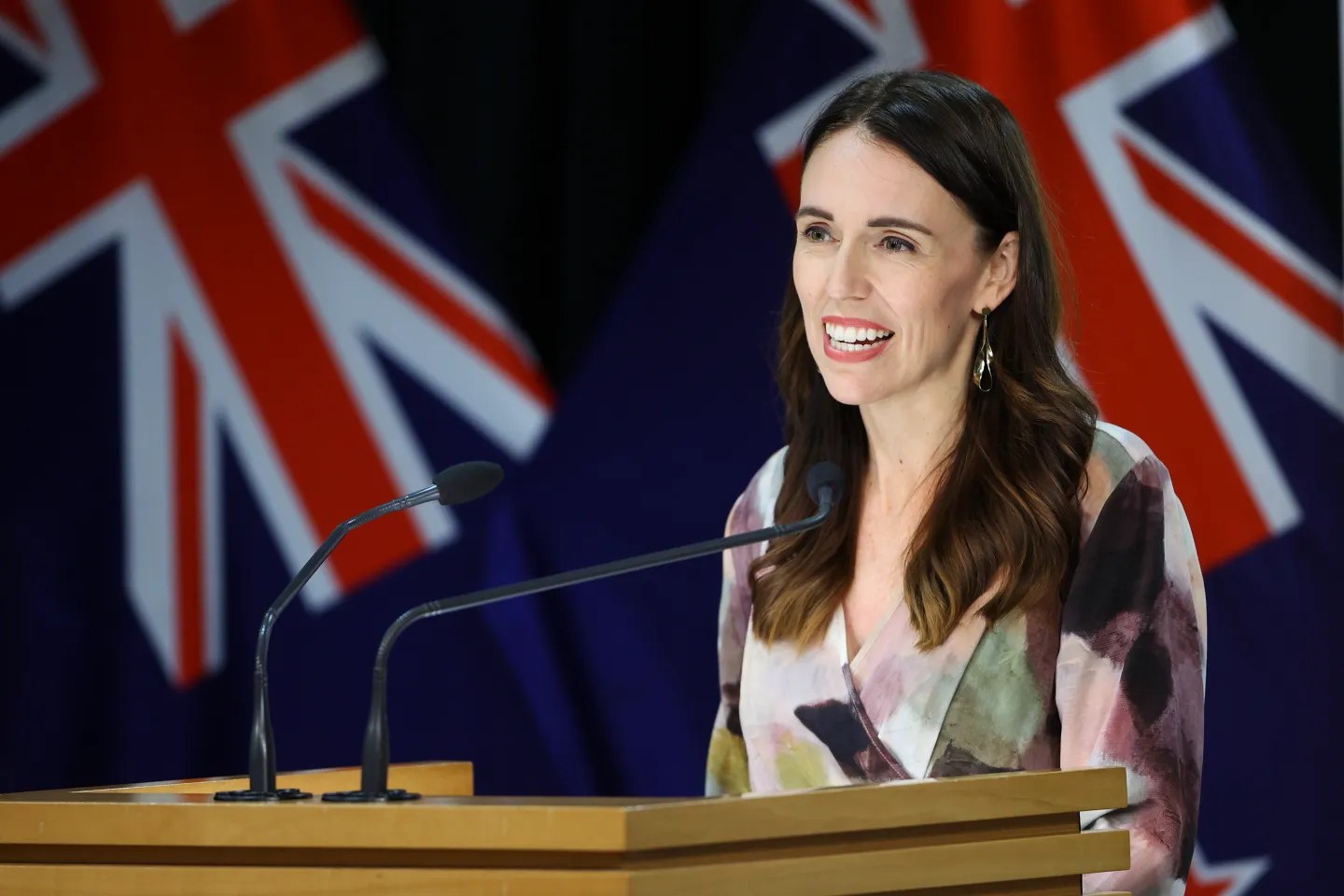
Who are the “adversaries of democracy”? The American people and that other party. How about this term “trusted source”? Remember Jacinda Ardern, Prime Minister of New Zealand, telling New Zealanders to not trust anybody or anything but her and the government of New Zealand? Same thing. “We are your single source of truth,” she said. She set up a website that New Zealanders were directed to use exclusively. Benson says it is our responsibility to “promote and amplify” so-called “trusted sources.” Different state. Same shit. This is the same “trust the science” and “listen to the experts” propaganda they used to lock you in your homes, make you wear a mask, and scare you into injecting into your bodies an mRNA gene therapy developed by the military-industrial complex (arguably the greatest medical scandal in history).

Jacinda Ardern, former Prime Minister of New Zealand

You can trust your government no more than you can trust the Catholic Church or any other power that stands over you. This is the bottom line for a rational being: its default is set to disbelief. You cannot trust your public health department and you cannot trust your local election official. If the latter were trustworthy, then they would demand voter ID and proof of citizenship. There would be no dropboxes, no postal voting, no other scheme to stack vans with votes. Just like the voting machine companies not letting the public see the guts of the devices that record its votes—the government has thrown people in prison who try—they want you gullible or scared. That they aggressively work against election integrity screams corruption.

When government is not transparent, you can safely assume the government is deceiving you. Governments aren’t citizens. Citizens have rights. Governments have powers, and in a free and open society, these powers are vested in them by the citizen. Citizens have a right to keep their thoughts and papers to themselves. They also have the right to see what the government is doing. The government has no right to keep anything from the people.

Until 2020, we almost always knew who won the election the same day we voted. France counts all the votes the day of the election, and France is bigger than every state in America. As of the most recent estimates, France’s population is around 68 million people. In comparison, the most populous US state, California, has a population of approximately 39 million. Why can’t a state the size of Michigan count all the votes by the evening of the day of voting?

There are moments in our history where we did not know the results right away, and the facts surrounding them are instructive.

In 1960, the race between John F. Kennedy and Richard Nixon was extremely close, with the result hinging on a few key states. Although Kennedy was declared the winner the night of November 8, it took several days for recounts and challenges to be settled. It appears now that Nixon probably won that election. Democratic Party cheating was rampant in Illinois (Chicago) and Texas. Those around him urged him to contest the election, but he resisted.

Nixon was declared the winner in Hawaii by a narrow margin, but after a recount requested by the Democrats, Kennedy was awarded the state’s three electoral votes. The controversy over Hawaii’s electoral votes extended into December, with both slates of electors—a slate for Nixon and a slate for Kennedy—cast votes. When the results were certified in early January 6, 1961, Congress ultimately counted the electors for Kennedy.

The election did not hinge on Hawaii, but you might have noticed something interesting about the case. You read that right: two slates of electors. Was anybody prosecuted? No. Why not? Because that’s the way federal law worked until after the 2020 election, when Democrats and establishments Republicans quietly changed the law (see The Project to Entrench Establishment Power: “Clarifying” the Electoral Count Act).

In 2000, in the contest between George W. Bush and Al Gore, the result wasn’t known until more than a month after Election Day, due to the Florida recount and a Supreme Court decision in Bush v. Gore, which effectively decided the election on December 12. For the record, I said then and I will still say now that 2000 was a stolen election. Gore was right to context the results and wrong to give up when he did. It’s okay to say that elections are rigged and stolen because Democrats had no qualms about saying 2000 was stolen.

In 2004, in the contest between Bush and John Kerry, Democrats once more told us that election denialism was fine. And they were probably right that the election was stolen. While Bush was eventually declared the winner over John Kerry on the morning after Election Day, uncertainty about Ohio’s results lingered into the following day. Kerry didn’t concede until November 3 after it became clear that Ohio’s results wouldn’t change. I thought Kerry gave up too early. Ohio’s results stunk like a fish market.

In 2020, allegedly due to the high number of mail-in ballots during the COVID-19 pandemic, counting in key states like Arizona, Michigan, and Pennsylvania continued for several days. The result wasn’t projected by major news outlets until November 7, when Joe Biden was declared the winner over Donald Trump. Can we say that election was rigged and stolen? No. Democrats have declared it treasonous to say that elections are rigged or stolen. They sicced the police state on conservatives who said so. Because they said so, submitting an alternative slate of electors in 2020 became a criminal offense.

I do have this feeling that after November 5, if Trump wins, election denialism will once more be okay.

Could This Be a Blowout?

Screen shot from today’s FiveThirtyEight poll of polls

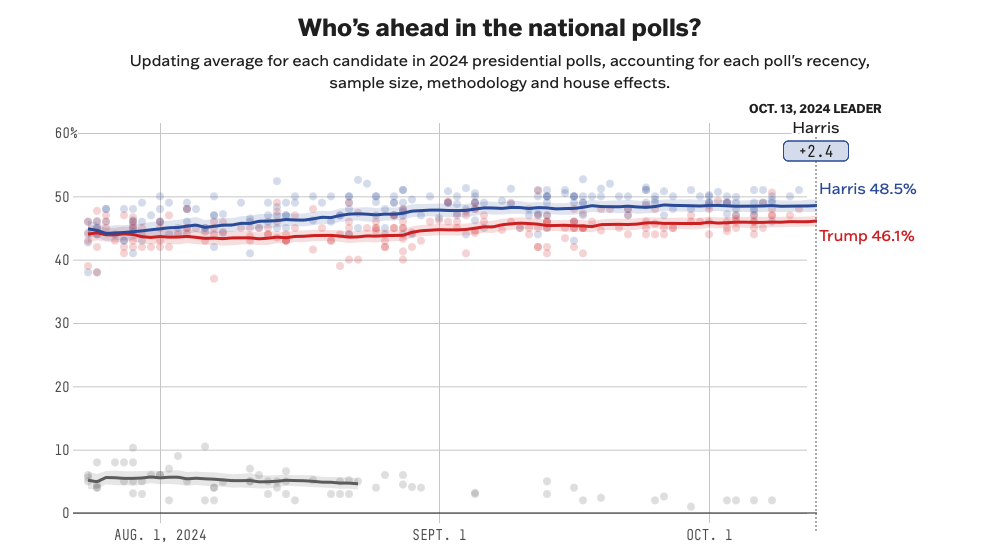
Everyday the gap shrinks. Above is FiveThirtyEight’s poll of polls. As readers can see, it’s not so much Harris sinking (she is) but Trump rising. For those out there who take refuge in the two-point lead for Harris, remember that she needs to be well outside the margin of error to win this election because (a) polls drastically undercount Trump’s support and (b) the Electoral College.

A significant number of Trump supporters won’t declare their support for Trump on surveys because of social desirability bias. This occurs when people alter their responses to appear more favorable or socially acceptable. In the context of polling, some respondents give answers they believe will make them appear more aligned with social norms, even if those answers don’t reflect their true feelings. This can skew poll results, as it leads to underreporting of controversial or socially disapproved opinions. Trump has been demonized such that some people will not admit they support him.

Moreover, polls oversample Democrats, since a lot of working class people are not home or don’t have the time to respond to polls. Since the Republican Party is the party of working class people, this also skews the data. Trump is almost certainly in the lead nationally when these factors are considered.

The New York Times finds the same trend as FiveThirtyEight. Its poll finds the race even tighter:

The New York Times

Trump is more popular now than he was in 2020 or 2016. What is more, Trump was more popular in 2020 than in 2016—which is why he won more than ten million more votes in 2020 than in 2016.

There’s at least one obvious reason for this shift. The percentage of Americans who say they have a great deal or a fair amount of trust in the mass media has trended sharply downward over the years, according to a recent Gallup survey.

Gallup

People are realizing every day that the media (as well as academia and the culture industry—which is why celebrity appeal is not working for Harris) is progressive propaganda and properly losing their faith in the legacy institutions and popular culture that have grown up around the corporate state to control mass consciousness. As they lose their faith in this domain they see Trump more clearly. What they see in place of a monster is a self-made man from Queens with liberal sensibilities and a wicked sense of humor. They like that.

Gallup

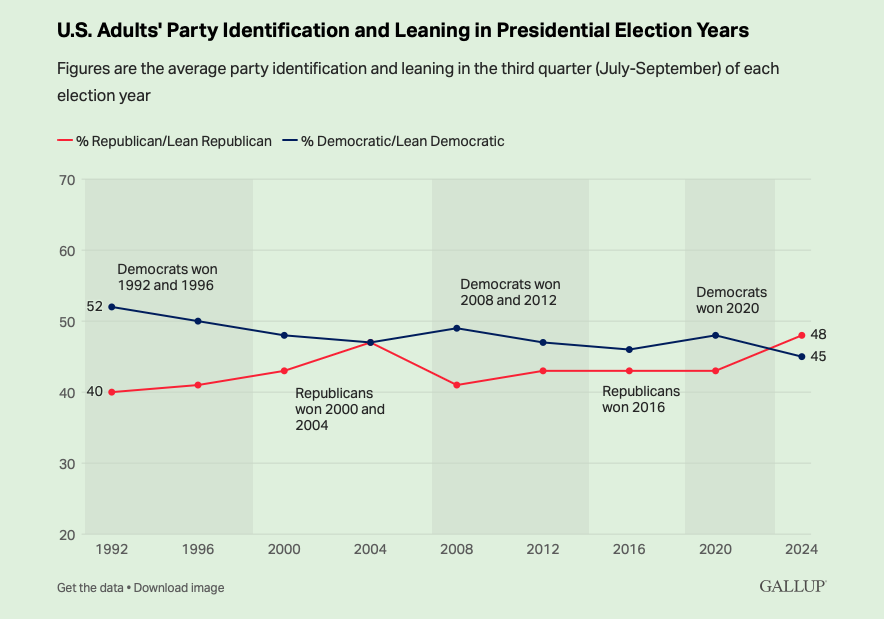
They also see more clearly that the Republican Party is shifting emphasis towards the democratic-republican principles and classical liberal values that underpin the American Republic. This is the attraction of populist-nationalism over against the corporate statism of the Democratic Party and progressive ideology. As a result, more Americans identify or lean Republican than they do Democrat, 48 to 45 percent respectively. Again, social desirability bias likely means that the gap is much greater than indicated by this poll. Moreover, by a five point margin, Americans believe that the Republican Party is better able to handle most important problems facing America, according to Gallup.

This is the situation in which the Harris campaign finds itself in the battleground states. Trump won 2016 and very like 2020 even though both Clinton and Biden were way up in the polls at this point in the election cycle. For example, Biden is shown here winning Wisconsin by 6.2 percent. On Election Day, he only won by only a few thousand votes. Officially.

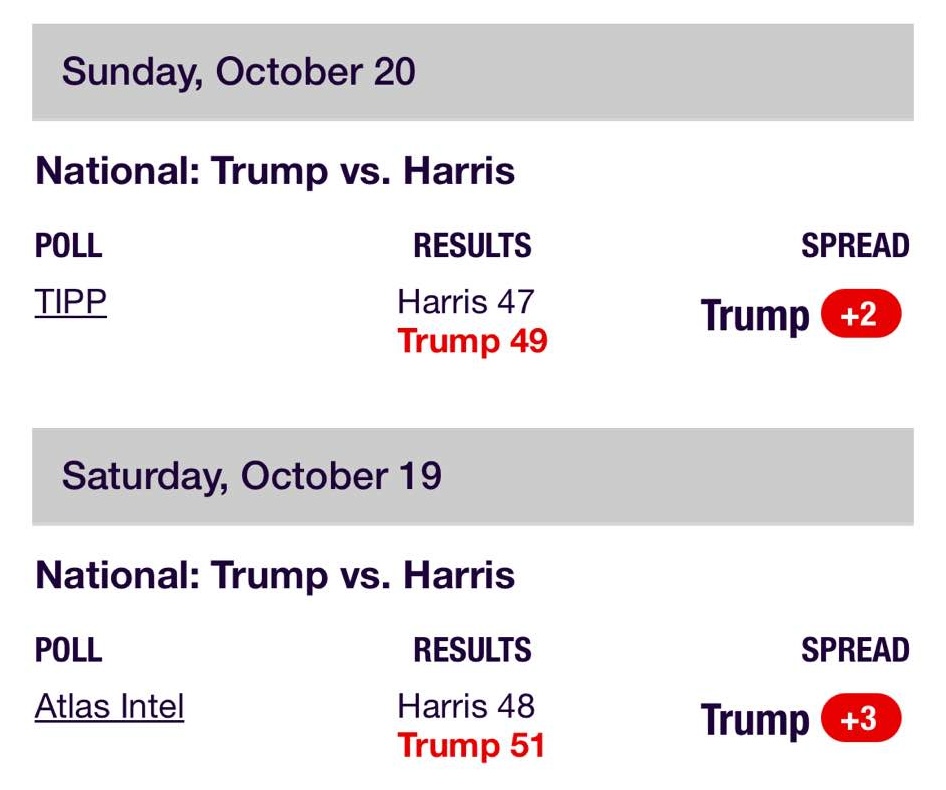
Now TIPP has Trump up two points (Trump Surges Past Harris, Seizing 2-Point Lead). This could be a blow out.

From RealClearPolling

The Housing Crisis in a Nutshell

In the 1960s, the percentage of foreign-born people in the United States was relatively low compared to earlier periods in American history and compared to today. In 1960, approximately 5.4 percent of the US population was foreign-born, while the remaining 94.6 percent were native-born. This was a period when immigration levels had significantly decreased due to restrictive immigration laws, such as the Immigration Act of 1924, which established national origins quotas that limited immigration from many regions. In 1960, the US population was about 179 million, and estimates suggest there were around 200,000 to 500,000 illegal immigrants. This means that illegal immigrants constituted roughly 0.1 to 0.3 percent of the total population at the time.

Source: Axios

The immigration landscape changed dramatically after the passage of the Immigration and Nationality Act of 1965, which abolished these quotas and set the stage for an increase in immigration in subsequent decades. As of 2023, about 14.3 percent of the US population is foreign-born,. This figure has been increasing steadily over the years and represents the highest proportion in over a century​. In 2024, with an estimated US population of about 334 million and, using the lowest estimates (provided by DHS) of 11 to 12 million, illegal immigrants now make up approximately 3.3 to 3.6 percent of the population. If higher estimates of 20 to 25 million illegal immigrants are used, they make up approximately 6 to 7.5 percent of the US population in 2024. ​Whichever number we go with, the percentage has clearly grown, reflecting changes in immigration policy, birder enforcement, and migration trends over the decade.

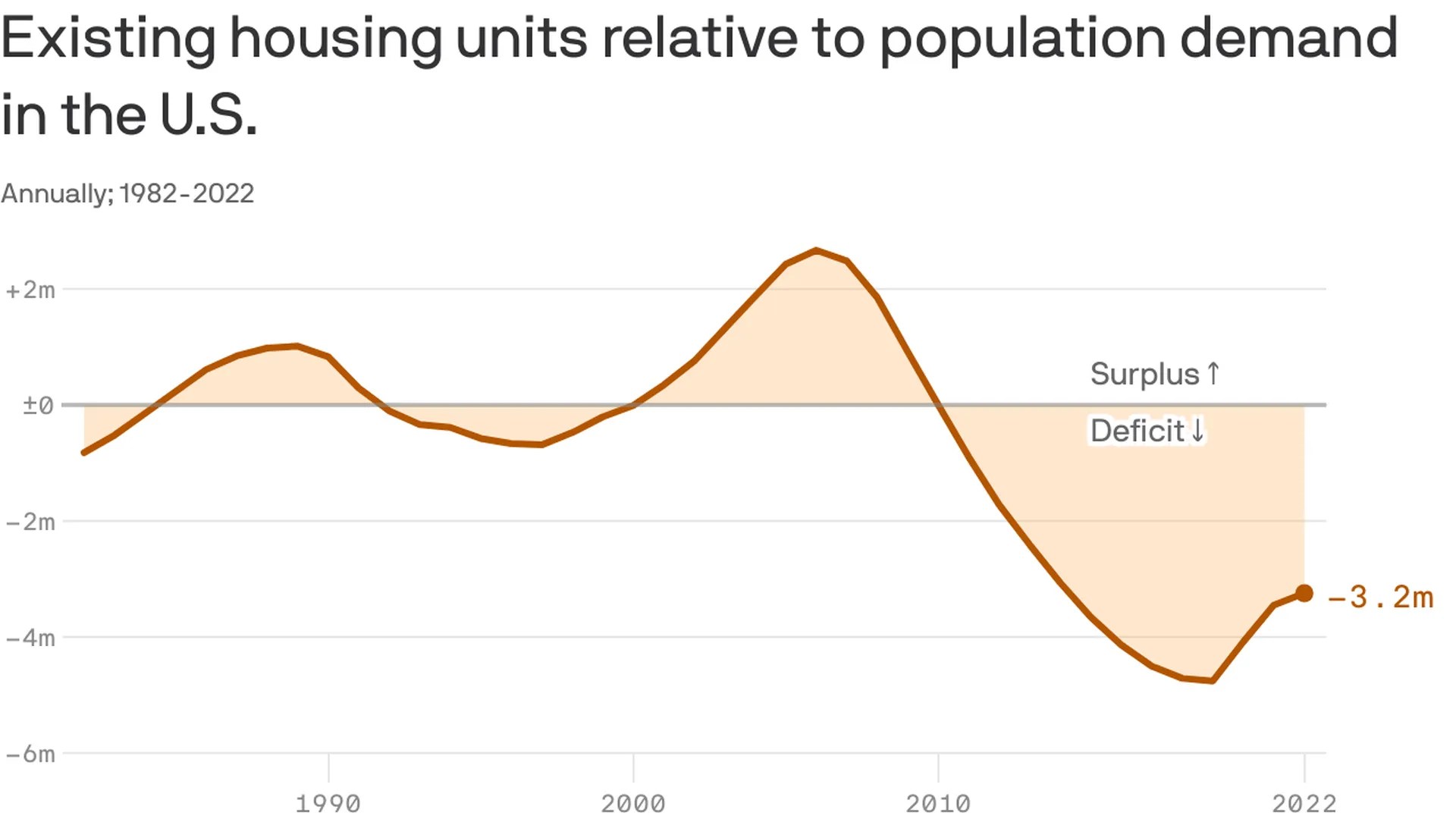
It is understood that the US faces a shortage of millions of affordable homes, especially for low- and middle-income renters. Estimates I have seen suggest a shortfall of 3 to 5 million homes. This shortage has driven up housing prices, making it harder for people to buy homes. It has also contributed to rising rents in many cities, exacerbating the situation. In 1960, the median home price was about $12,700, which, adjusted for inflation, equals approximately $111,760 in 2024 dollars. By comparison, the median home price in 2024 is estimated to be around $416,100, quadrupling of housing prices.

By the 1960s, United States had experienced a post-war housing boom, with a relatively high availability of affordable single-family homes, partly due to government programs like the GI Bill, which helped many veterans buy homes. Fast forward to recent years, the housing market has faced a critical shortage. Based on basic supply and demand principles, assuming the number of housing units remains constant, having millions fewer people in the United States would increase housing availability and bring down prices for native-born Americans and those foreigners legally in our country.

All these figures are easily available on the Internet. It takes only a few minutes to figure all this out. So, ask yourself, why doesn’t the mainstream media explain this to the American people? The answer is simple: the corporate media is part of the project to fundamentally change the demographic composition of the United States, to disorganize its communities and culture, undermine national integrity, and provide a dependent constituency for the permanent rule of the Democratic Party and its fellow travelers in the Republican Party. These are the transnationalists, and cultural pluralism is their strategy to realize their vision of a one world government run by global corporations. (I have written about this extensively on Freedom and Reason. Here is an example from January of last year: An Architect of Transnationalism: Horace Kallen and the Fetish for Diversity and Inclusion.)

Panic is Setting In

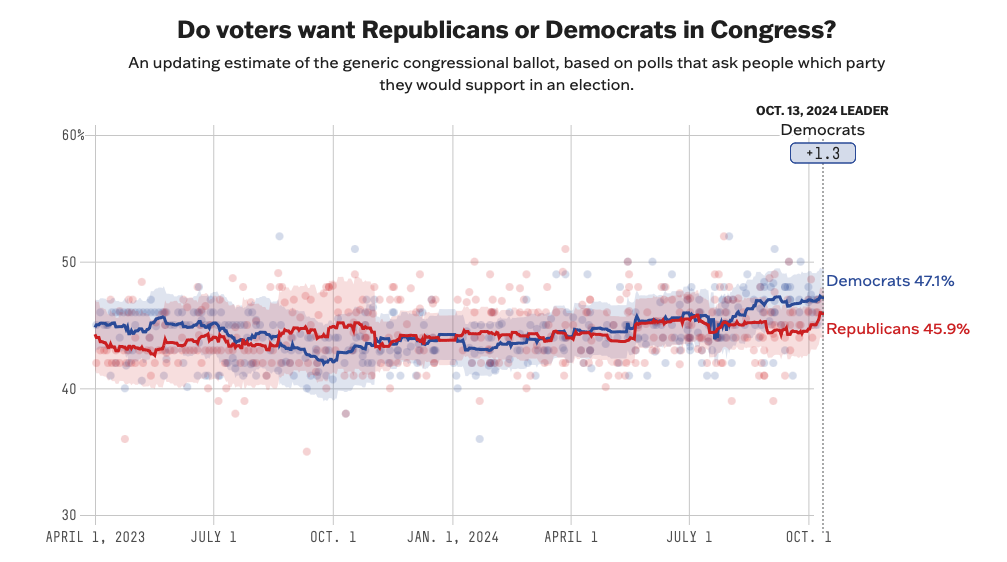
This is according to FiveThirtyEight. Look at the movement in the generic ballot as we approach the finish line. Democrats are trending upwards. But Republicans are trending upwards much faster and closing the gap. Harris is generally trending downward in the battlegrounds. She’s only up 2.4 percent nationally. She not only can’t break out of the margin of error, but Trump is closing. RealClearPolling is today reporting that NBC has it a tie nationally (here’s that NBC story).

Despite the mainstream media, social media, political elites, and the culture industry and its roster of celebrities doing everything they can to elevate Harris and trash Trump, they can’t put her or the Democratic Party in a statistical lead—and from past experience, we know the true strength of Trump and Republicans are elusive in polling. Despite everything the Establishment is doing—including the administrative state and its wide-ranging campaign of lawfare against its enemies—Trump and the Republicans are surging. JD Vance has been killing it on the MSM the past few days.

If on election night we see a repeat of 2020, tens of millions will not trust the results—and they will be right to dispute the results. The demand that people have faith in a corrupt system is a call to share in an illusion of election integrity. People who ask you to trust the government should not be trusted themselves. Democrats undermine confidence in the system. They sue to prevent the cleaning of voter rolls. They legislate and sue to prevent voter ID. They push for machine balloting, ballot harvesting, and drop boxes. They thwart efforts to establish voter verification and chain of custody. Then they gaslight you when you object. They call for censorship and deplatforming.

If Trump wins in a close election, expect Democrats to drag out the certification process and dispute the outcome like they did in 2000, 2004, and 2016. They will do everything they condemned Trump of and much more. And be prepared for pandemonium in the streets. Remember the riots in 2016 and 2017 when Trump won and was inaugurated? Expect mob violence if Trump wins. They’re freaking out. All day today they have dwelled on Trump’s farts and trying to make him out to be Hitler. The progressive side of the fence is Bedlam.

Today progressives raised the horror of Japanese internment because Trump intends to established detention facilities for criminal aliens. But the Japanese were US citizens. And who put them in camps? The paragon of progressivism Democrats Franklin Roosevelt did—the same man who did not honor the precedent set by George Washington and every other president to serve only two terms.

Take sixteen minutes out of your life and have your mind blown. If Trump wins in the Electoral College, the deep state may try to run Scenario 3.

Attraction, Behavior, and Ideology: When to Mind Our Own Business

“Transphobia” is as nonsensical a term as “Islamophobia.” What’s next? “Fasciophobia” for when people decry being hauled away for criticizing irrational belief systems? I’ve said this before, but it bears repeating.

Disbelief isn’t belief. It’s the absence of belief. I disbelieve the claims of religion and quasi-religious systems. I don’t believe in things that are impossible or that are not proven or provable by reason or facts. I’m an atheist. I don’t believe there’s a god. No apologies. If you want to believe in a god, that’s fine (you don’t need my permission), just don’t force me to. I’m a civil libertarianism, which is a political philosophy that advocates for the individual’s right to believe in what he will or not to believe in what he won’t, to express what he wishes or not say anything at all.

How is a political philosophy that seeks the negative liberty situation of not being compelled to believe or say things others believe and say a form of bigotry? It can’t be. Yet I encounter people all the time believe that if you reject or criticize their beliefs, then you’re a bigot. This position indicates the habit of deploying a self-sealing fallacy where everything a person disagrees with becomes bigotry. If this fallacy becomes common practice, and unfortunately it has, it allows for compelling people to believe and say certain things or have them act in bad faith. There are words for this attitude. Do you know them? Think about it and I will share some of them at the conclusion of the essay.

The word bigotry is thrown about in a reckless manner. Words have meanings. Bigotry is defined as the stubborn and unreasonable attachment to a particular belief, opinion, or prejudice. Sometimes the definition includes discrimination, hatred, or intolerance against those who are perceived as different or who hold different viewpoints. Let’s accept the second part for the sake of argument, since those making accusations of bigotry often advance the latter while eschewing the former (that’s a matter of usage). However, the first part, the part about stubborn and unreasonable attachment to a particular belief, opinion, or prejudice is the operative definition.

I was recently asked whether bigotry against trans people is even possible. I am asked about this with respect to several other faith-beliefs, as well. Or at least the question is assumed in discourse. I have been accused of “Islamophobia,” for example, a term that intends to convey bigotry against Islam—as if this were possible for an atheist to do, since the atheist has no religious beliefs to which to stubbornly or unreasonably cling. It is of course possible for the Muslim to be a bigot, since he often presents with a stubborn and unreasonable attachment to a particular belief, opinion, or prejudice. Moreover, Muslims are often hateful towards and intolerant of those who hold other viewpoints.

Disbelief in religious and religious-like ideologies cannot represent stubborn and unreasonable attachment to a particular belief or opinion since disbelief is not a belief or an opinion, but the lack thereof. Disbelief is the refusal to accept something as true or real without a compelling reason to do so. Disbelief is an expression of doubt or skepticism, often in response to something that seems implausible or contrary to what one knows to be factual or reasonable. It is therefore reasonable to criticize all beliefs that are not confirmed or verified. Why should faith-belief be spared from unflinching criticism? It shouldn’t. Irreligious criticism is the opposite of bigotry. It is the mark of an open mind.

Do I prejudge believers? Of course I do. Why? Because believers come with beliefs I disbelieve or reject. I can expect a Christian to believe certain things. Humans are (usually) thought-bearers, and very often the thoughts they bear are false and irrational. Some of their beliefs I confess to hating, if by hate one means an intense reaction characterized by strong aversion or enmity towards belief or behavior. It is my natural right to hate things; it is innate constituent of my evolved emotional inventory. That’s freedom of conscience. Nonetheless, as a civil libertarian, I tolerate beliefs I reject and hate. People are free to believe what they will and express those beliefs. What I am not obliged to tolerate are behaviors or actions based on those beliefs that interfere with my freedom or harm others. Moreover, a free society requires tolerance of others beliefs so that there is a guarantee that my beliefs will be tolerated. Otherwise, it’s not a free society.

Therians or Otherkin

The short answer, then, is no, it is not possible to be bigoted towards people who believe in impossible things like that a man can be a woman or a man can be without gender (nonbinary), since the rational person disbelieves in impossible things, which these things are. Again, it is obligatory or vital in a free society to be tolerant towards those who believe in things like “gender identity,” “souls,” “therians,” “thetans,” etc, because, among other things, one would like to enjoy tolerance towards his own beliefs, such as belief in his right to be freedom from compelled belief. However, it is entirely reasonable for a free people to criticize and defend any belief. I’d say more than this: it’s obligatory to do so if people wish to keep their society free.

What about homosexuality? Is bigotry towards homosexuality even possible? For sure, just as bigotry towards women, i.e., misogyny, is not only possible but widespread. There are many men (and some women) who believe the woman’s place is in the home. There are men (and some women) who believe that women have no right to female-only activities and spaces. They have a stubborn and unreasonable attachment to this opinion. When misogyny is put into practice, we know it as sexism. The same is true with heterosexism, which is the institutionalize practice of denying homosexuals full equality. Heterosexism generates and is perpetuated by bigotry against gays and lesbians, such as the bigoted position that heterosexuality is the only acceptable form of romantic love.

Homosexuality is the romantic or sexual attraction or behavior between members of the same sex or gender. It is one of the sexual orientations, alongside heterosexuality (attraction to the opposite sex) and bisexuality (attraction to both sexes). In a broader sense, homosexuality encompasses both the identity of individuals who experience same-sex attraction and the cultural and social practices associated with same-sex relationships. While the term “homosexual” is often used to describe people who are attracted to others of their own sex, some prefer terms like “gay,” “lesbian,” or “bi,”which can carry more positive and affirming connotations. I use these terms, too, but at the same time, there has always been a need to destigmatize the word “homosexual.” To put this another way, we should condemn anti-homosexual bigotry. Should we punish people for it? No, because bigots have a right to their bigotry.

Source

Homosexuality is very different from the idea “gender identity,” found in queer theory, in that the latter is not a natural attraction or behavior but an ideological construct. Gender identity is analogous to the soul in Christianity or the thetan in Scientology. Whereas the words used to denote homosexuality refer to real things, the words used to denote gender identity as constructed by queer theory call things into existence that have no actual reality. This is why the smear “transphobia” does not describe an actual phobia but constitutes a thought-stopping device used to chill criticism of the ideology. Accusations of transphobia do the same work as accusations of “Islamophobia” when devotees of this ideology and their allies seek to shut down irreligious criticism. A disbeliever cannot be a bigot for denying the claims of queer theory anymore than he can be a bigot for denying the claims of Islam.

The view that all ideologies are legitimately subject to criticism, which is central to my style of sociological critique, is rooted in the principles of intellectual freedom, critical thinking, and the pursuit of truth. No belief system or set of ideas should be immune from debate, doubting, questioning, or scrutiny. All ideologies, by their nature, represent particular interpretations of the world that are shaped by cultural, historical, and social contexts. As such, they are inherently fallible and open to challenge. To be sure, critics of this view often argue that ideologies play a crucial role in providing meaning, moral guidance, and social cohesion, and that constant criticism undermines these functions. But without the ability to critique ideologies, we risk of dogmatism, where ideas are accepted without question, which in turn leads to the suppression of dissent and the perpetuation of harmful beliefs. After all, racism provides meaning, moral guidance, and social cohesion. Should we not undermine these function with vigorous criticism of racist belief?

Irreligious criticism—and queer theory meets the anthropological and sociological definition of religion—closely aligns with the values of democratic societies, where freedom of thought and expression are protected, and where debate and dialogue are considered essential for the healthy functioning of public life. This is the ethos of the Enlightenment, which emphasizes reason, skepticism, and the continuous testing of ideas as a means to progress—and for sustaining freedom and making justice. By subjecting all ideologies to criticism, we better identify biases, uncover hidden assumptions, and refine or reject ideas that do not withstand scrutiny. This process is seen as vital for the advancement of knowledge and for the development of more just and equitable social systems. Should we not criticize Scientology because those who subscribe to these ideas will be offended or feel unsafe? If we do, are we bigots? Of course not. Not at all. It is a ridiculous charge.

The ideas of queer theory and its foundation in pseudoscientific tendencies in psychiatry and sexology are crackpot and not merely stand as legitimate objects of critique, but require vigorous critique because they are harmful to individuals and society. Homosexuality is not an ideology. Recognition of homosexuality is rooted not only in our commitment to individual freedom, but in admitting naturally occurring phenomenon. Trans genderism, in contrast, is a desire to manufacture simulated sexual identities, several orders down the precession of simulacra, things that have no basis in real world, indeed things that contradict observable and verifiable reality. A man can love another man and know him sexually. A man cannot be a woman in the same way that there is no thetan lurking inside each of us.

Discriminating against homosexuals is wrong because it violates fundamental principles of dignity, equality, and human rights. All individuals, regardless of their sexual orientation, deserve to be treated with respect and afforded the same rights and opportunities as others. Discrimination based on sexual orientation perpetuates harm by reinforcing negative stereotypes, fostering social exclusion, and denying people the freedom to live authentically and openly. At its core, such discrimination is an unjust exercise of power that marginalizes individuals based on a characteristic that is integral to their identity. It undermines the social fabric by promoting division and intolerance, which can lead to further prejudice and violence. Recognizing the humanity and worth of every person, irrespective of whom they love, is essential for building a fair and inclusive society where everyone has the chance to thrive. Discrimination against homosexuals has no rational basis; it often stems from unfounded fears, cultural biases, or outdated moral beliefs that have been challenged and debunked over time.

Discriminating against people based on their religious or ideological beliefs is wrong, as well, because it infringes on their fundamental rights to freedom of conscience, expression, and thought. These freedoms are cornerstones of a just and democratic society, allowing individuals to form and express their beliefs without fear of exclusion or persecution. When people are discriminated against for their beliefs, it not only denies them the right to live in accordance with their values, but it also undermines the principle of pluralism that is essential to a free and democratic society. Discrimination can lead to the marginalization of individuals and groups, fostering division and hostility rather than mutual understanding and respect. By denying people the opportunity to practice their religion or express their ideology freely, society risks creating an environment of conformity and oppression, where diversity of thought is stifled and innovation is hindered.

Limiting homosexuality in some way greater than limiting heterosexuality is discriminatory. But is the same true with religion? Religious liberty is undeniably a cornerstone of the American system, enshrined in the First Amendment of the Constitution as a fundamental right. This recognition is also found in international law. It reflects the commitment to allowing individuals the freedom to practice their faith without undue interference from the state. However, this commitment to religious liberty must be balanced with the responsibility to protect the rights and well-being of others, particularly vulnerable populations such as children.

Not all religions are equal in their impact on society. Some religious practices may involve rituals that are harmful, either physically or psychologically, to children and other members of society. In such cases, the state’s responsibility to protect its citizens may justifiably override the free exercise of certain religious practices. For example, practices that involve physical harm, such as alteration of genitalia, or indoctrination that severely impairs critical thinking challenge the boundaries of what religious liberty should protect. In the case of physical harm, I have long argued for stopping the practice of genital mutilation, for boys as well as girls. The problem of religious indoctrination that cripples the mind, this is more difficult, but it has to be criticized. The state must intervene to ensure that the rights of individuals, particularly those who cannot advocate for themselves, are upheld, albeit in a way that does not allow ideologues to use the coercive machinery of the state to advance a political-ideological agenda.

Moreover, the principle of religious liberty is rooted in a broader framework of secular values that promote equality, individual rights, and the rule of law. Religions or belief systems that are fundamentally incompatible with these secular values—such as those that advocate for the subjugation of women, the suppression of dissent, or the rejection of legal equality—pose a challenge to the very foundation of religious liberty. The state, in its role as a neutral arbiter, must ensure that religious freedom is not weaponized to undermine the rights and liberties of others. This is why the law cannot reflect religious doctrines, such as the prohibition of homosexuality in Jewish and Islamic texts. The First Amendment permits anti-gay belief. It does not allow these anti-gay beliefs to be institutionalized. In fact, it forbids this.

So are people allowed to subscribe to queer theory and see themselves as the gender they are not? Of course. Obviously. People subscribe to Christianity and believe they have a soul and order their lives around this belief (and try to order other people’s lives around it). It is not for you or me to force them to believe things about the world and themselves. We are obliged to tolerate these views. However, tolerance has limits, especially when those beliefs interfere with our personal freedoms or harm others. Beliefs and their expression become problematic when they lead to actions or policies that infringe upon our rights or the rights of others, such as my freedom to live according to my values, my safety, or my ability to access equal opportunities. If someone’s religious or ideological beliefs result in discrimination against us, such as being denied services, employment, or equal treatment under the law, this interference crosses a boundary from personal belief into harm. Similarly, if these beliefs promote violence, coercion, or the imposition of certain practices on us against our will, then they directly impinge on our freedom.

Thomas Jefferson’ s letter to the Danbury Baptist Association, dated January 1, 1802, is famous for articulating the concept of the “wall of separation between church and state.” In the letter, Jefferson wrote:

“Believing with you that religion is a matter which lies solely between Man & his God, that he owes account to none other for his faith or his worship, that the legitimate powers of government reach actions only, & not opinions, I contemplate with sovereign reverence that act of the whole American people which declared that their legislature should ‘make no law respecting an establishment of religion, or prohibiting the free exercise thereof,’ thus building a wall of separation between Church & State.

Here, Jefferson is expressing the idea that the government has no rightful authority to interfere in religious beliefs or opinions—these are matters of personal conscience. He distinguishes between beliefs (opinions) and actions, asserting that while government can regulate actions that affect the public welfare, it has no jurisdiction over personal religious beliefs. This separation, as Jefferson explains, is essential to protect religious liberty and prevent government from infringing upon the free exercise of religion. Jefferson’s statement emphasizes that the power of the government should be limited to regulating conduct that impacts others, not controlling or dictating personal religious beliefs.

It’s is vitally important to distinguish between the right to hold and express beliefs and the actions that stem from those beliefs. While everyone has the right to believe what they choose, this right does not extend to infringing upon the rights and freedoms of others. In a democratic society, the law serves as the arbiter in balancing these rights, ensuring that freedom of belief does not come at the expense of others’ freedoms. In essence, while tolerance is necessary for coexistence in a free society, it does not require you or me to accept or endure actions that trespass upon our rights and freedoms.

It does neither me nor you any harm that two consensual adults engage in sexual intercourse in the privacy of their own space. Whether the intercourse is between a man or a woman or between two men, we are obliged to mind our own business. We are, of course, free to have an opinion on it, and to express that opinion, but since the behavior does not compromise our freedom, we have no right to interfere with it. However, great harm is done when boys and men are allowed to participate in activities or trespass upon spaces reserved for girls and women. This is an action the violates the equitable arrangements established by sex-segregation in society. Great harm is done to them when males and females submit to life-altering drugs and surgeries that have no valid basis in medical science. In the case of adults, it is not their desire to do this that makes it wrong but the responsibility of physicians to do no harm—and the responsibility of our elected leaders to stop them.

Do we allow Muslims to remove the clitoris and labia of their daughter vaginas because they interpret their scriptures to mean that Allah demand this? No. Would it make it any better if doctors performed the surgeries? No. Any society that allows this is barbaric; it is permitting atrocities to be perpetrated on the basis of religious doctrine. We still allow Muslims (and Jews) to remove for religious reasons the foreskin (or prepuce) of a male infant’s penis. The foreskin is a fold of skin that covers and protects the glans (head) of the penis, the result of natural history. During circumcision, this tissue is surgically cut away, exposing the glans. It’s one thing to think that the male penis should be mutilated. It’s another to permit it.

When somebody accused another person of “transphobia,” what they are actually accusing the person of disbelief in the claim that men can be women or genderless and instead use scientific definitions of gender. A man is an adult male human. His pronouns are he/him/his. His gender is determined by his sex-determining chromosome (Y), gamete size and type (sperm), and reproductive anatomy which may be ambiguous due to a disorder of sexual development (such as a dysfunctional SRY gene on the Y chromosome). The smear is also attempting to silence those who object to males invading female spaces, as well as those who seeks an end to the atrocities being performed on children for the sake of ideology and revenue generation for powerful corporations.

If the state takes up the smear, and punishes those who criticize these barbaric practices, then totalitarian desire becomes manifest in the form of coercive government action. So some of the words I asked you to consider earlier are here pronounced—authoritarianism, fascism, and tyranny.

Trump in Aurora

“Aurora’s police chef [sic], Todd Chamberlain, told NBC News that the city is ‘not overrun’ and that it remains ‘a very safe city’ with a ‘wonderful community that is incredibly diverse.’” Source: “Amid dangerous exaggerations about migrants, Trump says he’ll ‘rescue’ Aurora, Colorado,” MSNBC.

Mike Coffman, the mayor of Aurora, Colorado, is pro-immigration. He doesn’t want Aurora to be perceived in a negative light. Of course he doesn’t. What politician would? He wants Aurora to be attractive for corporate investment. City leaders of Aurora are driven by the same motives that drive city leaders in Springfield, Ohio. These takes are not to be trusted.

Source: FBI’s Crime Data Explorer for Aurora, Colorado, last five years.

Moreover, Coffman has a problem in his city that he doesn’t want widely known, namely the fact that, despite his city being 15 percent black, according to the latest statistics, over the last five years, blacks have committed 43 percent (the plurality) of all violent offenses in Aurora, whereas whites are 60 percent of the victims of violent offenses.

Source: FBI’s Crime Data Explorer for Aurora, Colorado, last five years.

Blacks committed almost 50 percent of all homicides and 56 percent of robberies during this period.

Source: FBI’s Crime Data Explorer for Aurora, Colorado, last five years.

The problem of crime in Aurora is driven both by immigrant gangs and the displacement of blacks in Aurora due to immigrant labor. The numbers will get worse if America pursues the policies politicians like Mike Coffman advocate. This is why Donald Trump was in Aurora, Colorado. Politicians like Coffman won’t do the right thing. We need a national leader who will.

Why Crime Rates Fell After the Mid-1990s

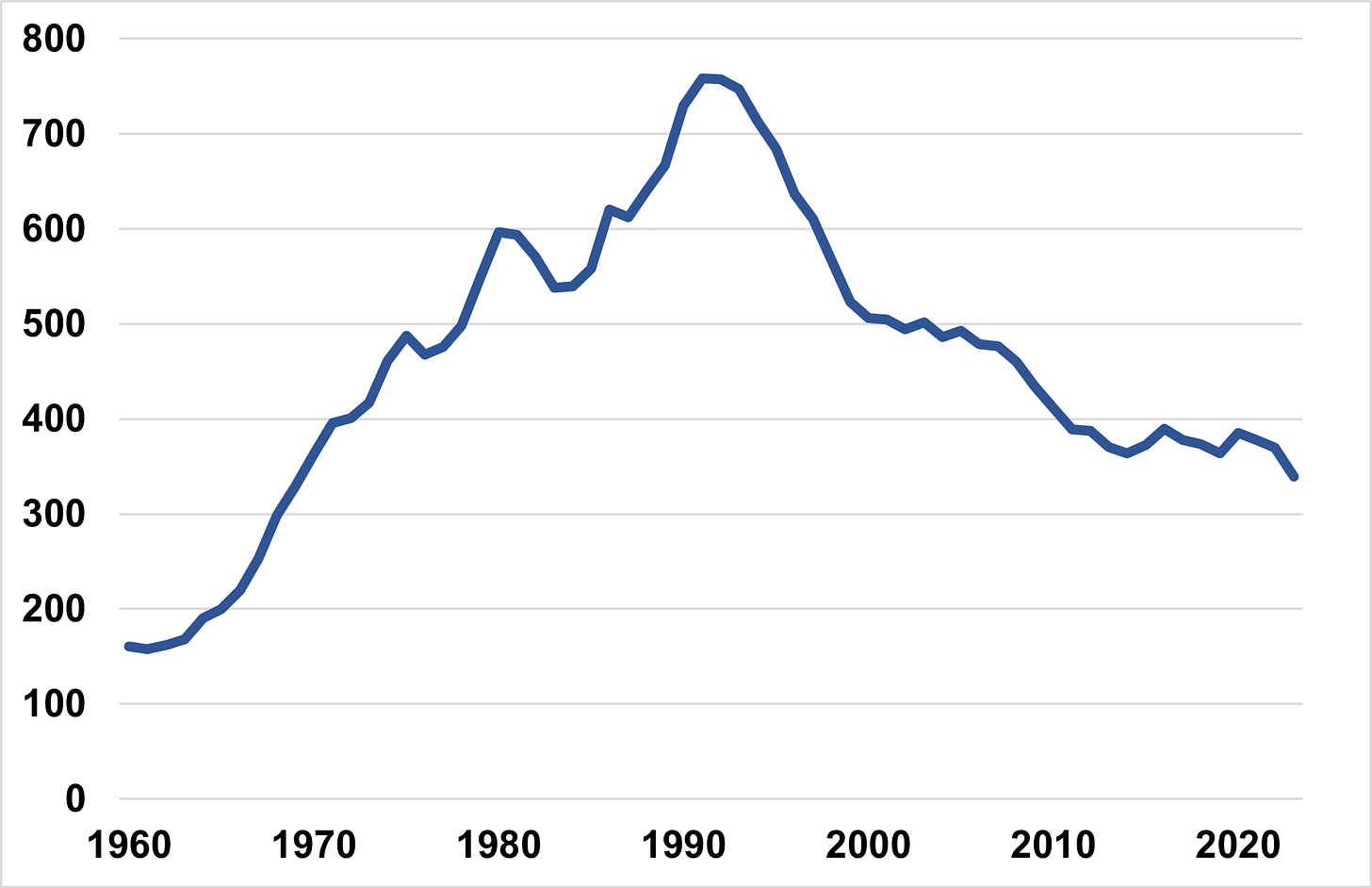
I am often asked why crime rates came down in the United States after the mid-1990s. There is the obvious reason that mass incarceration via the incapacitation effect that reduces crime by removing criminals from our streets. Sixty percent of state prisoners (most prisoners) are violent offenders (murder, rape, robbery, aggravated assault), and around half of nonviolent offenders are there for serious property offenses (burglary, theft-larceny, motor vehicle theft). More police on our streets has helped, as well, confirmed by the fact that depolicing is associated with a rise of crime over the last decade (which elites are partially obscuring by manipulating crime data).

The rise and fall in the rate of street crime 1960-2020 (Source: FBI Uniform Crime Report)

But there are other reasons. Getting lead out of the environment helped. Lead is a neurotoxin associated with aggression and impulse control. Another environmental factor is the constellation of synthetic estrogens that has emasculated the population; males in America are being feminized (along with other animals). On the technological front, the introduction and mass use of computers and video games has taken teenagers and young men off the streets and put them in front of screens (this has also had the effect of dropping fertility rates, exacerbated by the feminization problem). Since serious crime is largely perpetrated by young males (a fact well known for centuries), it follows that emasculating men and taking them out of the social environment will reduce crime.

There are no other reasons I can think of. The military is no longer absorbing young men. Indeed, recruitment is down. Social programs don’t suppress criminogenesis. On the contrary, these have the opposite effect through family disintegration. If you have any other ideas, let me know.

Crime remains high in black-majority inner-city neighborhoods comparatively. This is partly because of the aforementioned problem with family disintegration caused by social programming (government dependency) and the relatively low level of technological distraction (this is not to say that young blacks don’t have access to technology). But it is also because of the pathological subculture of violence associated with social programming and economic policy, especially the idling of black males through globalization (offshoring and immigration). This pathological subculture is reinforced by corporate culture industry targeting of the black demographic, which reinforces demoralizing libertine sensibilities.

It should be obvious to readers that what lies behind the continuing problem of crime in America (which is remarkable in comparison to other advanced industrial economies) is the corporate state project of transnationalism, which includes both offshoring of production and the importation of foreign labor, and the progressive social policy regime that Democrats have imposed on America’s cities.

Jew Hatred and the Normalization of Sociopathy

“October 7 was kind of like the American Revolution. If you take away the context.” —Trevor Noah

“True, true.” —Ta-Nahesi Coates

A few days I ago, on the anniversary of that despicable act, I commemorated October 7, 2023 with the essay Facing Down Evil. A few days later I witness this conversation between Trevor Noah and Ta-Nahesi Coates. Trevor Noah says, “October 7 was kind of like the American Revolution. If you take away the context.” Did the American patriots cross the ocean, enter English towns, and, while some people participated in a festival and others in ordinary daily activities, massacre civilians, rape women, and take hostages? When did this happen? In what context would this ever be acceptable?

“October 7 was kind of like the American Revolution. If you take away the context.” —Trevor Noah

There is no context in which such an act is acceptable. There was zero moral justification for Hamas action that day. Hamas is a genocidal death cult, those who participated in these actions the result of conditioned sociopathy from birth. Sociopathy at this depth cannot be reasoned with. The only option is annihilation. That the promise of paradise in Islam is a lie is icing on the cake. To be sure, the martyrs will never know their obsession was for naught. But I will. Hell is an imagined someplace. Annihilation is nowhere. Like Islam’s paradise.

Ta-Nahesi Coates: “The example I think about all the time is like Nat Turner, right? Like Nat Turner launches his rebellion in 1830. This man slaughters babies in their cribs. You know what I mean? And I’ve done this thought experience, this experiment for myself over and over. Does the degradation and dehumanization of slavery make it so that you can look past something like that? I try to imagine, and I think I can accurately imagine as much as possible, that there were enslaved people, no matter how dehumanized that said, ‘This is too far. I can’t do that.’”

He could have stopped there. But he didn’t. “Now, here’s the flip side of it,” he continued, “and I haven’t said this out loud, but I think about it a lot. Where I, twenty years old, born into Gaza, which is a giant open air jail [it’s not], and what I mean by that is if my father is a fisherman and he goes too far out into the sea, he might get shot by somebody off of, you know, inside of Israeli boats. If my mother picks the olive trees and she gets too close to the wall, she might be shot. If my little sister has cancer and she needs treatment because there are no facilities to do that in Gaza and I don’t get the right permit, she might die, and I grow up under that oppression and that poverty, and the wall comes down, am I also strong enough, or even constructed in such a way where I say, this is too far, I don’t know that I am. I don’t know that I am. I don’t know that I am.”

Everything Coates describes is the consequence of Palestinian resistance to peaceful coexistence with Israel. But put that aside for now. This is what is at issue: the problem of morality. Any truly moral person knows that this October 7 is too far. For such a person, perpetrating October 7 is unimaginable. A moral person does not excuse October 7 with an exercise in empathy that reimagines himself capable of such things, because such an exercise only dresses itself in empathy to engage in an exercise in justifying the indefensible. What brings a person to be able to think like this, to even suggest it? Deep seated hatred and loathing for victims of October 7—not for what they did (they did nothing), but for who they are.

Facing Down Evil

The October 7, 2023, Hamas attacks killed approximately 1,200 people in Israel. As of 2023, Israel’s population is about 9.5 million. To scale this to the US population (approximately 331 million), the toll would be equivalent to around 42,000 deaths if the same proportion of the population were killed in an attack on the United States. Does anybody believe the United States wouldn’t flatten the country that killed 42,000 of its citizens?

Iranian missiles rain down on Israel, here seen from Ashkelon, Israel, October 1

Hamas, Hezbollah, and the Houthis are proxies of Iran. What we see today is effectively a war between Israel and Iran. Israel must destroy Iran’s proxies to thwart Iran’s attempt at regional superiority. But more than this, the forces represent clerical fascism, a modern-day instantiation of nazism. By destroying its proxies, and by striking targets in Iran, Israel may be able to destabilize the regime and create the opportunity for the Persian people to overthrow the Islamic state and restore their once-great civilization. This would bring peace to the Middle East.

Ever since Jimmy Carter and Zbigniew Brzezinski stood by while the Islamic Revolution overtook Iran—meanwhile destabilizing Afghanistan by organizing a coup d’etat in Kabul—the Persian people have lived in darkness. The continuation of this darkness was facilitated by both the Obama and the Biden regimes. Obama’s 2015 nuclear deal (cover for a balance of power scheme) lifted sanctions and allowed Iran to access billions in frozen assets, which it used to fund its military and regional proxies. Biden has done the same.

The West can’t be both for and against Israel. The Islamist wants only one thing: the eradication of Jews everywhere. He will never seek peace because all he seeks is death. He teaches his children from birth to be martyrs. He hate the Jews so much that he forsakes his own offspring. This is not hatred over white settler colonialism and any of those other rationalizations. This is a religious hatred. Islamists see Jews as an evil to be wiped off the fact of the planet. This is an instantiation of collective psychopathy in the same way that the Nazis were driven by irrational hatred and loathing of the Jews.

Israel is facing down evil. There is no sides-choosing is circumstances such as these. There is no balance of power between good and evil. Israel is facing an existential threat. So goes Israel so goes the West. Islam is on the move. It must be resisted everywhere.