RFK, Jr. eats McDonalds and drinks a Coke and the corporate statists lose their minds. “Hypocrisy!” They cry in unison. Either they don’t understand what hypocrisy is or they don’t think the people do. So I’m here (once again) to educate those who don’t know what a word means.
God-level trolling
Hypocrisy indeed involves a discrepancy between expressed beliefs or principles and actions, but it is specifically tied to the pretense of belief or virtue. Hypocrisy is not knowing something is unhealthy or wrong and doing it anyway—that could be addiction, inconsistency, weakness, or something else. Hypocrisy arises when someone claims to hold a standard or value while acting in a way that contradicts it with the intention of deceiving others into believing he is virtuous.
Recognizing something is bad like smoking and wanting to reduce its practice but continuing to smoke may reflect human fallibility, etc., but not necessarily hypocrisy unless the person also claims not to smoke or condemn others for it while doing it himself.
The corporations that manufacture harmful products are very happy to see progressives misrepresent the concept of hypocrisy because it assists in the campaign to stop liberals from improving the health of Americans. Corporations stand to lose trillions if they’re pressured into making healthier products. Not just Big Ag and other corporations stand to lose but the Medical-Industrial Complex, which depends on unhealthy people. Indeed, the MIC makes and maintains millions of sick people in a continual basis
Peter Thiel’s recent remark to Bari Weiss that modern science has become “more dogmatic than the Catholic church was in the seventeenth century” is a powerful observation about the state of knowledge in the twenty-first century. Thiel’s observation reflects the extent to which the institutions of science, once rooted in skepticism and open inquiry, have been co-opted by external forces that cannot tolerate dissent.
Peter Thiel: "What has become 'science' is more dogmatic than the Catholic church was in the 17th century"
Watch as Bari Weiss tries desperately to get Thiel to criticize MAHA / RFK jr, and Thiel responds with a spectacular exposition of everything wrong with modern science. pic.twitter.com/a1l29BzQqd
The two dominant forces behind this shift are corporate power and woke progressive ideology. Corporate power subordinates scientific inquiry to the demands of profit generation, prioritizing outcomes that align with market imperatives rather than seeking objective truth. Progressive ideology operates as a form of quasi-religious dogma that legitimizes itself by appealing to moral imperatives, often stifling challenges to its tenets as heretical or harmful. Together, these forces create a system where skepticism is not just unwelcome but actively suppressed, as it threatens the legitimacy of the power structures behind the institutions.
The transformation of science into dogma can be traced to structural changes within the scientific enterprise itself, particularly the rise of “peer review” in the mid-twentieth century. What is often portrayed as a neutral process to ensure quality and rigor in research, peer review in practice is a gatekeeping mechanism that enforces conformity to institutional norms and ideological orthodoxy. Peer review functions less as an arbiter of scientific merit and more as a tool for maintaining the status quo, ensuring that dissenting perspectives are marginalized. This parallels the modern phenomenon of “fact-checking” in corporate media, which similarly operates under the guise of impartiality but often serves as a mechanism for censorship. Both are methods of consolidating authority by creating artificial structures of legitimacy, obscuring their true purpose: the control of information to advance particular interests.
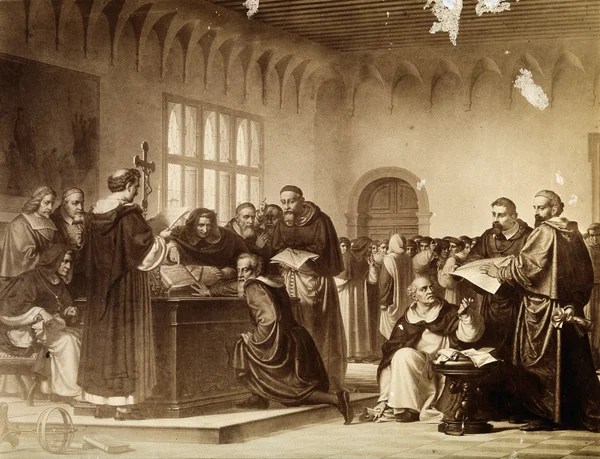
The trial of Galileo
In recent years, these mechanisms have faced significant disruption due to the proliferation of alternative sources of information. The internet and digital media have enabled the bypassing of institutional gatekeepers, allowing individuals to disseminate knowledge that is not only independent of corporate and ideological control but also demonstrably effective in practice. True science, after all, is validated not by institutional endorsement but by its utility and its ability to produce outcomes that benefit the broader public. The rise of alternative platforms has exposed the inadequacies and biases of the traditional systems, undermining their claim to authority.
The erosion of institutional credibility, then, stems from the growing recognition that these structures are not neutral arbiters of truth but mechanisms designed to legitimize the goals of the powerful. By prioritizing corporate profits or ideological conformity over genuine inquiry and public good, they have revealed themselves as tools of domination rather than sources of enlightenment. As a result, the public increasingly views these institutions with skepticism, recognizing their authority as a façade masking authoritarian control.
Authority itself must be understood in this context. As Max Weber told us, true authority derives from legitimate power, grounded in trust and transparency, and exercised in service of the common good. In contrast, what passes for authority in many contemporary institutions is power legitimized through hegemonic techniques—practices that manipulate consent and manufacture credibility. Either authority is legitimate power or it is a cover for power. The latter is not authority but authoritarianism. In exposing these structures for what they are, i.e., mechanisms for legitimizing corporate and ideological goals to achieve ends contrary to the interests of the people, the institutions of science and the media have lost their authority.
Thiel hits the nail on the head, and the reason for the problem he identifies is that the institutions of science have been captured by corporate power and woke progressive ideology—neither of which can tolerate skepticism, since skepticism of their preachments undermines their legitimacy.
This from Mashable just appeared on my timeline: “PSA: Your Twitter/X account is about to change forever.” If you’re going to leave Twitter for the reason identified here, then you will also have to delete Google, Bing, etc., because they’re all feeding your posts, tweets, emails, searches, etcetera into their generative AI systems. You will also need to stop publishing in journals, newspapers, nooks, etcetera. These, too, are being fed into AI. Oh, and your artwork, photographs, architectural drafts, musical compositions and performances—everything. Just stop living. Everything you do is fed into AI. Find a cave and go live in it.
The X (formerly Twitter) logo
Here’s what the propaganda offensive is about. X is targeted not because it’s doing something extraordinary. Indeed, X is the least of the worst offenders. X is targeted because it’s the least of the worst offenders. (So, in that sense, I guess it is extraordinary.) X the freest social media platform on the Internet, and the corporate state and censorship-industrial complex wants to scare you into leaving the platform to undermine its profitability (if Harris has been elected President, elites would be using additional weapons to accomplish this).
This is a very straightforward thing: The power elite don’t want you to have open and free media because when you do you become autonomous and unmanageable. Look at what happened on November 5. America—the world—got a massive injection of freedom and democracy, and the corporate state is freaking the fuck out about it. Every bit of propaganda now telegraphs existential fear. Their lies tell the truth of the situation. They’re freaking the fuck out because they are indeed fucked.
One more thing. This article suggests that people are not leaving X because of November 5. Wrong. They’re leaving X because of what happened last week. They’re leaving to find places to bubblize more hermetically so they can deepen the woke practice of cerebral hygiene. The left has become a cult. Woke is a religious movement. But here’s the thing, X is posting record numbers in terms of viewers and activity. X has become the biggest source of news not only in the United States, but where it is allow to freely operate around the world. The people have taken back the media—and their government. This is why I call X the “Gutenberg Internet” moment. We are living through something akin to the Protestant Reformation.
In 1849, French writer Jean-Baptiste Alphonse Karr wrote “plus ça change, plus c’est la même chose.” I think we may have falsified that truism. Folks wanted a revolutionary moment. You’re welcome.
I have been planning to write this essay for quite some time. Steven Bannon’s rant on the War Room this morning finally pushed me to do it because, while he knew the concept of “creative destruction,” he was a bit sketchy on where the idea came from, suggesting not only Joseph Schumpeter as its possible author but also Friedrich Hayek. Having expertise in the field of political economy, I thought to myself that I should go ahead and write it up so readers of Freedom and Reason can get a sense of the spirit behind the desire to deconstruct the administrative state. There’s a lot of fear out there about what all this entails, and one of the goals of this platform is help assuage fear so people can practically move forward without trepidation.
Joseph Schumpeter, Austrian-American economist and political scientist
Schumpeter was an influential Austrian-American economist and political scientist who explored the dynamic nature of capitalism and its ability to generate growth through innovation, but he also warned of its vulnerabilities, particularly to social and political changes. Schumpeter coined the term “creative destruction” to describe the process by which capitalism perpetually renews itself through innovation. In Schumpeter view, new technologies and adaptive business models disrupt existing structures, leading to economic progress while simultaneously making older industries and jobs obsolete. He rooted this in the cyclical nature of economies (influenced by the Kondratieff Wave theory, which I may write about in the near future), attributing booms and busts to waves of innovation. Schumpeter thus emphasizes the critical role of entrepreneurs as agents of change who drive innovation—and the problem of bureaucratic fetters on that critical role.
In his book Capitalism, Socialism, and Democracy (1942), Schumpeter argued that capitalism would eventually give way to socialism due to its own success. He saw that the rise of large corporations and bureaucratization would erode the entrepreneurial spirit, leading to a managed economy. It is crucial here to clarify Schumpeter’s notion of socialism aligns more closely with a corporatist or technocratic conception than with the classical Marxist vision of a workers’ state. Schumpeter’s socialism is characterized by the bureaucratic management of economic resources, a shift from entrepreneurial capitalism to a system governed by large corporations, bureaucracies, and technocrats. This form of socialism emerges not from workers seizing the means of production but as an evolutionary outcome of capitalism’s own successes, leading to an administrative state.
Friedrich Hayek, neoclassical political economist
Schumpeter’s concern is our present reality, but his concern was arguably insufficiently framed such that it would move the populace to resist more vigorously the rise of the administrative state in real time. Moreover, he saw this development as inevitable amid the complexification of the capitalist mode of production. For a more polemical and hopeful critique, then, we must turn to Friedrich Hayek, who viewed corporatist or technocratic developments as a grave danger to freedom and something that we can and should resist. In The Road to Serfdom (1944), Hayek warned that central planning, whether by bureaucratic elites or under socialism of the Schumpeter sort (or the Soviet style), leads inevitably to authoritarianism. And here we are.
I now to turn to the problem of authoritarianism in the American System, which I have discussed in create detail in past essays on this platform, and bring into view the administrative apparatus of the Executive Branch of the US Republic. One of the problems with the creation and proliferation of Executive Branch functions is the perception that they are original to the founding or otherwise organic to the Republic and therefore cannot be eliminated when they are determined to be redundant, useless, or detrimental to the overall government function, as well as to liberty. For example, when I tell people when the Department of Education was established as a Cabinet position, they are typically surprised, having assumed that this department was established much earlier and that it somehow contributed to the US supremacy as a scientific and technological powerhouse.
Actually, only four Cabinet positions were established in the first year in the first term of America’s first President, George Washington, the great wartime general who served as Chief Executive from 1789-1797: Secretary of State (to handle foreign affairs); Secretary of the Treasury (to manage the nation’s finances), Secretary of War (renamed Secretary of the Army in 1947 and absorbed into the Department of Defense); and Attorney General (established to provide legal advice to the President, becoming part of the Department of Justice in 1870). Secretary of the Navy, created to oversee naval affairs, would be established almost a decade later, in 1798 (absorbed into Department of Defense in 1947). After that there was a lull in the expansion of government, which then occurred incrementally. Let’s review:
The Postmaster General was a Cabinet-level position from 1829-1971, when the Postal Reorganization Act made the Postal Service an independent agency. Secretary of the Interior (1849) was created to manage domestic affairs, including natural resources and public lands. Secretary of Agriculture (1889) to oversee agricultural programs and policies. (Why not absorb this into the previous Cabinet post?) Secretary of Commerce and Labor (1903), now split into separate Departments of Commerce and Labor (1913). Secretary of Health, Education, and Welfare (1953), now split into two departments: Health and Human Services and the Department of Education (1979). Secretary of Defense (1947) to pull military leadership under a single authority. Secretary of Housing and Urban Development (1965) to address housing needs and urban issues. (Why not absorb into the Interior?) Secretary of Transportation (1966) to oversee transportation infrastructure and policy. (Interior?) Secretary of Energy (1977) to handle energy policy and nuclear management. Secretary of Veterans Affairs (1989). (Why not absorb into the Defense Department?) And, finally, Secretary of Homeland Security (2003) to coordinate national security and emergency preparedness.
Those at the Founding are necessary. But some of the others in that list are problematic, and we should revisit them. The Education Department has become captured by woke progressivism (SEL, DEI, Queer Theory, CRT, etc.) and repurposed for indoctrination in corporate statist ideology; the bureaucrats there are engaged in social engineering for the benefit of the power elite. Consequently, the United States has slipped from top dog in the world to lagging dozens of other countries in producing knowledgeable citizens. Some on the right might argue that it’s not a matter of eliminating the department but capturing it and pressing down into the masses an alternative ideology. But indoctrination is not the point of education. Education should be concerned with the development of critical thinking and practical skills. This is best left to local governments, those thousands of engines of innovation. Parents need choice and democratic control over the apparatus. The American System is, after all, founded on the principle of federalism.
I am not going to go through all of these departments (I parenthetically suggested some consolidation above), but while I am here, in addition to the Department of Education, I would like to schedule for termination the Department of Homeland Security. We should then eliminate the CIA, the CISA, and the FBI. Whether the Department of Justice should be abolished is something on which I need to reflect further, but I am leaning towards returning the Attorney General’s office strictly to the role of President’s counsel. I am bringing up the Justice Department because of its embeddedness in the domestic security apparatus. At the very least, we need to end the power of the administrative state to wage war against American citizens, and this will require a radical reorganization of the entire apparatus, during which its powers should be drastically diminished. What would be a particularly useful redesign of all this might be found in a Department of National Integrity, which would oversee immigration and naturalization, the charter ensuring states would have the power to determine whether those who cross the national border would be allowed to cross state borders.
The rise of the administrative state, as critiqued by Schumpeter and Hayek, presents a grave danger to the preservation of liberty and the proper functioning of democracy. Schumpeter’s vision of a bureaucratized, corporatist socialism driven by capitalism’s own excesses may seem inevitable, but Hayek’s warning in The Road to Serfdom urges us to resist this trajectory. The expansion of executive agencies and the entrenchment of bureaucratic power foster conditions ripe for authoritarianism, where central planning and administrative overreach undermine both individual freedom and democratic accountability. To counter this, we must recognize that many of these institutions, far from being organic extensions of the Republic’s founding principles, are modern impositions that can and should be reevaluated and in some cases eliminated. The federalist structure of the American System provides a framework for decentralization and local governance, offering a path to reclaim liberty from the grip of technocratic control. By dismantling unnecessary and counterproductive elements of the administrative apparatus, we not only honor the principles of limited government and self-rule but also safeguard the entrepreneurial and democratic spirit essential to preventing the slide into authoritarianism. This endeavor demands vigilance and bold action to ensure the preservation of liberty for future generations.
The man who snatches rockets out of the air, Elon Musk
Don’t be afraid of change. Face the challenge with the courage of the men who built this nation. Republicans now control the White House, the Senate, the House, the Supreme Court, and thirty-seven of fifty governors’ mansions. Eighty percent of counties across the United States shifted towards the Red. Many of these Republicans—an ever growing number of them—are not the Republicans of old. They are populist-nationalists and classical liberals. Indeed, there has been a mass exodus of liberals from the Blue to the Red team, seeing the reformed Republican Party as the place where the founding principles and values of America now reside. Moreover, the party has become the nucleus of the innovative spirit that drives not only economic but societal and personal development, represented by, among others, Elon Musk and his various endeavors. We now live in a new era. We can and must reclaim the greatest of America and build a future where all Americans prosper and live more freely. We owe this to future generations.
The corporate media is having a go at Pete Hegseth, Trump’s pick for Defense Secretary, for co-hosting Fox & Friends Weekend. What they don’t tell you is that Hegseth is a decorated US Army veteran and vocal advocate for veterans’ issues. They don’t tell you that the man graduated from Princeton University and earned a Master of Public Policy degree from Harvard’s Kennedy School of Government and then deployed to Afghanistan and Iraq (three times), earning among other honors the Bronze Star and Combat Infantryman Badge. After his military career, Hegseth became CEO of Concerned Veterans for America, where he focused on policy advocacy for veterans, especially in areas like healthcare reform and mental health support. Frankly, the only pick Trump could make for Secretary of Defense that wouldn’t draw jeers is an establishment figure itching to take the United States into more wars (more on that later).
Here’s how Senator Elizabeth Warren put it on X: “A Fox & Friends Weekend co-host is not qualified to be the Secretary of Defense.” She continued, “All three of my brothers served in uniform. I respect every one of our service members,” before adding: “Donald Trump’s pick will make us less safe and must be rejected.”
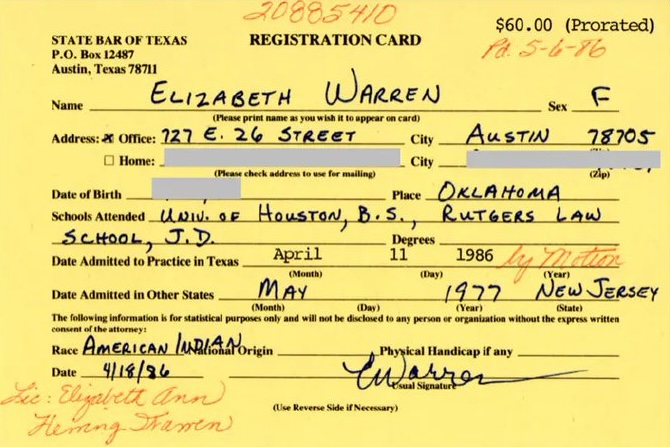
This is how dishonest Democrats are—and there’s nobody more paradigmatic of that dishonesty than Elizabeth Warren, a woman who falsely declared herself to be an American Indian on official forms.
DNA tests indicate Warren had an American Indian ancestor six to 10 generations ago. She is not an American Indian.
Unlike Warren’s claim to be American Indian, Hegseth is everything he claims to be. But the lying from progressives is off the hook.
Indeed, there were a lot of intangibles in this election. A big one was the matter of lying. That does not appear in the polling. However, the narrative for many years is Trump is a liar and that his labeling of legacy media as “fake news” was an illegitimate attempt to delegitimize a trusted source of information. But what the people saw with their own eyes and heard with their own ears is an endless stream of lies from not only the legacy media, but from Democrats, as well.
Trump’s pick for Attorney General Matt Gaetz
The nomination of House member Matt Gaetz for Attorney General has especially triggered progressives, who are claiming that Gaetz has been investigated for sex trafficking. It’s not uncommon for people to be investigated and exonerated. That’s why our system works from the position of legal innocence: a man is innocent until he is proven guilty beyond a reasonable doubt.
In Gaetz case, back in February 2023, the Department of Justice officially decided not to bring charges against the Congressman. Why? Because there were concerns over the credibility of key witnesses. The DOJ decision effectively closed the case without any charges being filed against him.
Given this, here is arguably nobody more qualified for the post than Gaetz; the man knows what it feels like to be persecuted by politicized agency controlled by the other party.
President Clinton looks on as VP Gore presents the National Performance Review. Behind them a pile of government regulations.
On September 7, 1993, Vice President Al Gore presented his final report, From Red Tape to Results: Creating a Government That Works Better and Costs Less (a Report of the National Performance Review) to President Bill Clinton in a ceremony on the South Lawn of the White House before his Cabinet, members of Congress, and hundreds of civil servants who helped craft the report and its recommendations. By 1999, estimates suggested that the initiative had saved around $136 billion through various cost-cutting measures, including workforce reductions, streamlining of federal agencies, and improvements in government procurement and service delivery.
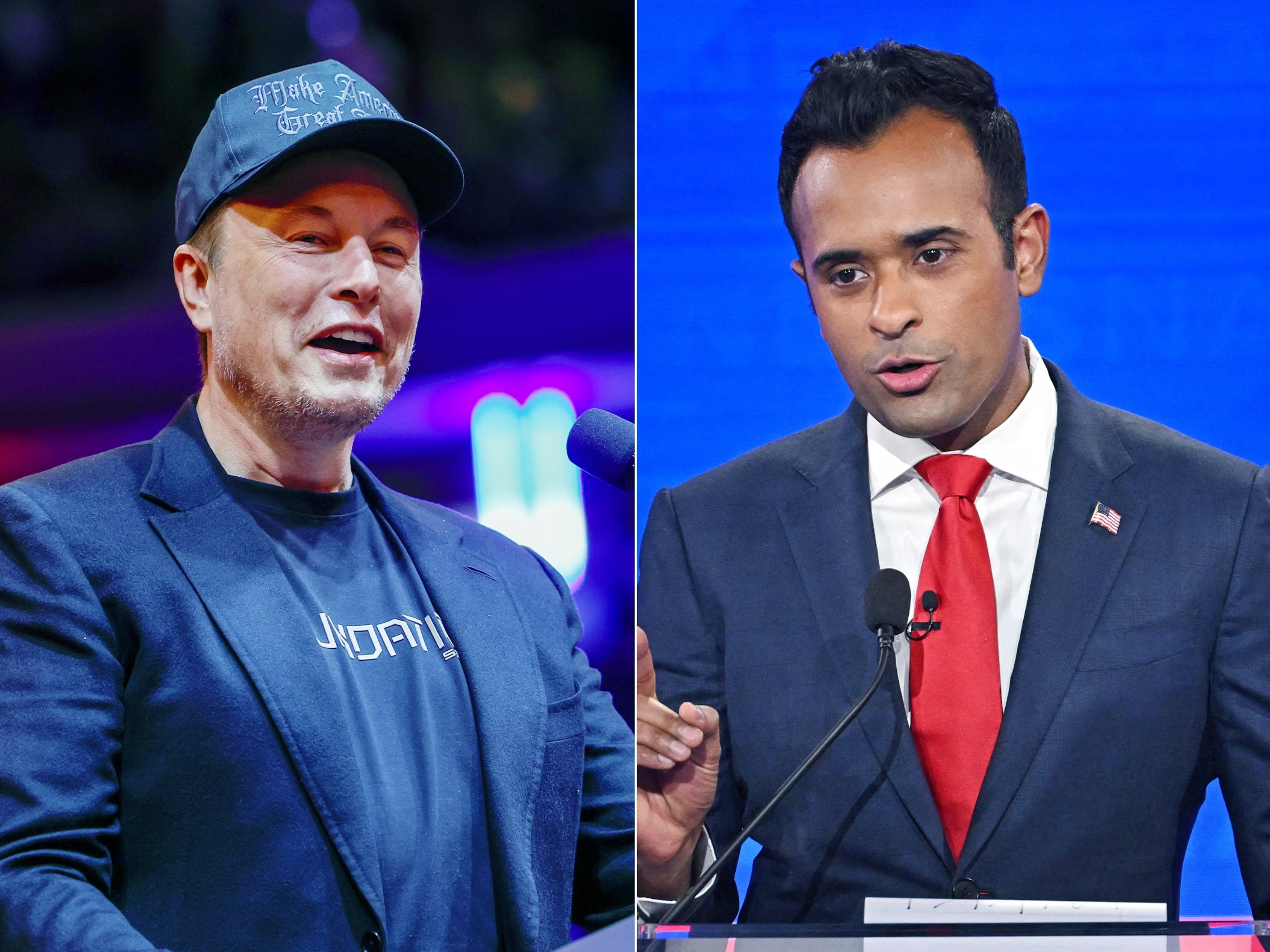
Yet, when Trump appoints Elon Musk and Vivek Ramaswamy to head the Department of Government Efficiency (DOGE), there is widespread mockery among progressives and the media elite. The double standard runs deep and long.
Elon Musk and Vivek Ramaswamy
And they continue to lie about Donald Trump. No, Trump is not a felon. One can only be a felon in New York when the jury verdict is entered into the record at sentencing. Why is this? Because the judge can set the verdict aside. Just because a jury renders a verdict of guilty doesn’t mean the defendant is a convicted felon. It means that a jury has told the judge that, in their opinion, the defendant is guilty. What is more, the New York case was one of the most ridiculous cases ever brought before a jury (see Rigged System! Blowing Up the Independent Judiciary). Expired misdemeanors artificially resuscitated by an underlying felony charge that was never actually identified? Are you freaking kidding me? Hell, the jury was told that they didn’t even need to agree on whatever charges they imagined. Even if Judge Juan Merchan eventually does enter a verdict of guilty into record it would likely be overturned up the line.
And, no, Trump has not be found guilty or even charged with sexual assault, another lie that progressive continue to perpetuate.
This is the way it has been for eight years now. The Steele dossier. The Russia hoax. The Zelensky phone call. The insurrection. The documents case. Attempting to overturning an election. Suckers and losers. Bloodbath. Good people on both sides. Admiration for Hitler. Ad nauseam. Lies and misrepresentations. Why? Because Trump is an outsider and threatens the hegemony of the Establishment.
Democrats thought they were building a one-party state. They were rudely interrupted on November 5, 2024. And they are losing their shit over it.
(This thing with dragging Trump with the “felon” label, even if true, is bizarre coming from progressives who often support their claim that the system is unjust by observing that one out of every three black men is a felon. They’re right about that. One-third of all black men in America is convicted felon. So would these progressives not support a black felon for a government post? Do they think that a felony conviction means political death? Or is that only in the case of white men People who claim to speak for justice ought to take some time to learn what that word actually means?)
Finally, maybe you haven’t heard but Pentagon officials have been informally discussing how the Department of Defense might respond if Donald Trump were to issue “unlawful orders,” for example, if the President were to dismiss large numbers of nonpartisan staff (let’s hope he does). It is as if military personnel have forgotten that the integrity of the United States depends on civilian control of the military, which is vested in the person of the President, who is under the Constitution, in addition to being Chief Executive, the Commander in Chief of the Army and Navy.
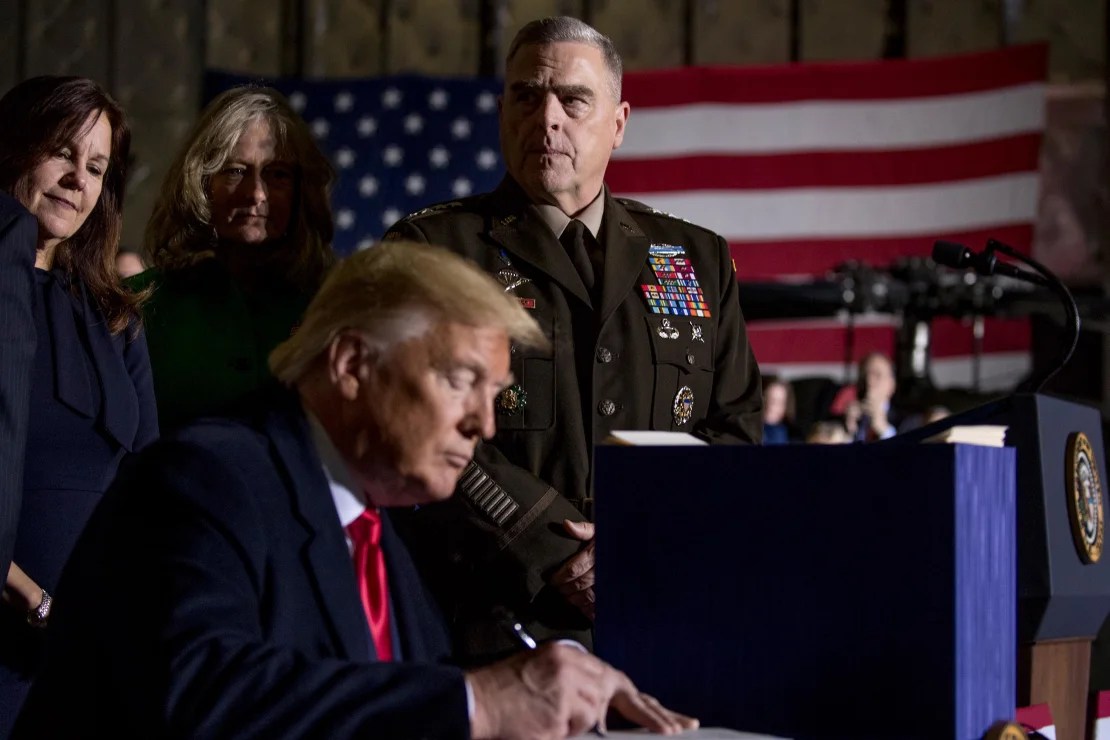
Joint Chiefs Chairman General Mark Milley behind the President
This isn’t the first time Pentagon officials schemed without Trump’s knowledge. Two days after the police riot on January 6, 2020, Trump’s top military advisor, Joint Chiefs Chairman General Mark Milley, took covert steps to prevent Trump from initiating a military strike or nuclear launch. On January 8, Milley convened a confidential meeting in his Pentagon office with senior military officials overseeing the National Military Command Center. He instructed them not to proceed with any orders unless he was directly involved. Milley confirmed their understanding of his orders by looking each officer in the eye and asking for verbal acknowledgment. Scary stuff.
Milley also communicated with a Chinese general during the final weeks of Trump’s presidency. He made two calls to Chinese General Li Zuocheng—on October 30 and January 8—assuring Li that he would provide a warning if the US were to plan an attack on that authoritarian regime.
This is an extraordinary admission. If Milley were to warn the Chinese of a pending attack, then this would allow China to thwart the attack or even strike US targets first. China is a nuclear power. Milley revealed that senior Trump officials, including Secretary of State Mike Pompeo and Defense Secretary Mark Esper, were aware of the calls. How is this not treason?
This is what Trump is up against. He was elected by the American people to represent in the highest office of the Republic the will of the popular sovereign, and behind his back, the military-industrial complex—made up of unelected bureaucrats that serve interests other than the popular sovereign—directs the war machine as they see fit and makes foreign policy on the sly.
Remember back during the Cold War when General Douglas MacArthur, commanding US and UN forces on the Korean Peninsula, publicly criticized President Truman’s policies? Truman relieved MacArthur of his command, asserting the principle of civilian control over the military. This decision sparked significant public debate but ultimately reinforced US constitutional norms.
What if the Pentagon wants to continue the proxy war in Ukraine against Russia when Trump has called a halt to that deadly war? Etcetera. You can see that we have a problem if the Pentagon is going behind the Command in Chief’s back and making their own policy. This is precisely why we must deconstruct the administrative state.
Suppose Trump does lie. Well, so do the media and Democrats. Seeing that it’s a wash in the regard, that no side has a monopoly on virtue, what is left over are the policy questions. The people don’t like diminished standard of living, globalization, mass immigration, gender ideology, grievance politics, forever wars, and a host of other things that legacy media and Democrats are on the wrong side of. The people also don’t like being called “racists,” “fascists,” “Nazis,” “deplorables,” “garbage,” etc. And they don’t like the corporate state bureaucracy working at cross purposes with the men and women they elect to lead this country. So they picked the party that promises to fixes the things they don’t like, that doesn’t call them names, and that promises to bring to heel unaccountable power.
The people trust themselves to know the truth. But Democrats don’t trust the people at all. And that’s as good a reason as any to not trust the Democrats.
They aren’t mean to be. They’re meant to protect domestic business and jobs and, more importantly, compel reshoring of industry and services and bringing jobs back home to America.
If products from China and elsewhere are made more expensive, then domestic production of those products becomes incentivized, which in turn creates jobs here at home. The more jobs that are created here—coupled with mass deportation—empowers labor and, making domestic workers worth more to employers, which in turn puts upward pressure on wages and demand for labor increases. All things equal, rising wages raises the standard of living produces superior life-chances. It creates the potential for fewer people dependent on government. All this raises quality of life well beyond wages. We may actually begin to repair the broken American family.
Remember why the neoliberals pushed “free trade” to begin with. By off-shoring of productive and importing cheap foreign labor, corporations push down wages for native workers. Globalization is literally class warfare, with transnational and even nationally-based corporations waging economic war on American citizens. In order to keep a semblance of the same standard of living, workers incur debt, which enriches the banks—and when they can’t pay their mortgages, the banks take their houses. All of this—along with rent-seeking, etc.—is an attempt to destroy organized labor and restore the falling rate of profit in the West. It certainly has worked to destroy organized labor (except public service unions, of course, which are part of the extended administrative state), but it couldn’t stem the fall in the rate of profit. This is because the “solution” to the problem is the cause of the problem.
Globalization and neoliberalism are what Democrats and establishment Republicans have been pushing for decades. It’s a failed policy for the working man and woman. We have to get back to a national economic strategy that puts American first. Tariffs are a logical step in that process. I look forward to seeing the free-traders eat crow.
It’s often called “going no contact.” A key tactic in cult induction is to separate people from their friends, family, and associates to estrange them from their core associations and pull them ever deeper into the doctrines and rituals of the cult. They do this by making the familiar sinister. For example, Scientology identifies “suppressive persons,” those the inductee or member feels—or is told to feel—don’t share her or his views. Cult membership creates a state of perpetual unreality where the subject of control becomes capable of believing the most unbelievable things.
We often think of cults as small and rare. But cults can be large and are quite common. They’re marked by the extraordinary capacity of members to rationalize reality—that is, deny the obvious. MSNBC provides a useful window into one of the largest cults in operation today, namely woke progressivism. You would think that Chief Resident of the Yale Albert J. Solnit Integrated Adult/Child Psychiatry program would not engaged in grooming tactics, but this is one of the big problems of psychiatry: this is how psychiatry increases its patient pool (Making Patients for the Medical-Industrial Complex).
There a new form of “going no contact”—women withdrawing from reproductive and sexual relations. Trump’s election as US President for a second, non-consecutive term has triggered strong reactions among some women on social media. In response to Trump’s victory, echoing a feminist movement in South Korea that instructs women to stop dating, having sex, getting marriage, and having children, women are pledging to go on a sex strike to voice their frustration and discontent (they are also shaving their heads). Pitched as a movement to achieve female autonomy from patriarchal relations, withdrawing from heterosexual relations en masse is a manifestation of an extremist ideology, one that rests on a mythology about men, and demands on the basis of that mythology transgression of societal norms that have been in place since time immemorial and served our species well. This is where woke progressive culture has brought us.
Woke culture shares a lot of features with Mao Zedong’s Cultural Revolution. Consider Mao’s “Four Olds” campaign aimed at negating “old customs, old culture, old habits, and old ideas” in China. The “Four Olds” movement encouraged the Red Guards to destroy anything seen as representing traditional or bourgeois values. Sacred sites, religious texts, and other items associated with historical traditions were attacked, as well as normal familial relations, with the goal of disembedding young people from the normative system that safeguarded them and prepared them for an autonomous life (to the extent that this could be achieve in Communist China), and reincorporating them into the void of Maoist thought, transforming Chinese society into a collectivist state with no independent thought or intrinsic moral value.
This type of transgressive praxis lies central to gender ideology. In his 1995 Saint Foucault, David Halperin explores Michel Foucault’s influence on queer theory, particularly how Foucault’s ideas of power and sexuality can be applied to understand queer desires and identities outside traditional frameworks. In there, Halperin makes the following observation: “Unlike gay identity, which, though deliberately proclaimed in an act of affirmation, is nonetheless rooted in the positive fact of homosexual object-choice, queer identity need not be grounded in any positive truth or in any stable reality.” He continues, “As the very word implies, ‘queer’ does not name some natural kind or refer to some determinate object; it acquires its meaning from its oppositional relation to the norm. Queer is by definition whatever is at odds with the normal, the legitimate, the dominant. There is nothing in particular to which it necessarily refers. It is an identity without an essence.”
While homosexuality, i.e., same-sex attracted, has an essence and limits, queer is nihilistic; life lacks inherent meaning, purpose, or value. “‘Queer,’ then, demarcates not a positivity but a positionality vis-à-vis the normative, a positionality that is not restricted to lesbians and gay men but is in fact available to anyone who is or who feels marginalized because of her or his sexual practices: it could include some married couples without children, for example, or even (who knows?) some married couples with children —with, perhaps, very naughty children. ‘Queer,’ in any case, does not designate a class of already objectified pathologies or perversions; rather, it describes a horizon of possibility whose precise extent and heterogeneous scope cannot in principle be delimited in advance.”
One finds rank and file transactivists identifying as Marxist-Leninist and proponents of Mao-Zedong Thought
Thus, in the same way Mao sought to disrupt traditional understandings and practices of cultural and family life in order to create a new society in which Mao Zedong thought would prevail and the multitude would behave accordingly, queer theory transgresses normative boundaries, including those that safeguard children and women, to create a new society in which queer theory is the hegemonic ideology the masses are required to obey, rules that are always in transitions as those unburden by what has been push their desires on those who resist or who go along for fear of what will happen to them if they don’t.
Gender ideology extends beyond trans activism and others who crave openly exercising their paraphilias. The “4Bs” movement, which originated in South Korea, has become a feminist wave, advocating for the rejection of traditional gender roles and intimate relationships with men. Initially a fringe element of South Korean feminism, the movement has gained international attention, particularly in the United States, following political shifts and perceived impacts, but especially the election of President Donald Trump. The movement represents a radical rejection of societal expectations surrounding heterosexual marriage, childbirth, dating, and sexual relationships, calling for women to reclaim autonomy over their bodies and lives and resistance to its extremism only makes it more determined to distort reality and disrupt normal social relations.
The “4Bs” is shorthand for four Korean words, each starting with “bi,” meaning “no.” The central tenets of the movement are Bihon (no heterosexual marriage), Bichulsan (no childbirth), Biyeonae (no dating), and Bisekseu (no heterosexual sexual relationships). These demands express a radical rejection of the roles that have historically been “assigned” to women, who have been expected to marry, bear children, and engage in heterosexual relationships as central elements of their identities and societal duties. By rejecting these “impositions,” women can challenge the patriarchal structures that have marginalized them and assert their autonomy.
The “4Bs” movement’s core message of resistance to traditional gender roles has found resonance beyond its borders. In the United States, following Trump’s victory in the 2016 presidential election, a similar sentiment began to take hold, particularly among younger women, preparing the ground for an equivalent movement in the US. Many young women on social media platforms like TikTok and X (formerly Twitter) have explicitly embraced the “4Bs” in the wake of the 2024 Trump victory, expressing their frustration with a political system they see as increasingly hostile to women’s rights and bodily autonomy.
One of the key reasons why the “4Bs” has found a growing audience in the US is the profound disappointment among many women regarding the voting patterns of men. CNN’s exit polls following the most recent presidential election revealed a striking gender divide: while 54 percent of women voted for Joe Biden and Kamala Harris, 56.5 percent of men voted for Trump. This stark contrast points to a troubling reality for women who know that a significant portion of the male electorate supported a candidate who they believe disrespects their bodily autonomy and perpetuates sexist attitudes. For these women, the “4Bs” movement offers a form of resistance, a way to reject the traditional roles that they claim men have been allowed to dictate.
Moreover, the rise of social media has facilitated the spread of this and other tendencies by allowing women to amplify their voices. Platforms like TikTok, X, and chatrooms on various social media sites have provided a space for women to reinforce perceptions about gender relations and express their desire to transcend them. The anonymity and reach of social media have allowed young women to discuss issues such as autonomy, consent, and gender equality, and gender identity in ways that would have been difficult in mainstream media and ordinary social spaces. But in the bubble they become distorted and exaggerated. Warped discourses on gender relations are reinforced in the same way that other destructive ideas have spread across social media, leading to such pathologies as transgenderism and self-identification with various psychiatric categories in the DSM-5 (see Why Aren’t We Talking More About Social Contagion?).
Obviously, there is a thematic similarity between Mao’s “Four Olds” campaign and the principles underlying the “4Bs.” But the crucial point here is that they parallel each other substantively. Both push to challenge and replace dominant cultural values and social norms. Mao’s campaign during the Cultural Revolution sought to eliminate “old ideas, old culture, old customs, and old habits,” aiming to dismantle traditional structures and make way for a society built on new collectivist ideals. Mao wanted a complete rethinking of social values, relationships, and even personal identities, urging individuals to reject longstanding cultural and social practices seen as obstacles to progress. The feminist 4Bs movement represents a similar spirit by rejecting traditional gender expectations that are deeply embedded in culture. The call for “no dating, no sex, no marriage, and no childbearing” is a deliberate rejection of the social roles traditionally “imposed” on women, especially those centered around relationships with men and family roles, which are rooted in natural history. Like Mao’s campaign, the “4Bs” challenges social norms as a way to subvert power dynamics, questioning and refusing to participate in practices that proponents argue reinforce gender inequality.
In assaulting on the truth, transgressive politics create a climate in which lying to self and others becomes endemic to discourse, constituting the structure of a person’s cognitive frame. There are several theories in social science that address how cognitive framing can lead to communication breakdowns due to differing meanings assigned to the same words. Prominent among them is frame theory, rooted in cognitive linguistics and sociology, which explores how individuals use mental frameworks, or “frames,” to interpret signs, symbols, and situations. When two sides have different frames, even when using the same terms, they interpret those terms differently, leading to misunderstandings or outright communication failures. Any meaningful dialogue requires first clarifying the meanings of words and determine the words upon which there is agreed-upon meaning.
A key contributor to this theory is linguist George Lakoff, who emphasizes that words evoke mental frames shaped by culture, experience, and ideology. For example, the term “freedom” may mean personal autonomy to one person, while for another, it might imply the ability to uphold social responsibility without external interference. Another example is the way in which, for progressives, “democracy” becomes a cover for “bureaucracy” or “technocracy.” Differing frames mean words evokes entirely different values and ideas depending on affinity, leading to conflicting interpretations and failures in meaningful dialogue.
Likewise, Erving Goffman’s frame analysis in sociology suggests that people organize experiences and meaning-making into “frames” that guide their understanding of situations. When people communicate without aligning these frames—particularly when they are unaware that they even hold different frames—misinterpretation is likely. This misalignment can be especially pronounced in emotionally charged discussions, where words carry significantly different connotations for different groups, based on their unique cultural, ideological, or personal experiences.
The proliferation of lies, then, can be seen as a consequence of frames that distort words from their intended meanings, obscuring objective reality. While frames are meant to help individuals interpret and organize experience, they also act as filters, refracting or even warping what might otherwise be universally understood signs and symbols. When individuals hold opposing frames, their perceptions of reality diverge, with each group interpreting signs in ways that align with their worldview. This distortion can lead to a fundamental breakdown in the shared understanding of language itself, where words no longer reliably represent the same concepts across perspectives. Words like “justice,” “equality,” or “freedom” become battlegrounds for ideological warfare, as each side asserts its frame as the only truthful interpretation, casting the other as misinformed or deliberately deceitful.
As frames become increasingly rigid and polarized, they encourage a kind of epistemic insularity, where individuals disregard or reinterpret information that does not align with their established worldview (I have often referred to this as the practice of “cerebral hygiene”). In such an environment, deliberate deception or lies become endemic, as individuals and organizations tailor facts to fit within their frames. Here, language becomes an instrument of manipulation rather than a means of authentic communication. The result is not simply a diversity of perspectives but a clash of competing versions of reality itself—some closer to truth, others to falsehood. Lies, in this context, are not merely the result of dishonesty but are embedded in the structures of cognition and communication themselves, perpetuating a climate of obscurantism where language is weaponized to obfuscate rather than illuminate truth.
The many videos I see of progressives in hysterics over the election, the blame for their situation (fake videos aside) in large measure rests on the shoulders of those who have for years politically manipulated language and, more immediately, lied about Trump and mischaracterized his politics. The effects are not small. There are people who have actually killed themselves over the election result. One man, 46-year-old Anthony Nephew, killed his family before killing himself.
There are people close to me who are terrified by a Trump presidency. When I listen to the explanations for why they believe what they say about him, it’s the lies they repeat (see Averting Catastrophes and a Few Other Friday Afternoon News Items with Commentary). When I try to show them why these are lies, and why the liars are lying, I find they’ve taken no time to listen to the other side or find out for themselves whether the claims are true or false. But more than this, they have taken no time to work out the problem of meaning in word usage (or a theory of power). They can’t believe me; their cognitive frame applies different meanings to words we use in ways that make my claims and arguments appear extreme or untoward. I sound like the freed prisoner who has returned to Plato’s cave to explain to his colleagues still chained to the wall what he saw on the outside. They wonder what happened to me, as if I were radicalized by rightwing media and political figures.
This is a huge problem. We have one side of the electorate that is remarkably incurious about reality and tangled in ideology. They believe their ideology represents the real world. “We are the educated,” the progressives say. Look at the crosstabs and you will see that the educated did indeed vote for Harris. But educated in what? In what way? A person educated in gender studies is not going to be smarter than an engineer—or the carpenter who dropped out of high school and uses complex mathematics daily. The gender studies graduate is going to see the world through gender ideology, a neoreligion that denies truth and admits it does. The panic we witness tends to be associated with belief in the most impossible things, e.g., the notion that boys can be girls, or ridiculous things, e.g., that heterosexual relations are imposed on women and are generally oppressive. In this way, woke progressivism makes people not merely ignorant, but stupid—and self-destructive.
I understand the tenacity of these people in clinging to ideology. It’s associated with a personality type. Indeed, modern politics is in many ways a division between those personalities who are close minded and those who are open to other points of view and who listen to what people are saying, working to make sure that the meaning of the words used mean the same thing to everyone involved in the conversation—and to find that consensus on the basis of a shared concern for accuracy and precision in conveying reality.
But Jürgen Habermas’ ideal speech situation is not what’s going to build the new consensus. As intellectuals and leaders in the Democratic Party pivot in the face of reality, and the corporate state media talking heads pivot with them (not everybody on the progressive side is deluded, and some are already “standing up” to the woke progressive mob), many of the faithful will follow them towards the center. But centrism has always been a cover for the administrative state and regular technocratic rule, and as such the center is always the illusion of a genuine consensus.
Donald Trump has averted at least two catatrophies
Legacy media figures and social media profiles are trying to explain what happened on Tuesday in a predictable way: by condemning America as a racist and sexist country. I don’t know if they will every come around to the truth, but here it is if they ever decide to: Kamala Harris didn’t lose because she is a woman, or black, or Asian. Harris lost because a majority of states and an absolute majority of Americans rejected progressive policy and politics and voted for Donald Trump and populist-nationalism.
Until progressives take the time to understand why Americans wanted Trump as President, and why they want America First policies, they’re going to have a devil of a time winning elections in the future—even if they throw money at them (Democrats three to every one Republican dollar this time around). I can guarantee progressives that shaming and trashing their fellow Americans isn’t going to cut it. Folks are over that. Mutual knowledge was realized big time November 5, 2024.
* * *
Following up on something I told you several weeks ago, this from The New York Post: “Last year, the bureau initially estimated that violent crime slipped nationwide by 2.1% in 2022 compared to 2021. But this past September, the FBI quietly released a revision showing that violent crime actually rose 4.5% in that time frame” (source). This is an example of how progressives politicize crime statistics.
This development strongly suggests that the FBI cooked the books so the Biden-Harris Administration could claim that crime was down under their watch in order to make a stronger case for reelection. This is what House members are trying to determine. If this was intentional, it would constitute significant election interference.
* * *
This isn’t the first time the administrative apparatus hid or obscured information to interfere with an election. Before the 2020 election, the FBI hid the Hunter Biden laptop from the public for several months. When Rudolph Giuliani and associates revealed the existence of the laptop, even sharing some of its content, more than fifty intelligence officials wrote an open letter, which was widely circulated, claiming it was “Russian disinformation.” They did this knowing that the laptop was authentic. In other words, they lied; the CIA ran cover for the FBI to protect the Biden-Harris campaign.
Polling data shows that had the laptop been a campaign issue a significant portion of the electorate would likely have instead voted for Trump. For example, a survey of 1,335 adults conducted by the Technometrica Institute of Policy and Politics (TIPP) found that nearly 80 percent of Americans believe that President Donald Trump likely would have won reelection if voters had known the truth about Hunter Biden’s laptop (source).
When we say that the 2020 election was rigged, it’s things like this that we’re talking about. The deep state doesn’t want Donald Trump to be president because his America First stance complicates the globalist project to incorporate the American populace into the transnational political-legal order. Tens of millions of Americans saw through the lies this time. They remembered the Hunter Biden laptop lie, and they reflected on the myriad of other lies—the lockdowns, social distancing, masks, vaccines, “safe and effective,” “suckers and losers,” “good people on both sides,” “bloodbath,” “dictator on day one,” “inject bleach,” “drink fishtanks cleaner,” “eat horse paste,” ad infinitum.
* * *
As I know many of you have figured out (and if not, read more Freedom and Reason), fascism is not the presence of a charismatic leader who talks tough or other such reductive nonsense. Fascism is corporate statism, i.e., an unelected, undemocratic, and illiberal structure and process of administrative and technocratic control. When Democrats and progressives in the media tell us that Trump is a danger to democracy, what they really mean is that Trump is a danger to bureaucracy. People saw through that and voted in defiance of the demand that the people accept the illusions.
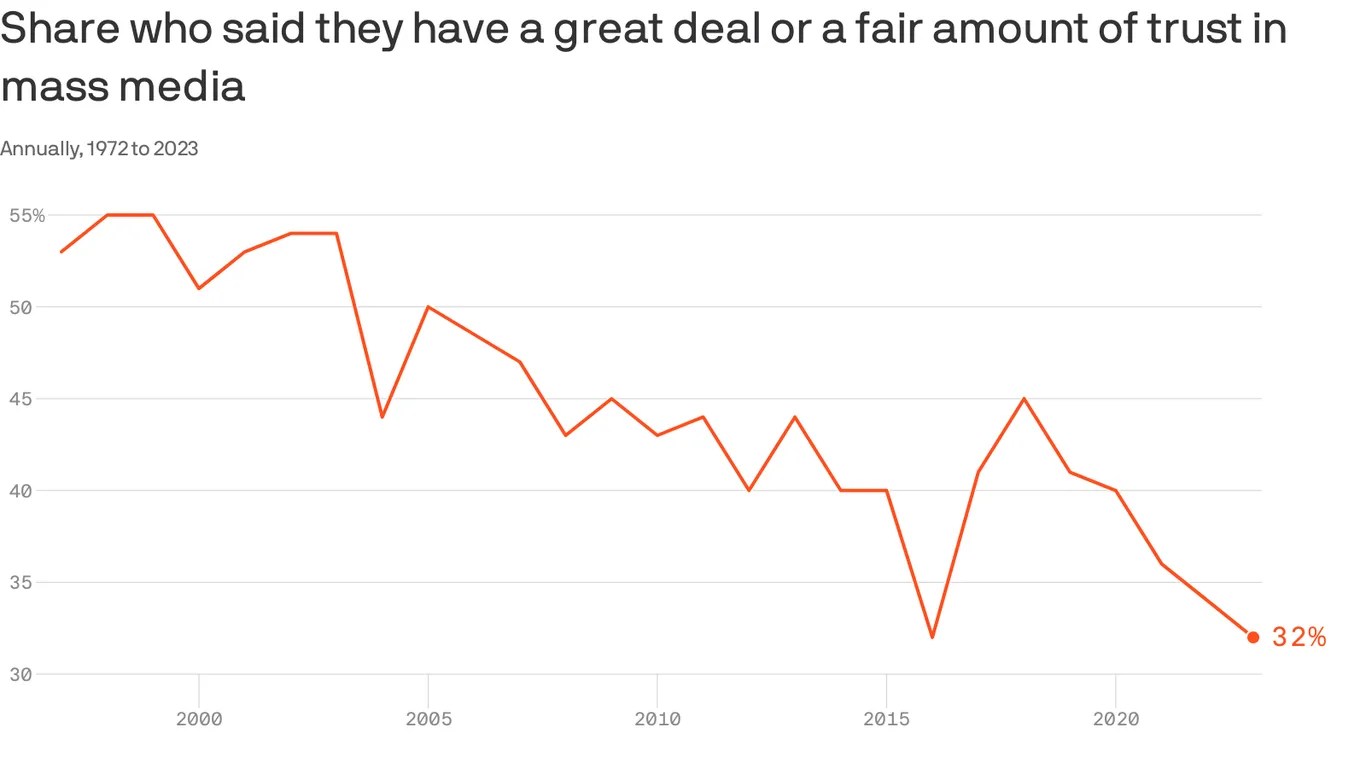
They could see that fascism protects the apparatus of bureaucratic control via the political manipulation of language and lying (along with lawfare, etc.). Many voters not only understood that Democrats and progressives lie constantly but why they lie. They now grasp why mainstream media lies. This is why the Democrats lost and the mainstream media is now more unpopular than Congress. Like Toto, the concern citizen pulled back the curtain to reveal the Great and Powerful Oz, only what was revealed was not a well-meaning huckster, but something dark and dangerous.
Elon Musk buying Twitter and turning into the free speech platform X was certainly a game changer. That’s why progressives despise Musk. For those who conflate liberal and progressives, you’d think they’d be thrilled that we’re on the threshold of a Kennedyesque moment, replete with rocket ships (literally grabbed from the sky) and satellites and plans for world peace. But, no, they hate what’s coming with the same passion they hated the Kennedys back then. That’s why they assassinated Jack and Bobby. And that’s why they tried to assassinate Trump—and probably will again. Their blown cover shatters the conflation.
I worry a great deal about Trump’s safety. He is a once in a generation talent operating in a political milieu that destroys talented people. Worse, he is a patriot. My hope is that he secures peace between Russia and the Ukraine, allows Russia to protect ethnic Russians in Ukraine, and pulls NATO far away from the Russian border—even better, pulls the United States from an alliance that should have gone away with the dissolution of the Soviet Union. But should Trump do these things, the military-industrial complex will have it in for him big time. The power elite did not like Jack Kennedy’s concern for peace in the world. Peace doesn’t sell weapon systems. They won’t take kindly to Trump’s push for world peace. They didn’t take kindly to it the first time around, as we all witnessed with our eyes and ears.
And they won’t take kindly to Trump’s moves to reign in the medical-industrial complex and Big Food, either. Just as corporate capitalism needs war to sell weapons, and the medical industry needs sick people to move its goods and services. Like dead Ukrainians, sick people are money makers. There are children to alter and mutate.
* * *
Scott Pressler
Republicans don’t lump the LGB with the TQ. This confuses people in the bubble who think—like I did for before my deep dive—that trans is “gay adjacent.” This is why it’s so important to get out of the bubble. The bubble weaves the woke items together in a seemingly seamless tapestry. But pull a thread (they’re all loose and hanging) and the fabric unravels. To avoid this, progressives dare not pick at threads—or tolerate those who do.
It only took a few weeks of Steve Bannon’s War Room back in March of 2020 for me to realize that the populist movement was not only ascendant but the rediscovered liberal path. That’s why liberals like Bobby Kennedy, Jr., Tulsi Gabbard, Naomi Wolf, Elon Musk, Joe Rogan, and many others have joined the movement. Already we hear Bannon and others taking care to use the word “progressive” to describe the threat to democracy instead of “liberal.”
Ever since that March when the technocrats made us hide our faces and stay away from each other—except for those participating in the color revolution that helped install the Biden-Harris regime—I have been writing about America’s political realignment on Freedom and Reason (which, by the way, has broken all previous records this year). What I argued then—and the past four years have only confirmed my thesis—that the “left-right” continuum makes little sense anymore.
Traditional labels actually line up like this: corporatists and progressives (authoritarians) on the one side, and liberals and conservatives (libertarians) on the other. The dynamic can also be rendered thusly: transnationalist (or globalists) versus patriotic nationalists. The latter is shamed for its libertarianism, but that’s what America is, or at least should be, all about, namely liberty. Once all that was sorted out, and the Republican Party reformed around the new dynamic, it was inevitable that liberals would move to the Republican Party. I expect they will continue to do so. (It feels like Jimmy Dore and his ilk are almost there, doesn’t it?)
The party is today more like the party at its inception, i.e, the party of individualism, innovation, and invention—and a patriotic commitment to our Union. To be sure, there were moments in between where it seemed the party would come closer to its original conception. But neoconservative and neoliberal hegemony took it off course (e.g., the Reagan presidency was hijacked by these tendencies). Indeed, these tendencies saw it form the Uniparty with Democrats. Bush, Sr., Clinton, Bush, Jr., Obama—these regimes constitute an unbroken string of Uniparty presidents. Now the neoconservatives and neoliberals are on the run, and it feels like morning in America.
Hilarious (terrifying, actually) reading all these X accounts who are genuinely puzzled about why there were so many fewer votes this time around compared to last time. I’m talking about the 2024 Presidential Election that produced a resounding rejection of Democratic presidential nominee Vice-President Kamala Harris by American voters. Why these accounts aren’t puzzling over the many more votes last time round than the time before that validates Guy Debord’s Spectacular Society.
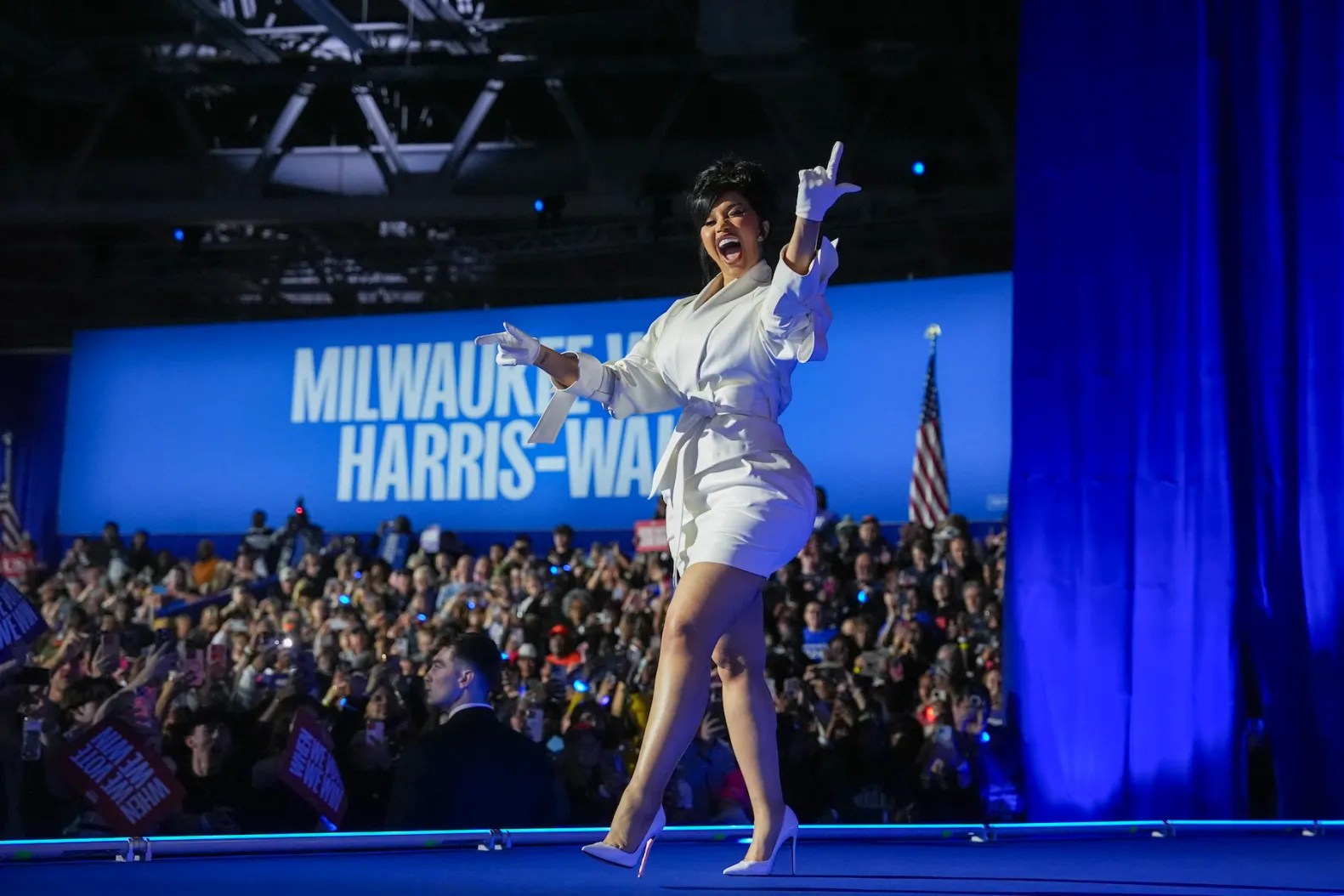
Cardi B during a campaign rally for Democratic presidential nominee Vice President Kamala Harris November 1, 2024 in West Allis, Wisconsin
Guy Debord’s Society of the Spectacle, published in 1967, is a critique of contemporary capitalist culture focusing on how social relations are increasingly mediated by commodities and images. Debord argues that modern society is dominated by the “spectacle”—a pervasive system of representations that distorts reality, substituting direct human experience (what we’re calling “common sense”) with mediated representations. He describes the spectacle as a social relationship between people mediated by phantoms, meaning that people no longer directly experience—or control—their lives, but instead view their existence through a filter of commodified symbols that direct their days.
The spectacle serves to reinforce and perpetuate capitalism. People are enticed into passivity, lulled by the endless consumption of commodified identities and entertainment forms (templates) rather than actively engaging in authentic social relationships. In this way, the spectacle creates a situation of alienation where individuals are disconnected from each other and from their own lives. It’s a system that reduces human life to a (vicious) circle of consumption, where one’s identity, meaning, and even purpose are bought and sold.
The spectacle obscures economic, political, and social realities, fostering a culture of distraction that keeps people from questioning the conditions of their own subjugation. Debord argues that the spectacle is not just advertising, consumer culture, and the mass media, but a larger social system that pacifies individuals and prevents collective social change by manufacturing consent and stifling dissent. Frequent visitors to my blog, Freedom and Reason, will know this as a theme in my critiques of late capitalism (see Supper in the Spectacular Café; Wait Until You’re Older; Widening the Shot—Seeing Behind the Scenes; Celebrating the End of Chevron: How to See the New Fascism.)
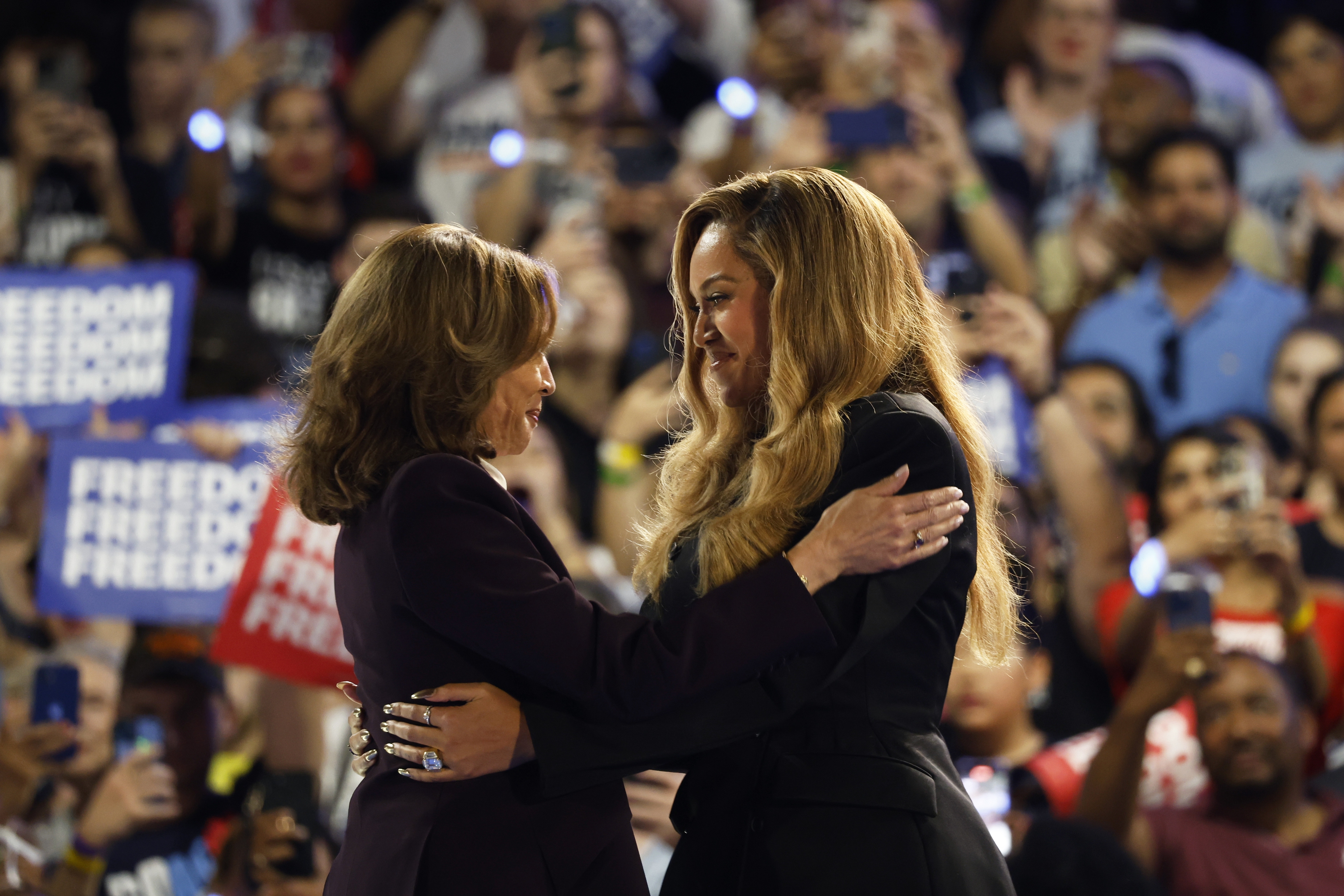
Debord’s critique also concerns the cult of celebrity—an aspect of contemporary culture even more relevant today, with the rise of digital media and the increasing role of the internet in shaping social identity. The obvious example, and a performer in the present spectacle, is US Vice-President Kamala Harris, who paraded before voters a menagerie of celebrities. Her rallies were free concerts targeting the intersectionally-conscious cultivated by the Culture Industry.
Democratic presidential nominee Vice President Kamala Harris and Beyonce during a campaign rally Oct. 25, 2024, in Houston. (AP Photo/Annie Mulligan)
I assume the so enraptured could never entertain the thought that Trump won the popular vote in 2020. But subtract 15 million from 81 million and rerun the numbers. See what you see. As it is, Trump only slightly underperformed his 2020 numbers compared to his 2024 ones (and they’re still counting votes). Here are the adjusted numbers for 2020: Biden 66.3 million; Trump 74.2 million. This leaves Biden with roughly 47 percent of the vote (roughly the same percentage Kamala is received this past election) and Trump winning nearly 53 percent of the vote (he won 51 percent this past election).
I chose 15 million rather than the 18 million widely reported because the count is still ongoing. There may be more outstanding vote that I have considered here; if so, I will return and correct the numbers. Voter turnout in Presidential Elections after 2000 has been 60%, 62%, 58%, 59%, and 66% through 2020. That last number is an outlier. Indeed, one has to go back to the dawn of the twentieth century to find that robust of a turnout. So far, turnout appears to be about 18 million votes shy of the 2020 total. More importantly, at 67,978,219, Harris is presently 13,305,282 million shy of Biden’s 81,283,501 votes. What happened to those millions of Democratic voters? (See How I Knew Trump Would Win.)
You didn’t expect the simulation you’re scheduled to live in to be rolled out all at once, did you? There was a world before Winston. Winston could never know that for sure because those who came before him didn’t fight hard enough for the truth, but he suspected as such since it was his job to curate fake news for the Ministry of Truth. But you are in a position to know. At least for now, those of us who know Winston’s fate did fight hard enough. Let’s keep fighting!
It needs to be said that in this struggle not all sides are the same. One side wants a system wherein the result arrived at is one of honest effort and process. The other side wants power whatever it takes. They want a one-party state. This is the side that wants democracy to be a black box, wherein the result is contrived (and democracy dies in darkness I’ve heard). This side is blue.
Even with numerous states not requiring proof of citizenship or identity, the right side prevailed. But, as we know from only four years ago, this outcome is not guaranteed. So let’s get this on the agenda: proof of citizenship to register to vote and same day in person voting with photo IDs. There’s only one reason not to do this.
There are many items on the agenda.
The End
Debord advocates a form of resistance he calls détournement (hijacking, rerouting)—the disruption and subversion of dominant cultural narratives, signs, and symbols. By creating situations that disrupt the spectacle’s hold on consciousness, he believed individuals can reclaim genuine human experience and foster revolutionary consciousness—for us on the populist left, this means the revolutionary consciousness that founded the Republic.
Corporations not only control labor and the economy but also infiltrate cultural and social spaces, reshaping how individuals perceive themselves and the world around them. The social logic of corporate statism lies at the source of the puzzlement I noted at the start.
Soon, those in control who grasp the implications of the solution will come round and stop the subalterns from realizing it.
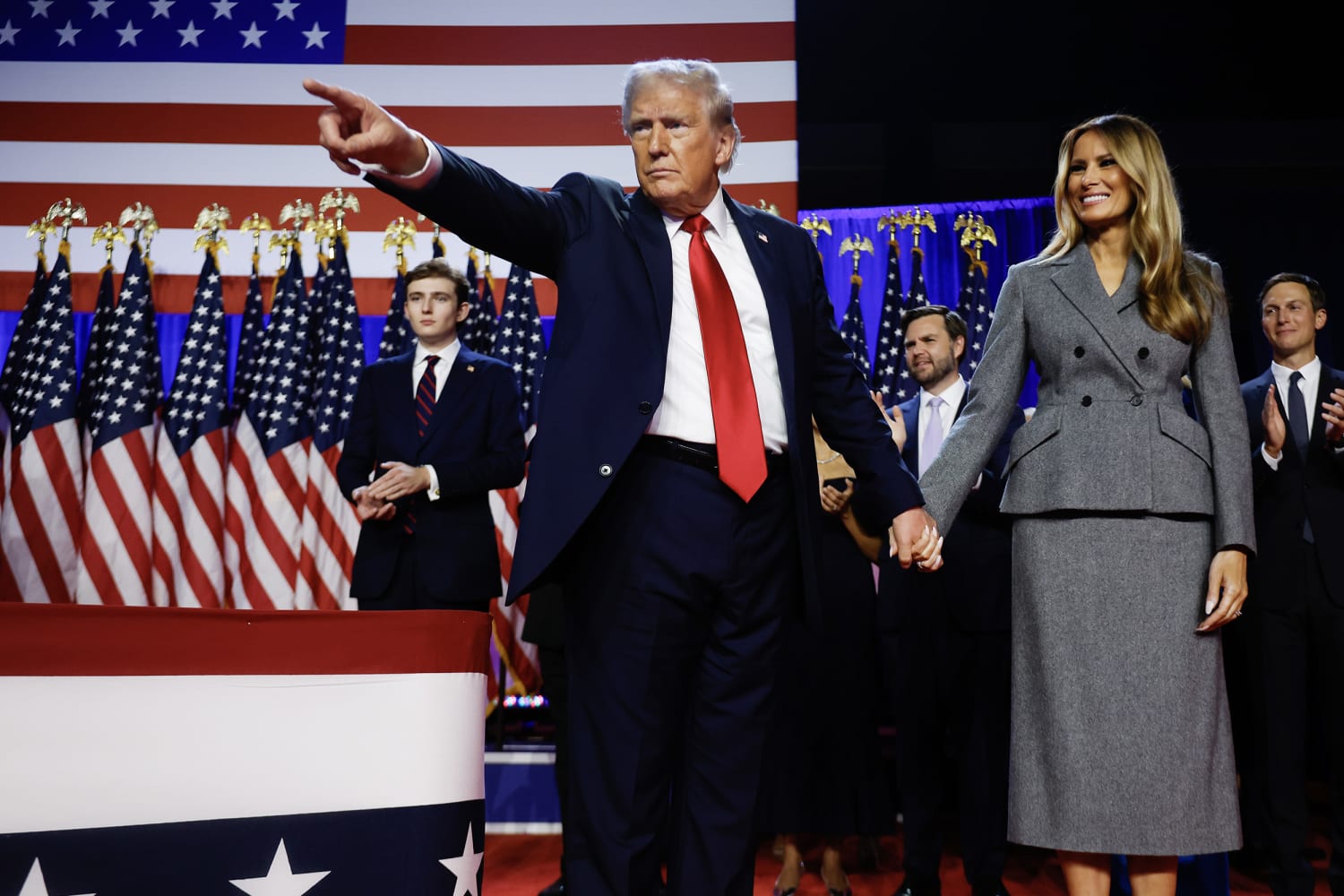
Trump with his wife, Melania, Election Night 2024 (source)
I will write a longer essay on this, but there were several inputs to my expectation Trump would win. Here’s one of them.
I knew the polls were overestimating support for Harris—and I knew roughly by how much. As I have been telling people, Harris needed to be well outside the margin of error going into election night to even have a chance.
In 2016, the national polling average (aggregate) from FiveThirtyEight had Clinton at 45.7 percent to Trump’s 41.8 percent, a 3.9 percent advantage. The official vote was 48.2 percent Clinton to 46.1 percent Trump, a 2.1 percent difference, roughly half of what the polling aggregate predicted.
Clinton won almost 66 million votes to Trump’s nearly 63 million votes. The difference was not enough to overcome the electoral college.
In 2020, the national polling average from FiveThirtyEight had Biden at 51.8. percent to Trump’s 43.4 percent, an 8.4 percent advantage. The official vote was 51.3 percent Biden to 46.8 percent Trump, a 4.5 percent difference. As in 2016, the aggregate polling overestimated the Democrat percentage by nearly twice as much.
Biden won just over 81 million votes to Trump’s nearly just over 74 million. Take note of this. I will come back to it in a minute.
In 2024, the national polling average from FiveThirtyEight had Harris at 48 percent to Trump’s 46.8 percent, a 1.2 percent advantage. The official vote was 47.5 percent Harris to 51 percent Trump, a 2.5 percent difference.
See the pattern? Polling consistently underestimates Trump’s support. The error is so consistent that you can predict the outcome if you account for it.
The vote is still being countered, but as it stands right now, Harris has roughly 66.5 million to Trump’s roughly 71.5 million.
Now, about that official Biden vote count. Where did 15 million Democratic voters go between 2020 and 2024?
One has to take account of phantoms, as well.
Finally, I expected Trump to win 312 electoral votes. We are still waiting to see whether that expectation holds.













 freedom and reason