
I haven’t forgotten about Springfield, Ohio, a flashpoint in the 2024 election that deserves our continued attention. The controversy reminded me of my experience is East Tennessee as a graduate student at the flagship university in Knoxville learning about, among other things, the superexploitation of black workers in East Tennessee during the Manhattan Project at the Oak Ridge site and surrounding areas. That situation provides a historical-comparative point in discussions of the situation in Springfield, Ohio, and the superexploitation of Haitian immigrants discussed in my previous essay A Case of Superexploitation.
The University of Tennessee-Knoxville is known for its strong environmental sociology program. I studied that subject under the guidance of Sherry Cable, and my early publishing success was in this area (see Advancing Accumulation and Managing Its Discontents: the US Antienvironmental Countermovement; The Anti-Environmental Countermovement).
I had been wanting to write about the Oak Ridge situation for many years, but moved on to other subjects. The situation in Springfield jogged my memory of that experience—and interest—and so today I finally write about Oak Ridge. I’m relying on my notes from that period and my general knowledge of Cold War history. What you will learn today (if you don’t already know about it) is that Oak Ridge is an instance of environmental racism but also a paradigm of the racialized split labor market I discussed in my essay about Springfield. I connect the Oak Ridge situation to Springfield and elaborate the situation of Springfield residents and what they can look forward to if they don’t organize politically to resist it.
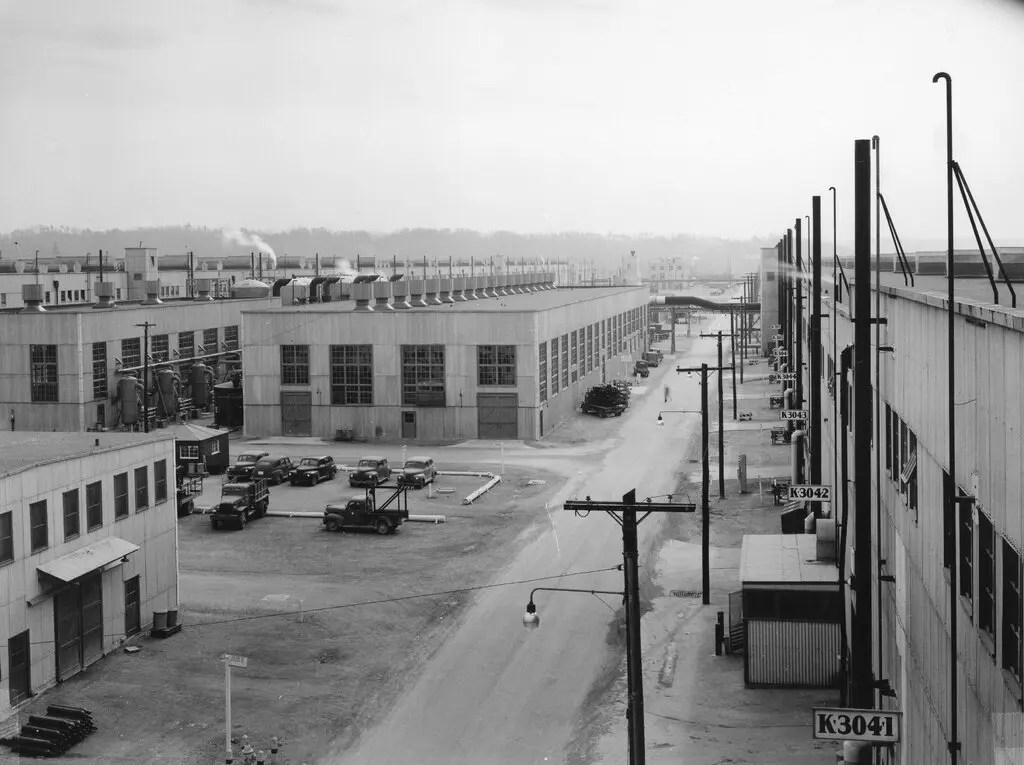
During World War II, Oak Ridge was created by the federal government as a secret city. Part of the greater Manhattan Project to develop the atomic bomb, rapid construction of a nuclear facilities required a vast workforce, and black workers (among others) were recruited from the South for this work. The black workers were mostly employed in low-wage, labor-intensive jobs such as construction, janitorial services, maintenance, and other forms of unskilled labor. Despite the promise of higher pay, they were paid significantly less than their white counterparts and were subjected to poor working conditions.
Crammed into hutments, cramped makeshift dwellings that lacked basic amenities like running water and proper insulation, housing conditions for black men were segregated and inferior. Black women, hired primarily as domestic help, faced similar discrimination and marginalization. Employed as cooks, laundry workers, and maids for white families, their wages were among the lowest in Oak Ridge. Black workers were systematically excluded from skilled and supervisory positions, despite some of them possessing the same qualifications as white workers. Racial segregation extended to every aspect of life in the secret city—dining, recreational facilities, and transportation.
The hazardous conditions that black workers faced during the Manhattan Project, particularly in East Tennessee at Oak Ridge, added another layer of exploitation beyond low wages and poor living conditions. Black workers were subjected to toxic materials without proper protective gear or safety protocols. Reports from this time describe black laborers working in dangerous conditions, including being exposed to mercury and other toxic chemicals, sometimes wading knee-deep in these substances. There is film of this, which I and my fellow students watched in seminar. The workers were seen as expendable labor. These exposures had long-term health consequences. Many black workers developed chronic illnesses, including cancers, respiratory issues, and other diseases linked to their work with toxic substances.
Moreover, the surrounding environment in Oak Ridge and other parts of East Tennessee became heavily polluted. Mercury, radioactive materials, and other industrial pollutants contaminated the air, soil, and water. The evidence of environmental racism is clear; black communities were disproportionately impacted by the environmental degradation in the area. The fact that black workers were often housed in segregated, substandard areas close to the most polluted sites exacerbated the injustice. They bore the brunt of both the immediate dangers of toxic exposure and the long-term environmental harm, with little recourse for improving their living and working conditions. Contamination of the environment persists. In the mid-1990s, at a birthday party in a park, there were signs by the creek nearby warning visitors to not touch the rocks, as they may be radioactive.
* * *
If we take the city manager at his word (see that previous essay), in the Midwest city of Springfield, Ohio, in 2024, the US government is contracting with private defense firms to produce advanced military technologies as part of a national security initiative. The city, once part of a thriving industrial region, like so many other Midwest cities hollowed out by globalization, is presented with “new opportunities” made possible by the construction of defense production facilities, where the US government, partnering with private companies, under the guise of “revitalizing the region,” is importing a vulnerable racialized populations for purposes of superexploitation. This is why he Haitians are there and why the corporate state and its media apparatus is obscuring the truth.
So here is the truth: Like the black workers at Oak Ridge decades earlier, Haitian workers in Springfield are segregated from the local population, living in housing repurposed as barracks with more construction on the way. Entire families, but also many young military age men, unable to afford rent on their meager wages, crowd into small rooms. The workers are kept isolated, both geographically and socially, from the local population, their temporary status reinforcing their vulnerability.
What will the conditions be like in the defense factories? Will the African-Carribean migrants work long shifts handling hazardous materials used in the production of cutting-edge military technologies, including experimental weapons systems, advanced electronics, and drone components? Very likely. Can we expect that safety regulations, though officially in place, will be rarely enforced for these temporary workers? Very likely. To shield the defense companies from legal liabilities, the government has cultivated a system where migrant workers are hired through temp agencies. This arrangement allows the companies to maintain plausible deniability regarding labor abuses, passing responsibility onto the agencies, which are less regulated and harder to hold accountable.
The corporate media will be, as they are now, uninterested in investigating and reporting on this developing situation. But we cannot allow the situation to go unnoticed. These temp agencies act as intermediaries, doling out short-term contracts and ensuring that migrant workers remain in a state of precarious employment, easily fired, deported, and replaced at the first sign of unrest. Workers know their situation is exploitative, but many feel trapped, and they need voices like ours to raise their profile. Those with temporary protected status fear the government might not renew their status, while those in the country illegally know any form of protest or refusal could lead to deportation. To be sure, they should be deported. They are here illegally and this work can be performed by citizens who have more control over the life chances because of their citizenship.
What can the legal residents of Springfield expect? Will the waste from the defense factories leak into nearby rivers, poisoning the water supply? Will toxic air emission cause respiratory illnesses among both workers and residents in the surrounding areas? Past experience tells us that these and other outcomes are almost certainly guaranteed. The factories, inevitably located in the poorer, predominantly minority neighborhoods of the city, will disproportionately affect these vulnerable communities, but they will in the end affect everybody. This is why the greater community must organize against corporate power and the collusion with federal, state, city, and local governmental bodies. Importing migrant labor is a key part of disorganizing political resistance. This was why the corporate media ridiculed Trump, Vance, and Republicans who were speaking up for the legal residents of Springfield. Their job is to protect the corporate state by obscuring its machinations and marginalizing its critics.
Recall the train derailment in East Palestine, Ohio, which occurred on February 3, 2023, when a Norfolk Southern freight train carrying hazardous materials derailed. Around fifty cars went off the tracks, with twenty of them containing chemicals like vinyl chloride, a toxic and flammable substance. Ostensibly, authorities conducted a controlled release and burn of the chemicals, which created a massive smoke plume. The incident raised concerns about air and water contamination in the area. Residents were temporarily evacuated, and although officials initially stated that the air and water were safe, many people reported health issues, including respiratory problems, rashes, and nausea. Many readers won’t readily recall that situation because they never learned about it. This is the function of the corporate media: to hide the facts by not covering them and then treating those who have concerns as “conspiracy theories,” etc.
* * *
Springfield, Ohio has become a microcosm of twenty-first century labor exploitation, where the superexploitation of migrants, facilitated by temp agencies and backed by the state, echoes the racialized labor systems of the past. Hidden behind the rhetoric of economic stability and national security, the government and private companies have constructed a system of modern indentured servitude, where the most vulnerable bear the heaviest burdens in the name of economic revitalization and defense. The corporate media obscures the truth of the situation by deft deployment of propaganda tactics developed over the course of decades. But for the free and open spaces on the Internet, it would be virtually impossible to know and raise awareness about this situation.
In my previous essay on this platform cited above, I spent considerable time explaining why resistance to the foreign culture undermining the traditions of Springfield is not racism. However, those attacking the residents of Springfield for their resistance to the superexploitation of immigrants and the destruction of their neighorhoods are doing so to obscure the actual racist practices of the federal and state governments under the control of the historically racist party—the Democratic Party—and the corporate interests they serve.

 freedom and reason