
“We have it in our power to begin the world over again. A situation, similar to the present, hath not happened since the days of Noah until now. The birthday of a new world is at hand, and a race of men, perhaps as numerous as all Europe contains, are to receive their portion of freedom from the events of a few months. The reflection is awful, and in this point of view, how trifling, how ridiculous, do the little paltry cavilings of a few weak or interested men appear, when weighed against the business of a world.” —Thomas Paine, Common Sense, 1776
I addressed this several months ago in the essay Am I Rightwing? Not Even Close. I have addressed the matter elsewhere, as well. With Republicans in command of the federal government (as well as most state governments), I think it is useful to remind readers of the importance of understanding the meaning behind the terms we use not only to defend ourselves against mischaracterizations, but to also understand the promise of November 5, 2024. This essay will clarify the meanings of “right-wing” and “left-wing” to expose the propaganda project that confuses the populace over the tendencies that either advance or hinder the life-chances of the common man. (For another essay on this matter, see Manufacturing Estrangement: The Confused Labeling of Political Standpoints.)
The original meaning of right-wing traces back to the French Revolution (1789-1799), where political factions were symbolically aligned by seating in the Estates-General and later the National Assembly. Those seated to the right of the president supported the monarchy, the established social hierarchy, and traditional institutions like the church and aristocracy. In this context, being right-wing signified a commitment to order, hierarchy, and the preservation of longstanding cultural and political systems against revolutionary change.
Right-wing politics emphasizes values such as charismatic and traditional authority, cultural continuity, and respect for inherited traditions. It is often associated with the defense of the belief in natural hierarchies, i.e., the rightness of social stratification, and skepticism toward egalitarian or redistributive efforts that disrupt established order. Aristocracy, monarchism (or absolutism), and religious institutions are historically seen as key pillars of right-wing ideology, representing stability and legitimacy rooted in divine or inherited authority.
Right-wingers in France desired to perpetuate the ancien régime, the political and social system that existed in France before the French Revolution of 1789. The term, which means “old regime,” encapsulates the aristocratic and hierarchical structure of society, dominated by monarchy, feudal privileges, and rigid class distinctions. The ancien régime featured centralized monarchical power, which reached its height under Louis XIV’s absolutism, epitomized by the belief in the “divine right of kings.” It was supported by traditional institutions like the church and feudal laws, which legitimized a stratified social order.
This system was deeply rooted in medieval traditions characterized by three main estates: the First, Second, and Third Estates. The First Estate was comprised of the clergy, who held significant spiritual and temporal power and were often exempt from taxation. The Second Estate was comprised of the nobility, who controlled vast swaths of lands, enjoyed privileges such as tax exemptions, and held influential positions in government and the military. The Third Estate was comprised of the commoners, which included everyone from peasants, proletariat, and the emerging bourgeoisie (the middle class). This group bore the burden of taxation and was excluded from political power, despite making up the overwhelming majority of the population.
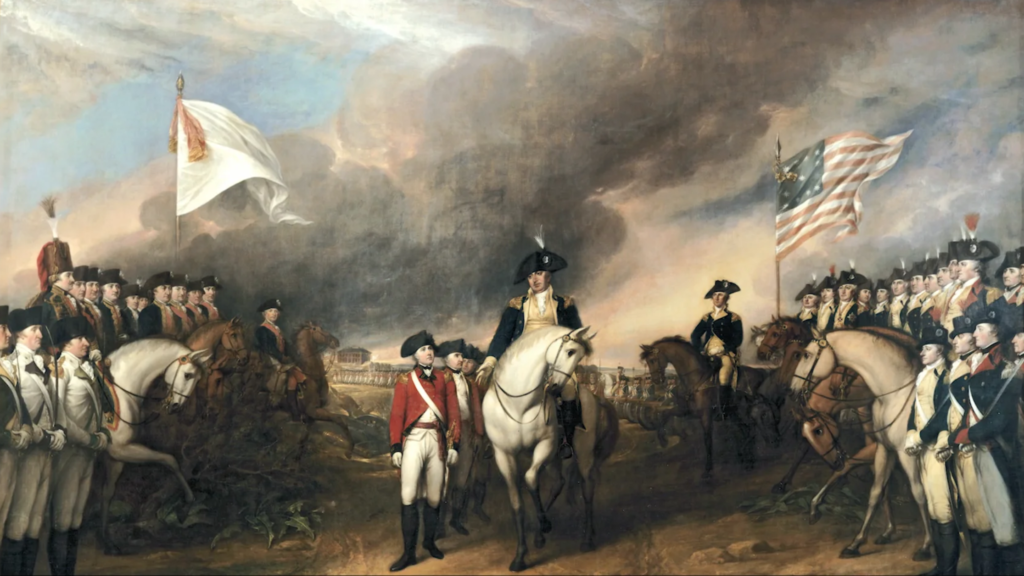
The French Revolution marked the end of the ancien régime, overthrowing the monarchy, abolishing feudal and hereditary privileges, and entrenched social hierarchies, striving instead for equality and democratic-republican principles. The French Revolution, as well as the American Revolution marked the beginning of modernity. Those who led these revolutions were left-wingers, liberals and other radicals, who sought to make the world over again.
The ideals that emerged from the revolutions of the late eighteenth century, particularly liberalism, sought to replace the hierarchical and divinely sanctioned order of the ancien régime with a system rooted in individual rights, limited government, rationalism, and the rule of law. This new order emphasized negative liberty—the freedom from coercion, whether by the state or other authorities—and laid the groundwork for democratic-republican governance and free-market economics. These principles became the cornerstone of modernity, challenging the reactionary forces of monarchy, feudalism, and centralized religious power.
However, the contemporary landscape reveals a shift that paradoxically undermines these modern values under the guise of progressivism. The rise of corporate statism, administrative rule, and technocratic governance signals a departure from the liberal ideals of autonomy and decentralized authority. These structures, often animated by the ideology of woke progressivism, embrace a collectivist ethos that prioritizes identity categories, inorganic equity mandates, and an ever-expanding bureaucratic apparatus. This postmodern condition, rather than advancing the liberatory aims of modernity, marks a regression to centralized control, albeit under a new guise.
This shift can be seen as reactionary and regressive because it rejects the Enlightenment principles of individualism and universalism that defined the liberal revolutions. Instead, it reintroduces a kind of neo-feudal hierarchy, where social status is increasingly determined by one’s alignment with dominant ideological frameworks rather than merit or personal freedom. The corporate state, with its fusion of government and corporate interests, mirrors the patronage systems of the ancien régime, where power is concentrated in the hands of elites insulated from democratic accountability.
This dynamic has not only transformed the institutions traditionally associated with progressivism but also reshaped the political alignment of many liberals. The embrace of free speech, the defense of market principles, and skepticism of centralized power—once hallmarks of liberal thought—are now more commonly found among modern conservatives. Of course, these remain the hallmarks of liberal thought.
Thus the migration of liberals to the Republican Party reflects a diminishment of the right-wing ideologies that animated the party during its Religious Right phase. The Republican Party’s embrace of Christian conservatism and evangelical Christianity emerged prominently in the late 1970s and early 1980s, in part an electoral strategy to become competitive after decades of progressive Democratic domination. More broadly, the Religious Right was a cultural movement that aligned conservative evangelical and fundamentalist Christians with the Republican Party, driven by shared concerns over social issues and a desire to promote traditional moral values in public policy, such as religious traditionalism and rigid hierarchy. With the emergence of populist-nationalism, a modern conservatism rooted in democratic-republican politics and classical liberal principles has emerged.
The irony, then, is that what is branded as progressive or left-wing today often resembles the reactionary forces of the past. By prioritizing control through technocracy, bureaucracy, and ideological conformity, these movements betray the emancipatory promise of modernity. They replace the dynamism of liberal thought with a stifling orthodoxy that privileges centralized power and social stratification under new labels. Far from being progressive, this emerging postmodern order undermines the very freedoms and values that the revolutionary liberals fought to establish, revealing it as a deeply regressive force.
I have said this before, but it bears repeating. As a lifelong liberal, I have always understood liberalism to be more than a fleeting political label—it is a coherent system of ideas grounded in individual liberty, limited government, free markets, and the pursuit of justice through reason and universal principles. Many people I know, who also once identified as liberals, stuck with the Democratic Party as it abandoned these foundational ideas for a postmodern worldview rooted in collectivism, identity politics, and technocratic control. My argument has always been that people do not get to take the labels with them when they abandon the principles those labels represent. Liberalism is not whatever the Democratic Party or its progressive wing claims it to be at any given moment. It is an ethical and philosophical tradition, and if one’s politics and commitments no longer align with its core tenets, then one has left liberalism behind.
Those of us who remain committed to liberal principles find ourselves in a peculiar position, labeled as “right-wing” because we have not shifted our values to follow the Democratic Party’s postmodern turn. This mischaracterization reveals more about the party’s transformation than about our politics. We did not move; the party moved. In doing so, it has blurred the boundaries of liberalism for the masses, co-opting the term for an agenda that is fundamentally at odds with its classical meaning—and causing the modern conservative to condemn liberalism in name, conflating the label with progressivism, while embracing its principles. Steadfastness to liberal ideals underscores the continuity of our commitment to the principles of modernity. Far from being “right-wing,” our politics affirm the very liberal tradition that founded the American Republic, but has since been abandoned in favor of ideas that are, ironically, reactionary and regressive.

 freedom and reason