
The mass shooting in Birmingham, Alabama, last night, that left four dead (so far), and seventeen wounded, is not a problem of guns but of violent crime. Guns don’t shoot themselves. People use guns to shoot other people (and themselves). If the public wants to reduce homicide, it needs to understand why people kill other people. Part of this is understanding who is doing the killing. The security state and the corporate media want the public to believe it’s the lone white male. The public has yet to learn who perpetrated the Birmingham shooting because it’s not. It usually isn’t.

Serious crime skyrocketed between the mid-1960s and the mid-1990s. Why this happened requires a long and complex analysis. However, what brought down crime after the mid-1990s is not a complicated story. Progressives tell us that it was the assault weapons ban, which came into effect in September 1994 and sunset in September 2004. But so-called assault weapons are involved in a very small portion of homicides (fewer than one in twenty)—and who is robbing people with an AR-15? What brought crime rates down was a drastic expansion of the criminal justice system—incarcerating more violent offenders for longer periods of time and putting more police on the street focused on crime prevention, drug trafficking, and gang activity. NewYork City under Mayor Rudolph Giuliani and Police Commissioner William Bratton is the paradigm.
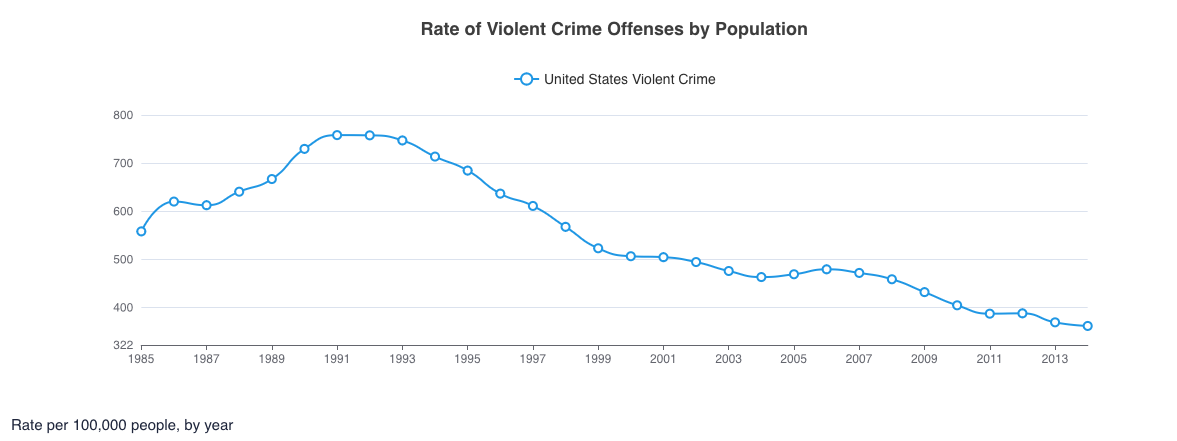

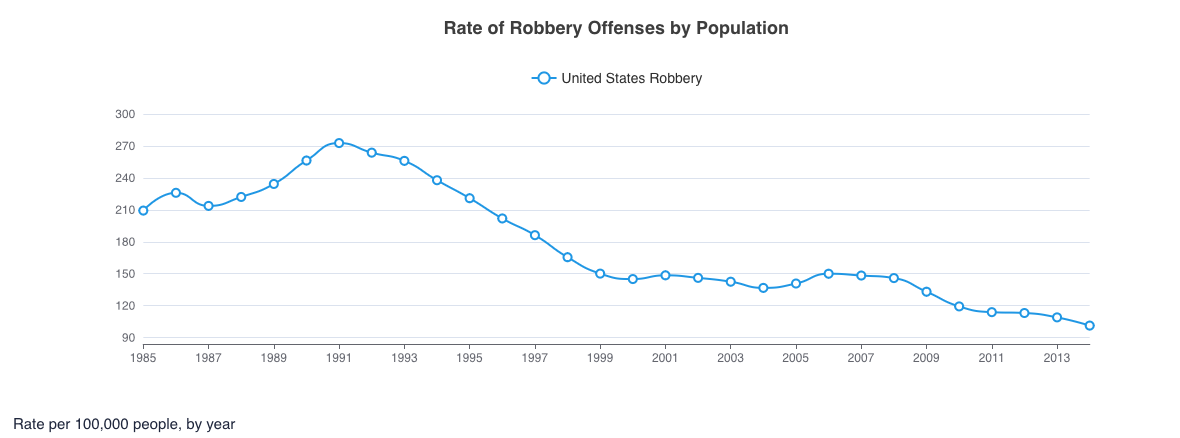
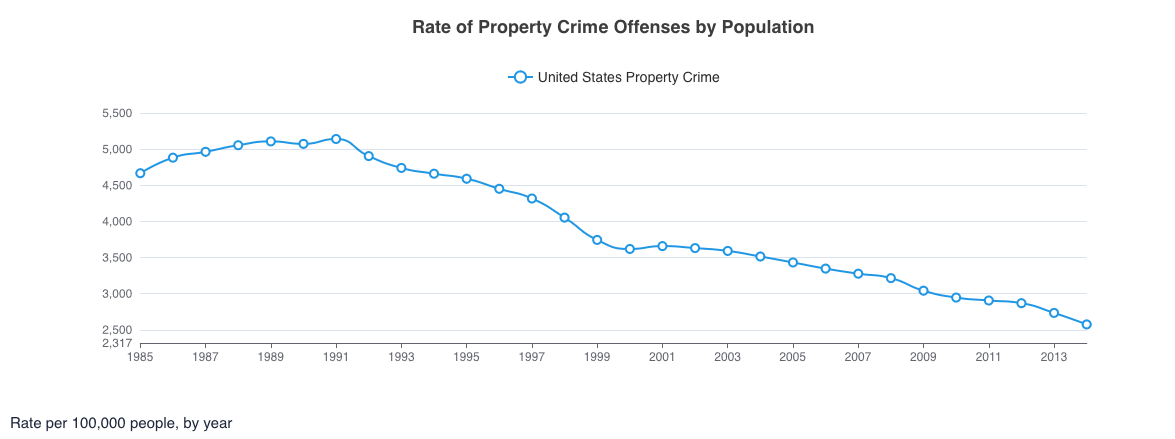

Thanks to the tilt of criminal justice policy and practice towards law and order, the nation enjoyed a historic drop in crime after the mid-1990s. But that’s been reversed over the last decade. And it shows no signs of letting up. The DOJ’s Criminal Victimization for 2023 is out. The Department of Justice found that violent crime increased 37 percent from 2020 to 2023, rape 42 percent, robbery 63 percent, and stranger violence 61 percent. The NCVS does not include murder statistics, and the FBI has still not released the 2023 statistics (and the 2022 statistics are incomplete), so I can’t report that figure for that year. But I can report murder for the years earlier, and it’s scary. Also in the DOJ report, property crime is up 13 percent, driven by motor vehicle theft, which increased 48 percent.

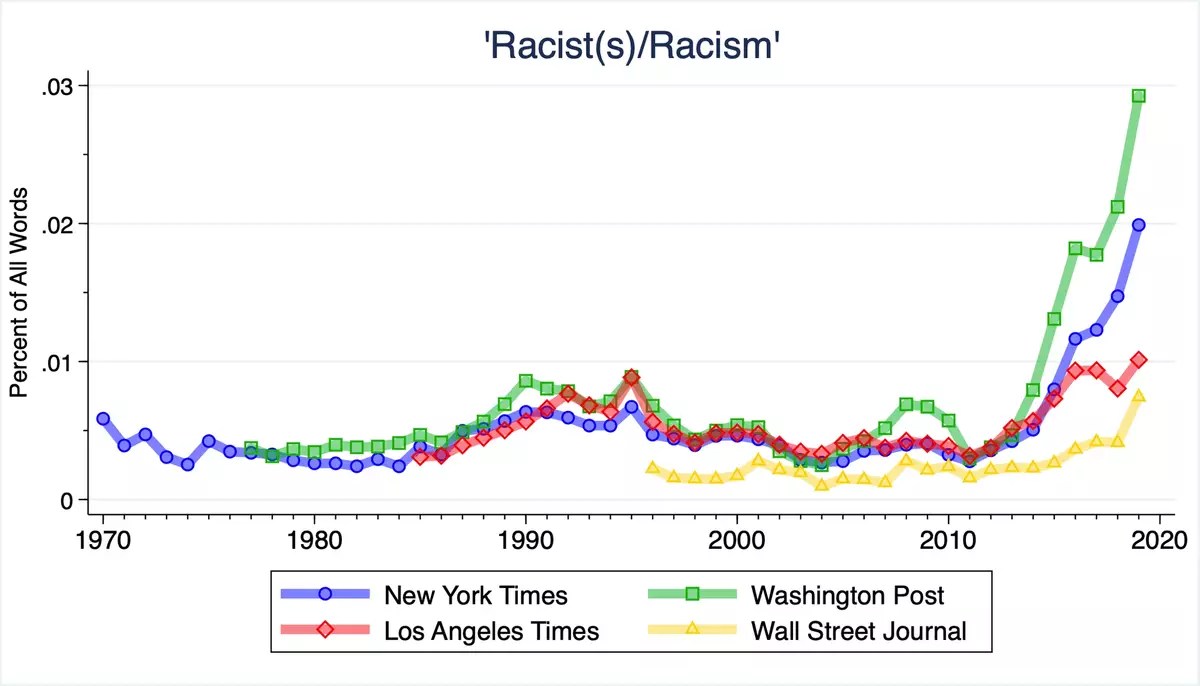
What went wrong? Around 2010, academics and the mass media began pushing the white supremacy/white privilege narrative. In a detailed content analysis of major media sources published in Tablet in 2020, “How the Media Led the Great Racial Awakening,” Zach Goldberg finds that, “[y]ears before Trump’s election the media dramatically increased coverage of racism and embraced new theories of racial consciousness that set the stage for the latest unrest.”
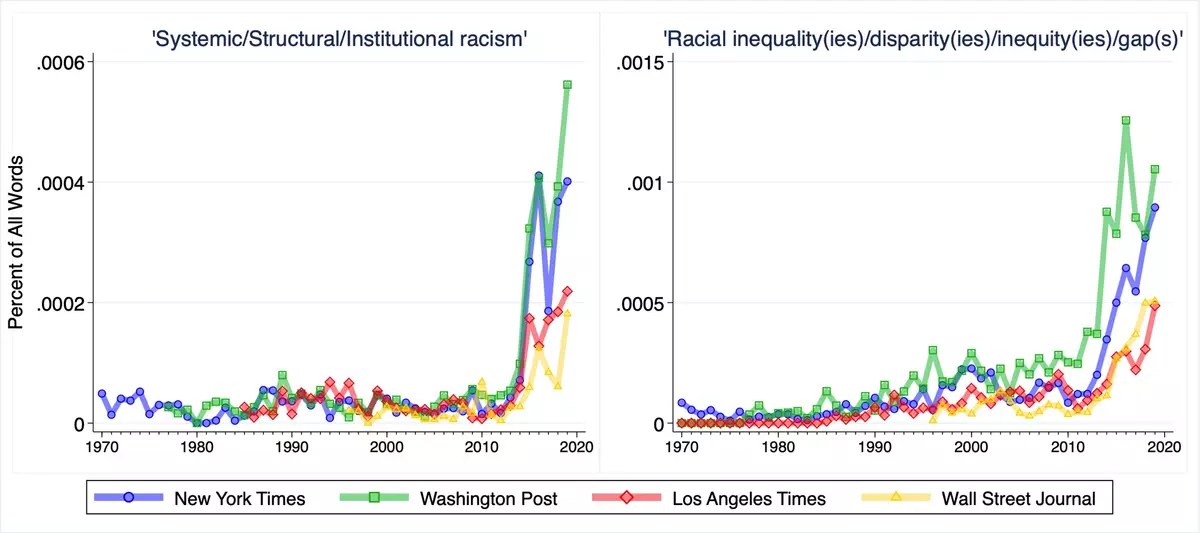
You can find Goldberg’s article here, and I strongly encourage you to read the whole thing, but I want to pull a few charts from the piece to make the point immediate for you. In the first two charts, the reader will see the drastic increase of reference to “racists” and “racism” occurring around 2010 and a corresponding rise in the percentage of the population who reported that racism in the United States is a problem—this after a long decline.

Indicated by the next several charts, the use of terms like “racists” and “racism” were buttressed by a slew of novel or academic terms developed by progressive social scientists and historians and pushed out by the corporate media and culture industry: “systemic racism,” “structural racism,” and “institutional racism”; “racial privilege” and “white privilege”; “racial hierarchies,” “whiteness,” and “white supremacy”; “racial disparities,” “racial inequalities,” and “racial inequities.”
In this way, the alleged effects of “whiteness,” “systemic racism,” etc., were identified as causing racial disparities and inequities without any demonstration of the validity of the alleged independent variables or their explanatory power. No matter, the terms comprised the assumption in force. Reinforced by race hustlers like Ibram X Kendi and Robin DiAngelo, and through constant repetition, the abstract facts of racial disparity became their own cause, especially since even suggesting they were explicable by reference to causes outside of the antiracist narrative risked being labeled a racist.


Two major pieces of this narrative played a critical role in producing the crime wave we’re currently suffering: (1) dissemination of the myth of a racist criminal justice system and (2) sowing resentment among racialized populations impoverished by globalization—offshoring and immigration. Elites blamed the situation of blacks on working class whites to deflect from the fact that transnational corporations and white progressives and their black collaborators were responsible. Against a backdrop of decades of decay in America’s central cities caused by Great Society social engineering and the destruction of the black family, demoralization combined with decarceration and depolicing produced rising rates of violent and serious property crime.
Today, there is more violent and serious property crime than there has been in a long time. It’s so bad that many city and state governments are not reporting out the statistics—hence in unavailability of the FBI Uniform Crime Report. Predictably, serious crime predominates in blue cities run by progressive politicians and policymakers. These are the same politicians and policymakers who manufactured the myth of the racist criminal justice system and socialized identity politics, i.e, the reracialization of the nation’s collective consciousness. Given the criminogenic conditions that these politicians and policymakers perpetuate, without effective public safety measures, violent and serious crime inevitably returned.
What can we do about it? If you don’t want to do anything about it, or make it worse, then vote Democrat. But if you want to return to the rule of law and public safety, then you will have to vote for the alternative. We are on the threshold of a new day—but we have to seize it. Not seizing the moment is not a neutral act. We can vote for Harris and remain in the ever-growing authoritarian darkness of the corporate state, or we can vote for a movement that is bringing together the left and the right around democratic-republican principles of governance and classical liberal values. Things are more hopeful than they have been in my lifetime. But half the nation wants to be governed harder by the nanny state. And the nanny state—and the destruction of the family it brings—lies at the heart of criminogenesis in America.

 freedom and reason