

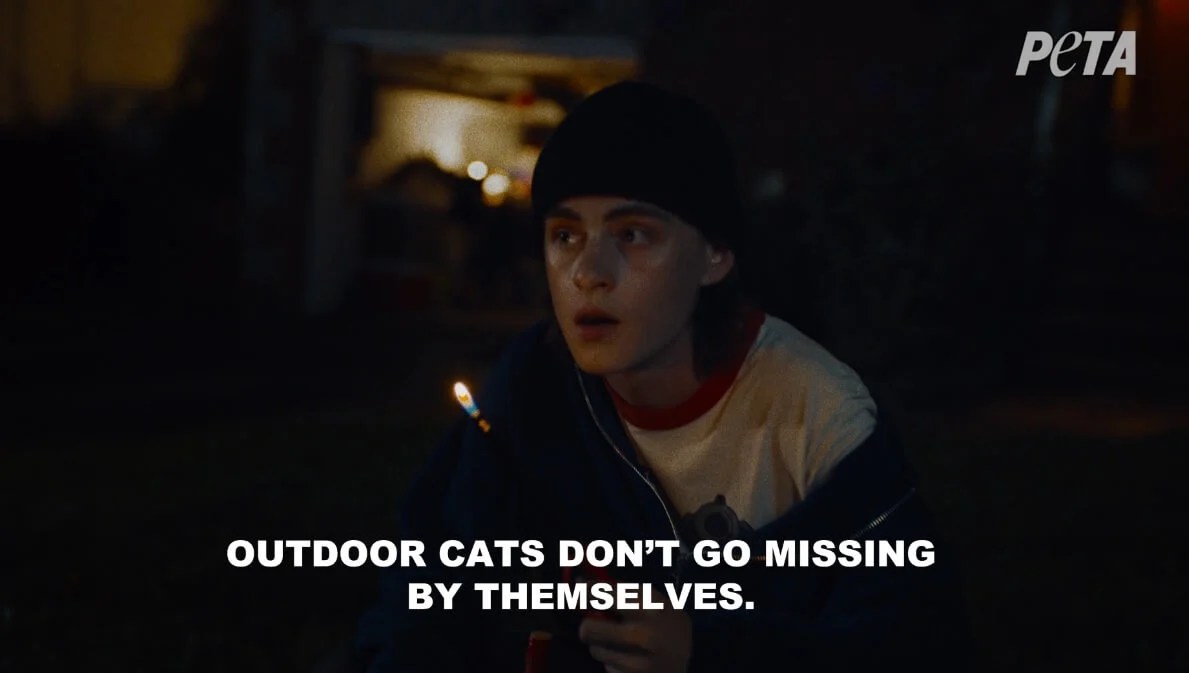
Responding to the killing of Cats in Ohio and elsewhere, People for the Ethical Treatment of Animals, or PETA, has put out series of public service announcement emphasizing that “Outdoor cats don’t go missing by themselves.” This is true. Toms wander off from time to time, but generally speaking, if your cat doesn’t come home, it’s probably been killed. It could be coyotes. It could be humans. It seems that the authorities aren’t interested in finding out whether it’s the one or the other. But they are interested in racializing the problem of immigration by telling the public that concern over the safety of cats in Ohio is a symptom of white supremacy.
The PETA ad is based on actual events. Here’s a report on these events, from the Dayton Daily News, dated July 10, 2024: Dayton man charged after reportedly setting kitten on fire. Eric Keith Williams, 21, of Dayton, faces charges of arson and cruelty to companion animals, according to records from Dayton Municipal Court. The arson charge is a first-degree misdemeanor, and the cruelty to companion animals charge is a fourth-degree felony. The Humane Society of Greater Dayton, assisting local authorities, has taken custody of the cat. Thankfully, the cat survived its injuries and is currently being treated as it recovers. Dayton is about thirty minutes from Springfield.

Above is the booking photo of Williams. Below is the cover image of the ad that depicts Williams’ crimes. It would seem that PETA felt it necessary to change the race of the perpetrator. PETA confirms that this is the case they built the video around. “Shocking reports of people attacking cats have recently grabbed headlines across the U.S., prompting a new PETA video series that will air nationwide, including in Dayton, where a man was arrested after intentionally setting a kitten named Joffrey on fire in July.” Another of PETA’s 30-second TV commercials, “Outdoor Cat,” also features a young white man. The race of the actual perpetrator in that case is unknown, as he (or she) has not been identified. Both men represent the stereotype of the antisocial white kid who revels in cruelty to animals.
I won’t share here the horror of cat killing videos one can find with little effort on X (formerly Twitter). I understand why they need to be shared, but as a cat lover they are difficult to watch. What concerns me is the way that criticism of migrant culture that permits the killing of cats for food or for protective magic in Caribbean religions, principally Obeah, Santería, and Vodou, are being portrayed as expressions of white supremacy. The reason for this is obvious— to tamp down opposition to the corporate state strategy of flooding the country with Third Worlders for the superexploitation of their labor and demographic realignment for political purposes.
It is important for the public to know something about the Third World cultures and religions that represent a threat to companion animals, as these cases are appearing with alarming frequency (hence the PETA campaign, which downplays the cultural aspect of the problem by focusing on decontextualized individual incidents). I will mention three here and then follow up in a day or so with a longer essay on why the conflation of culture and race is fallacious and why tens of thousands of Haitians were dumped on Springfield, Ohio. Culture is being conflated with race enable the smear that will bring disrepute on those who complain about mass immigration and paralyze those who consider joining them.

Obeah is a system of spiritual and healing practices originating in West Africa that was brought to the Caribbean during the transatlantic slave trade. It was characterized as a form of sorcery or witchcraft by colonial authorities, encompassing a wide range of practices including divination and protection against spiritual harm. Obeah is particularly associated with Jamaica, blending African spiritual traditions with indigenous and European influences. Cats’ teeth and other body parts are used as charms in this religion.
Santería is a syncretic religion that developed in Cuba among enslaved Africans, primarily of Yoruba descent. It blends traditional Yoruba religious practices with elements of Catholicism, as enslaved people were forced to adopt Christian rituals while covertly maintaining their own spiritual traditions. Central to Santería are the orishas, deities that embody natural forces and human qualities. Rituals often involve animal sacrifice and divination. While Santería is practiced widely in the Caribbean and Latin America, it has also spread to North America through diasporic communities.
Vodou, which I wrote about a few days ago (Is This the Second Coming of Hunter Biden’s Laptop is a Hoax?), is a religion with roots in West African Vodun and has evolved into a distinct tradition in Haiti. Like other Afro-Caribbean religions, it blends elements of African spirituality with Catholicism, with a strong emphasis on ancestor worship, ritual possession by spirits, and the maintenance of harmonious relationships with the spiritual world. Vodou practitioners honor loa (also spelled lwa), or spirits, which act as intermediaries between humans and the divine. Rituals often involve offering of food or animal sacrifices to the loa or for protective magic.
As I will explain that pending essay, increasing flows of Haitians, especially those from the poorest rural areas, are bringing Vodou to the United States. Enabled by the doctrine of multiculturalism, which portrays the demand for assimilation of foreigners into American culture as a expression of racism, Haitian migrants, especially coming in such large numbers, and effectively walled off from other workers in a split labor market, are forming ethnic enclaves in which conformity to civilized norms and values cannot develop.

 freedom and reason