
Update (8-27-2024): When I said the fake politics of joy I did not mean to suggest that the “Strength Through Joy” (Kraft durch Freude, KdF) campaign was fake. “Strength Through Joy” was a propaganda tool, projecting an image of a benevolent and caring government. It was designed to foster a sense of pride and unity among Germans, aligning them with the Nazi ideology and goals. The concept of the “people’s community” (Volksgemeinschaft) was central to the campaign, which sought to create a cohesive and ideologically unified society. The program was one of many ways the Nazi regime sought to control and influence the daily lives of German citizens, blending social welfare with political indoctrination.

Update (08-24-2024): In her speech at the DNC, Kamala Harris said Donald Trump is not a serious person. Of course he is, and yesterday it all got even more serious, as Trump welcomed to the stage Robert F. Kennedy, Jr., who just suspended his own presidential campaign and endorsed Trump. It is well-known that I have been waiting all my life to vote for Bobby Kennedy and to see him unite with the populist-nationalist movement reclaiming the American Republic was a powerful moment in my life. I knew it was hard for him, but he did the right thing. His candidacy was helping Harris, and the single most important thing to accomplish in this moment is the defeat of the Harris-Walz ticket. It is no exaggeration to say that another four years of progressive rule will likely by the dirt that fills the grave of the greatest experiment in democracy and liberty the world has ever known. We can’t let this happen. We have to fight like hell for the United States.
“This decision is agonizing for me because of the difficulties it causes my wife and my children and my friends,” Kennedy said on Friday. “But I have the certainty that this is what I’m meant to do. And that certainty gives me internal peace, even in storms.” Bobby Kennedy did the right thing by endorsing Trump. Tulsi Gabbard did the right thing by offering to serve as Trump’s running mate. Naomi Wolf did the right thing by working with Steve Bannon to expose the corporate state’s pandemic lies. These are patriots. The Democratic Party is the party of corporate power and administrative rule. Indeed, there is nothing democratic about the party at all, as these four progressive elites laugh about in discussing how the Party sacked Biden and installed Harris (who has yet to hold a press conference or sit down for an interview with the media).
* * *
Remember Hubert Humphrey’s “Politics of Joy” theme? His campaigns manufactured the construct as a hallmark of his political identity, particularly during his 1968 presidential campaign. The theme was pitched as Humphrey’s “optimistic vision for America,” emphasizing “positive government action” to improve the lives of citizens, especially the downtrodden and resentful. Humphrey believed that government should play an active role in creating a diverse, equitable, and inclusive society. Sound familiar? His campaign stood up the theme to contrast Humphrey to the divisive and turbulent politics of the time, particularly the proxy war on the other side of the planet, as well as crime, disorder, and riots in cities at home. Humphrey was Vice-President to Lyndon B. Johnson, who, as President, declined to run for a second term. Starting to sound even more familiar now?

During the 2022 Minnesota gubernatorial campaign, Tim Walz, the incumbent governor, ran for reelection on the “Politics of Joy” theme. Did you know that Humphrey was also from Minnesota? He served as the US Senator from Minnesota from 1949 to 1964 before being tapped as the Vice President under Johnson following the assassination of John F. Kennedy. When Humphrey run for the presidency in 1968, he represented Minnesota’s progressive values on the national stage. The Walz campaign focused as well on positive messaging that highlighted his achievements in Minnesota and a vision for a better future. This approach contained a concealing rhetoric of decidedly not focusing on divisive issues, instead emphasizing empathy. The goal was to build a coalition of diverse supporters who felt included in the political process (not that they actually would be). The campaign engaged with voters through a positive and uplifting tone, encouraging “civic participation” and fostering a “sense of community.” This approach aimed to manufacture a joyful experience that simulated popular empowerment.
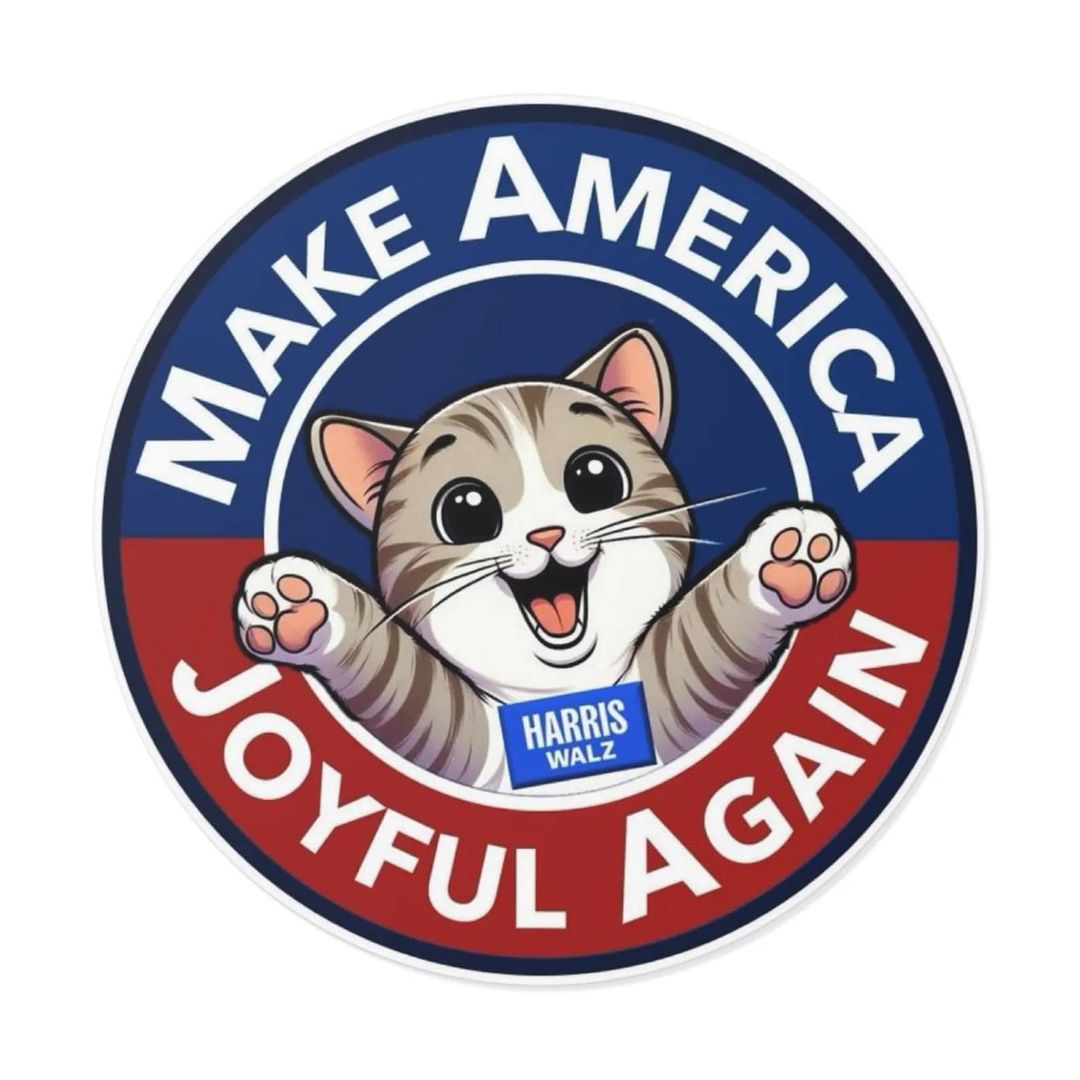
Before continuing, I want restate the obvious: Joy is a feeling of great happiness and pleasure that comes from good fortune, success, or wellbeing. Events, people, and things bring one joy. Joy is emergent from conditions, relationships, and situations. Joy cannot stand as a valid politics to cover the failures of past administrations or the perils of future ones. To be sure, something that looks like joy may be simulated, but it is an illusory state of gladness—a fool’s paradise. Dissimulation is the act of pretending to feel a certain way, such as happiness, when you don’t actually feel that way. This is the joy of the Harris-Walz campaign. It’s fake joy. Like the Clintons and the Obamas, Harris and Walz are constructs. They don’t care about you or your country. They only care about themselves.

Like Walz today, Humphrey’s “politics of joy” was a cover for his lifelong commitment to progressive causes. Humphrey was a key figure in the social welfare programs during the Great Society era that undermined by the black family in America’s central cities by promoting idleness and dependency on paternalistic government. Humphrey was also a strong advocate for mass immigration, arguing for removing “discriminatory quotas.” He was a supporter of the Immigration and Nationality Act of 1965, also known as the Hart-Celler Act, which abolished the national origins quota system that had been in place since the 1920s. This act, signed into law by President Johnson, opened up US immigration to people from all parts of the world, rather than favoring European immigrants whose cultures were similar to those of America.
Humphrey’s optimistic message was betrayed by the political and social unrest of the late 1960s, making it challenging to resonate with voters who were increasingly disillusioned by the ongoing conflict in Vietnam and domestic issues. America would find out later the dreadful consequences of open borders, but they were rightly suspicious then of the direction progressives were taking America, and as the 1968 campaign unfolded, the return of populist and nationalist sentiment and the desire for a return to the traditional values that created safe and stable communities became ever more apparent.
Humphrey was up against Richard Nixon in 1968, who ran on a platform of “law and order” and a promise to bring an end to violent foreign entanglements. Nixon’s law and order politics extended to his views on immigration. He was concerned about the border security and the enforcement of immigration laws; Nixon believed in maintaining strict control over immigration to prevent illegal entry and ensure that immigrants adhered to US laws. Nixon’s campaign capitalized on the growing discontent with the Johnson administration, particularly over its handling of the war and the civil unrest at home. He appealed to the “silent majority,” the majority in America’s heartland and in its suburbs, who were fed up with the social upheavals of the 1960s—the anti-war demonstrations and urban violence.
Nixon’s strategy to position himself as the candidate of order and stability, contrasting with the more progressive image and legacy of Hubert Humphrey, was a successful one. The campaign appealed to Southern voters who, in the wake of the abolition of Jim Crow segregation, were increasingly embracing republican ideals of federalism, limited government, orderly community life, and safe streets. Nixon won the election, taking 301 electoral votes to Humphrey’s 191. The populist campaign of George Wallace drew significant support from voters likely to vote for Nixon, especially those concerned with federalist principle, law and order, and small government, which dampened Nixon’s popular vote count (43.3 percent for Nixon to 42.7 percent for Humphrey).
In 1972, Nixon, emphasizing successes in foreign policy, particularly the opening of diplomatic relations with China and the ongoing Strategic Arms Limitation Talks (SALT) with the Soviet Union, as well as the strength of the economy and declining crime rates, won in a historic landslide, winning all but Massachusetts and the District of Columbia, capturing 60.7 percent of the popular vote. His Democrat opponent, South Dakota’s George McGovern, ran on a platform of guaranteeing every American an annual cash payment. (McGovern has beat out Ted Kennedy for the Democratic Party nomination. Kennedy’s campaign was complicated by a car accident on Chappaquiddick Island, Massachusetts, which occurred in 1969, that resulted in the death of Mary Jo Kopechne, a campaign worker. Kennedy had been the driver of the car.)
McGovern’s running mate, Maryland’s Sargent Shriver, was well known for his joyful demeanor. His charisma and upbeat personality were considered significant assets, Shriver’s energy and optimism were palpable in his public appearances, which helped him connect with people and inspire them to engage in the cause of social justice—as defined by progressive elites. Shriver was a key figure in Johnson’s War on Poverty, a set of initiatives ostensibly aimed at addressing inequality and poverty which in effect created widespread dependency on the government among ghettoized blacks and undermined the integrity of the black family, which fueled a historic increase in inner city crime and violence. In fact, Shriver played a central role in creating and leading the Office of Economic Opportunity (OEO), which oversaw the various programs.
* * *
Recalling this history is compelling a digression, one that I think is relevant to the dynamic of today’s politics, which are eerily like those of my formative and teenage years. One of Nixon’s great failures at President was his attempt to reign in inflation—a legacy of Johnson’s Great Society programs and the prosecution of an unwinnable foreign war—by instituting price controls. In August 1971, Nixon announced a series of measures known as the “New Economic Policy,” which included a 90-day freeze on wages and prices. This policy was designed to stabilize the economy. The freeze was thus part of a broader strategy that included devaluing the dollar and suspending the gold standard (with implications that require a separate essay). While the controls temporarily stabilized prices, they created more problems than they solved, including shortages and disruptions in the supply of goods. The Harris-Walz campaign is promising to reign in the inflation resulting from Bidenomics with price controls. It’s one play from Nixon’s playbook they ought not play.
Nixon’s other great failure was his attempt to gain control over the CIA and reign in J. Edgar Hoover’s FBI. To be sure, from the standpoint of civil liberties and human decency this was a laudable goal, but it was a failure in the sense that it undermined Nixon’s presidency—as it had John Kennedy’s. With respect to the CIA, Nixon was critical of the agency’s activities and its role in various covert operations, especially after revelations about the CIA’s involvement in domestic spying and other controversial activities (assassination being the most obvious). Nixon attempted to limit the CIA’s activities and to increase oversight of its operations. What is more, Nixon and his advisors sought to use the CIA in ways that aligned with their political objectives, which is appropriate for the Executive; however, in its role as part of the administrative state apparatus, the CIA resisted.
As for the FBI, Nixon was worried about directly challenging or reforming the FBI under Hoover’s leadership. However, the Watergate scandal brought FBI operations into the spotlight (which, along with the CIA, was later dimmed with the dramatic albeit limited hangout orchestrated by the Church Committee in 1975). The FBI’s investigation into the break-in and subsequent cover-up became a central focus of the scandal, which the media portrayed as an attempt by Nixon to interfere with the FBI’s investigation. At least Nixon wasn’t assassinated, indicating a change of Deep State tactics. Nixon resigned from office on August 9, 1974, becoming the only US president to do so.
Nixon’s successor, Gerald Ford, pardoned the former president on September 8, 1974. Ford had been a major figure on the Warren Commission, which cleaned up the assassination of JFK by penning the crime on a sole assassin, a patsy named Lee Harvey Oswald, who was subsequently murdered by Jack Ruby in the basement of the police station two days after Oswald had allegedly fired upon Kennedy from the Texas School Book Depository in Dallas. President Johnson tapped Ford to serve on the commission. Ford would publish Portrait of the Assassin in 1966 based on his work on the commission, which he would vouch for the rest of his life. Smart move.
Upon speaking with the CIA, Trump reversed a promise to release all the files on JFK’s assassination, saying that potential harm to US national security, law enforcement or foreign affairs is “of such gravity that it outweighs the public interest in immediate disclosure.” That didn’t stop an attempt on his life. Trump now campaigns behind bulletproof glass.
And we can’t ask Thomas Matthew Crooks anything about it.

 freedom and reason