
Two days ago, MSNBC columnist Anthea Butler wrote about “the ridiculous moral panic over the Olympics’ opening ceremony.” She should have waited a day. Yesterday, The New York Post confirmed what I knew all along: “A Paris 2024 Olympics spokesperson admitted the controversial drag show version of ‘The Last Supper’ seen in Friday’s opening ceremony was indeed inspired by the iconic da Vinci mural—despite attempting to vehemently deny it following fierce backlash.”That’s right, they threw Jolly under the bus. They knew he was lying and they didn’t want to caught up in a scandal. Too many people knew. And they liked the performance and its purpose. Remember, they said mission accomplished.
The Wrap confirmed the statement from Paris 2024 producers that it was in fact inspired by Da Vinci’s famous painting. “For the ‘Festivities’ segment, Thomas Jolly took inspiration from Leonardo da Vinci’s famous painting to create the setting.” The producers said in the statement, “Clearly, there was never an intention to show disrespect towards any religious group or belief.” And then the rationalization used by many before switching to the Feast of Dionysus ruse: “He is not the first artist to make a reference to what is a world-famous work of art. From Andy Warhol to The Simpsons, many have done it before him.”
Acts of irreligious criticism don’t need to point to the myriad other acts of irreligious criticism to justify themselves. France is a free society. As I said yesterday, just stand by the product. Don’t lie, rationalize, and gaslight. I didn’t need confirmation (see my earlier essay Apollo is Crucified and Butch Dines on Dionysus; see also The Paris Olympics and the War on Western Culture). I have eyes in my head and a depth understanding of mythology, Christianity iconography, and postmodernist thought and praxis. Apparently others don’t and are well rehearsed to add two and two and come up with five (they are obedient to the Party). I hope they’re prepared to accept the producers’ confession, but I doubt many will be. Like Butler, they went all in on conservative bashing. They embarrassed themselves.
I keep getting a version of the question. “Why do you care so much?” As I explained yesterday, I care so much because I reject lies and rationalizations and refuse to be gaslit by the ideologically bamboozled and blinkered. It moves me to social critique because the intent to deceive is sociopathic. I’m a criminologist. I have that kind of mind. As I have always understood it, my profession of sociology calls on its practitioners to expose the pathologies of the Power Elite (see C. Wright Mills’ 1956 The Power Elite and his 1959 The Sociological Imagination for guidance). This Olympic thing from the beginning has been a clinic in lies, rationalizations, and gaslighting—all to push an agenda with totalitarian ambitions. The media and your Democrat fiends have been telling you that you did not see what you saw. Christians, recall the kings and prophets who do not see what you see (Luke 10:24, Matthew 13:17)—until you allow yourself to be blinded by ideology and partisan loyalty. I’m not a Christian, but this is one of the best pieces of advice the New Testament has to offer. (I will have more negative things to say about Christian doctrine in my Sunday Sermon.)
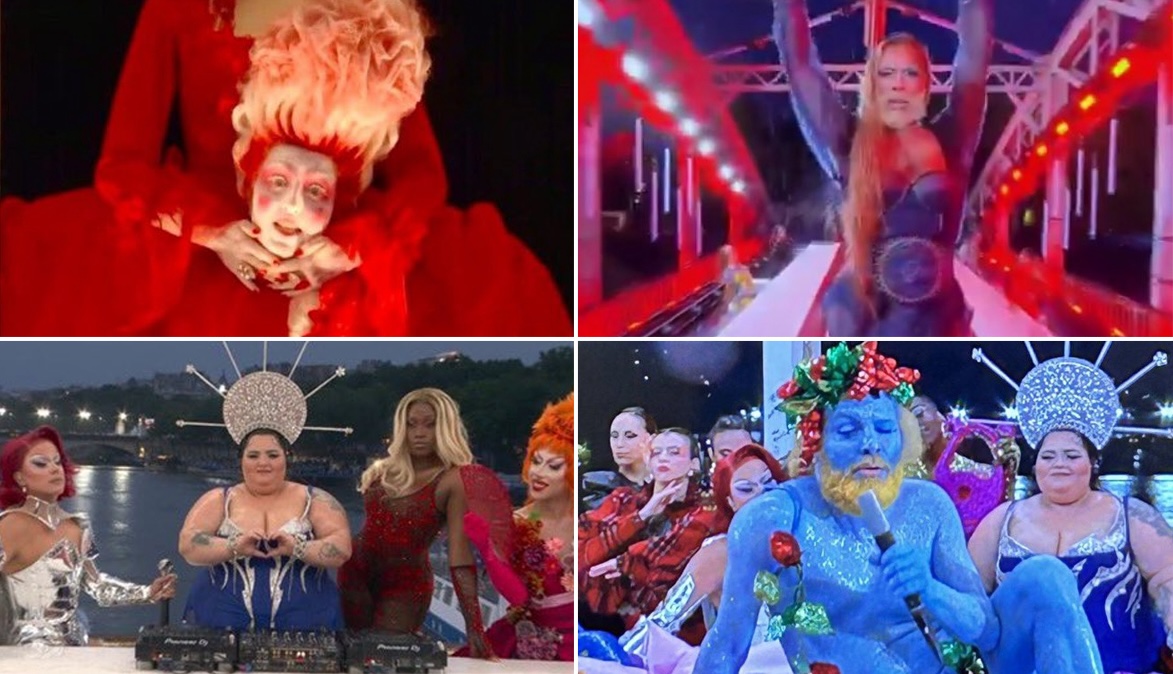
Friday night could not have provided a better example of what I have been arguing for years now on Freedom and Reason. But this not merely about me being right. It’s about the seriousness of the moment, and the fact that this imperial ideology has men punching women in the face at the Olympics for the first time in the history of the Games couldn’t punctuate more loudly the seriousness of the moment. Hearing the denials of its significance by those around you is further confirmation of the dire circumstances in which we find ourselves. Don’t let them shame you into doubting your judgment.
The misogynistic spectacle celebrating male battering of women is scheduled for this Friday and Saturday. I discuss the matter in depth tomorrow. But I wonder if the producers will actually air the bouts? I’m struggling over whether to watch women being pummeled by men with female passports. I have seen one of the men (Imane Khelif) assaulting a woman at a 2022 Golden Belt Series bout and it sickened me (I am sharing it below). The look on the woman’s face when she realizes she didn’t stand a chance haunts me. The man appears to carry her to humiliate her. For those who don’t know boxing, carrying a fighter means allowing them to finish the fight when the other fighter could stop this opponent any time he wanted. In this case, probably not because the man feels bad, but to downplay the reality that men really do have natural physical attributes that give them a decisive competitive advantage. If he felt bad he wouldn’t be in the ring with her in the first place. Seeing her congratulate him on his win looks like the work of internalized woke scolding.
The social theorist in me always asks, what cultural critic and social theorist could best help me negotiate the terrain here? I can think of five off the top of my head, most immediately George Orwell, but I have given readers enough Orwell lately. The French Marxist Guy Debord, best known for his 1967 The Society of the Spectacle next comes to mind. Debord critiques the pervasive nature of modern capitalist society, which he argues has transformed human interactions and relations into commodities and superficial representations. According to Debord, the “spectacle” refers to the dominance of appearances in society, where social life is mediated by consumer culture and mass media, leading to an alienated and passive populace. The spectacle perpetuates a false reality that obscures the true conditions of existence, reinforcing the power structures of capitalism and alienating individuals from authentic social connections and self-awareness. These circumstances rob people of their agency and capacity to think deeply about the world around them.
A Debordian analysis of the opening ceremony of the 2024 Paris Olympics would emphasize the point that the ceremony, with its grand displays and global media coverage, serves as a quintessential spectacle that transforms the authentic cultural and human elements of the Olympics into commodified images for mass consumption. The function of ceremony, in Debord’s view, would be to reinforce dominant and emerging capitalist ideologies by promoting consumerism and corporate sponsorship. The highly choreographed and visually stunning event, whatever its artistic merit (in this case not a lot for the segment in question), would function to mask underlying social realities, such as the exploitation of human labor and of vulnerable minorities. Ultimately, Debord would see the opening ceremony as a means of perpetuating the illusion of consensus and progress, while obscuring the deeper divisions and inequalities within society. The popular reaction tells us that the spectacle failed spectacularly. That’s good news.
However, Debord does not speak to the transgressive element. This is the moment that prepares the stage for misogyny in the squared circle this weekend. For an analysis focused on that, that is, the spectacle aimed at undermining common sense understandings to prepare the masses to accept a new and inorganic common sense, one might turn to the works of Antonio Gramsci, Herbert Marcuse, and Michel Foucault. Gramsci’s concept of cultural hegemony explores how dominant groups use cultural institutions to maintain power and how counter-hegemonic ideas can challenge and change societal norms and values (I have written quite a lot about Gramsci of late, so I will leave it there). Marcuse, a member of the Frankfurt School who bridges critical theory and postmodernism (which is not a kind thing to say from my perspective, although I am being charitable), examines how advanced industrial societies manipulate consciousness and integrate individuals into the system, particularly through the co-optation of transgressive elements in culture and art. See his books Eros and Civilization and One-Dimensional Man for more. Perhaps in the future I will critique Marcuse’s work. I have already critiqued him for his authoritarian position on free speech and the corruption of critical theory (see The Noisy and Destructive Children of Herbert Marcuse). The French philosopher Michel Foucault’s analysis of discourse, power, and and knowledge reveals how societal norms are constructed and maintained, offering insights into how spectacles are used to shape thought and control populations by shifting perceptions and understandings. Widely recognizes as the “father of queer theory,” Foucault is arguably the figure most responsible for the nihilistic direction of latter poststructuralism. I am preparing a major piece on queer theory, so I will leave my analysis of Foucault to the future.
These thinkers provide frameworks for understanding the menu at the Spectacular Café, its various appetizers designed to challenge existing norms and prepare the masses for the main course, novel dishes whipped up from old ways of thinking and organizing society. Upon inspection, the café serves nothing but bad food. The ingredients are subpar, the dishes are poorly prepared, and the hygiene standards are questionable at best. Despite numerous complaints from patrons who fall ill after dining there, the café remains open. The reason? The government, which should be responsible for ensuring public health and safety, is either indifferent or complicit. Perhaps the café owner has influential friends in high places, or maybe the bureaucracy is so sluggish and corrupt that no action is ever taken. In any case, the food there is tainted and it will make you sick.

 freedom and reason