
“[This] deeply secular postmodern society knows who its enemy is, they are naming it, and we should believe them.” —Bishop Robert Barron, Diocese of Winona-Rochester, Minnesota
“In France, we are republic, we have the right to love whom we want, we have the right not to be worshippers, we have a lot of rights in France, and this is what I wanted to convey.”—Artistic director Thomas Jolly.
Why would Thomas Jolly say that initially if this performance were something other than what the world immediately understood it to be? Right not to be worshippers of what exactly? Nobody worships Greek gods anymore. Right to dissent from ancient pagan religions? Why would that be noteworthy? What he meant was that he is not bound by the blasphemy rules of Christianity. I agree with him. France has religious liberty. And should. But if this were about the Feast of Dionysus, Jolly would have said so then rather than saying so after the controversy had legs. The Greek pantheon is an ad hoc rationalization. If this were a depiction of the pantheon, where is Poseidon’s trident? Why would any director miss out on a prop that would clearly convey the meaning?
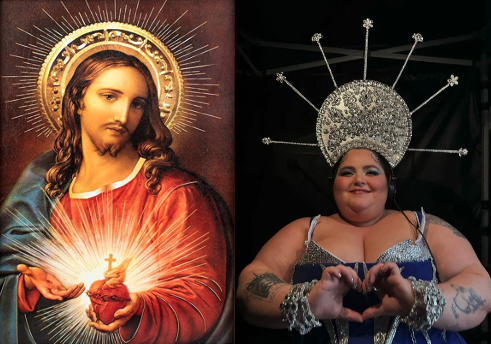
You can see in the picture I have provided that Barbara Butch is performing the iconic Sacred Heart Jesus. This is so the identity would be unmistakable to the audience. The composition apes da Vinci’s work, albeit many of the dancers are jockeying for camera time and disrupt the symmetry. Dionysus, the god of chaos, debauchery, and ecstasy, does make an appearance. He is the disruptive force inserted into the scene. That’s the political point of the performance: to juxtapose Christian super/ego rigidity with the pagan id, i.e.,the pleasure principle, the unbridled Eros. It was a transgressive action by a queer artistic director. He denies that he was being subversive, but the method behind a piece like this is to deconstruct traditional norms and values through subversive imagery and revel in the libertine. Hedonism is typical of these expressions, which is why Dionysus is fetishized.
The most significant part of the opening ceremony of the 2024 Paris Olympics, I recently told a Facebook group, is when, instead of the self-described “love activist,” Butch and her apostles feasting on the body of Apollo, the Greek god of sun, light, healing, music, poetry, and prophecy, they were instead served the living body of Dionysus, aka Bacchus, the god of wine, fertility (odd choice there), ecstasy, and theater. Apollo, who represents harmony, order, and reason was a no show. He was held up at his crucifixion. Instead the world got the god of frenzied dance and rituals bent on breaking down the barriers of individuality and transgress social norms. Was this the Feast of Dionysus, also known as the Dionysia, occurring around the same time in the calendar year as the currently enacted Feast of the Sacred Heart in Christian practice? Or was this “The Last Supper”? (The video has since been deleted according to Breitbart.)
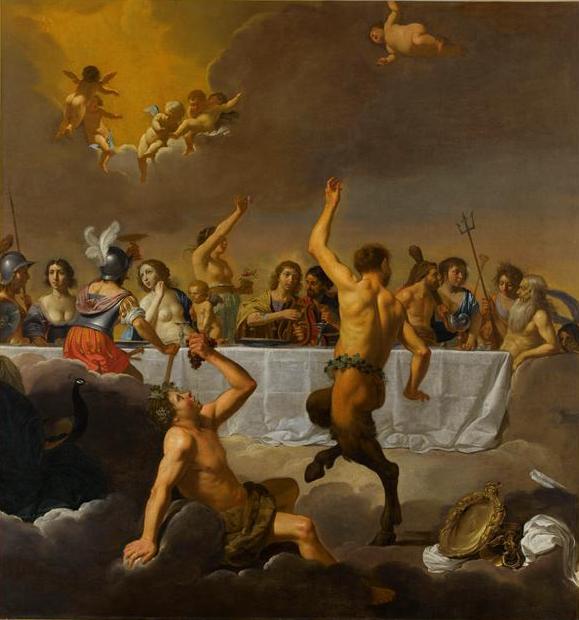
Whether this was the Dionysia, the Feast of the Sacred Heart, or the Last Supper, it was the perfect choice given the politics projected by performance and the justification given by those who put on the performance. In gender ideology, there is a praxis known as “queering” the situation or space. A key part of queering activities, situations, and spaces is to subvert traditional religious beliefs and practices, as well as Enlightenment values, and substitute for them debauchery and nihilism. We see this in the example of the Sisters of Perpetual Indulgence (SPI), also called Order of Perpetual Indulgence (OPI), a street performance protest movement that uses drag and Christian religious imagery to problematize moral thinking around issues of gender (recall the 2023 Los Angeles Dodgers scandal). We saw the same thing in Paris, Butch’s Sacred Heart Jesus made obvious by the inclusion of halo pressed onto her head and flashing the heart gesture (see above).
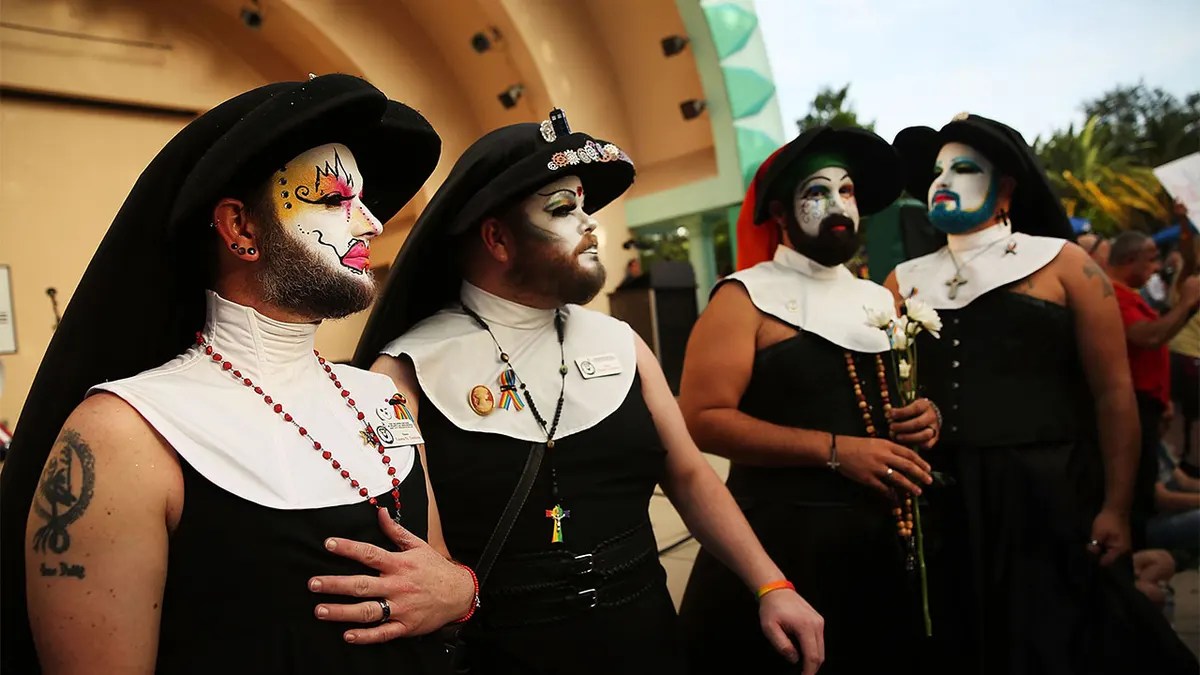
So it was a send up of the Last Supper and the Christian ritual period surrounding the passion and crucifixion of the Christ. It seemed immediately obvious to me. But perhaps you have to grasp both postmodernist politics and study of mythology to see it for what it was (you don’t). To be sure, at a vulgar level, the purpose of the performance explained itself. Especially when a man in black with his testicles hanging out of shorts rubbed up against the child near the “love activist.” But denials in the aftermath, including from Jolly himself, require that we make it clear the significance of the imagery and the intent of the performance we can infer from that. Jolly and others are lying about the work.
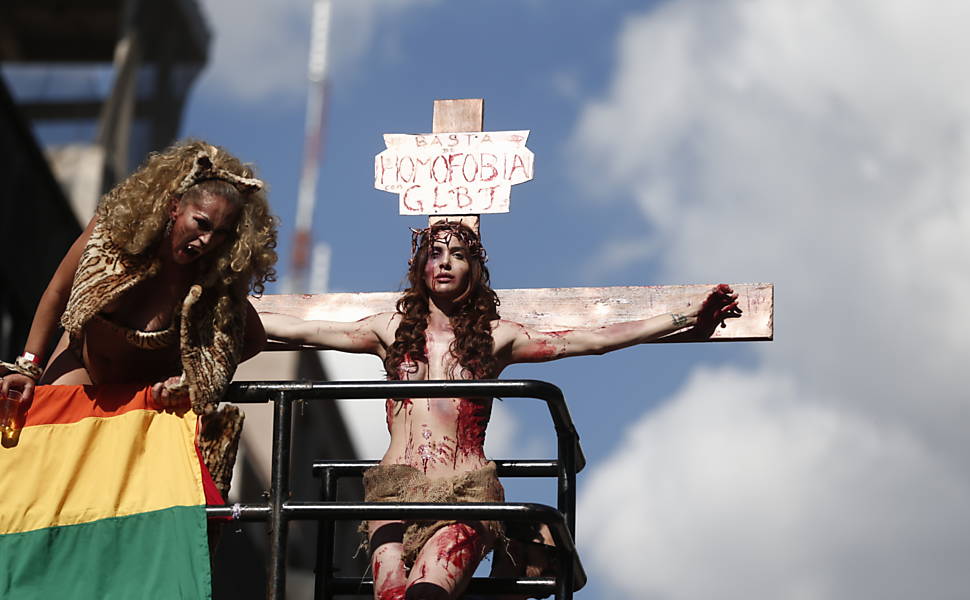
Before moving to my analysis, I wish to say a few things about Christianity and the double standard surrounding irreligion criticism and parody. I’d like the reader to imagine the Games had presented a sendup of Muhammad on his winged horse. There was a ghostly mechanical horse gliding across the Seine River. Viewers were told that it was not Death on that pale horse, but Sequana, the Goddess of the Seine River (previous depictions of Sequana show her rowing a boat). But suppose Allah’s prophet were upon that horse instead. There’d be blood on the streets of Paris and likely in a lot of other major European cities. Christians are a super tolerant bunch. Nietzsche went hard on them for that. I won’t, though.
It’s not that I am too troubled by irreligious criticism, parody, even ridicule. I’m an atheist. I’ve never laughed as hard as I laughed during Monty Python’s The Life of Brian (except for two scenes in Something About Mary that almost gave me an abdominal hernia). The problem is not the mocking of religion per se but the political-ideological purpose of the performance. Queer activists used the mega platform of the Olympics to push an ideology that is destructive to sound family systems and the safeguarding norms governing the relations between adults and children. More broadly, the figure of Dionysus, rather than that of Apollo, represented the postmodernist assault on modernity. Butch’s Jesus looked favorably upon Dionysus. World Apollo?
As I noted in The Paris Olympics and the War on Western Culture: Preparing the Masses for the New World Order, this isn’t the first time the Olympics have been used to propagandize a captivated audience (there, I discuss the Berlin Olympics in 1936). This is an agenda, plain for the world to see, one with a very long history, and it’s what we should be talking about. Instead, we’re talking exclusively about whether we saw what we saw and whether what we saw was offensive to (at least some of) the 2.4 billion Christians around the world, many of whom are in peril in the Islamic world and living the sphere of the CCP. Not that we shouldn’t be concerned about that. This wasn’t playful. And the Games added insult to injury by apologizing not for having offended Christians but for Christians having taken offense (not a subtle slight if you get the difference). The Games also declared: mission accomplished. So they weren’t really sorry.
Western civilization, with its once mighty pillars of progress, order, and reason, finds itself adrift in a sea of trepidation—and nihilism. This crisis of legitimacy, which I have been documenting on the pages of Freedom and Reason for many years now, is not merely an economic or political phenomenon but a profound cultural crisis steeped in existential malaise. It is a spiritual crisis (you can take that as literal or figurative). The Olympics have given us cause to revisit the ancient duality of Apollo and Dionysus, as these two encapsulate the eternal struggle between chaos and order, passion and reason, dissolution and structure, to elucidate the problem. The Dionysian elements in postmodernist thought and anti-humanist culture has played a significant role in the situation in which the West finds itself by challenging the foundations of Western civilization and paving the way for a nihilistic ethos. Even if the opening ceremony really has been about Dionysus, as Jolly insisted two days later after receiving an outpouring of hate and ridicule, the purpose would be the same.
I cannot work with this subject without acknowledging Friedrich Nietzsche’s analysis of the Apollonian and Dionysian, primarily presented in his work The Birth of Tragedy, wherein he explores the duality of human nature and art through these two contrasting concepts. For Nietzsche, the Apollonian represents individuality, logic, and order, the personification of these the Greek god Apollo, symbolizing rationality and structured beauty. In contrast, the Dionysian embodies chaos, emotion, and ecstasy, reflecting the instinctual and primal aspects of life. Nietzsche argued that the fusion of these forces in Greek tragedy created a profound aesthetic experience, with the Apollonian providing form and the Dionysian offering emotional depth. This dynamic interplay is essential for the creation of authentic art and understanding the complexities of human existence.
But that is not how the transgressors view the matter. In postmodernist thought, the dialectic of Nietzsche’s Dionysian and Apollonian elements is viewed through a lens of deconstruction and relativism. Unlike Nietzsche’s idea of a productive tension between these forces, postmodernism interprets this duality as a situation where one side’s dominance leads to the negation or cancellation of the other. And the postmodernists have picked their side. In the darkness of postmodernist nihilism, which pushes the idea that traditional norms and values lack inherent meaning, are confining and limiting, and therefore worthy of overthrowing, the cancellation of one force by the other is the natural outcome of the collapse of absolute truth and inherent value—and where nature takes too long, transgressive action accelerates the collapse. Instead of lamenting the loss of reason, postmodernist view its collapse as an opportunity for the creation of new possibilities; the absence of fixed structures or definitive resolutions is a space for ongoing reinterpretation and individual creativity, which comprise a gloss for the anarchist desire for no boundaries or rules.
The loss of the Apollonian is the loss of the Enlightenment. Apollo, the god of harmony, light, and reason represents the Apollonian spirit that has traditionally underpinned Western civilization. It is through Apollo that humans seek knowledge, impose a structure on the world, and aspire to ideals of beauty and order. This Apollonian drive has manifested in the great achievements of arts, philosophy and science embodying the Western quest for meaning and truth. Dionysus, in contrast, is the god of ecstasy and unbridled passion—of debauchery. The Dionysian spirit embraces chaos, dissolution, and the irrational aspects of human nature, as well as in social relations. It celebrates the emotive, the instinctual, the primal, often in direct opposition to the Apollonian pursuit of order and reason.
The Dionysian impulse leans into the inherent chaos and unpredictability of existence and suggests itself not merely as a counterbalance to the alleged rigidity of Apollonian ideals, but to the overthrow of structure—that is, it is poststructuralist. So whether it was a sendup of da Vinci’s “Last Supper” or the Dionysia, Jolly chose the body of Dionysus for the drag queens and trans-identifying to feast upon—in the presence of children while the world watched.
The crisis of legitimacy in Western civilization stems impart from a disillusionment with the Apollonian project, a disillusionment organized by the transgressive forces of the corporate state in the context of late capitalism. The Enlightenment promise of progress through reason and science in the context of corporate statism has given way to a deep skepticism about the foundations of knowledge and truth. To be sure, the skepticism is not entirely unfounded, as the excesses of rationalism and technocratic governance have often led to alienation, environmental destruction, and social fragmentation (see Marx and Weber). But this is not an indictment of the idea of modernity, only its corruption by corporate power. In this vacuum, the Dionysian forces emerge with gusto. Postmodernist thought, with its radical deconstruction of grand narratives, epitomizes this development. It challenges the Apollonian ideals of objective knowledge, stable identities, and universal values. Postmodernism revels in the fluidity of meaning, the plurality of perspectives, and the celebration of the marginalized and the fragmented. It thrives on chaos. But people seek order in the whirlwind.
I can’t leave the subject without touching on Sigmund Freud’s psychoanalytic theory concerning the internal tension between order and chaos within the human psyche. For Freud, the instinctual, primal part of the psyche, the Es, or “it,” is driven by the “pleasure principle.” It embodies chaotic and uncontrolled desires, seeking immediate gratification without regard for societal norms or reality. This component of the psyche is analogous to the concept of chaos, as it operates from basic impulses and drives that can disrupt a person’s sense of order. It contains in it two forces, each named after a Greek deity. Thanatos is the “death drive,” the instinctual tendency for aggression, destruction, and a return to an inorganic state. Eros is the life drive or libido, the instinctual tendency towards life, love, and self-preservation. It includes nurturing and sexual instincts, fundamental to the pursuit of pleasure and the formation of relationships.
Thanatos and Eros exist in the psyche as a dynamic tension that requires a control structure. In the well-adjusted person, the Es is governed by the Ich, the “I” or “ego,” which functions as a rational mediator between the demands of the Es and the constraints of the external world and social environment. The ego operates on the “reality principle,” striving to satisfy the Es’ desires in a manner that is socially acceptable and practical. The ego’s role is to manage and balance these conflicting forces, akin to the principle of order, by employing judgment, planning, and problem-solving to navigate life’s complexities. Later, Freud added the idea of the Über-Ich, the “over-I” or “superego,” which imposes a sense of order by regulating behavior through conscience, ensuring that actions align with accepted norms and values. This aspect of the psyche reinforces order by counteracting the Es’ impulses and guiding the ego in maintaining ethical and societal compliance.
The postmodernist and nihilistic push to transgress social norms and boundaries is a project to dismantle the superego’s moral constraints and distort the ego’s regulatory functions. By embracing radical individual freedom challenging traditional values, this movement often seeks to strip away the superego’s role in enforcing societal standards, thereby enabling the ego to prioritize unrestrained gratification of the id’s primal urges. This produces the libertine, who is characterized by a lack of moral restraint, especially in matters of personal behavior and sexuality. The libertine rejects conventional moral and social norms in favor of pursuing personal pleasure and freedom without regard for ethical or societal constraints. Libertinism is marked by an indulgence in hedonistic pleasures and a disregard for traditional values related to morality and propriety.
With the erosion of normative boundaries and the destabilization of the superego, the ego becomes increasingly driven by the most destructive aspects of the pleasure principle, leading to harmful consequences for both individuals and society. The causa sui of the queer project is nihilism.
Postmodernism’s critique of metanarratives claims to have exposed an arbitrariness in our cultural and intellectual constructs. However, in making this claim, it undermines the possibility of constructing new, coherent systems of meaning. The relentless deconstruction of norms, values, and truth leaves those enacting the rituals in a state of nihilism, where nothing is certain, and all is relative. This nihilistic turn is particularly evident in contemporary culture and praxis. Art and literature have become exercises in irony and pastiche, devoid of sincere engagement with the human condition, which the opening ceremony of the Games demonstrates in spades; people are still arguing about what it was, but whatever it was it was complete shite artistically. The aesthetic was crude and obnoxious. It was an instantiation of a politics that has devolved into vulgar spectacle, where power, unmoored from any substantive vision of the common good, is sought for self-aggrandizement, the social fabric fraying as communities splinter into isolated and antagonistic identities, each claiming its own truth and rejecting any notion of a shared reality. None of this is accidental. Nihilism is an instrument of control.
* * *
I now want to attempt—in vain I am sure, since the indoctrinated see what they want to see and not what they see (Matthew 13:17)—to put to rest the desperate rationalization that what we witnessed this Friday was anything other than the mocking of “The Last Supper,” the celebrated fifteenth century painting by Leonardo da Vinci, used on Friday as a backdrop to the celebration of Dionysus. Significantly, the painting is in the Convent of Santa Maria delle Grazie in Milan, Italy. It was commissioned by Ludovico Sforza, the Duke of Milan, as part of the renovations to the convent’s refectory (or dining hall). It is a religious work that carries great meaning for both the faithful and the secular humanist. As a child, among my many idols (Copernicus, Darwin, Einstein, Galileo, Marx, Newton) there was de Vinci. Like him, I had an early interest in anatomy, and I was left-handed—and wrote backwards. My identification with him led me to study his works and his biography. Like the names of all the dinosaurs and NASA programs, I knew da Vinci front to back. The “Last Supper” fascinated me even though I have never heard the call of the divine.
The “Last Supper” depicts the moment Jesus announces that one of his disciples will betray him. Leonardo’s composition captures the dramatic reactions of the disciples to this news, each responding in a unique way. This creates a powerful narrative with emotional intensity. The symmetry of the array of reaction is crucial to the piece. Jesus is at the center, forming a calm and balanced focal point, while the disciples are grouped in threes, a dynamic and religiously salient arrangement of figures (you will note the pattern in the images from the opening ceremony). Leonardo’s mastery of linear perspective creates a sense of depth, drawing the viewer’s eye to the center (how could it be otherwise). The use of light and shadow enhances the three-dimensionality of the figures. It’s a work that defies but a glance. It invites the observer to dwell in the moment and contemplate its significance.
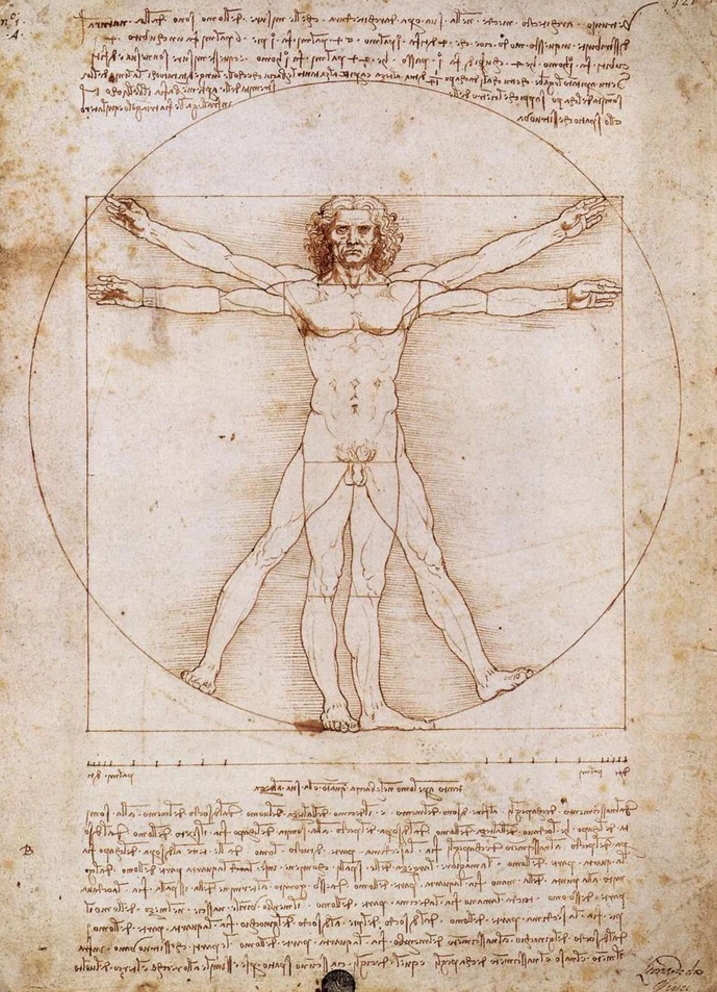
Did da Vinci draw inspiration from the Greek myth of Dionysus as some have suggested? Typical of the man, his process for creating “The Last Supper” involved meticulous study and preparation, so we have a record of the thought and process. Da Vinci is legendary for his extensive use of live models and cadavers, which helped him capture realistic human expressions and movements (he did the same with horses). He spent hours observing and sketching people to understand their gestures, facial expressions, and physical forms. He would often roam the streets of Milan, studying people and making detailed drawings in his notebooks. He would attend public executions to capture tortured bodies and the end of life. Those around him looked upon him with suspicion—his morbid interests and left handedness and all. This practice allowed him to create highly realistic and dynamic figures in his paintings. His knowledge of anatomy rivaled the physicians of his time. When I was a child, my parents bought me a reproduction of one of his sketch books. I would study it for hours.
What I am saying is that if da Vinci was importing Greek mythology, we would very likely know about it. There is no evidence that Leonardo da Vinci was inspired by the myth of Dionysus in the design of “The Last Supper.” Leonardo’s source of inspiration for this work was the biblical narrative, which is found in all four Gospels. Indeed, “The Last Supper” depicts arguably the most significant moment in Christian theology, focusing on Jesus Christ and his apostles and negation of human agency in the work of Satan to fulfill prophecy. The scene captures the moment when Jesus announces that one of his disciples will betray him, prompting a range of emotional reactions. Religious context and the narrative structure and content guided Leonardo’s composition.
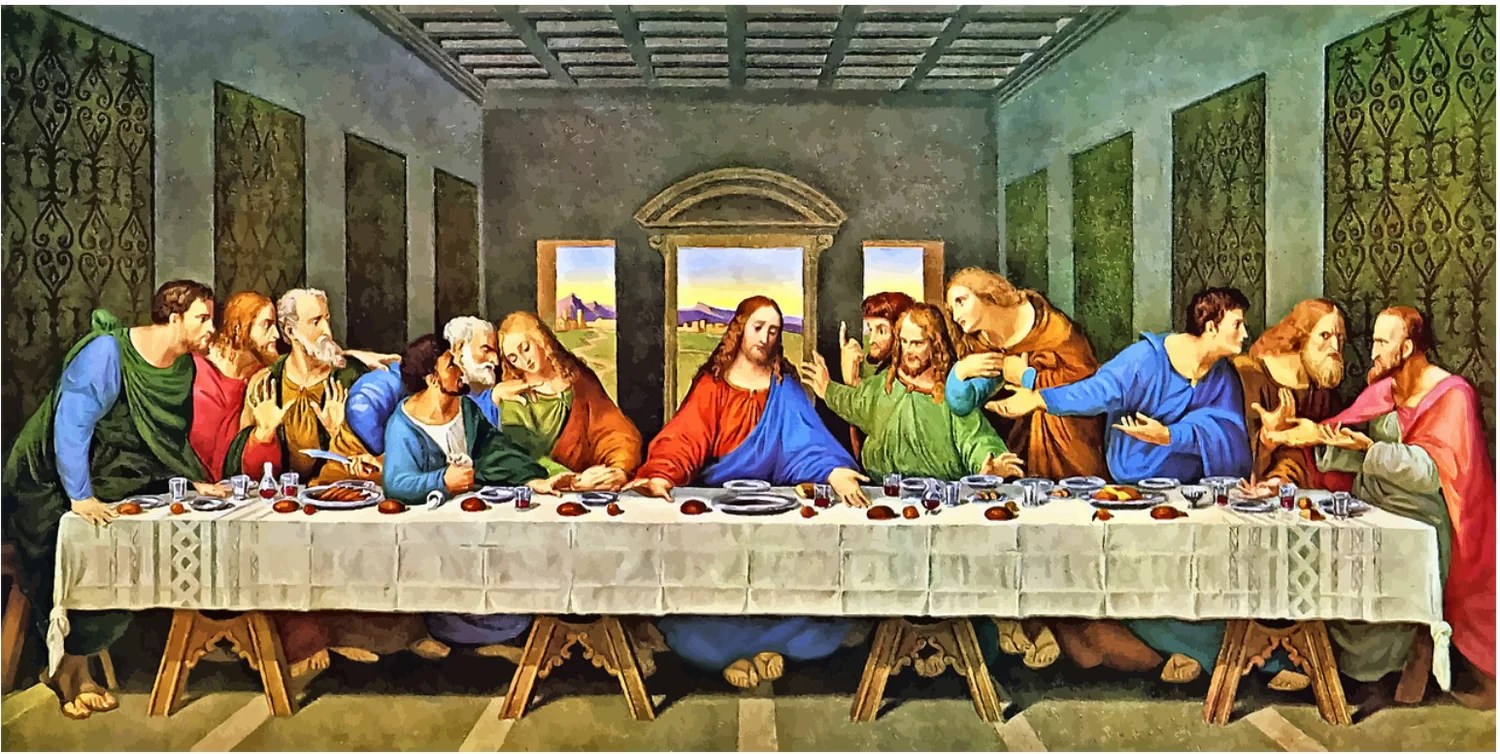
“The Last Supper” is a paradigm in scene setting. In John’s Gospel, Jesus announces that one of the disciples will betray him, which confuses the disciples and prompts them to seek clarity on the identity of the betrayer. Simon Peter signals to another disciple, often identified as John, the “beloved disciple,” to ask Jesus for more details. Jesus responds that it is the one to whom he will give a piece of bread after dipping it in the dish. Jesus then dips the bread and gives it to Judas Iscariot. After Judas takes the bread, Satan enters into him, and Jesus tells Judas to do quickly what he is about to do, referring to the betrayal. This moment is crucial to the narrative, marking the beginning of Judas’ destruction and emphasizing themes of betrayal, loyalty, and prophecy fulfillment. De Vinci’s painting does not explicitly depict Satan entering Judas, but rather captures the tension and emotional turmoil among the disciples following Jesus’ announcement. Judas is shown holding a small bag (he is at the front of the group to Christ’s left) likely containing pieces of silver, his reward for betraying Jesus. His body language and expression reflect his guilt and inner conflict.
While Leonardo was no doubt well-versed in classical mythology and almost certainly familiar with the stories of Dionysus (how could he not be), his emphasis was on conveying the phenomenological realism of the biblical scene, achieved through careful study of human expressions and interactions. Leonardo’s approach was generally more aligned with the humanistic and religious themes of the Renaissance rather than incorporating allusion from Greek mythology into this particular work. His focus was on creating a powerful and emotionally resonant depiction of a key moment in Christian history. Again, remember where the painting exists—in the Convent of Santa Maria delle Grazie in Milan, Italy. Jolly may not regard the Olympics to be an occasion in which dignity should be respected. But da Vinci held great reverence for places in which he worked. To be sure, da Vinci’s personal religious beliefs are a matter of contention, but that he was deeply interested in religious themes and his work often reflected a sincere engagement with Christian iconography is not disputed.
As for the spectacle at the opening ceremony of the Paris Games, Jolly’s denials notwithstanding, this was self-evidently not a depiction of the Dionysian feast. Jolly is trying to clean up after the performance got wrecked by critics for both its offensive character and its vulgar aesthetics. He got the rise he wanted, but now he is afraid. This was a mocking exploitation of da Vinci “The Last Supper” with the Pagan god of debauchery dropped into the scene to disrupt the identification of the betrayer who set into motion the events leading to Jesus’ arrest and crucifixion, a necessary moment in order for Jesus to press his love into the world, here leaning on Thomas Altizer’s thesis concerning the death of God, which centers on the idea that God’s death represents a profound transformation in the nature of divine presence and love.
I want to briefly clarify what might be an obscure reference for those who haven’t studied theology. According to Altizer, the death of God is not merely an abstraction, but an historical and existential reality that signifies God’s total immersion into the world. In the moment of God’s death, manifest in the crucifixion of Jesus, God pours his love into the world, signifying the complete and unconditional embrace of the world by the divine, manifesting love in its most radical and tangible form. This act would simultaneously bring light and truth—the virtues of the Apollonian spirit. In this moment, the culmination of a dialectical process unfolding, God’s transcendence becomes immanent, engaging the human condition and transforming fundamentally the dialectical relationship between the divine and the world.

It is this love that Jolly negated on Friday night with the inclusion of Dionysus—Jolly seeks to reduce love to the pleasure principle. The day of the performance Jolly said, “In France, we are republic, we have the right to love whom we want, we have the right not to be worshippers, we have a lot of rights in France, and this is what I wanted to convey.” This line, we have the right not to be worshippers, is an admission that the performance was an act of religion blasphemy (and Greek mythology is a dead religion). This line, we have the right to love whom we want, makes sure we understand what follows.
Jolly is aware that homosexuality is an abomination in the Judeo-Christian tradition. The entrance of Dionysus, the transgressive god, into the scene of the Last Supper is in part symbolic of the desire to negate the scriptural prohibition on homosexuality. This is one of the goal of the Sisters of Perpetual Indulgence (SPI), as well. I have no want for homosexuality to be illegal. Nor do I think homosexual relations are not loving. I have gays and lesbians close to me. But there’s more to the queer project than that. The letters of the acronym don’t stop at “LGB.” The project it is not about normalizing sexual equality but about liberating erotic desire in an unbridled manner—of normalizing paraphilia, the reckless desire of the Es. You have seen the signs: “Love is love.” That tautology avoids defining love. This is not about altruistic love (agape), familial love, platonic love, romantic love, of self-love (not in the narcissistic sense, for this is really self-obsession). This isn’t about emotional attachment, care, and the desire for the well-being of the loved one. The meaning of love in the sense conveyed by the performance is fetish and kink and transgressing the norms that safeguard children and women.
The negation of the prohibition of homosexuality has already been achieved. Same-sex marriage became legal in France on May 18, 2013. This is not what is being pushed here. It is not about the right to love whom we want. It is about the right of the individual to be the other gender, or no gender, or both genders—and compel everybody else to accept delusional thinking. This is why Hermaphroditus, a child of Aphrodite and Hermes, a member of the Erotes, a species of winged entities associated with fornication, who was, at the request of a prominent Naiad (nymph), fused with her body to produce a deity that was both genders/sexes simultaneously, is being thrust before us, trans activists sharing images of representations of Hermaphroditus to claim that such beings existed in history (see Anti-Minotaur: Reclaiming The Truth of Gender From the Labyrinth of Lies). The postmodernist project is a project to make it impossible for people to distinguish between reality and simulation, between good and evil.
In the end, the dead giveaway is the halo worn by the “love activist” and the heart hand gesture. The attempt to deny what we all saw is an insult to our intelligence. That’s Sacred Heart Jesus. Butch was there to make sure the audience knew what was being mocked—and why. Those of us who see what we see know what that was and we have heard the message before. So the transgressive Greek god of debauchery crashes the party. That doesn’t indicate anything but the thing itself. Jolly should just lean into it. All those defending the performance should lean into it with him. The people aren’t stupid. Stand by your work, I always say. Be proud of it. Own it.
Transgressive theater is a big part of queer praxis. The Sisters of Perpetual Indulgence are a notable example. But public displays of Pride are generally transgressive. Bondage and humiliation, sado-masochism, and puppy play are performed in public and in front of children. There is no shortage of pictures and video if you need evidence. Jesus is a common theme at events and parades. Christianity is targeted for its allegedly stifling sexual norms. I think the reason people are accepting Jolly’s rationalization is that, as allies, they can see what this looks like and they want the movement to project a positive imagine, so they cover for the movement when it goes to far. They think, “If this is about the Feast of Dionysus, since he’s a Greek god, then no big deal. It’s the Olympics, after all.” But Jolly knew what he was doing. and now you do, too.
* * *
“This is no big deal. Why are you spending time on it?” It must be a big deal or else the world wouldn’t be talking about it. I am political sociologist who is keenly interested in ideology and religion. The essays on Freedom and Reason are about power and knowledge and the corruption of understanding. “Why do you care?” I have also been asked. Because I am committed to the principles of Enlightenment and to the safeguarding of children. And because I hate people lying and gaslighting others. As soon as everybody started saying this was something other than it was, something this high profile, I had to write about it. It’s what I do: I debunk false claims.
And this: “Boxers who failed gender tests at world championships cleared to compete at Olympics”: “The situation has arisen because the world championships last year was run under the auspices of the International Boxing Association, whose president, Umar Kremlev, told the Russian news agency, Tass, that DNA tests had ’proved they had XY chromosomes and were thus excluded from the sports events.’” It wasn’t just the opening ceremony that pushed the delusion that men can be women. Now they’re allowing men to compete against women in combat sports in the Olympics.
How was this allowed? The International Boxing Association (IBA) was barred from running the Olympic boxing tournament in Paris. Boxing in Paris is now being run under the auspices of the IOC’s Paris 2024 Boxing Unit, “which has more relaxed rules than the IBA.” Is that the new euphemism for endangering the health and safety of women to advance woke ideology and let men perpetrated sanctioned violence against women: “more relaxed rules”?
“Rules regarding who should compete in the female category have been hotly contested in recent years. But there has been less debate about combat sports, where the risk of serious injury and even death is far higher. Scientific research has also found that the average punching power is 162% greater in those who have gone through male puberty compared to females.” That’s on average. There are men who punch many times harder than that. But punching power is not the only metric. Men have a much different facial structure from women, one evolved for combat. Men have deeper eye sockets, heavier brow ridges, thicker cheek bones, bigger mandibles, and more facial musculature and connective tissue. A man punching a woman in the face can cause serious damage—bone fractures, blindness, and brain damage.
How is this “hotly contested”? Even without these risks, why is it fair to let men compete against women in any sport? Why is the fact that a man may break a woman’s face a special reason? It’s women’s sports. It’s not men’s sport. Men shouldn’t be competing in women’s sports—because men are not women. Some issues have two sides (some have more). This is a one-sided issue. This is the only side: men should compete in the men’s category. And before you say, “But trans women are women,” let me remind you of the truth: trans women are men. Our species cannot change gender. This is an anthropological fact.
I hope that my critics can now see why I spent so much time talking about the opening ceremony. The spectacle the world saw last Friday was not just aesthetic garbage (to be sure, it was utter shite). It was propaganda aimed at normalizing the queer praxis of transgressing of boundaries between men and women (and adults and children). It’s all connected. Trans activists are disordering normal gender relations for a reason. I’m telling you what that reason is. Those who say, “Nobody cares?” or “Why are you so interested in this?” are doing the work of the sociopathic overlords who are destroying everything good about the world.
Michael Parenti warned us a long time ago that the rich have ever wanted only one thing—and that is everything. And everything includes your ability to say that 2+2 = 4 and to keep safe children and women from male predation.

 freedom and reason