“A dominant power may legitimate itself by promoting beliefs and values congenial to it; naturalizing and universalizing such beliefs so as to render them self-evident and apparently inevitable; denigrating ideas which might challenge it; excluding rival forms of thought, perhaps by some unspoken but systematic logic; and obscuring social reality in ways convenient to itself.” —Terry Eagleton (1991)
“If in all ideology men and their circumstances appear upside-down as in a camera obscura, this phenomenon arises just as much from their historical life-process as the inversion of objects on the retina does from their physical life-process.” —Karl Marx and Frederich Engels (1845)
“Marx rejects the [Feuerbachean] disjunction as being neither exhaustive nor exclusive. It is true that there is no action without a violation of some right or interest. It is not true that such action need be blind, uninformed by theory or reason. It is true that one can think without acting directly but it is not true that no injustice is thereby done. For existing injustices are tolerated and remain unaltered. Philosophical activity may be conceived as action in behalf of values and interests which have been criticized by knowledge and reason. The very fact that philosophy is an activity in a world of space, time and incompatible interests, makes it clear that its goals cannot be absolute truth or absolute justice. But the fact that action is thoughtful makes it possible to achieve beliefs which are truer; the fact that thought leads to action makes it possible to achieve a world which is more just.” —Sidney Hook (1936)
George Orwell is arguably best known for Nineteen Eighty-Four, published in 1949, wherein he imagines a totalitarian regime that governs a state called Oceania. The regime manipulates reality through language (see Manipulating Reality by Manipulating Words). Inverting reality as a mechanism of ideational control is the central theme of the novel. The fictional government, Ingsoc (Newspeak for English Socialism), led by the Party and (probably simulated) leader Big Brother, a metaphor for omnipotent power and total surveillance, exercises complete control over the lives of the proles by presenting an inverted image of society in which slavery is portrayed as freedom.
Total control is achieved over the population of Oceania through various means. By controlling language with Newspeak, a specialized jargon designed to limit the range of expression and therefore thought, the Party controls the way people communicate, making it difficult for them to convey dissenting or heterodox ideas. Indeed, Newspeak makes it difficult for people to even think, since the strategy reduces their conceptual inventory, shrinking the range of meanings associated with signs and symbols, and, crucially, planting limiting reference frames in their heads. It even allows for contradictory thoughts to be held simultaneously, an effect Orwell calls “doublethink.”
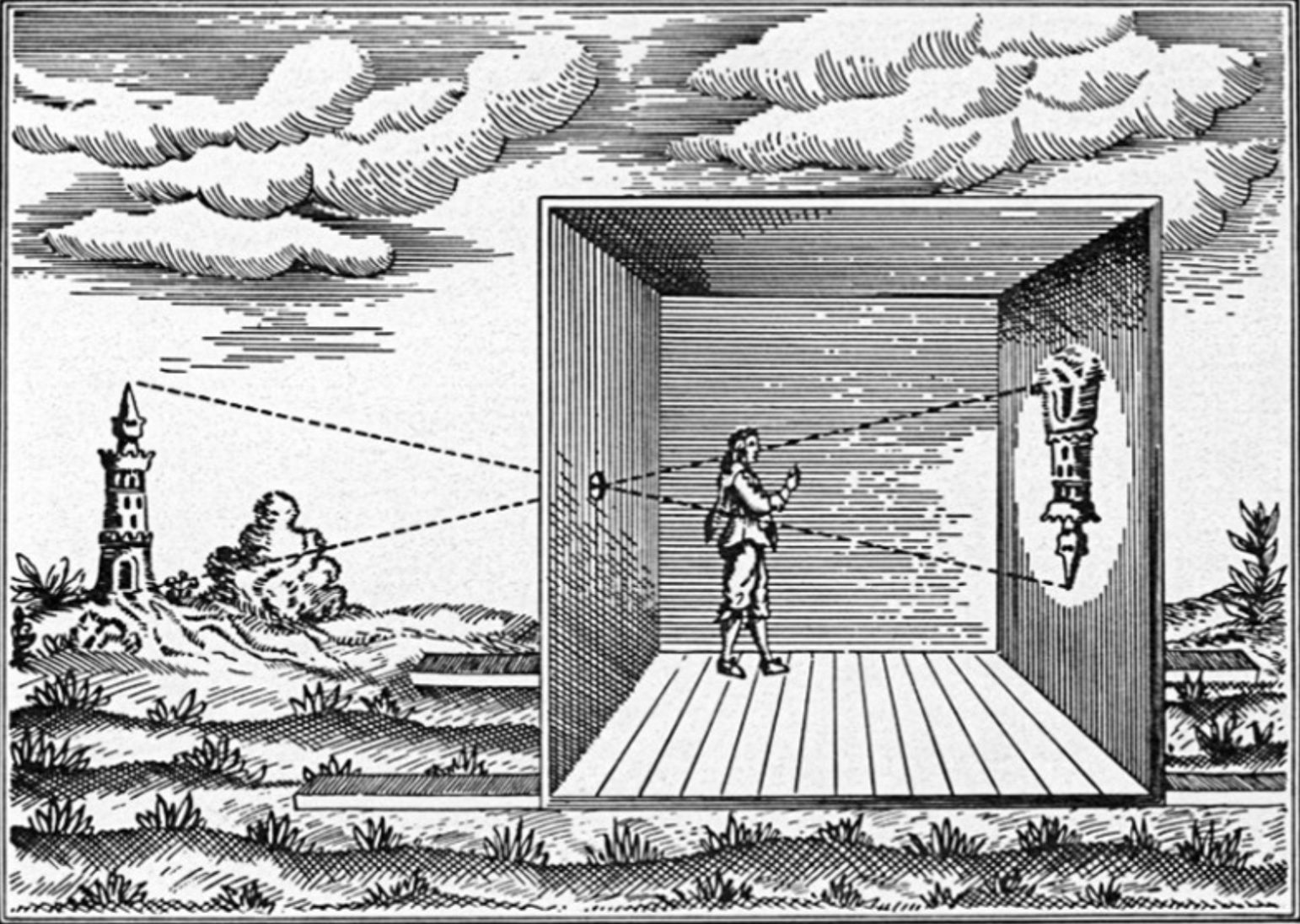
In this way, and with a caveat we will come to, the distortion of reality in the Orwellian dystopia is analogous to the way an image is inverted in a camera obscura. The camera obscura is an optical device that projects an inverted image of the external world onto a surface, usually a screen or wall, via a small aperture or lens (see above illustration). It was an important tool for early artists and scientists in developing an understanding about the principles of optics and perspective. It works the way the lens of the human eye works. Natural history has made our brains such that the organ rights the image so we see the world in its correct orientation. However, while the brain naturally and normally corrects the physical image, ideology can invert understanding of history and society and lead the people to the wrong conclusion and thus habituate self-oppressive behaviors.
In The German Ideology, published in 1845, Karl Marx and Frederich Engels use this metaphor to convey the way ideology and false consciousness work in a capitalist society (presumably any socially-segmented mode of production). Under capitalism, people are alienated from the true nature of the social relations that govern their lives. This alienation can be seen as a distortion or inversion of reality, similar to how the camera obscura projects an inverted image of the outside world.
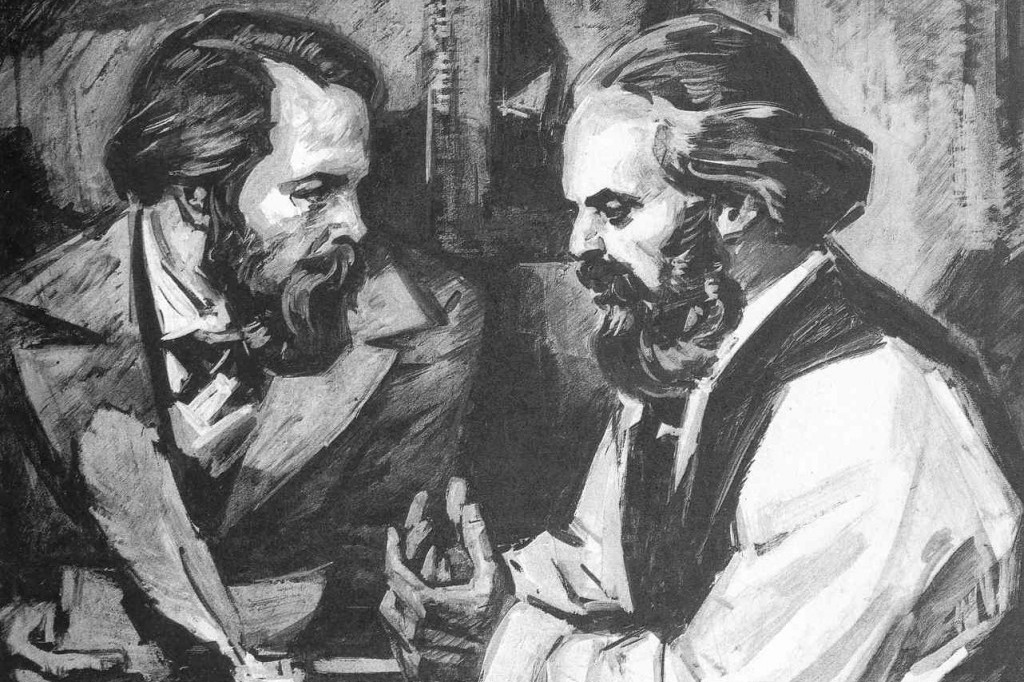
Marx and Engels write, “The production of ideas, of conceptions, of consciousness, is at first directly interwoven with the material activity and the material intercourse of men, the language of real life. Conceiving, thinking, the mental intercourse of men, appear at this stage as the direct efflux of their material behavior. The same applies to mental production as expressed in the language of politics, laws, morality, religion, metaphysics, etc., of a people. Men are the producers of their conceptions, ideas, etc.—real, active men, as they are conditioned by a definite development of their productive forces and of the intercourse corresponding to these, up to its furthest forms. Consciousness can never be anything else than conscious existence, and the existence of men is their actual life-process. If in all ideology men and their circumstances appear upside-down as in a camera obscura, this phenomenon arises just as much from their historical life-process as the inversion of objects on the retina does from their physical life-process.”
In this interpretation, Marx and Engels’ work can be understood as an attempt to invert the prevailing ideologies and false consciousness created by capitalist systems, much like how the camera obscura inverts the external world, only in this move using critique to right the image that ideology inverts, what Ludwig Feuerbach, in his 1842 work The Essence of Christianity, described as the transformative method. Feuerbach was Georg Hegel’s star pupil. What the pupil did was stand Hegel on his feet, as Marx once metaphorically put it.
The paradigm of how this works lies the fact that billions of people think they were created by gods when really the gods are the invention of people—inventions some use to control others. The transformative method involved examining religious and metaphysical concepts and revealing in them their human, material, and psychological bases. Feuerbach sought to demonstrate how abstract ideas could be understood as projections or sublimation of human desires, emotions, and needs. Feuerbach argued that traditional religious ideas, including the concept of God, were not expressions of supernatural realities but were instead anthropomorphic representations of human qualities and ideals. In this way, he aimed to “transform” religious thought into an understanding of human nature and society.
“Feuerbach takes his point of departure from the fact of religious self-alienation, from the splitting up of the world into a religious, imaginary world and a real one.” Marx and Engels write. “His achievement consists in dissolving the religious world and revealing its secular foundations.” They then make a critique: “He overlooks the fact, however, that after completing this work the chief thing stills remains to be accomplished. The fact that the secular foundation lifts itself above itself and fixates itself as an independent empire beyond the clouds can only be truly explained in terms of the internal division and contradictions of this secular foundation. The latter must first be understood in its contradictions and then through the elimination of the contradictions practically revolutionized. For example, once the earthly family is discovered to be the secret of the holy family it must be theoretically criticized and practically transformed.”
There are several features of the totalitarian system Orwell describes in Nineteen Eighty-Four that deepen our understanding of ideological control by drawing our attention to inversions of the sort Marx and Engels describe. Here we come to the caveat I hated at a moment ago. For, in Orwell, the camera obscura is not a result of an intrinsically contradictory situation in need of resolution into a higher unity (or a lower one), but the result of a determined effort by the Party to control the population for the purpose of perpetuating the oppressive order. For Marx and Engels, estrangement from reality is a condition of the capitalist mode of production.
I noted earlier Orwell’s concept of doublethink. Doublethink is the ability to hold two contradictory beliefs in one’s mind simultaneously and accept both of them as true. This concept is used to manipulate citizens into accepting false information and cultivating the ability to individuals to change their beliefs to align with the Party’s needs of the moment. The proles must be taught to the technique and are punished when they don’t acquire it. The Party uses slogans like “War is Peace,” “Ignorance is Strength,” and “Freedom is Slavery.” These are paradigmatic of the linguistic expression of inversion—of the camera obscura. The Party disseminated these slogans through various media, including posters, public speeches, and the two-way telescreen, which bears some resemblance to today’s social media system.

The Party constantly rewrites history to align with its current narrative, altering documents and records to erase the evidence that contradicts the present version of events. For the standpoint of historical materialism, the false history of the bourgeois historian is not the result of party demand; the bourgeois historian sees history through the ideological lens provided him by the social system in which he prospers. His failure to critically engage the system is what prevents him from writing history truthfully.
In both worlds, Orwell’s dystopia and Marx and Engels’ social history, false narratives make it difficult for citizens to access accurate historical information or remember historical events, since these are altered by the imposition of ideology. In Orwell’s world, the Thought Police monitor citizens for any signs of dissent or independent thought. The black helicopters hover above (in the 1984 film). Those who deviate from the Party’s ideology are arrested and subjected to torture until they conform to the Party’s beliefs. In Marx and Engels’ world, there are those who police thought, but, again, the thought control apparatus is more structural than consciously engineered.
Orwell’s warning is that when those in power control the narrative and manipulate reality to their advantage, they can maintain their authority and suppress opposition, while hiding their power. This recalls Antonio Gramsci’s concept of hegemony, which refers to the ways in which a dominant group, often the ruling class, maintains its power and control not just through force or coercion, but through ideological means that win the consent of the subordinate classes (I recently used Gramscian analysis in the essay The Paris Olympics and the War on Western Culture: Preparing the Masses for the New World Order). To secure its dominance, the ruling class establishes a cultural and ideological consensus that permeates society’s institutions, including education, family, media, and religion. This ideological dominance shapes the beliefs, norms, and values of the populace, making the existing social order seem inevitable—natural. By embedding a visione del mondo into the cultural fabric, the ruling class ensures that their power remains unchallenged, as subordinate classes internalize and accept their subjugation as the status quo.

Gramsci’s theory of hegemony highlights the importance of cultural and ideological struggles in the fight for political and social change and order, suggesting that any challenge to the dominant order must also engage in a battle of ideas and values. For Marxists, a key part of the battle is righting the image and therefore the truth of this world. Inverting the perception of reality not only deceives the populace, but also erases the truth, leaving citizens in a state of perpetual confusion and subjugation.
If we are to apply Orwell’s insights concerning the power of conceptual inversion, an ideological technique that covers for an undemocratic method of power and control, then we should be looking for instances where language is being manipulated and be able to reveal to what ends it is being so shaped. We should find the media employing euphemisms and carefully crafted language to make undemocratic actions appear democratic and acceptable. Phrases like “protecting national security” or “preserving law and order” might be used to justify actions that undermine democratic principle. At the same time, these slogans may also cover the opening of borders and depolicing. The populace is encouraged to simultaneously believe in the importance of democracy while supporting policies and actions that erode democratic institutions—the administrative state and the technocratic apparatus, corporate governance and neoliberalism, a vast military apparatus and global projection of transnational power, all wrapped in progressive ideology. Citizens may be told that curtailing civil liberties is necessary for their own safety, thus practicing a form of doublethink.
The media disseminates propaganda that portrays those who question the undemocratic methods as extremists or threats to democracy—enemies of the Party. Populists become redefined as fascists, while the actual fascists are presented as the defenders of democracy (I talked about this in yesterday’s essay Stripped of its Historical Bounded Features, What is Fascism?). Propaganda requires extensive historical revisionism. This is to erase past assumptions. The establishment manipulates historical narratives to any evidence of undemocratic actions or corporate control, portraying the actions and control as good and necessary, while portraying the republic as evil, the perpetrator of genocide, slavery, white supremacy—a completely illegitimate institution. This makes it difficult for citizens to discern the truth about their democracy’s history.
The policing of thought is comprehensive. Dissent or criticism of the establishment’s actions are marginalized or suppressed. People expressing concerns about the influence of corporations and the erosion of democracy are painted as conspiracy theorists or troublemakers or traitors—fascists and racists. Corporate governance is redefined as democracy while actual democracy is portrayed as mob rule. The media portrays corporate interests as essential to the functioning of democracy, framing the consolidation of power and wealth as a natural and beneficial outcome of democratic processes.

Sheldon Wolin, in his classic Democracy, Inc., beheld a world where the very institutions that claim to uphold democracy are, in fact, complicit in its erosion. The media, instead of serving as a watchdog, would be portrayed as a tool for shaping public perception and maintaining the status quo. The populace, deceived by carefully constructed narratives, unknowingly supports actions and policies that undermine the core principles of democracy, all while believing they are defending it.
Wolin argues that contemporary democracies, particularly in the United States, have evolved into “managed democracies.” In these systems, with elections and democratic rituals still in place, are largely managed and controlled by powerful elites, including the administrative state, corporate interests, and political parties. One key aspect of inverted totalitarianism is the overwhelming influence of large corporations on the political process. Corporations exert significant control over government policies, elections, and the media. This corporate dominance often occurs behind the scenes and is not always transparent to the public. Inverted totalitarianism is characterized by the apathy and political disengagement of the general population. While citizens still have the right to vote, they are often disenchanted with the political system and may feel that their voices have little impact on policy decisions. This disengagement serves the interests of the powerful elites who can manipulate the system without significant opposition. Inverted totalitarianism is thus marked by a lack of true accountability. While democratic institutions remain in place, they are often co-opted or manipulated by the powerful, making it difficult for citizens to hold those in power responsible for their actions.
Wolin emphasizes the role of media and spectacle in inverted totalitarianism. Political campaigns and news coverage become highly focused on entertainment and sensationalism, diverting attention from substantive policy issues and reinforcing a sense of passive consumption rather than active political engagement. This observation is also found Manufacturing Consent: The Political Economy of the Mass Media, by Noam Chomsky and Edward Herman. They present the thesis that mass media in the United States serves as a propaganda system that promotes the interests of elite groups. They developed a “propaganda model” that outlines how media content is shaped by a set of filters, including ownership, advertising, sourcing of information, flak, and ideology. These filters ensure that news coverage and political discourse align with the interests of powerful corporations and government entities, effectively “manufacturing consent” (a concept borrowed from the work of Walter Lippmann, similar to Edward Bernays’ “engineering consent”) among the public for policies and actions that benefit the elite. Chomsky and Herman argue that the media’s role is not to inform the public but to serve as a tool for ideological control and maintenance of the status quo.
Both Orwell and Wolin emphasize the manipulation of language and information to control public perception. In Nineteen Eighty-Four, the Party uses Newspeak and propaganda to control thought; in inverted totalitarianism, corporate-controlled media and political messaging shape public discourse and obscure the true nature of power. Both authors highlight the undue influence of powerful entities. In Nineteen Eighty-Four, the Party represents totalitarian control, while in inverted totalitarianism, it’s the corporations and elites who hold sway over the political process. Wolin’s concept of managed democracy and Orwell’s portrayal of a totalitarian regime both depict the erosion of true democracy; the appearance of democracy is maintained while its substance is hollowed out. The media plays a significant role in both Orwell’s and Wolin’s critiques. In Nineteen Eighty-Four, the state-controlled media spreads propaganda, while in inverted totalitarianism, corporate media serve to distract, entertain, and promote the interests of the powerful. Both authors address the problem (success) of public disengagement. In Nineteen Eighty-Four, citizens are manipulated into apathy and obedience, while in inverted totalitarianism, the public’s disillusionment and disinterest in politics serve the interests of the elites.
In summary, Wolin’s concept of inverted totalitarianism provides a contemporary framework for understanding the erosion of democracy in a corporate-dominated political landscape. When viewed alongside Orwell’s insights into totalitarianism, it underscores the enduring relevance of their critiques and the importance of vigilance in safeguarding democratic principles and protecting the integrity of political discourse. Marx and Engels remind us that all this is possible because of the estrangement of people from aspects of their nature as a consequence of living in a class-divided society. In a capitalist system, workers become alienated from the products of their labor because these products are owned and controlled by others (namely the capitalists). This alienation manifests in several dimensions: workers are alienated from the products they create, as these goods do not belong to them; they are alienated from the production process, as they do not control the means or conditions of their labor; they are alienated from other workers, as competition and class divisions foster disconnection and hostility; they are alienated from their own humanity, as the repetitive and dehumanizing work undermines their creativity and potential. This estrangement distorts a worker’s perception of reality, making it difficult to understand his true place in the world and the nature of their exploitation. Because workers are separated from the products of their labor and the process of creation, workers struggle to see the broader economic and social structures that shape their lives, leading to a fragmented and incomplete view of the world. This is the work of the camera obscura.

 freedom and reason
One thought on “Inverting the Inversions of the Camera Obscura”