
“I believe in the United States of America as a government of the people, by the people, for the people; whose just powers are derived from the consent of the governed; a democracy in a republic; a sovereign Nation of many sovereign States; a perfect union, one and inseparable; established upon those principles of freedom, equality, justice, and humanity for which American patriots sacrificed their lives and fortunes. I therefore believe it is my duty to my country to love it, to support its Constitution, to obey its laws, to respect its flag, and to defend it against all enemies.” —William Tyler Page, The American Creed
The bureaucracies of secular institutions are not obliged to provide for their employees moral instruction. This role properly belongs to familial and religious institutions. In public institutions in America, employers are prohibited from requiring their employees to undergo moral instruction. This is because, believing that in a free society matters of conscience should be freely chosen, the Founders of the American Republic institutionalized the separation of church and state.
The United States Bill of Rights guarantees American citizens freedom of religion, i.e., conscience, speech and press, which allow for the free expression of opinion and sharing of information, assembly and association, privacy, and the presumption of innocence. An American citizen is free to believe or not believe in moral doctrines adopted by administrators and managers; administrators and managers are allow to personally hold and express any doctrine; they’re not allow to compel others to hold and express the same. A man is free to utter or not utter moral slogans. He is free to attend or not attend courses of moral instruction—whatever the content. However, secular institution should take care not to make employees feel compelled to attend any such course of instruction due to peer pressure. And, following from principle, such courses should not exist in public institutions. A man has a right to keep his views to himself; he should never be questioned about his beliefs. He is presumed innocent of whatever offense administrators suppose he committed unless they have evidence and the inquisition is legitimate; to compel him to receive moral instruction on the grounds that he is a priori guilty of not subscribing to the moral code his employers wish he did is contrary to the principles of a free society. So is the act of compelling him to think and speak in the language of a code—whether he subscribes to it or not.
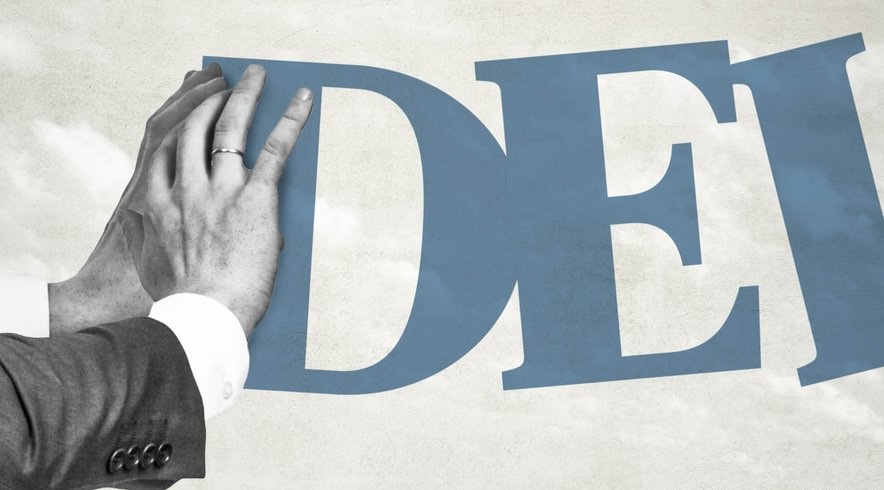
American society has allowed the tyranny of moral instruction in public institutions to occur for far too long. Today, and for some time now, secular institutions and organizations in the West have imposed upon their employees a moral code known as diversity, equity, and inclusion, or DEI. DEI seeks a normative framework ostensibly designed to foster a more diverse, inclusive, and fair environment within organizations and society’s institutions. It emphasizes the importance of recognizing and valuing diverse backgrounds, experiences, and perspectives, aiming to create an environment where everyone feels respected and has equal opportunities. DEI initiatives purport to address systemic biases and inequities, promoting equitable access to resources and opportunities while fostering a sense of belonging for all individuals, which it does by excluding opinions and viewpoints it claims undermine that sense of belonging. DEI encompass policies, practices, and programs that support underrepresented or marginalized groups, aiming to dismantle barriers to inclusion and ensure fair treatment for all. You may find all this appealing. You may have a moral argument about why this is important. Others may not. They may reject the premise of the argument.
DEI is diametrically opposed to the American creed of colorblindness and the foundational ethic of individuality set down by the framers of the Republic; DEI demands instead that employees engage with others in ways that acknowledge and respect their unique identities rather than disregarding them. At the heart of this moral philosophy, what is known as identitarianism, DEI requires employees to recognize that each individual’s background, culture, and experiences shape their perspective and sense of self. By interacting with others in terms of their identity, employees are conscripted into a project of validating the lived experiences of others and affirm their value within the community. DEI asks employees to move beyond superficial acceptance and actively engage with and appreciate the diverse characteristics each person brings, the focus being not what a person brings to the enterprise, not on merit or talent, but who they are and how they feel. The goal is to foster deeper understanding, mutual respect, and a more inclusive environment where everyone feels seen and valued for who they “truly” are, for their “authentic self,” and make them “feel welcome”—and “safe.” In other words, DEI is a moral system, a system very much akin to religion, clashes with the American creed. Employees are conscripted into project to negate the American creed through the practice of the identitarian creed.
Because people often find paradoxes when there are none, I want to stress that the argument here is not about advocating for the teaching of the American creed, but rather recognizing it as an ethical and legal framework presumed to be in force within public institutions. This framework, grounded in principles of colorblindness and equality, is a settled matter—unless the Bill of Rights is repealed. Additionally, it is important to acknowledge that in a society shaped by a long history of immigration, numerous creeds coexist but in the ideologically-neutral sphere of the American creed. The American creed operates by ensuring equal treatment for all individuals, regardless of race, religion, or personal belief systems. This foundational principle is what enables diverse creeds to be respected and upheld. It is precisely through the application of the American creed that individuals are treated equally, irrespective of their distinct identities. Far from being a paradox, this reflects the American creed in action.
The American creed functions as a negative force in institutions, acting as a safeguard that prevents employees from being indoctrinated by the positive force of other ideologies. The creed is assumed in the operational framework of public institutions, ensuring that individuals are free from the imposition of any particular moral or ideological system. Similar to the distinction between “negative liberty,” which refers to the freedoms individuals enjoy from government interference, and “positive liberty,” which encompasses the conditions necessary for personal success, the American creed ensures freedom from the arbitrary moral systems imposed by public employers. It protects individuals by maintaining a framework where personal beliefs and identities are respected without mandating conformity to specific ideologies. This negative liberty inherent in the American creed upholds the principle that public institutions should not impose particular ideological views on their employees, thereby preserving individual autonomy and freedom. Upon reflection, it may seem bizarre that DEI was ever allowed in the first place. However, what lies behind the systematic violation of basic rights DEI represents is the emergence of the corporate state and the progressive negation of democratic-republicanism and classical liberal principle.
Therefore, in the context of enhanced political consciousness, this is an ideal moment to time to remember what the American creed entails. The American creed refers to the set of core values and beliefs that define the national identity and ethos of the United States. It encompasses principles such as equality, individualism, initiative, liberty, meritocracy, representative democracy, and the rule of law, with emphasis of equality before the law and equity where there are actual group differences. Rooted in foundational documents like the Declaration of Independence and the Constitution (with its Bill of Rights), the American Creed emphasizes the inherent rights of individuals to life, liberty, and the pursuit of happiness. It underscores the idea that all people are created equal and should have equal opportunities to succeed. It does not, however, guarantee equal outcomes; nor does it treat individuals as concrete personifications of abstract demographic categories.
The creed serves as a guiding framework for American society, promoting the ideals of justice, freedom, and civic responsibility. Everything about DEI flies in the face of the values of the American creed. In contrast, DEI focuses on recognizing and valuing the unique backgrounds, experiences, and identities of individuals within a community or organization, and even beyond this, as employers concern themselves with the moral lives of their employees out in the world. When a public institution disciplines or punishes an employee for a comment on social media, this is an instantiation of imposition of a moral framework the First Amendment prohibits. DEI ostensibly seeks to address and dismantle implicit biases and systemic inequities that allegedly harm marginalize or underrepresented groups. It presumes that such implicit biases and systemic inequities exist, and it needs all employees to agree that the premise necessitating intervention is true. In other words, you are not only required to participate in the ritual, you must accept the truth of the doctrine.
Crucially, then, for DEI to exist as an industry, it must imagine the problems it means to solve. It must imagine that the world is organized around a hierarchy that lifts cis-gendered, heterosexual, male, white Christians and Jews to the top of the pyramid, while putting and keeping queer, homosexual, Muslim, nonwhite, and female persons, at a disadvantage. If an employee doesn’t believe the imagined hierarchy of oppression, then he is a heretic, a status labeled variously “bigot,”“homophobe,” “Islamophobe,” “racist,” “sexist,” “transphobe,” etc. The side that labels him these things is presumed to be the legitimate side. Without any democratic process and in the face of individual right, an ideology became institutionalized, enforced by an army of bureaucrats and clerics. Those who work in the DEI industry exclusively train for their roles in the administration of the doctrine. They have careers they expect to work at over their lifetimes. Because they have the training, they have the wisdom; they are the righteous who tell others what to believe and punish them when they don’t accept the doctrine or practice the ritual.
Just like the church that must always exist to save the wretched from their transgression, identified by the terms of the doctrine, since the raison d’être of DEI is solving the problems of various original sins, i.e., the legacies of chattel slavery, compulsory heterosexuality, patriarchy, and so on, the resolution of which, falling under the purview of representative government having been substantively addressed, albeit denied by doctrine, DEI will always find problems to solve by defining problems into existence, problems that will by said to issue from the imagined hierarchy of oppression. Thus, at the core of the project is the belief that the problems DEI is charged with solving have no ultimate solutions. These problems can’t have solutions, since that would mean the industry goes away. The personal investment in doctrine is obvious; one’s career is advanced by “identifying” problems, i.e., by manufacturing them. We see this also in the area of Pride, where, having achieved the goals of the gay and lesbian rights movement, those same organizations (for example, in the United States, the Human Rights Campaign) perpetuated themselves into the future by manufacturing the trans rights cause.
To be sure, we need a new government in Washington DC that move to make the incorporation of the Bill of Rights even more robust. We will need new governments at the state level, as well. But the imposition of doctrine on public employees won’t finally go away until we resist the very premise upon which it moves: the imagined hierarchy of oppression grifters encourage people to step into. We have to reassert the American creed as our guide and insist on all the protections of the constitutional republic. We need to demand a society that recognizes across its institutions the foundational principles of democracy, equality, individualism, initiative, liberty, meritocracy, and equality before the law as articulated in the nation’s founding documents and in judicial rulings. We have to demand recognition of the inherent rights of individuals, the notion that all people are created equal, and insure equal opportunities for success.
Whereas the rhetoric of social justice is the illiberal expression of the corporate state, the American Creed promotes civic responsibility, freedom, and justice, universal principles that apply to all citizens, without explicitly addressing the specific needs and identities of diverse groups—and even more than this: prohibiting the fetishization of identity from affecting the advancement of any given individual. In short, the managed decline of the American Republic must be stopped.

 freedom and reason
Home run.