
Bruce MacKinnon’s November 6, 2020 editorial cartoon, published only a few days after the disputed presidential election that led to the illegitimate Biden regime, still speaks to the urgent need to differentiate between actually-existing fascism and depictions of populist-nationalism as a manifestation of right-wing extremism.
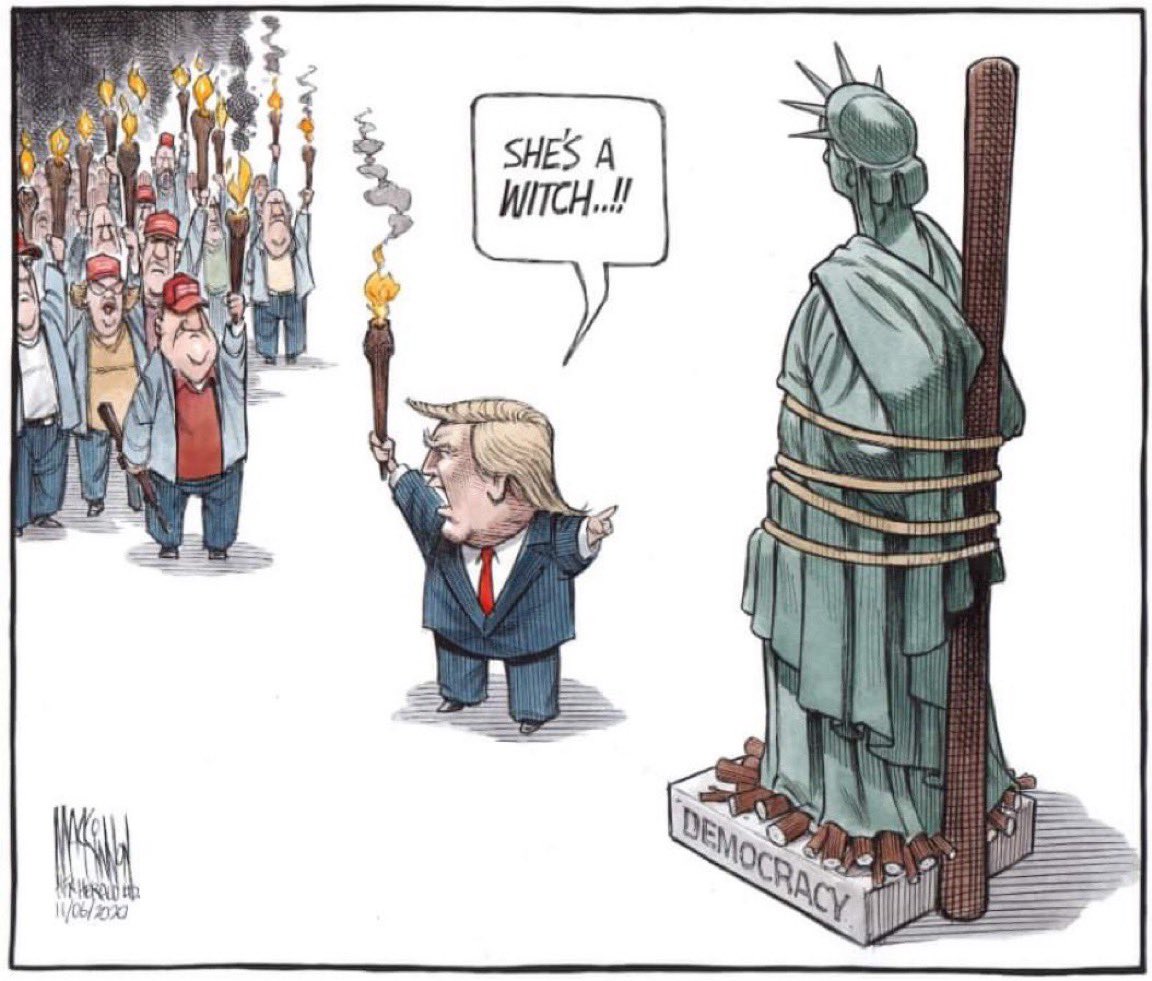
What is especially deceptive about the cartoon (albeit likely not intentional) is the suggestion that it is democracy the MAGA crowd seeks to immolate. As I have noted several times on Freedom and Reason, progressivism supplants democracy with technocracy. It is in fact the federal bureaucrat who has Lady Liberty bound and ready for destruction. Think censorship, corporate control, surveillance, etcetera.
You can check this by asking yourself who it is that desires freedom of movement and choice to be controlled by public health edict. There are many such revealing questions. Who is it that desires social media companies to censor and deplatform those who express ideas that offend groups favored by the Democratic Party? Why is it okay to festoon public school classrooms with Pride Progress propaganda but subject to FBI knock-and-talks those concerned parents who object? These indicators of the New Fascism require a proper analytical framework to see and assemble into an accurate picture of the threat confronting freedom in the transatlantic space.
I have published many essays describing and analyzing the “New Fascism” on Freedom and Reason (see, e.g., my August 2021 Totalitarian Monopoly Capitalism: Fascism Yesterday, Today, and Tomorrow for a lengthy analysis). One source of skepticism to this analysis comes not from a disagreement over facts but from a significant degree of incommensurability between methodologies. I’m a sociologist, while skeptics hail from the disciplines of history and political science. (There are skeptics in sociology, as well, but this is largely due to the discipline having become thoroughly corrupted by woke progressivism.)
Sociologists focus on the structure and function of social phenomena, abstracting core principles from various historical instances to understand broader patterns. In the case of fascism, sociologists, if working properly, identify essential characteristics such as authoritarianism, mass mobilization, and the suppression of dissent, and then examine how these elements manifest in different contexts. This approach allows for the identification of fascistic elements in systems that may not fit the historical instances of fascism in the first half of the twentieth century but operate on similar principles in functional terms and are therefore concrete instantiations of fascism.
Historians are concerned with the specificities of historical events, emphasizing the unique circumstances and developments that define instances of fascism. They document the rise of fascist leaders, detail the socio-political contexts, and periodize the chronological progression of events that lead to the establishment of fascist regimes. This approach may help in understanding the concrete manifestations of fascism in different historical periods and locations, but it often leads to time locking the phenomena that indicate fascism, which results in denial of really-existing fascism in contemporary Western societies. Even historians who work comparatively fail to see fascism in its contemporary manifestations.
Similarly, political science focuses on governance structures, institutional frameworks, and political behavior. While this can offer insights into how fascist regimes come to power and even how they function, it can also lead to an overemphasis on formal political processes and narrowly defined state structures, potentially overlooking the more subtle and pervasive social and cultural dimensions of fascism that sociologists are better equipped to analyze. Political science, with its tendency towards quantification and model-building, often misses the nuanced and dynamic ways in which fascist ideologies permeate everyday life and social relations.
Franz Neumann, a prominent political scientist and legal theorist, best known for Behemoth: The Structure and Practice of National Socialism, published in 1942, emphasizes the chaotic and polycratic nature of the Nazi regime. Unlike theories that stress the centralization and monolithic structure of fascist states, Neumann argues that Nazi Germany operated more like a “non-state” where various power blocs—the party, the military, the industrialists, and the bureaucracy—competed for dominance. Neumann’s critical theoretical approach allows for him to develop an account of fascism, which he defines as totalitarian monopoly capitalism, that grasps its function rather than its formal self-declarations.
For Neumann, fascism is an economic and political response to the crises of capitalism. He posits that fascism emerged as a reaction to the threats posed by both liberal democracy and socialism to the capitalist order. In his analysis, fascism served the interests of monopoly capitalism by dismantling democratic institutions and repressing labor movements, thus ensuring the dominance of capitalist elites. This perspective highlights the economic dimensions of fascist regimes and the ways in which fascists manipulate social and political structures to maintain capitalist hierarchies. In my analysis of fascistic systems, I insist on attention to function; instead of asking whether it is “populist,” “nationalist,” etc., I ask: what is it that fascism is seeking to achieve and how does it go about achieving it? Does it do the work of capitalism? Does it pursue work via authoritarianism, mass mobilization, and the suppression of dissent? If so, then it is fascism.
To draw out the contrast in methodology, historian and political theorist Roger Griffin, who developed a comprehensive analysis of fascism in his 1991 The Nature of Fascism, puts central to his definition of fascism the concept of “palingenetic ultranationalism.” This term refers to the notion of national rebirth or renewal, where fascist movements seek to revive a perceived lost golden age and create a new, purer national community. Griffin’s theory emphasizes that fascism is not merely about authoritarianism or violence but is fundamentally a revolutionary ideology aiming to transform society and culture. Griffin thus lends intellectual heft to the propaganda that fascism is at its core n extreme form of populism and nationalism, when in fact fascism has nothing to do with these time locked and culturally specific elements. In this way, Griffin makes fundamental to fascism what are peculiar and superficial elements.
Usefully, sociologist Barrington Moore Jr., in his 1966 Social Origins of Dictatorship and Democracy, identifies a phenomenon he describes as “revolution from above,” which he uses to describe the process through which the capitalist class initiates and controls social and political changes to maintain their dominance and prevent revolutionary upheaval from below. In this view, fascist regimes emerge when traditional elites feel threatened by the potential for revolutionary change led by the lower classes. To preempt or suppress these radical movements, capitalist elites collaborate with authoritarian movements, which promise to preserve the existing social order.
Moore conveys the possibility and unfolding of the “revolution from above” in this way: rapid industrialization and economic changes disrupt traditional social structures, leading to increased antagonisms between social classes; landowners and industrial capitalists fear losing their privileged positions in the hierarchy; liberal democratic institutions are unable to manage the economic and social upheavals caused by modernization, creating a political vacuum and disillusionment with democratic processes (this is the legitimation crisis Jürgen Habermas describes in his 1973 book by the same name); these developments make authoritarian alternatives appealing and, harnessing these means, capitalists suppress those who threaten their economic and political power.
An analysis of the current situation in the transatlantic space finds these basis for a fascistic revolution from above. The Third and Fourth Industrial Revolutions (3IR/4IR), which emerge in the post-WWII period, comprise a transformative era marked by the fusion of biological systems and digital technologies with physical systems. It represents a paradigm shift where advancements in fields like artificial intelligence, biotechnology, nanotechnology, and robotics redefine industries, economies, and societies globally. At its core, the situation is characterized by the blurring of boundaries between the biological, digital, and physical spheres. This convergence leads to innovations such as smart factories, where automation and data exchange optimize manufacturing processes, thus eliminating human labor; personalized medicine, where digital technologies and genetic information drive healthcare goals, including transhumanist desire; and smart cities, where interconnected infrastructure, ostensively to improve efficiency and quality of life, leads to the total control over the populations in high tech estates.
The impact of these developments extends beyond technological advancements, influencing socioeconomic dynamics and governance structures, introducing new challenges including accelerated job displacement due to automation, ethical concerns surrounding data privacy and artificial intelligence, and disparities in access to technology and its benefits. Moreover, the rapid pace of change during this period has necessitated adaptive strategies from businesses, governments, and individuals to harness its potential while addressing its implications for education, employment, and equality. In essence, in a period driven by innovation and technological integration, man confronts a world that is shaping a future where the digital, physical, and biological realms converge to redefine how he interacts, lives, and works. More than this, it is a world where the liberal democratic structures of constitutional republics are a hinderance to interests of corporate power thus necessitating a revolution from above. These are the conditions of the New Fascism.
Sociology, not in its woke progressive corruption, but as C. Wright Mills and others used it, is for this reason more relevant today than ever. Yet it is historians and political scientists the media seeks out for commentary. The superficialities of these disciplines lend themselves to a critique of contemporary populism and nationalism that promotes the corporate agenda. Although a political theorist, Sheldon Wolin’s constructs of “managed democracy” and “inverted totalitarianism,” presented in his 2008 Democracy Incorporated: Managed Democracy and the Specter of Inverted Totalitarianism, exemplify the sociological approach. I have discussed his work a few times on Freedom and Reason. I want to elaborate his views here .
Wolin argues that modern forms of governance, while not fitting the historical template of fascism, share fundamental similarities. Managed democracy refers to a system where democratic processes exist but are controlled and manipulated by elites, reducing genuine democratic participation. Inverted totalitarianism describes a system where corporate power and state authority merge to exert control over society, without the need for a dictatorial figurehead. These constructs highlight how fascistic principles can operate in contemporary democracies, where the facade of democratic institutions masks the underlying authoritarian control.
At the heart of Wolin’s analysis is the idea that inverted totalitarianism represents a transformation of democratic governance into a system where corporate and economic power wield disproportionate influence over political processes and policies. Unlike classical totalitarianism, which relies on a centralized state apparatus and charismatic leadership, inverted totalitarianism thrives on the integration of corporate interests with governmental functions, resulting in a form of governance where economic elites and large corporations shape political agendas and decision-making.

Here are the chief elements of inverted totalitarianism identified by Wolin: Corporate interests exert significant influence over the electoral process, legislative bodies, and regulatory agencies through campaign contributions, lobbying, and revolving-door relationships between business and government. While inverted totalitarianism maintains the facade of democratic institutions and electoral processes, these mechanisms serve to legitimize corporate influence rather than empower citizens. Democratic participation becomes increasingly symbolic, with elections and political discourse controlled and manipulated to perpetuate corporate agendas and maintain the status quo. This is all elaboration on the structural logic of the capitalist state.
Wolin highlights the role of technological advancements in facilitating surveillance and control over public discourse and dissent. Technologies of communication and surveillance enable the monitoring of citizens’ activities, interactions, and preferences, fostering a climate of self-censorship and conformity conducive to maintaining corporate power. (This analysis aligns with Orwell’s Nineteen Eighty-Four, where a totalitarian regime exerts complete control over society through surveillance, propaganda, and the manipulation of truth, all without the traditional trappings of a historic fascist regime. Orwell’s work underscores the sociological insight that the essence of fascism can be abstracted and identified in various forms of governance, beyond the specific historical contexts that historians study.)
Inverted totalitarianism operates through the promotion of consumerism and the proliferation of spectacle in media and culture. Consumer culture encourages individual consumption as a distraction from political engagement, fostering a culture focused on materialism rather than systemic issues. Spectacle, in the form of entertainment and celebrity culture, distracts and pacifies the public, reinforcing the hegemony of corporate interests. Together, these dynamics create a societal framework where the appearance of democracy and freedom masks deeper structures of control, effectively maintaining existing power dynamics and discouraging meaningful political participation and critique. (In his 1967 The Society of the Spectacle, Guy Debord refers to the pervasive use of entertainment and celebrity culture to pacify and divert public attention. This spectacle saturates society with superficial distractions, suppressing critical thought and reinforcing corporate hegemony.)
The term “managed democracy” is often attributed to political scientist Peter Mair. He used it to describe a system where democratic processes are superficially maintained, but significant decisions and policies are tightly controlled by a ruling elite or a dominant political party, thereby limiting genuine political competition and citizen influence. This concept has been applied to various political contexts where democratic institutions exist but are effectively managed or manipulated to maintain certain power structures. Wolin uses the term to describe the illusion of choice and democratic participation within inverted totalitarian systems. Political elites and corporate interests collaborate to manage public opinion and limit alternatives outside the boundaries of acceptable discourse, thereby marginalizing dissent and alternative political movements.
Awareness that Wolin is describing our situation doesn’t require another several paragraphs of pulling under these analytical observations the concrete evidence demonstrating it. As you were reading my summation of the man’s work, your mind already went there. Wolin’s analysis of inverted totalitarianism serves as a critique of contemporary corporate states, correcting the distracting conventional understanding of totalitarianism as solely a relic of twentieth-century dictatorships. But it might be useful to make explicit the fact that the presidency and candidacy of Donald Trump and his tens of millions of supporters do not represent the fascistic impulse progressives and the Democratic Party tell us they do. Quite the contrary. The populist-nationalist movement is a movement to reclaim democratic-republican principles of governance and classical liberal values from the fascists who currently steer the masses via the fourth branch of government, i.e., the administrative states, and the technocratic apparatus—unconstitutional, unelected, unaccountable.
This is why progressives are fear-mongering over the Heritage Foundation’s Project 2025 and the Supreme Court’s decision concerning the Chevron deference. I discuss Project 2025 in my recent essay Project 2025: The Boogeyman of the Wonkish. The agenda calls for, among other things, the deconstruction of the administrative state, i.e., the dismantling of federal agencies, shrinking the federal bureaucracy and replacing thousands of civil servants with those loyal to democratic-republican principles, and mass deportation of undocumented immigrants. “I know nothing about Project 2025,” Trump claimed yesterday, distancing himself from the plan. “I have no idea who is behind it. I disagree with some of the things they’re saying and some of the things they’re saying are absolutely ridiculous and abysmal. Anything they do, I wish them luck, but I have nothing to do with them.” However, many of the organic intellectuals associated with the populist-nationalist movement have embraced it.
I will however expound on the overturning of the Chevron deference for the balance of this essay since this goes directly to the problem of the administrative state. The case in question is Loper Bright Enterprises et al. v Raimondo, Secretary of Commerce, et. al. Noting that “Chevron, decided in 1984 by a bare quorum of six Justices, triggered a marked departure from the traditional judicial approach of independently examining each statute to determine its meaning,” held: “The Administrative Procedure Act requires courts to exercise their independent judgment in deciding whether an agency has acted within its statutory authority, and courts may not defer to an agency interpretation of the law simply because a statute is ambiguous; Chevron is overruled.” The June 28, 2024 decision may very well mark the beginning of the end of the fourth branch of government.
Established by the Supreme Court in the case Chevron USA, Inc. v Natural Resources Defense Council, Inc. (1984), the Chevron deference was a legal principle guiding courts in their review administrative agency decisions in the United States. The principle dictated that courts should defer to reasonable interpretations of statutes made by administrative agencies when Congress has not clearly addressed the specific issue in the law. The preference introduced a two-step framework for courts to determine when to defer to agency interpretations: First, the court would determine if Congress has clearly spoken on the issue in question. If the statute were clear and unambiguous, the court must adhere to Congress’ intended meaning. Secondly, if the statute were silent or ambiguous on the matter, the court evaluated whether the agency’s interpretation was reasonable. If it is deemed reasonable, the court deferred to the agency’s interpretation. In practice, Chevron deference applied primarily to federal agencies interpreting federal statutes within their regulatory authority.
The rationale behind Chevron deference was grounded ostensively in administrative law principles and separation of powers. It recognized that administrative agencies possess specialized expertise and knowledge in interpreting complex regulatory statutes and implementing legislative mandates. By deferring to agency interpretations, courts aimed to promote consistency in regulatory enforcement and allow agencies flexibility in adapting to evolving circumstances within their statutory authority.
However, critics argued that it can lead to excessive delegation of legislative and judicial powers to unelected bureaucrats, potentially undermining democratic accountability and judicial oversight. Regulatory agencies, despite their expertise, are subject to ideological capture. This means that their decisions may be influenced more by political agendas or the interests of powerful groups, such as corporations, rather than purely objective expertise. This is particularly concerning in cases where regulatory agencies oversee industries that have significant economic or political influence. Allowing agencies too much discretion led to biased regulatory decisions. Opponents of Chevron deference argue that judges, by virtue of their training and role in interpreting the law, are better equipped to determine legislative intent. They argue that judges have the legal expertise necessary to analyze statutes and regulations impartially, without being swayed by political pressures or corporate interests. By interpreting legislative intent themselves rather than deferring to agency interpretations, judges can ensure that the law is applied consistently and in line with legislative goals.
Contemporary analyses of fascism benefit from interdisciplinary perspectives but face challenges due to methodological differences among sociologists, historians, and political scientists. Sociologists emphasize identifying core principles of fascism, such as authoritarianism and suppression of dissent, across diverse contexts, while historians focus on specific historical manifestations. Political scientists often analyze governance structures but may overlook broader societal impacts. Concepts like inverted totalitarianism, which weave together political theory and sociological insight, highlight how corporate and state power intertwine in modern democracies, challenging traditional views of fascism.
The challenge posed by corporate state power finds its potential answer in populist-nationalism, a movement striving to revive democratic-republican principles and classical liberal values. At its core is a critique of the administrative state, often perceived as an unconstitutional and unaccountable fourth branch of government. This administrative state, bolstered by doctrines like Chevron deference, grants substantial authority to bureaucratic elites, diminishing the role of elected representatives and eroding democratic accountability. Populist-nationalism advocates for curtailing the administrative state’s influence, viewing it as a tool that concentrates power in non-elected hands, thereby circumventing traditional checks and balances. By negating doctrines such as Chevron deference, which defer to bureaucratic interpretations of laws, this movement aims to restore judicial oversight and enhance the role of elected officials in decision-making processes. Ultimately, it seeks to reclaim governance from what it sees as the undue influence of corporatist interests embedded within the administrative apparatus.

 freedom and reason