
A note before beginning. Today is New Year’s Day 2024. In years past, I have resolved on the eve of this day to be more obnoxious in my criticisms of religion and in my defense of free conscience and thought. This year I am resolving once again to be more obnoxious in these areas; for one thing, by sharpening my focus on the subject area of the neo-religion of transgenderism. To be sure, 2023 already found me walking this path, but I intend to deepen my footprints as I continue to trod upon it.
Here’s the type of impression I mean to leave by years end, this one inspired by Helen Joyce’s observation that the assertion “Trans women are women” functions to mystify the category women. Joyce is referring to what is called a “hypnotic” or “power” phrase, trance-inducing incantations with thought-stopping power. Joyce here cites the work of Robert Lifton who, in Thought Reform and the Psychology of Totalism, writes, “The language of the totalist environment is characterized by the thought-terminating cliché. The most far-reaching and complex of human problems are compressed into brief, highly reductive, definitive-sounding phrases, easily memorized and easily expressed.” It’s an oppressive application of the logic behind cognitive-behavioral therapy, in the oppressive case a mantra to help people manage intrusive ideations that undermine their faith in gender identity and everything that flows from it.
The phrase “Trans women are women” is not meant to be true, but designed to prevent reflection on the colonization of women’s spaces by men. The effect of chanting the opposite of the truth—“War is peace,” etc.—is an instantiation of what George Orwell calls “crimestop” in Nineteen Eighty-Four, his dystopian novel exploring the character of totalitarian society. Crimestop is the necessary mental discipline for being a good party member. It marks one’s subordination to the system of control. It’s the commandment in the New Testament to never blaspheme the Holy Spirit; open doubting reveals the heretic (hence the unpardonable sin).
A Facebook friend noted yesterday morning that, if the phrase were true, why must it be qualified? It’s like saying red is blue and that they are the same. “If two things are indeed the same,” he asked rhetorically, “shouldn’t both be called the same thing without qualification?” Exactly. That’s why the woke propagandist created the term “cis gender”: the trans woman becomes a subset of women, as do cis women, whose essentialism is denied and therefore also their sex-based rights. It’s why trans activists are so triggered by adjectives such as “biological” and “real.”
Regular readers of Freedom and Reason will recall that I object to the construct “biological woman” because it’s redundant or tautological. But we have to differentiate real women from simulations of them (which is almost always obvious if one doesn’t suspend his disbelief). Unlike light, which is a spectrum, the two gender (or sex) categories comprise a binary. This diagram locates trans women in the correct category.

In truth, “trans woman” is a subset of male paraphilial (AGP, etc.) or cultural (e.g. drag) expression. A trans woman in the women’s bathroom is really a man in the women’s bathroom. You’re not suppose to think about that, of course, hence the magic phrase. If the spell doesn’t work, you’re a bigot.
Again, the assertion doesn’t need to make sense. Its purpose is to cause people to ignore the senselessness—the irrationalism—of the new arrangements imposed on the people by the elite who govern them and interpreted by the clerics assigned to the task. Indeed, the existence of spells that function to obscure the irrationalism of religious-type belief is a chief indicator that such a belief is present. This is the subject of today’s essay.

As the number of young people asserting the LGBTQ+ identity surges amid growing skepticism that gender identity in the subjective sense represents something real and scientific, gender ideologues have taken to asserting that trans people are a natural occurrence, a supposed corollary of the unremarkable anthropological fact that what today are referred to as trans people are a social-historical phenomenon—not the content of the belief system but the existence of belief system that supposes such content.
The core problematic is the notion of “gender identity,” a concept invented by psychiatrist and sexologist Robert Stoller in the last 1960s and picked up by queer theorists to legitimize the trans gender movement. Gender identity refers to an individual’s deeply-felt internal experience and understanding of his own gender. It’s what a person perceives himself to be in terms of gender. The argument is that gender identity may or may not align with the sex “assigned” to someone at birth. Moreover, while gender (or sex) is often understood in binary terms (man/woman, male/female), gender identity is a deeply personal and individual aspect of identity that exists on a spectrum. More than this, one can declare their emancipation from the spectrum and be no gender at all.
One finds an analog in the case in Rachael Dolezal, who identifies as trans racial, in her case a woman assigned the race of white at birth but whose racial identity is black. Racial identity refers to an individual’s deeply-felt internal experience and understanding of her own race. Although we may think we know Dolezal’s race (Dolezal passes well enough to fool a lot of observers), Rachel is in the best position to know her true racial identity. Although Dolezal’s racial identity is not subject to falsification, since it is a deeply personal and individual aspect of her identity, i.e., it is subjective, it is for those reasons her authentic self.
If you’re wondering whether my analogy is sarcasm, you are on to something. As I have documented on Freedom and Reason, Dolezal and others like her have been brutally mocked for identifying as trans racial. She has even been labeled mentally deranged. Trans identifying individuals and their allies have attacked me for suggesting that there is a parallel between trans racialism and trans genderism, but I have yet to hear a reason why they are not. If anything, given that racial categories are not genotypic in the way gender is, trans racialism is the easier of the two trans types.
The various types of trans identification, including what are today called “furries,” or therianthropes, are not novel phenomena. Anthropologists and mythologists have documented the existence of such liminal characters and personas across cultures and throughout time. “Liminal” refers to a state of being in-between or on the threshold, often describing a transitional or intermediate phase. The term comes from the Latin word limen, meaning “threshold.” In various contexts, liminality is associated with ambiguity, transformation, or transition, a sense of being neither here nor there, this or that.
In anthropological studies, liminality is connected to rites of passage and rituals. It describes the phase during a ritual where individuals are neither in their previous status nor yet in their transformed state. This period is marked by ambiguity, the individual across from what he wants to or will be (the literal means of “trans”) and can be a time of psychological and social transformation. In psychology, the concept is applied to transitional phases in personal development, where individuals may experience uncertainty and ambiguity as they navigate changes in identity, relationships, or life circumstances. The term is also used in cultural and literary studies to describe moments or situations that blur, challenge, or transgress boundaries, creating a sense of ambiguity or suspension/violation of normal rules.
In sum, liminality is a concept that highlights the dynamic and fluid character of certain experiences, moments, or spaces, these often made to be as such. It should be obvious now to readers that the transgressive method of queering people and spaces is an anthropological phenomenon.

In Greek mythology, Hermaphroditus, a child of Aphrodite and Hermes, and a member of the Erotes, a species of winged entities associated with fornication, was, at the request of a prominent Naiad (nymph), fused with her body to produce a deity that was both genders/sexes simultaneously. It’s no surprise, then, that gender ideologues have taken to sharing images of representations of Hermaphroditus to claim that such beings existed in history.
The act of hypostatizing simulacra is called “euhemerism” or “euhemerization.” Euhemerism is a theory or approach that interprets mythology or legends as having historical origins, particularly by suggesting that mythological accounts are distorted or embellished records of actual historical events and figures. The term is derived from the ancient Greek writer Euhemerus, who proposed the idea that the gods worshiped in his time were once mortal rulers and heroes whose deeds and accomplishments were later mythologized and deified.
Richard Carrier has argued that the function of euhemerization is to make the mythic real by locating in space-time that which never existed or is impossible (Jean Baudrillard would locate such simulacra later in the precession). Similarly, shamans and ritual fetishes and totems across cultures and throughout history have often occupied a space betwixt-and-in-between categories mythic and real. There are many ancient stories of beings neither here nor there or one thing or the other.
In Sumerian mythology, Inanna (Ishtar to the Assyrians), the ancient Mesopotamian goddess of fertility, love, and war, is sometimes depicted as having wings and bird’s talons. In ancient Celtic and Gallo-Roman myth Cernunnos is a man with antlers and sometimes an ungulate bottom. There are many examples. Half wo/man/half beast, half woman/half man, half Erotes/half Naiad and so on, are attempts to realize the power of myth in ritual action by manifesting the divine—the ethereal, the transcendent—in the corporeal or concrete world, represented in costumery and simulacra—all of which require suspension of disbelief and an ideology to sustain it.
As I have written about on Freedom and Reason, the religious character of gender ideology is undeniable. All the boxes in the checklist are ticked: beliefs and doctrine, customs and traditions, events and celebrations, leadership and rules, myth and supernatural things, ritual practices, sacred objects, places, and writings, and signs and symbols. Pride Progress and the trans flags (as well as the Black Lives Matter flag) are the same as the Christian nationalist flag.
The angry response to those who doubt the trans doctrine is also an indicator of the presence of religious sentiment, in this case the immature emotional response typical of adherents to a new religion. When the religion’s construct of gender identity is denied, a cry goes up claiming that trans people are being erased. I’m sure you have heard this claim. But those who deny trans doctrine recognize that there are adherents to the queer religion just as they understand that there are Christians, Mormons, Muslims, and so on. Nobody doubts Scientologists exist. What is disputed there is that the thetan is a real thing that exists in persons to be revealed through auditing.
It’s the same logic as with gender ideology. When somebody says that nobody is trans they mean that nobody really has a gender soul that entered the wrong body. That they don’t believe the central doctrine of the religion does not erase the faithful. It just means that congregation hasn’t yet converted everybody to its religion. However, the anger is understandable. The religion is very young, in historical terms in its infancy, and thus, like a lot of young and immature religions, desperate to convince itself of the doctrine it sets before the world by making others bow down to it.
Christopher Hitchens made this observation about Islam. Islamists hate it that people reject Islam and blaspheme Allah because they are still an insecure faith. They have created a term for those who are critical of Islam: “Islamophobes.” Islamists even perpetrate violence against the infidel to at the very least silence the critics of Islam. Trans ideology and activism has this exact character. Those who disbelieve are “transphobes” worthy of having violence visited upon them (“Punch a TERF”). Moreover, like Islam, more than managing their common insecurity, the queer church seeks obedience because it is a proselytizing force, one with clear imperialist ambition.
The difference between the trans doctrine and Islam in the West is that gender ideology is being installed in the institutional structure of the modern nation-state. It’s becoming the state religion in the way Islam has become the state religion across the Arab world (and even beyond). The West is entering a new theocratic phase of history. This is why we must speak out. Our human rights to free conscience and thought depend on defending the secular character of the modern nation-state.
I want to emphasize that it is normal and natural for humans to ritualize uncertainty and transition in an attempt to reign in forces that move beyond their control. Magical thinking is at least as old at the artifacts indicating it. We see the management of anxiety/stress associated with liminality in status elevation/degradation ceremonies, where the transformation of a person into the thing he or others want him to be, a martyr for example (he may not wish to be the things people want for him, e.g., a felon or a witch—or a martyr), or what he will inevitably become.
Becoming can be a very real event, for instance in a boy facing natural process of puberty, his transition to a man ritualized to manage the apprehension that comes with drastic change or undesired fate. Taking on the latter example, the postmodernist subjectification of objective biological processes has been used to justify the management of anxiety of sexual development through the medical-industrial practice of blocking puberty using potions (dangerous chemicals), redefining a necessary stage of child development as arbitrary, something that others mean to force on the dysphoric individual, a denial of reality requiring at least the elaboration of myth, with euphoria (“trans joy”) the alternative end sought. This is only one of the ways gender ideology is harmful to those who have been inducted into the religion.
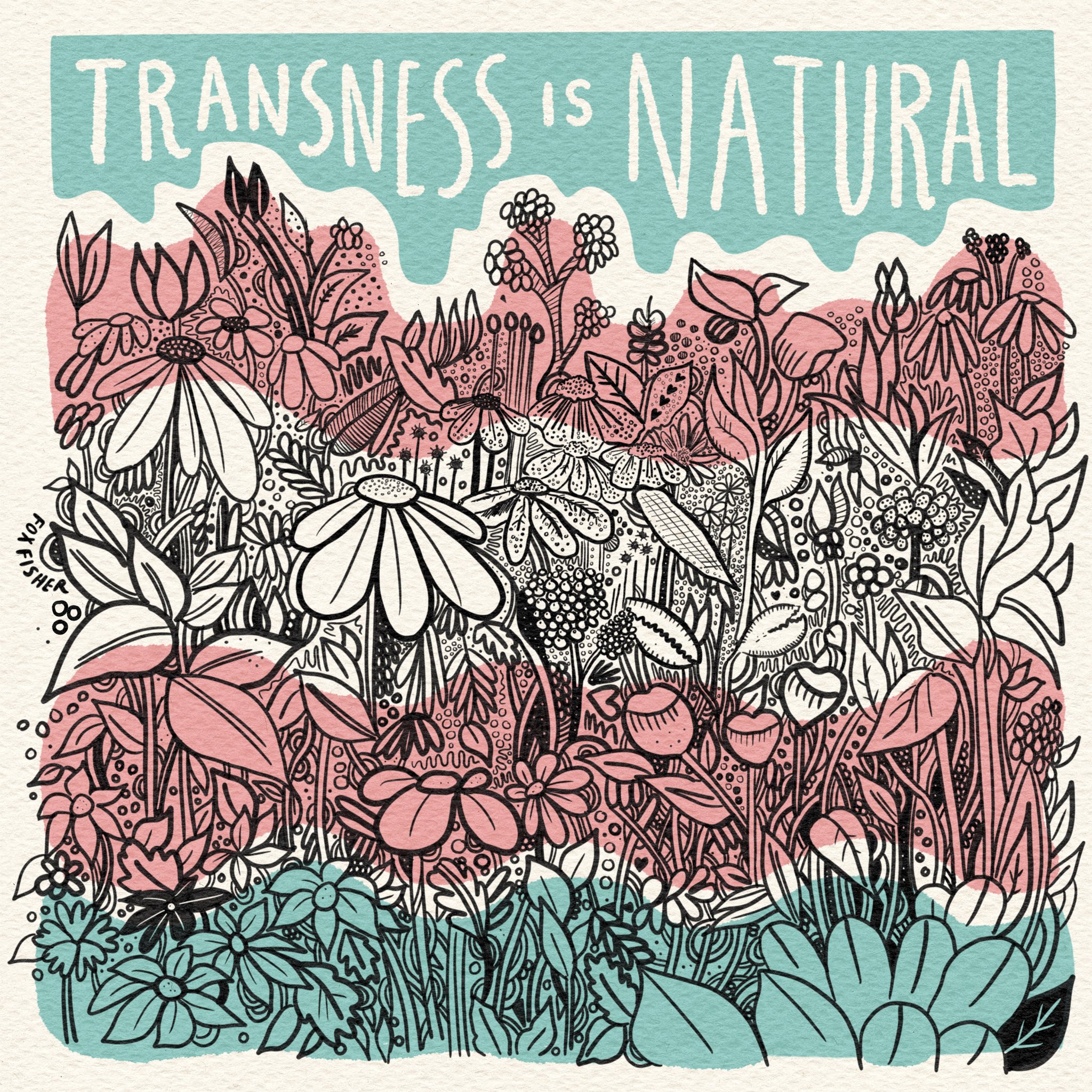
The trend to naturalize a subjective phenomenon is a desperate one, indicating an awareness that the establishment of a theocratic order based in gender ideology is meeting with significant resistance. X (Twitter) over the last few days feels like November is already here—indeed, we might expect November to be for all of 2024. The reaction is paradoxical in that it becomes ever more explicit in its religious character in its attempts to rationalize its contradictions.
If we suppose Hermaphroditus—pronouns he/him, by the way—is representative of an intersex condition, i.e., the sublimation of an observed phenomenon, an extraordinarily rare anomaly in the sexual development of mammals, gender ideologues are still left with the reality that transgenderism is something entirely different.
I explore this problem in my response to this tweet by a person who has convinced himself that he’s clever. To save you a trip to X (Twitter) (although you may wish to see a clearly image of Katy’s shit cartoon), this is what I wrote: “Because he is a boy. That’s the difference. It’s an objective difference. The point of the cartoon fails utterly. Thinking you’re a boy when you’re not, if you genuinely believe you are a boy, is not knowing you’re a girl. It’s the literal opposite of knowing what you are. Of course, a girl likely knows she is a girl yet wants to be a boy. But wishes can’t override the impossible. She cannot be what she isn’t. It’s like ‘knowing’ you’re a different species of animal or an angel, something you cannot be or something that doesn’t exist. Subjectivity in action can only change some things. It can’t change essential things or conjure impossible things. If a girl could become a boy then there would be no demand for affirmation because bad faith would be unnecessary. How would a girl know she’s a boy if she isn’t one? Etcetera. Arguments from gender identity are entirely fallacious. A cartoon can’t fix that.”
Aware of this problem, one act in the attempted naturalization of subjective phenomena is the claim that science confirms the existence of brains oriented towards one gender or another despite the sex of the individual. We’ve been told that gender is a social construction, but the existence of gendered brains admits that gender is rooted in the brain.
I will come to the problem of social construction later in the essay, but what would be the relevance of brain scans to transgender policy, even supposing that brains are gendered in this way? Should professionals determine whether people are trans based on brain scans? Should this determination be part of gender affirming care (GAC)? If they don’t have the right brains, then no trans for them?
If trans is real because brains and (and the rest of) bodies can be incongruent, then brain scans must matter for determining policy, and in diagnosing the condition and prescribing the care. If they don’t matter for CAG, then what is the relevance of brain scans? It’s hard to believe that those in the transgender movement would limit transing to those with the correct brain scans. They have the standard definition to gender identity to fall back on, namely that the nonfalsifiable construct, that is, the faith piece of the belief system. Indeed, as this 2018 article in ThinkProgress warns “Research on transgender brains may not be as helpful as you think.” Why? Because “Transgender health care has a troubled history of gatekeeping.”
However contrary its myth and ritual are to the typical format, gender ideology, like other religions, confuses myth with reality. It collapses ontology into epistemology where reality is what we know it to be. Put another way, the way we know the world makes the world we know. That’s why early in its development queer theory explicitly states that gender is a “performance,” announcing its ritual character, at once denying gender is a natural historical phenomenon, while in its sexological sense remaining an an innate and authentic thing.
Gender ideology is a paradigm instantiation of postmodern regression to the primitive, a neo-religion with ancient analogs. That millions of people march to the paradox—and that the medical-industrial complex justifies its profiteering by appealing to the authority of the various associations that have grown up around it—testifies to its religious character.
I have thrown in the fact that trans people are real in this sense. To be sure, this religion exists, as do its congregants; but, like all religious substance, the content is imaginary and irrational, and the congregants are mistaken about what they are and can be; so, we are asked to suspend our disbelief along with them—or at least act in bad faith or remain quiet about the truth. Moreover, like other religions, the faithful are there to be taken advantage of.
Not only does this religion exist, but it’s also growing. An article in the Advocate, an American LGBT magazine established in 1967 that has long monitored and promoted the expansion of the LGBT community, announced that the “LGBTQ+ Population in the US Grows by Over 2 Million.” This is the largest it has ever been in recorded US history. According to the article, referencing a study by the Williams Institute at UC Los Angeles, 13.9 million adults in the US identify as LGBTQ+, accounting for 5.5 percent of the country’s total population. “That’s up one whole percentage point—and over 2 million people—from their 2020 report, which found the LGBTQ+ population accounted for 4.5 percent of the population at 11.3 million adults,” the article celebrates. History will record trans identification as one of the more remarkable instances of social contagion.
But what’s a “LGBTQ+” person? It’s an abstraction constructed by clustering radically different and often manufactured identities to engineer the appearance of a large and growing minority used for various purposes. The “LGB” piece refers to sexual orientation. The “T” to gender identity. Thus, while lesbian, gay, and bisexual orientations concern sexual attraction and behavior, an objective feature of the mammalian class, gender identity is defined as a person’s innate sense of their gender, an entirely subjective claim. Trans is a simulation, an act of feigning gender through simulation, often a very poor (and toxic) mimicry of the thing it seeks to represent. None of this is a result of the natural history of our species.
When I have these discussions the concept of social construction often comes up, so let me turn to this matter briefly. This concept is used in cultural studies and social sciences to analyze how societies collectively create and assign meaning to various aspects of their shared reality. In other words, a social construction refers to those aspects of the world that are created and defined by society rather than being inherent or natural; these aspects are products of human interaction and interpretation rather than objective, pre-existing realities.
Examples of social constructions include aspects of gender, language, race, etc., although these have natural historical features, as well (which is why Dylan Mulvaney can’t be a woman any more than Rachael Dolezal can be black). The socially constructed character of things isn’t fixed or universal but shaped and given meaning by the cultural, historical, and social context in which they exist. This observation, while true, can also distort the natural historical character of things, especially when interpretations are politically weaponized.
Cultural studies and social science, the latter colonized by the former, have historically used the concept of social construction differentially; however, over the last several decades, the former, working from the postmodernist epistemic, its method known as deconstruction, has corrupted the latter. So, while understanding social constructions can help reveal the ways in which cultural, political, and social forces shape our perceptions and interpretations of the world, in the postmodernist turn it has become an academic gloss for political-ideological agendas mean not to analyze the world but to transform it. This is the meaning of the “Q” in “LGBTQ”: queering is a praxis of transgression—a slur has rehabilitated as a methodology.
In light of this, gender critical thinkers need to highlight the fact that aspects of reality that are socially constructed, including even material elements (housing, for example), and use this fact to debunk gender ideology. Sex (or gender) roles are indeed significantly socially constructed, which explains why they are to some extent culturally and historically variable. This explains why, when men cosplay women, they don culturally familiar stereotypes (fashion, mannerisms, etc.). For example, almost all women wear pants most of the time. Yet trans women wear dresses. And because men in dresses rarely pass, they seek accessories seeking liminality, such as neon-colored hair, clownish makeup, and facial piercings.
However the attempt to escape their gender manifests, its socially constructed character does not obviate the natural historical reality that the human species, like all mammalian species, is genotypically and substantially phenotypically dimorphic and immutable despite hormonal and cosmetic intervention. Putting the matter bluntly, men are not women and cannot be. Aa woman is more than a stereotype or a sex role. She is more than a social construction. A woman is a result of natural history. The “accusation of misgendering” from this standpoint assumes as true the opposite of what is true.
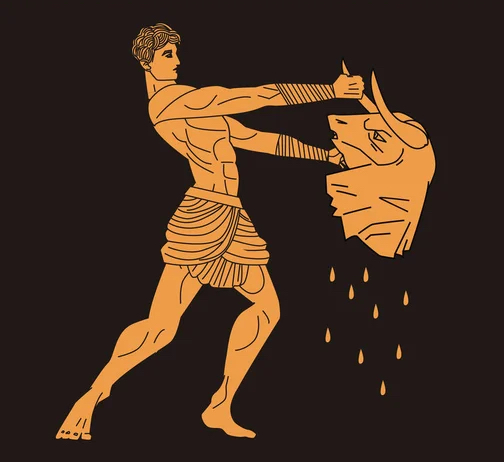
In his 1976 book, The Dialectic of Ideology and Technology: The Origins, Grammar, and Future of Ideology, sociologist Alvin Gouldner advances a critique of Max Weber’s demand for a value-free sociology. Gouldner invokes a Greek myth of the Minotaur to produce a metaphorical device that captures the essence of the critique. Weber argues for the idea that sociologists should aim to separate their personal values and beliefs from their scientific analysis of society. (Robert Merton famously explored the value of disinterestedness in his 1942 Scientific Monthly essay “The Normative Structure of Science.”) Gouldner criticized Weber’s admonition, arguing instead that complete value neutrality is impossible, and that the pursuit of such neutrality can lead to a lack of engagement with social issues.
Since this essay concerns the problem of mythology, and since Gouldner uses the myth as a metaphor in identifying the problem, I will digress for a moment and tell readers about the Minotaur. It’s an incredible story in both meanings of that word.
In Greek mythology, was a creature with the head of a bull and the body of a man. According to the myth, King Minos asked Poseidon for a beautiful white bull as a sign of his favor. However, Minos did not sacrifice the bull as he had promised. As a punishment, Poseidon caused Minos’ wife, Queen Pasiphaë (the goddess of sorcery and witchcraft), to fall in love with the bull. Pasiphaë sought the help of the craftsman Daedalus, who constructed a wooden cow for her. Inside this wooden contraption, Pasiphaë hid and mated with the bull, resulting in the birth of the Minotaur.
The Minotaur was confined to the Labyrinth, a maze-like structure designed by Daedalus (helped by his apprentice son Icarus), located in the palace of King Minos. The Athenians, as part of the tribute they were required to pay to Crete, sent young men and women to be sacrificed to the Minotaur. Theseus, the Athenian hero, eventually slew the Minotaur with the help of Ariadne, King Minos’ daughter, who provided him with a thread to navigate the Labyrinth.
Gouldner uses the situation of the Minotaur, who in the Labyrinth was isolated and detached from society, to convey the problem were sociologists to strictly adhere to Weber’s concept of value neutrality—to wit, the problem of detachment from the social realities under study. The “Anti-Minotaur” thus represents the opposite approach, one emphasizing engagement with the social world.
Gouldner’s call for sociologists to actively acknowledge their own values and biases (an idea Sandra Harding picked up years later in her essay “After the Neutrality Ideal: Science, Politics, and ‘Strong Objectivity,’” in a 1992 issue of Science and Politics) is a methodological point tied to the broader goal of equipping observers with a reflexive lens to critically examine power relations and social injustices. By acknowledging and grappling with their own standpoints, sociologists can better understand how their positions and perspectives might influence their research, a self-awareness that may, in turn, enhance the ability to critically analyze social dynamics, developing a more nuanced and critical understanding of the social issues they study.
* * *
My point in the present essay is a call to recognize the political power play and political economy that gender affirming care represents and the ideology that justifies it by recognize how the sociologist’s embeddedness in woke ideology prevents him from resisting the progressive naturalization of what an interested objective standpoint would easily identify as atrocities and oppressive arrangements.
Much of the world outside of sociology is already aware of these problems. On the way home from visiting family the day before yesterday, I listened to a conversation involving satirist Andrew Doyle, a gay man, on the podcast Triggernometry. Doyle recounted the experience of a friend, also gay, who was convinced by doctors that his same-sex attraction indicated a woman trapped in a man’s body. The friend was in a vulnerable place at the time and believed the doctors—even though what they told him is an impossibility. Doyle’s friend now realizes that but no longer has genitals because the doctors removed them.
The industry doesn’t remove genitals for free. Doctors don’t mutilate bodies because they’re sadists—although it cost this man and men like him much more than money. There’s no money in homosexuality. GAC is a billion dollar industry. The victims of these atrocities often require life-long treatment.
Legislatures across the United States are trying to protect at least children from this exploitative practice (I argue that these practices should be banned). Judges, listening to the experts and substituting themselves for the wisdom and will of the people, are stopping them. Just as judges are striking down bans on propaganda in public schools and libraries used to groom and sexualize children. Judges are accepting on faith the neo-religion of transness and using their authority to aid the corporate state project to legitimize an emerging theocratic order.
I recently urged an individual who attempted to explain why the appeal to experts was not the same as the fallacy of appealing to authority to watch a few trials. I told him that if he did he would see experts on both sides. The jury makes up its mind on fact and reason or it’s lazy, biased, or intimidated. To be sure, judges could theoretically weigh the facts and apply logic, but, as we have seen, something else appears to be at work.
As I have noted in other writings, reflexology has its experts and associations. So do chemical manufacturers. Medical science is no different. Trans is a billion dollar industry. Whenever people resort to experts they’re appealing to authority. They can’t make the argument, so WPATH, etcetera. Name dropping—which is not the same as citing one’s sources—is like name calling.
The archaeological record, cultural ethnography, and historiography provide ample evidence of humans pretending to be other animals, gender and genderless beings and states, supernatural entities, etc. Liminality and ceremonial practices and roles are universal in our species. Perhaps this indicates something about our evolutionary psychology. But that this tendency may be inherent in the genome doesn’t mean the characters and personas conjured by myths and rituals are actually-existing things.
Gender identity remains a mythic projection, one constructed by crackpots during the Sexual Revolution, an element in the elite-led countercultural movement to undermine the functional normative structures that protect individuals from commercial and religious exploitation. The project is to shift from the ontological standpoint of truth to a consequentialist one—the terms and values of which elites define.
To be sure, there are millions on the side of the transgressive push of consumerism and narrative, a development falsely but intentionally and transparently sublimating itself as emancipatory and virtuous (e.g., in the rhetoric of social justice). Some people more easily suspend disbelief than others (this, too, may be a variable expression of the genome); but viewed rationally the effort to suspend disbelief indicates that there are things to be disbelieved. That men can be women is at the top of the list of things to be disbelieved if we mean to reclaim the truth of gender.
So let us resolve on this New Years Day to trod harder the path to collective sanity by speaking the truth in the face of the lie, by using our words to differentiate the real from the mythic, and by clearing from the institutions of law and science the overgrowth of ideology that obscures reason.

 freedom and reason