“Well, Doctor, what have we got—a republic or a monarchy?” was the question posed to Benjamin Franklin by a woman outside the Constitutional Convention in 1787. “A republic, if you can keep it,” he replied.
The New Year observance is a moment not only to look forward to the promise of a new stanza in our lives, personal and collective, but to reflect upon the past year, and those prior to it, to understand how we got to where we are and what we must do to ensure that we no longer repeat the errors of the past. That’s why we resolve to change the things about ourselves we don’t like and that make our lives less than what they could and should be. In this essay, the last of 2024, I want to be frank in accessing the present situation with respect to immigration so that we can wake up tomorrow from tonight’s celebrations with a sober outlook going forward.
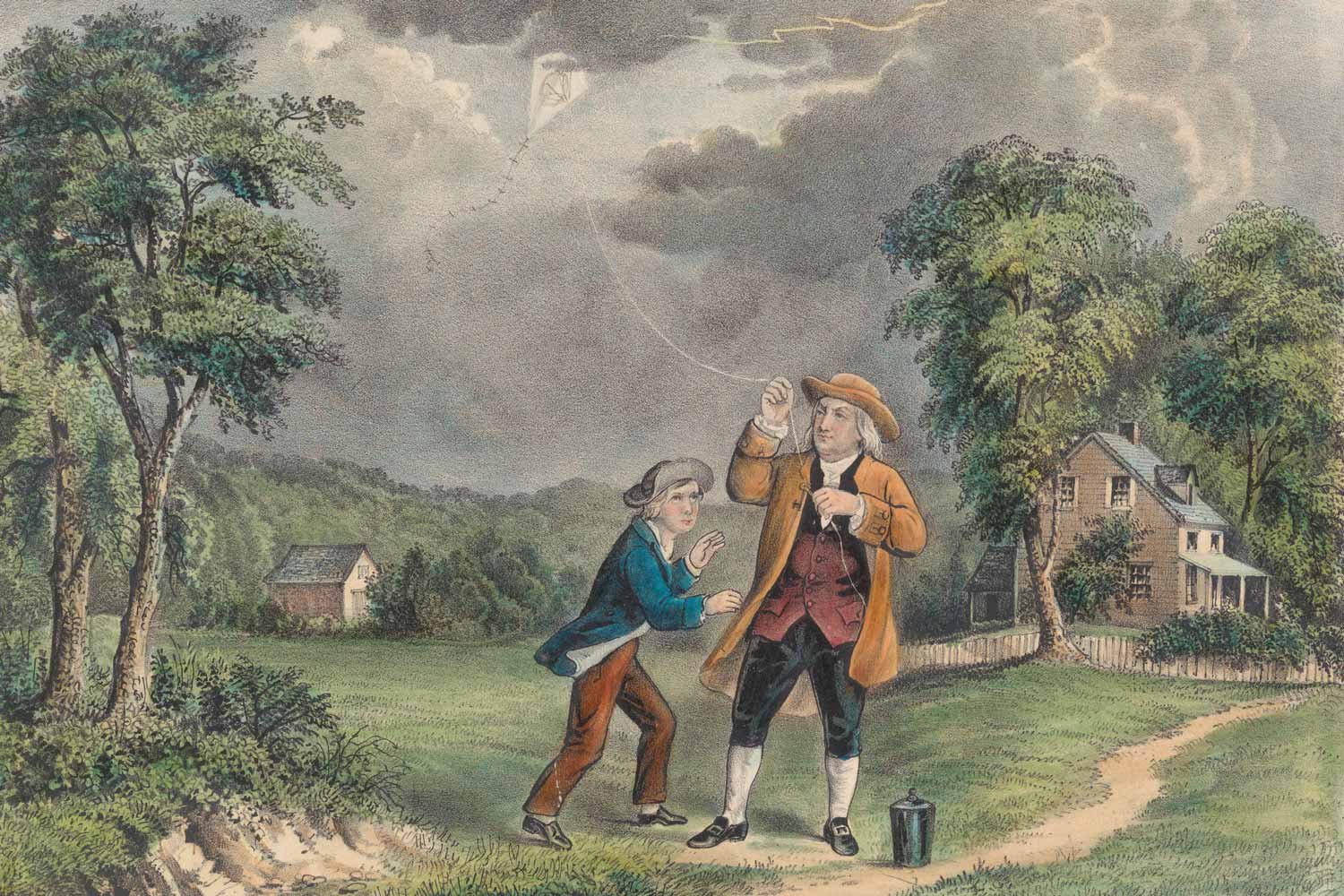
Currier and Ives, “Franklin’s Experiment June 1752.”Metropolitan Museum of Art.
Mass immigration is class warfare, waged against low-skilled workers in labor-intensive industries, disproportionally black and brown, as we can see by the millions that have crossed—and are still crossing (with concierge service)—our southern US border, as well as the importation of tech workers in capital-intensive sectors, seen, for example, in the H-1B visa and related program. The purpose of these policies is to drive down wages and undermine class solidarity by replacing native-born and naturalized citizens with low-wage foreign labor seeking to live off of the riches generations of American citizens have built and sacrificed for. (There’s more to it, as I explain in my essay The H-1B visa Controversy: The Tech Bros Make Their Move, but undermining the American worker is the bottom line.)
The rationalization of the globalism dynamic by the credentialed class testifies to the role that strata performs in legitimizing the corporate state system; for if the bureaucrats, managers, and professionals who pull the levers of the administrative apparatus—those who devise the ridiculous rules wielded to tell the citizen what to do all day long, how he’s supposed to talk about his situation, what his life and his family’s lives are worth, and that at the same promote a select few into affluence and positions of command—represented the citizens of this nation and not corporate power, then they would have been in rebellion over immigration policy over the last four years. Be not like kings and prophets. See what you see. Hear what you hear.
Sure, some of the subaltern are scared to speak up, and I appreciate that they reach out to me privately to tell me that (while apologizing for their timidity), but most of the apparent equanimity is only superficially passive; the subaltern confess their sympathies by voting for the party that has organized the devastation of the proletariat, namely the Democratic Party and its fellow neoliberals and neoconservatives in the managed opposition, i.e., the establishment Republicans (even if they don’t vote for the latter, they rehabilitate their legacies and welcome them to the club—just ask Dick and Liz Cheney).
DHS Secretary Mayorkas listens as Pres. Biden speaks before signing an executive order on immigration, Tuesday, Feb. 2, 2021.
We can know the people who sell out the American citizen by the way they defend Biden, Mayorkas, and the rest of the traitors who betray the American Republic. We can see it in their silence about the mass media coverups and the brazen trashing of the deplorables. We know who they are by the way they tell the working people that they’re racist for voting for the nationalist and the patriot while pushing solidarity-destroying programs like affirmative action and DEI. Feeling safe and secure in their power, ensconced in offices of the technocratic behemoth, they openly smear those who defend the cultural and national integrity of the United States as “nativists.”
But what is the nativist, really? It’s the man who defends the cultural and national integrity of the country to which he has sworn his allegiance. This is his home. What is citizenship for, after all, if not to benefit the native in a republican situation—a situation the US Constitution requires of every state? The purpose of the rule of law in a free society is to advance the interests of the citizen, not to be used against them for the sole benefit of the aristocracy and their sycophants. That’s why it’s called a republic, if it genuinely is one. Yes, some of us mean to keep it, Doctor Franklin.
Support for open borders and mass immigration testifies to something else, as well. It testifies to the role of public employee unions in the academy and government in rationalizing the corporate state system—the same system that devastated private sector unions. I wrote about this in October of this year in my essay Co-optation and Negation: Understanding Corporate Hegemonic Strategy. You will find there a revealing chart concerning the shift in union participation from private to public sectors. See also Progressivism Hasn’t Been Betrayed—It’s Been Installed, an essay I penned in April 2022, lost in the stack of drafts, recently found and published a few weeks ago. That essay is the basis for many essays I have written since (and even before) concerning the role progressives play in weakening the democratic-republican foundation of our nation.
This is the type of content you will find on Freedom and Reason, which is enjoying its best year to date, with more than 7,000 visitors and 13.5 thousand reads. These are modest numbers, but the platform punches above its weight. Thank you for your attention. Happy New Year!
* * *
Update! Debrina Kawam is the name of the woman Sebastian Zapeta, a 33-year-old Guatemalan citizen who entered the US illegally, set on fire F train at the Coney Island-Stillwell Avenue station in Brooklyn on the morning of December 22. She was 57-years-old.
Deb Kawam
Zapeta was removed from the US back to Guatemala in June 2018—during Trump’s first term—after US Border Patrol encountered him in Arizona. We are uncertain of when he reentered. If it was under Biden, then we know how easy it must have been for this monster to reenter the country. If he returned under Trump, remember how the Democrats fought Trump every step of the way in his efforts to secure the Southern border. In the end, Kawam’s demise is on the open borders crowd.
People like to tell us that legal residents in the United States have a higher aggregate crime rate than immigrants. Illegal or legal immigrant? How would they know this? Supposing it’s true, consider the staggering levels of crime in America’s Blue Cities perpetrated by citizens; there is no Western country with comparable rates of crime. But the comparison is irrelevant, since if Zapeta were not here, Kawam would still be alive and living out her golden years.
It’s hard to exaggerate the depth of evil exuded by Biden and Mayorkas (see Trump is Right: Biden-Harris are Allowing in Serious and Violent Offenders). But there are other evil actors to be identified in this event. I watched the uncensored video of the burning woman. She stood and walked to the open train door, fat dripping from her body engulfed in flames. She lived for what must have seemed an eternity to her, while Zapeta fanned the flames with his jacket. Others were there. Nobody did anything.
The Daniel Penny prosecution made the responsibility diffusion problem worse. There was a cop there. He told Zapeta to clear out of the area. New York is fucked. If Democrats had their way, we’d all live in the fucked version of that once great city. They’ve had their way for far too long. Remember that two years from now when congressional elections come back around.
For rational discourse to be a pragmatic thing, that is, a thing that moves matters forward with common purpose, a speech situation depends on shared meaning of the words in use. I have written about this a great deal recently on Freedom and Reason with regards to the words “gender” and “sex,” pointing out that the word “gender” has only recently come to exclusively mean behaviors, expectations, identities, roles, and typifications (stereotypes) that societies attribute to individuals based on (other or self) perceptions of femininity and masculinity. In earlier essays on this platform, I have written about the words “ethnicity,” “nation,” and “race,” and the way these words are manipulated for ideological purposes. Considering the recent controversy over immigration, I want to return to these words and clarify them once more to help bring the discourse back to a rational foundation.
But before getting to that, it may be useful to summarize my point about the gender-sex distinction, as I intend to make a point later on that references it. The exclusive notion of gender holds that it is a cultural and social construct that varies across time and space, encompassing identities beyond the binary of female and male; this repurposing of the word is found among intellectuals concentrated in academic institutions, as well as the DEI departments of corporations and governments that find that distinction strategic, and a type of activist seeking to disrupt ordinary understandings of gender to normalize paraphilias. In this minority view, sex, in contrast to gender, is strictly a biological classification based on physical attributes such as chromosomes, gametes, hormones, and reproductive anatomy, typically classified as female and male, or (rarely) intersex. However, even here we find proponents of gender as a social construct disconnected from sex, arguing that sex is also a social construct—and that the science that reifies it is ideological system organized by oppressive power. (Postmodernism has successfully colonized our sense-making institutions, which explains why these institutions no longer make sense.)
A common objection I have encountered in socializing this point is that “words change,” an obvious and trivial observation. It’s similar to the command that “one shalt not kill.” Killing describes an action or an event. The actual command is that one shalt not murder. This is because one is interested in why someone kills. What was the reason? The relevant questions are seek to determine justification and motive. Words indeed change; the pertinent question is why they change. More to the point: who is changing them and whatdo they gain by changing them. It ought to be obvious that those who can change the meaning of works have the power to do so. Thus determining who is changing the meaning of words tells us a lot about who possesses power. How they are changing the meaning of words tells us a lot about what they are up to. Resisting the meanings they give to words is a crucial part of keeping discourse rooted in the universal and not in narrow group interests where words have self-serving value.
The artificial distinction between “gender” and “sex” was manufactured in the mid-twentieth century, particularly in anthropological, psychological, and sociological scholarship, which highlighted how gender roles are learned and socially enforced. Obviously gender roles are culturally and historically variable. However, as I have shown, gender and sex are synonyms and the terms “gender roles” and “sex roles” are interchangeable. One can thus make the observation that sex roles are culturally and historically variable—and that one possesses a “sex identity.” To put this another way, there is no gender role outside of the physical anthropological reality of gender, which is based on chromosomes, gametes, hormones, and reproductive anatomy, with gametes being the basic differentiation, binary and immutable. To say that the same is true of sex is to say that the words are synonyms. Therefore, the distinction between the words is in point of fact ideological.
Cole Thomas, The Course of Empire Destruction (1836)
Today, many authoritative voices tells us that race as a social construct used to categorize and divide people based on physical characteristics, such as facial features, hair texture, and skin color. According to this account, racial distinctions mostly rely on perceived biological differences, or phenotype, though its advocates will tell you—anthropologists, (some) psychologists, and sociologists primarily—that race has no significant genetic basis and is instead a product of social consciousness and historical contexts. So is race to postmodernist eyes analogous to gender? It’s assigned at birth. No, it is not analogous to gender, for while I am whatever gender I say I am (and I can change that whenever I want), I am not entitled to the race of another. Never mind that there is no reason behind the double standard.
Crucially, the concept of race emerged in the seventeenth century with the Enlightenment and the rise of modern science. It comes from the Italian word razza meaning “kind,” “breed,” or “lineage. Given that the physical characteristics identified above, which comprise phenotypes, exists independent of consciousness, and, moreover, are grouped (which can be demonstrated empirically with factor analysis), the notion that these are social constructs in the typical meaning of that concept—an idea or practice created and maintained by society, rather than being inherently natural or biologically determined—is fallacious.
Like gender, race does not exist because people collectively agree to give it meaning and significance thus shaping how individuals interact and perceive the world; race exists because it is a biological reality. Offspring look like their parents and, given geographical distribution, groups have emerged from the process of natural selection with significant differences between groups, to be sure distributions that do not negate the significant variability of attributes within groups, but that also do not negate the reality of phenotype. We may therefore describe race as geographically differentiated ancestry, what some anthropologists would like to define as “clines” to convey the gradual variation in certain biological or genetic traits across geographic regions or populations.
Ethnicity, in distinction to race, refers to shared cultural practices, language, traditions, and values associated with a group of people. The word comes from the Greek word ethnos, which means “people” or “nation.” Unlike race, ethnicity emphasizes cultural identity rather than physical characteristics. Cultural identity is sometimes associated with religious identity. In ancient and medieval periods in Europe, the Middle East, and North Africa, ethnicity often centered on Christian, Jewish, and Muslim. During the formation of nation-states, ethnicities became more organized around national identity, such as English, French, German, Irish, Swedish, etc. Ethnicity does sometimes include a racial component, since shared cultural practices are associated with common ancestry and therefore ethnic differences intersect with racial differences. however, the one is irreducible to the other.
Unlike the distinction between gender and sex, the distinction between ethnicity and race is not manufactured, but real. Culture is not an expression of genetics, but a sociohistorical development. In fact, culture can drive natural history, as human beings just in the normal course of living collectively change their physical environments. In the case of ethnicity and race, it is the conflation of the terms that has in back of it an ideological motive. We see this in the accusation of racism when one criticizes culture, for example in the furor over Donald Trump and JD Vance drawing attention to the problem of Haitian migrants in Springfield, Ohio (see A Case of Superexploitation: Racism and the Split Labor Market in Springfield, Ohio).
Down through history, different ethnic groups have sometimes assimilated with other nations producing greater cultural homogeneity in the context of empires and nation-states. The paradigm of assimilation in the modern period is the United States. However, since the twentieth century, with the emergence of cultural pluralism, or multiculturalism, advanced by cosmopolitan elites in the service of corporate power, diverse ethnic groups are encouraged to keep their cultural particularities intact, while assimilation has become characterized as a racist desire—even though ethnicity and race refer to different things.
A nation is a large group of people united by shared cultural, historical, linguistic, or political ties, often inhabiting a specific territory. It can also refer to a political entity—a sovereign state or a country. In the first sense, nation and ethnicity are synonyms, in that both ethnicity and nation refer to a people. Early nations, like Egypt or Mesopotamia, were bound by centralized governance, geography, and language. In the ancient period, such as the Roman Empire, and then during the Middle Ages, a period of decentralized governance, the concept of a “nation” came to be used to refer to groups sharing cultural, linguistic, and religious ties. The modern idea of a nation was shaped by Enlightenment, as well as Romantic notions emphasizing shared identity and self-determination.
The concept of the nation-state—political entities defined by shared nationality—emerged from the latter notions, especially in Europe, with these notions organizing the world with the expansion of the capitalist world-system. The period of decolonization following the fall of Western empires (also a result of the expansion of the capitalist world-system) redefined nations, as many newly independent states created cohesive national identities among diverse populations.
The system of nations are today fraught, as the struggle between national sovereignty and the transnationalization of capitalist production with the rise of corporate governance have generated an ongoing debate about nationalism versus cosmopolitanism, with the latter advocating multiculturalism and smearing the former as “nativists” and “racists.”
What the cosmopolitan type desires has an historical analog. During the Middle Ages, economic systems operated through decentralized networks, distinct from the centralized model of nation-states where capital flows were constrained by the rule of law in some fashion answerable to the people. Bourges, a city in central France, served as a significant medieval hub for trade and culture, exemplifying the autonomy of city-states. Bourges, alongside Genoa, Hanseatic League, and Venice, thrived by participating in trade networks that bypassed larger feudal structures. We can thus draw a parallel between these historical examples and modern global economic systems, where digital platforms, financial institutions, and multinational corporations operate through decentralized networks, challenging the authority and structure of nation-states.
Understanding the meaning of these words is crucial to avoid misspecifying the dynamic that is presently undermining the modern nation-state, which has historically been based on shared culture, language, etc.
In light of this, we can conceptualize the modern nation-state to be of three sorts. The first, the ethno-state, where citizenship is based on ethnicity. Here we often find this status based on the principle jus sanguinis, a Latin term that means “right of blood,” i.e., establishing citizenship on the basis of that of the parents. A Swede, for example, is a citizen of Sweden because she was born to Swedes, who comprise an ethnic group. Thus this practice is also known as the principle of descent.
The second sort of nation-state is one based on civic nationalism, often found exercising the principle of jus soli, a Latin phrase meaning “right of the soil,” referring to the principle that a person’s citizenship is determined by their place of birth, commonly known as “birthright citizenship.” In this way of reckoning citizenship, one’s political identity is built not around culture or ethnicity as much, but more on a national creed and type of government citizens pledge to uphold. Historically, this has been the practice in the United States, justified by an interpretation of the Fourteenth Amendment (the same article used to rationalize corporate personhood).
The third type of nation, which is the one sought by the cosmopolitan type, is really a simulation, which is to say that it is no nation at all, but an artificial construct designed to serve the interests of global elites who define and redefine national boundaries as it suits them. This notion of nation is associated with multiculturalism, an ideology manufactured by organic intellectuals to justify the effective erasure of national identity, becoming the prevailing sensibility in sense-making and governing institutions. While ethnonationalism and civil nationalism are not mutually exclusive, the latter compatible with jus sanguinis (which ought to be the principle by which all citizenship is determined), the transnationalist concept is antithetical to nationalism, which ought to be obvious by the structure of the word itself; just as the praxis of transgenderism means to erase the gender boundaries, transnationalism means to erase national boundaries.
Transnationalists desire a world seen only in terms of economic relations, thus negating the concept of the nation as homeland. By effectively erasing borders, it seeks to uproot people from their culture and make them not servants of themselves but instruments for producing wealth and privilege for those who control the means of production. Without borders, the rule of law is determined by technocrats whose only allegiance is to transnational corporate power, not citizens. This is the desire for a high-tech feudal estate system. Thus the accusation of “nativism” is a derogatory term invented by multiculturalists to smear native Americans who advocate for national sovereignty and collective self-determination, all of which depend of cultural integrity, i.e., ethnicity or the nation.
Cole Thomas, The Course of Empire Desolation (1836)
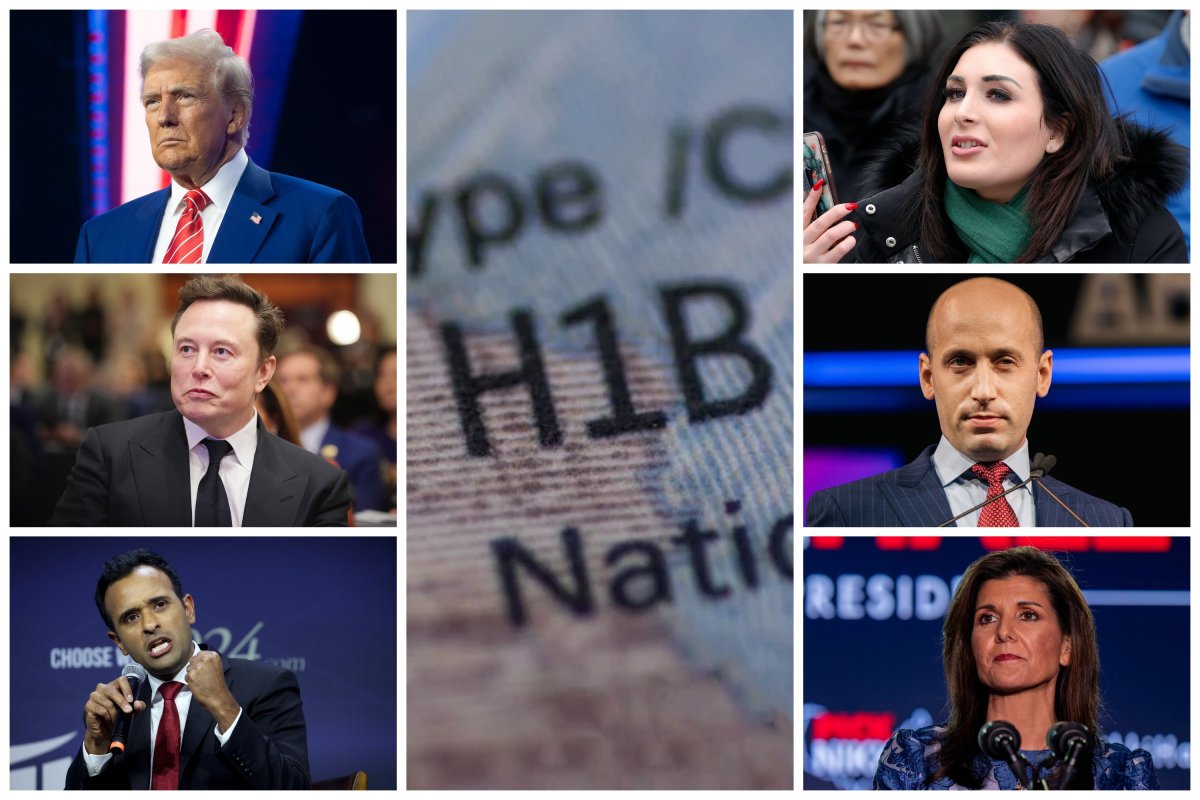
We thus hear in advocacy for the H-1B visa program, which enjoys the support of Elon Musk, Vivek Ramaswamy, and Donald Trump, transnationalist sympathies that are at odds with the populist-nationalism expressed by these three and many others during the 2024 campaign. They argue that we need this (and other) programs so corporations have access to talent around the world. This is not what is really sought by Musk and other capitalists; what is sought is cheap labor for the reasons explained in my previous essay, The H-1B visa Controversy: The Tech Bros Make Their Move.
But even if there were true, it would reflect imperialist desire rather than nationalism. As history has made clear, the emergence of empire is a sign of civilizational decay amid cultural disintegration. America as a civilization cannot survive the disintegration of its culture caused by the present pace of immigration. People are culture-bearers, and whatever economic contribution new arrivals might make, the cultures many of them bear are antithetical to ours, and without any determined plan to assimilate those who are amenable to it, the American Creed cannot survive the practice. We are great because of our creed. Our creed is the spirit of our republic. We cannot keep our republic if we lose it.
There’s been a lot of commotion in the social media sphere about the H-1B visa program over the last several days. On X, Elon Musk tweeted about the lack of native-born engineers and the need for engineers in the tech world, amplifying the H-1B visa controversy President-Elect Trump’s pick of Sriram Krishnan for senior advisor on artificial intelligence triggered; and while Musk desired to promote the practice, or at least defend it, the unintended consequence of his tweets was to raise awareness of, and thus opposition to the practice. Musk’s DoGE partner Vivek Ramaswamy worsened things by blaming American culture for the lack of native-born engineers. The United States prizes the jock over the nerd, Ramaswamy tweeted. Musk has since accused opponents of the H-1B visa program—the heart of the America First movement—of racism.
Progressives and the corporate state they shill for, all in on open borders, devoted to the cause of transnationalism and the high-tech serfdom that comes with it, love the schism this has produced between tech bros and MAGA, wondering aloud how the historically pro-business Republicans could oppose immigration when there is such a need for skilled immigrants. What they mean to accomplish is obvious enough: to set the central issue of the 2024 campaign on its head. Musk’s smearing of MAGA as racists, and his move to restrict the speech of some of the most prominent populists on X, couldn’t be more out of the corporate state playbook.
To some degree, the controversy rests on a false dilemma, one that’s meant to make Republicans look like hypocrites, in addition to driving a wedge between Trump and his allies (Musk and Ramaswamy’s DoGE project is another obvious target). However, many rank-and-file Republicans aren’t against immigration per se. They’re for selective immigration and in opposition to illegal immigration.
To be sure, the H-1B visa program is a special problem. I disagree with Trump on this issue. My view is that international students can get an education here, then go back to their country and improve it for their fellow citizens. No automatic green card. No chain migration. Moreover, Moreover, community colleges should be exclusively for citizens of the United States; the point of the community college system is to provide an opportunity for working class Americans to develop skills to scale the socioeconomic ladder. For comparison, watch Trump explain his position:
JUST IN: Trump comes out in support of immigration visas backed by Elon, says he has "many H-1B visas on my properties," according to the New York Post.
Trump made the comments during an interview with the Post, saying he thinks the program is "great."
How we go about legal immigration is the debate to be had. We should repeal the Hart-Celler Act of 1965. This is because what is really at the heart of the concern over immigration is national sovereignty and cultural integrity, since we cannot keep the first if we undermine the second. We should reform the H-1B visa program to exclude the automatic rewarding of a green card, as well as end the practice of chain migration. And we should invest billions in expanding our community college and technical school system and recruiting low-income students to them.
Many of those who hear my arguments concerning immigration probably suppose the same thing about me that they about MAGA Republicans—that I am anti-immigrant. But in my writings on this, I have always stressed that I do not categorically oppose immigration. My wife is an immigrant and a naturalized citizen (for more than twenty years now). I not only know and work with immigrants, but have hired and retained them.
The reason I rededicated myself to this platform, Freedom and Reason, in the summer of 2018 was having witnessed the migrant crisis firsthand during my research trip to Scandinavia. There I saw a stark difference between older arrivals to Sweden, for example Persians who escaped the tyranny of clerical fascism, and new arrivals from the Middle East and North Africa. One group has elevated Sweden. The other is turning it into a shit-hole. Culture matters.
My criticism of the prevailing immigration policy is primarily about the tolerance, even encouragement by Democrats and establishment Republicans, for large-scaled immigration from the Third World. This is especially true of low-skilled labor. The livelihoods of the most vulnerable among native Americans are undermined by cheap foreign labor (more on this in a moment). As for the need for high-skilled labor, we need to do a better job in our educational system of steering native-born talent into technical programs where they can learn the necessary skills. At the same time, because the tech sector is always expanding (exponentially so), there will likely always be a need for some foreign talent—but not the H-1B visa program as it currently exists.
But the tech industry wants foreign workers not merely because they can’t find the talent here. That argument has always been something of a ruse. It’s not only the best and the brightest being invited to learn, train, and/or work in America. The capitalist-intensive sector wants cheap high-skilled labor just as much as the labor-intensive sector wants cheap low-skilled workers—and these sectors are not mutually exclusive.
The business elite desire a system of modern indentured servitude, where foreign workers so desperate to escape the inferior conditions of their home country that they will settle for far less than the market can pay, thus driving up corporate profits. The bonus is the green card and the path to citizen. What about the Einsteins we’re told we’d be missing out on? After all, we built our space program using foreign talent, right? True. But look at the numbers. They were few. And they came from Europe, bearing European culture. And they assimilated. Not all cultures are compatible with American culture. Not all culture-bearer assimilate with American culture.
The purpose of promoting mass immigration from the Third World is manifold. First, the obvious: the superexploitation of cheap foreign labor. Second, capitalists strive to diminish opportunities and wages for native-born workers in low-income and labor-intensive sectors, millions of whom have already been ghettoized and made dependent on welfare. The displaced millions comprise Marx’s industrial reserve army, except the capitalists never intend to use them during expansionary periods. The first and second are strategies for the maximization of surplus value, and racism is central to the project. Third, capitalist disorganize the political organization and class solidarity among workers via cultural pluralism and unfair competition. This has long been a strategy in class warfare. And, four, the Democratic Party seeks to enlarge its constituency. By changing the nation’s demographic composition, and by creating more dependency on the party and big government, the party of the corporate state and transnationalism produces more of those who vote for a living.
The system we've constructed with H-1B visas, whether we like it or not, incentivizes people to come here and serve as essentially indentured servants for Big Tech, taking on the tough, grueling jobs that few here in America are excited to perform at the current suppressed…
This manifold strategy, with some articulation (e.g., many foreigners come with degrees that their home countries paid for), also works for highly skilled labor in capital-intensive sectors. And while it may seem more difficult to raise the skill level of potential American workers given circumstance, if Third World countries can do it, then that can be accomplished here, as well. After all, given circumstance, it’s hard to deploy the industrial reserve army in labor-intensive sectors—but we should. To be sure, there is in the way a profound obstacle, and not the one Ramaswamy claims. It’s not that we prize the jock over the nerd in America; it’s that the government rewards idleness and tolerates a subculture of crime and violence.
The propaganda depicting those who share my position as “anti-immigrant,” “nativist,” “racist,” and “xenophobic,” is part of the four-fold strategy I just described, since mutual knowledge about the purpose of mass immigration builds popular support for a more restrictive policy and deportation of those who are illegally here. The propagandists are doing the same thing in Europe, because Europeans have had enough of it, too. The elite need to make those of us who care about national sovereignty and cultural integrity look backwards and prejudiced. They conflate race, culture, and immigration to produce an easily digestible meme to rule our subconscious.
I beseech you, don’t let the corporate state propagandists warp the populist-nationalist position concerning immigration. Ask instead why rank-and-file workers should support open borders and resist deportation. It’s not in their popular interests. Hold fast to principle. Trump has in back of him the will of a majority of Americans. It’s not merely what Trump wants. It’s what the people want. Indeed, in the end, it’s really about what the people want. As for Trump himself, he needs to reflect long and hard on any decision that would walk back the reason the multitude voted for him.
In a recent post, The Red Shift and What it Means, I updated readers on the partisan political situation (Republicans control the federal government and most state governments) and made some observations about what that means for America. I said this (and other things) about why voters abandoned the Democrats: “They don’t want indoctrination camps masquerading as educational institutions. They’re tired of cultural managers telling them how to think and feel about things.” The sentiment is thus, as I posted to X a few days ago: I am only obligated to tolerate those beliefs and practices that do not harm others or intrude upon their liberty. I am not obligated to accept or affirm the beliefs of others.
Senator Joe Manchin of West Virginia
Today, on X, I ran across a CNN interview with Joe Manchin, the Senator from West Virginia, and founder of Enersystems, a coal brokerage company his family owns. He is leaving the Senate and, at a bar talking to a reporter, reflected on the state of the Democratic Party. In so many words, he said the same thing I just said. “The D-brand has been so maligned from the standpoint of—it’s just, it’s toxic.” He no longer considers himself a Democrat “in the form of what Democratic party has turned itself into.” The party has become toxic, authoritarian and censorious, contemptuous of ordinary Americans. “They have basically expanded upon the thinking: ‘Well, we want to protect you there, but we’re going to tell you how you should live your life from that far on.’” “They’re too extreme,” he says of the Democrats. They “go too far.” “The Republican says: ‘Oh, let the good times roll. Let anybody have anything they want.’”
What did this to the Democratic party? Woke progressivism. “Woke.” Blacks started using the term around the 1930s. Then, it strictly meant an awareness of issues affecting black people. Good enough. That was a useful exercise before the mid-1960s. What woke has come to mean is radically different from this original meaning. Today, it is the belief that there is a de facto hierarchy of oppression invented by various postmodernist epistemics (critical race theory, queer theory, postcolonial studies) in which white straight people and adjacents (such as Asians and Jews) are the oppressors and all the rest of the people—black, brown, trans—are the oppressed. In this fallacious way of seeing the world, the oppressors are depicted as using free speech, individualism, perfectionism, rational thinking, timeliness, etc., as means to keep down the oppressed. The oppressed therefore must wield group power based on identity (imagined communities in a post-truth world) and feelings, and confront reason and speech with suppression and violence.
The woke are successful in this endeavor because the corporate elite have found woke ideology to be a powerful means for undermining political consciousness and class solidarity. For centuries, the ruling class used to use racism to divide the people. They still do. But racism does not fix the hierarchy. Woke progressives have flipped the hierarchy—and added to it an ever growing number of other oppressive groups. It’s the way kings maintained control of the territories they claimed. It’s an old model updated for our times. We thus see the perversity of woke in its atavistic, primitive, and tribalism notions of collective and intergenerational guilt and responsibility. As such, woke is antithetical to the democratic-republican and classical liberal foundations of the American Republic. The ethos of the United States is autonomy, individualism, free conscience, privacy, publishing, speech, and many other wonderful things.
Manchin denies ever having been on the woke progressive side. If you listen to the principles he espouses, he’s a liberal and a republican. His critique of the Democratic party’s stance on social issues: “First of all, as an American, and as someone in the Senate, and I’m going to take the Constitutional Oath, the Constitution that I take very, very, very, very seriously, I’m going to help every human being pursue the pursuit of happiness life in their life, pursuit of happiness. I don’t care who they are. I don’t care what color. I don’t care any of the things, live and let live, just do it and that’s you, and I’m going to make sure you have that opportunity in life to live your life. Just don’t make your life, if it might be on the extreme, or in the minority of few, make me believe that’s the norm or make me and my family believe, or my children believe or this or that. No, I will protect you. Just don’t try to mainstream it. And the Democratic party, the Washington Democrats, have tried to mainstream the extreme.”
The fact that the deep state and the establishment media brazenly lied about Hunter Biden’s laptop makes the Matt Gaetz case proof of the corporate state hegemony spearheaded by the Democratic Party and establishment Republicans (the neoliberal and neoconservative wing allied with progressives).
Yes, innocent until proven guilty, but I have seen the contents of the Biden laptop, and if reckoned rationally, and reported accurately, not only would the laptop have brought down the Biden regime, but likely would have prevented the last four years from happening at all.
We all know that if that laptop has belonged to Don Jr., with one-tenth of the incriminating evidence contained on it, it would have dominated the corporate propaganda cycle for months. The Democrats would have impeached Trump over it. Hell, they impeached Trump over trying to get to the bottom of the Biden laptop, which, as Chief Magistrate, was his duty, certainly his prerogative. Remember the phone call to Ukraine? That was what that was about.
Never forget this moment in history—the COVID-19 pandemic, the BLM color revolution, the impeachments, the rigged election, the censoring and deplatforming on social media, the imposition of gender ideology on our children, the celebration of Islamic terrorism, the (twice) attempted assassination of the President. If you couldn’t see it before, you have to be willfully blind to not see it now.
The great American sociologist C. Wright Mills called it more than 60 years ago when he told us about a power elite. Reading that book (which everybody should), it feels as if the situation were intractable. But that all changed with Donald Trump, Elon Musk, and RFK, Jr. Finally, there is hope. The sunlit uplands is in view. We’re not there yet, but the potential to reclaim the American Creed is greater today than at any point in my lifetime.
Update on the partisan political situation and some observations about what it means. I have some other comments, too, actually a few tweets to share, one with Ronald Reagan, the other Milton Friedman. First, the present situation.
As of December 2024: Republicans control 28 state legislatures, accounting for 59 percent of all states. Republicans hold 27 governorships across the United States, accounting for 54 percent of US state executive branches. The US Supreme Court is 6-3 conservative majority. Federal appellate courts are approximately 55 percent Republican-appointed. Over 60 percent of state supreme court justices are affiliated with or appointed by Republicans. In the House of Representatives, Republicans have secured at least 218 seats, the minimum required for a majority. In the Senate, Republicans have gained a majority with 53 seats. Republicans have captured the White House, with a majority of states, including all seven battleground states—Arizona, Georgia, Michigan, Nevada, North Carolina, Pennsylvania and Wisconsin. Crucially, there were no counties in the United States that shifted blue in 2024. Eighty percent of counties shifted red. All the states did.
Trump giving out MAGA hats
The quibbling over the size of Trump’s popular vote victory (the most votes of any Republican President) distracts from the more significant fact that Republicans are the majority party across America. This represents a significant change in partisanship during my life. When I was born in 1962 (the year Ronald Reagan switched parties) and many years after, aside from the Executive, Republicans were in the wilderness. Today, Democrats are in the wilderness, and by all indications will stay that way.
One might be tempted to ask Democrats to look at what they stood for when they were in the majority and then at what they stand for today. But this assumes that the party was substantially different when it was in the majority. Moreover, it assumes that the American populace has remained substantially the same over the last several decades. To be sure, some Democrats who have left the party have said the party left them (I think Reagan coined the cliche). But both assumptions are partly or entirely wrong. Democrats have been progressive and corporate statist for more than a century, and racialist from the start. The people, hammered by globalization—mass immigration, the transnationalization of production—have come to the realization that progressivism and corporate statism are the cause of their woes.
The people have finally come to the conclusion that don’t like neoliberalism and neoconservatism. They don’t want indoctrination camps masquerading as educational institutions. They’re tired of cultural managers telling them how to think and feel about things. They want an end of the forever wars. They want the freedom to hold and express opinions, including the right to criticize the things they don’t like or want. They don’t want big intrusive government. They want to return to the American Republic their ancestors established.
True, the Democratic Party shifted loyalties from private sector blue collar unions to the unions of the credential class. Union density peaked at the end of World War II. It began its decline with the Cold War. There were no public employee unions. That changed in the 1970s. By 2016, private sectors unions comprised only around seven percent of the population—the lowest level since the nineteenth century. At the same time, public employee union density is more than one-third. True, the Democratic Party walked away from the rule of law (after finding it in the 1990s). Democrats shifted on many other things, as well, most notably free speech and the right of the people to their own conscience. But the party’s core attributes—technocratic control of the population, identitarian politics—has not changed since Woodrow Wilson’s administration.
The cumulative effect of decades of Democratic Party control of the government on the American people changed them.
Newt Gingrich described the shift as a revolution back in 1994. With hindsight, he wasn’t wrong. He saw it coming. Ross Perot had a lot to do with that. We think of revolutions as sudden. But if you pay attention, the rate at which awakenings occur is variable across history. The slow moving (attempted) coup of MAGA during Trump’s first term told us that the revolution had substantially already occurred. The power elite saw it, too. But their counterrevolution failed. The revolution is restored.
In his 1946 essay “Why I Write,” George Orwell writes, “Every line of serious work that I have written since 1936 has been written, directly or indirectly, against totalitarianism and for democratic socialism, as I understand it.” Orwell was a democratic socialist in the sense that he believed in addressing social inequalities through democratic means rather through authoritarianism or revolutionary violence. Therefore, as he understood it, it was not the way progressives and social democrats use that term, i.e., command of the administrative state and the technocratic apparatus, including the education system, to compel individuals to ape the language of the Party.
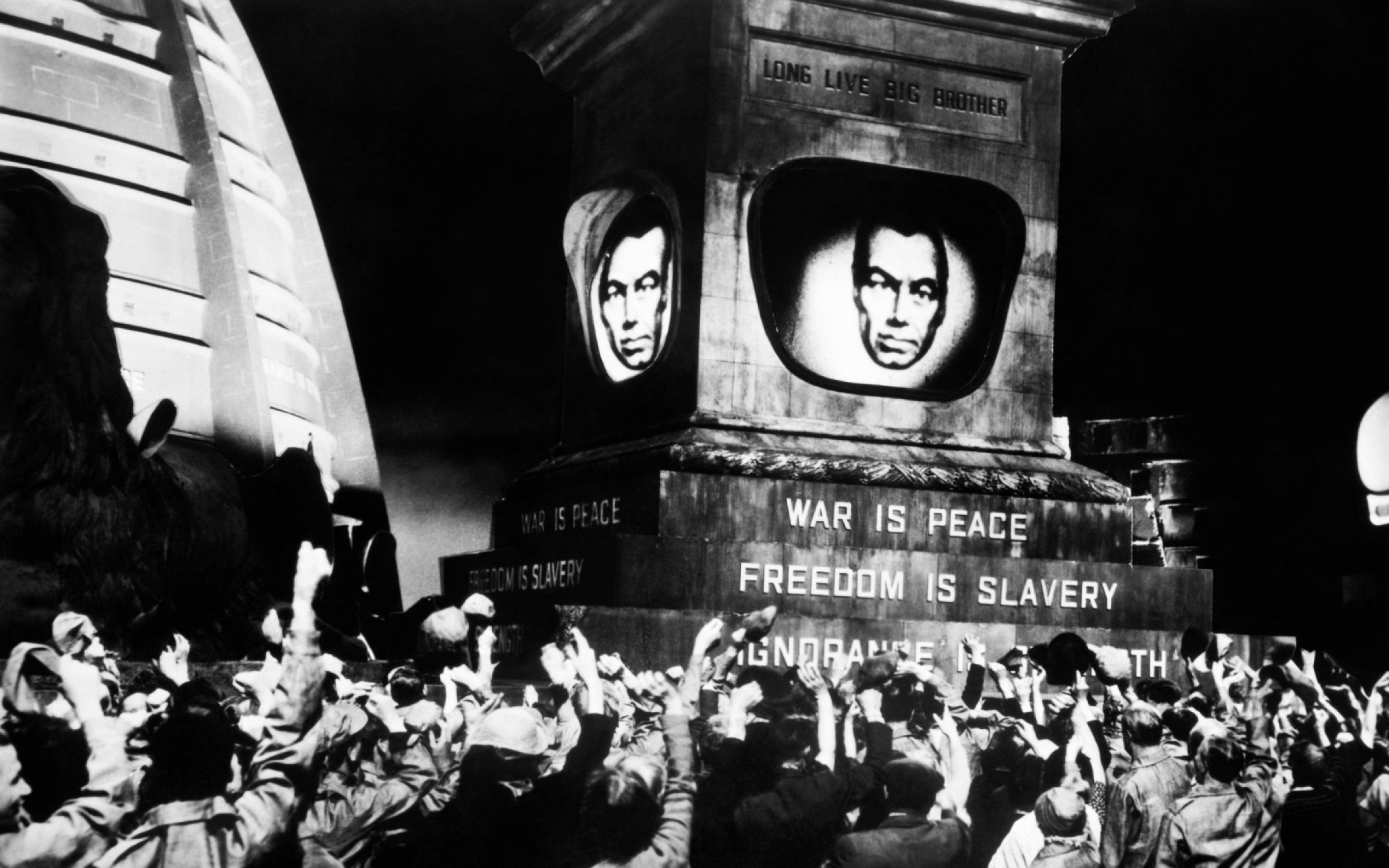
Still from a 1956 dramatization of George Orwell’s novel.
Orwell would not have stood with the side claiming to be “on the left” today. He was clever enough to sniff out even the softest totalitarianism. What progressives and social democrats seek is what Orwell named “Ingsoc” in his masterwork Nineteen Eighty-Four. Ingsoc is Newspeak, i.e., short for “English Socialism,” the totalitarian ideology that governs the fictional society of Oceania, where the Party holds absolute control over every aspect of life. Ingsoc is a distorted and perverted form of socialism, co-opted by the ruling Party to maintain its dominance. Although it uses the language of socialism, such as equality and collective control over the means of production, it is ultimately a system of extreme oppression where the people have no real power. This tells you what Orwell understood as the true meaning of socialism, and it was not what the progressives have on tap.
The defining feature of Ingsoc is its totalitarian nature, with the Party exerting absolute control over not only political and economic life but also the personal lives and thoughts of citizens. Under the leadership of Big Brother, a figurehead (likely a third-order simulacrum) who symbolizes the Party’s omnipotent power, every action is monitored, and dissent is crushed through manipulation of information, surveillance, and fear of what will happen if one doesn’t obey Big Brother. The Party’s control is so complete that citizens cannot even think freely; the Party manages not only their actions but also their very thoughts. The famous formulation of “2+2=5” does not merely represent the desire that the people repeat the “truths” of the regime, but that they believe them, and do so without hesitation. Acceptance of the Party’s line is to mimic reflex.
Ingsoc uses Newspeak, a language designed to limit the range of thought. By simplifying language and eliminating words that could facilitate subversive thinking, Newspeak prevents rebellion by removing the means to express dissent. This manipulation of language is coupled with doublethink, the ability to accept two contradictory beliefs simultaneously. These methods allow the Party to control the perception of reality itself. Citizens are taught to accept the Party’s version of truth, no matter how obviously false or contradictory it may seem.
This desire is exemplified in the Party slogans, such as “War is Peace,” “Freedom is Slavery,” and “Ignorance is Strength.” These exemplify the contradictory thinking the Party encourages. Likewise, the modern slogans and demands of today’s Party—“Transwomen are women,” the rebranding of discrimination as “diversity,” the exclusionary demands of “inclusivity,” all which invert reality, as well as fallacious claims that “speech is violence” and “words are weapons,” and the pursuit of speech codes, cancel culture, and deplatforming—is authoritarian desire achieved through the control of thought via the manipulation of language.
There are many parallels between woke progressivism and Orwell’s nightmare dystopia world of Oceania. In that world, the Party rewrites history, using the Ministry of Truth to continuously alter past records, ensuring that the Party’s narrative always aligns with the present power structure. By erasing or changing historical facts, the Party ensures that it can never be questioned, as there is no objective past to compare against. Ingsoc’s control over history is a key method by which the Party asserts its dominance over the people, as citizens are unable to look back at past events for clarity or understanding. The constant surveillance by the telescreens and the ever-present threat of the thought police make it clear that no aspect of life is beyond the Party’s scrutiny. Big Brother represents the Party’s absolute surveillance and control, symbolizing the fear that the Party instills in the Proles, reminding them that they are always being watched, even in their private thoughts. And, of course, those who deviate from the line are sent to the Ministry of Love for rehabilitation.
The way this manifests today is through the establishment of something along the lines of neuro-linguistic programming (NLP), albeit not explicitly. The core premise of NLP is that the way people use language shapes their attitudes, cognition, emotional state, and ultimately their behaviors. According to NLP, by changing the language patterns of individuals, it’s possible to shift how they think, feel, and act. For example, if children are likely to grow up with an understanding of gender as binary and immutable, which children have since time immemorial, and the goal is to interrupt that naturally emergent pattern, something like NLP can be deployed to, through techniques like anchoring and reframing, alter those patterns, which leads to changed attitudes, emotions, thoughts, and thus behaviors sought by elites. By altering language, elites reprogram popular responses to various situations.
One of the ways individuals are so reprogrammed is to confuse corporate statism and dependency on the government for democratic socialism. However, in Orwell’s novel, Ingsoc, while using the rhetoric of socialism, is not concerned with improving the welfare of the people. Instead, it’s an authoritarian system that seeks to maintain power at any cost. In Nineteen Eighty-Four, this power is sought for its own sake, much like the situation in the Soviet Union. If the corporate state context, power is sought to secure an endless source of profit and privilege for the capitalist class.
In either case, Orwell’s depiction of Ingsoc is a warning about the dangers of any ideology—whether left-wing or right-wing—hijacked by authoritarian rulers who manipulate it to justify repression. Through the Party’s totalitarian control, Orwell shows how ideologies are constructed serve the interests of those in power, leading to a society where freedom and truth are obliterated in the name of maintaining absolute control—for whatever end.
We see this today in the demand for obligatory use of preferred pronouns in government and public agencies. I just finished arguing with somebody on X who deployed all the Orwellian tricks to argue that compelling children to use a teacher’s preferred pronouns is not only fair but necessary in order to avoid discrimination—as if speech acts signaling the truth of things and situations can be discriminatory—as if it is not a fundamental violation of the child’s right to freedom of conscience and speech.
Is compelling children to speak the language of gender ideology for the sake of power itself? Part of it, for sure. There are people who delight in forcing or shaming others into affirming their delusions. We describe such person with several words—narcissists, sadists, sociopaths. And they need this affirmation since either they themselves know they are not what they claim to be or the constant reminder they are not triggers their dysphoria. But the other part of this is the source of profit and privilege children represents to corporate elite. It’s the same thing that feeds the pharmaceuticals and foods industries, and the toy companies. This is why elites are eager to put children on the path for physiological and morphological modification in the medical-industrial complex: the profits are massive and, since they make permanent medical patients of the individuals ensnared, sustainable.
Orwell was pro-working class, as I am and have always been. Orwell was a populist, deeply concerned with the welfare of ordinary people, and therefore he believed, as I do, that economic systems should be structured to ensure equality and fairness, as well as to have provisions of care for those who could not take of themselves. But, then, even a hardcore neoclassical liberal like Friedrich Hayek believed that the state had an obligation to take care of the elderly and the affirm. In the end, Orwell believed in the common man and his right to free conscience, speech, publishing, assembly, association, the right to keep and bear arms, privacy, and the rule of law—and the democratic-republican process necessary to change the law.
In the X debate I referenced earlier, Trump and Musk were portrayed as “fascists.” If in their collective guts progressives sense Trump and Musk as the enemy, it is because Trump and Musk actually stand closer to Orwell, whereas progressives stand closer to the administrative state and technocratic control over populations, which they do not only because we can see them, but because they admit to what we see. This is why they have no trouble compelling speech in public schools. What is “misinformation” and “hate speech” is the information they want corporations to censor because it undermines their authoritarian ambitions. They see indoctrination as education. They see technocracy as democracy. They’re fascists hiding behind the language of sympathy.
I have quoted this passage before, but it’s relevant here given what I just said. CS Lewis: “Of all tyrannies, a tyranny sincerely exercised for the good of its victims may be the most oppressive. It would be better to live under robber barons than under omnipotent moral busybodies. The robber baron’s cruelty may sometimes sleep, his cupidity may at some point be satiated; but those who torment us for our own good will torment us without end for they do so with the approval of their own conscience. They may be more likely to go to Heaven yet at the same time likelier to make a Hell of earth. This very kindness stings with intolerable insult. To be ‘cured’ against one’s will and cured of states which we may not regard as disease is to be put on a level of those who have not yet reached the age of reason or those who never will; to be classed with infants, imbeciles, and domestic animals.”
The culturally pluralistic kafir who believe removing pork from menus is inclusive of Muslims are sanitizing Western culture for the sake of a religious ideology. When this happens in public schools it contradicts the Establishment Clause. The text of the First Amendment is explicit—Congress shall make no law respecting an establishment of religion. But if you need a translation, it means that the government cannot establish an official religion or favor one religion over another. The First Amendment applies to federal, state, and local governments and agencies.
What about serving alternative meals for Muslims without pork? I guess, but that’s a slippery slope. How many religions have dietary restrictions? Buddhists generally avoid meat and meat-based foods. Hindus avoid foods believed to retard spiritual development, which include garlic and onion. Etcetera. With respect to Islam, Muslims forbid meat that is dead before butchering. You heard that right: the animal must be conscious and alive when the slaughtering takes place.
Inclusivity as conceptualized by woke progressivism has an anti-working class origin. Cultural pluralism is a transnationalist project. It was initiated by progressives early in the development of their movement. See for example the early twentieth century writings of Horace Kallen (you can find his 1915 Nation piece online without much trouble). Cultural pluralism, or what today we call multiculturalism, is designed to undermine assimilation and instead keep ethnic and racial groups in their boxes and subservient to the corporate elites.
The Tower of Babel
Cultural pluralism is analogous to the story of the Tower of Babel in the Bible where Yahweh, the Hebrew deity, confuses the speech of the masses to keep them from building a tower to get to heaven. In Genesis 11, we learn that the people had one language and a common speech. The deity came down to see the tower the people were building and said, “If as one people speaking the same language they have begun to do this, then nothing they plan to do will be impossible for them. Come, let us go down and confuse their language so they will not understand each other.” In the real world, organic intellectuals of the industrial class like Kallen colonized the administrative apparatus and established law and policy that disorganized the masses to keep them from developing class consciousness and politically organizing to achieve their right. (See An Architect of Transnationalism: Horace Kallen and the Fetish for Diversity and Inclusion.)
The transnationalists have been so successful that, today, assimilationism is portrayed as racist because it robs immigrants of their culture. Of course this is a false portrayal, but those conditioned to accept the explanations from the woke progressive ideologue feel it in their bones to be true. At the same time, robbing the indigenous peoples of Europeans of their culture (and livelihood) is not portrayed as racist. Quite the contrary—it’s portrayed as reparations and social justice. Indeed, Europeans themselves are portrayed as racist for celebrating and striving to preserve their culture, which the multiculturalist portrays as white supremacist.
This is why it’s so important to examine the motives of those who presume to tell you about justice. Who do they speak for? What is their ulterior motive? Well, look around you. What are the effects? Those with the most power produce the most profound effects. You don’t need smoking guns. You just need to understand cause and effect. When public policy is the cause, it’s not hard to determine why the policy looks like it does. Public policy doesn’t write and enforce itself. It’s written and enforced by people with power.
* * *
A related note on woke.
Without the social justice blacks used the term to refer to awareness of social and political issues affecting starting around the 1930s. The slogan was often “Stay woke.” It strictly meant an awareness of issues affecting black people. That was a useful exercise before the mid-1960s. What woke means today is radically different from this original meaning. Today it is the belief that there is a de facto hierarchy of oppression invented by various postmodernist epistemics (critical race theory, queer theory, postcolonial studies) in which white straight people and adjacents (such as Asians and Jews) are the oppressors and all the rest of the people—black, brown, trans—are the oppressed.
In this warped view of the world, oppressors are said to use individualism, free speech, perfectionism, rational thinking, timeliness, etc., as tools to keep down the oppressed. The oppressed therefore must wield group power based on identity (imagined communities) and feelings and confront reason and speech with suppression and violence. The woke are successful in this endeavor because the corporate elite have found woke ideology to be a powerful means for undermining political consciousness and class solidarity. The ruling class used to use racism to divide the people. They still do, but have flipped the hierarchy and added a growing number of other identity groups to the mix. It’s the way kings have maintained control of territories for millennia. It’s a very old model updated for our times.
As such, woke is antithetical to the democratic-republican and classical liberal foundation of the American Republic, which is based on individual, free conscience, speech, publishing, privacy and many other wonderful things. We see the perversity of woke in its atavistic, primitive, and tribalist notions of collective and intergenerational guilt and responsibility.
Incorporation refers to the legal doctrine under which the Bill of Rights, originally applicable only to the federal government, made applicable to state and local governments through the Fourteenth Amendment’s Due Process Clause. The First Amendment’s protections against government establishment of religion and free exercise of speech and publishing, which extends to state and local governments and agencies, indicates these rights preclude ideological symbols in public schools to avoid government endorsement of exclusive movement politics. To be sure, the principle of free speech selectively protect certain displays, depending on the context and purpose, but as a general rule, a government endorsement of exclusive politics is constitutionally problematic.
It is generally problematic for the government to endorse exclusive politics because it undermines principles of equal treatment and neutrality, which are foundational to democratic governance. While the Establishment Clause specifically addresses religion, broader principles of the First Amendment and equal protection indicate that government should avoid taking actions that appear to favor one political ideology over others, particularly in public institutions like schools and libraries. Moreover, the clear intent of the Establishment Clause covers conscience, as the Founders made clear in their pronouncements and writings—am intent explicitly stated in the United Nations Universal Declaration of Human Rights and the International Covenant on Civil and Political Rights. Such endorsements alienate individuals or groups with differing views, thereby compromising fairness and inclusivity. This displays must come down.
Florida is seeking to ban the display of Pride Progress, Black Lives Matter, and other political flags on government property.
To this end, Florida is seeking a ban on displays of Pride Progress, Black Lives Matter, and other political flags on government property. This is appropriate and necessary because government spaces, such as public schools and libraries, must be ideologically-neutral spaces if we are to have a free and open society wherein individuals are at liberty to develop their own opinions and feel free to express them.
A Pride Progress flag on the wall of a classroom put up by a teacher or an administrator is self-evidently government endorsement of a particular ideology. It would be the same if the Christian nationalist flag were hung on the wall of a classroom. It’s one thing for a student to express an opinion, and even have it appear on the wall of a classroom in a display where other students are allowed to express different and contrary opinion. But if a teacher or administrator endorses particular movement ideologies by posting their symbols, especially while restricting others, encouraging some expressions while discouraging others, then those have to be taken down and those endorsements sanctioned. Teachers and administrators represent the government. They therefore cannot impose their views on parents and students.
It may help to understand the importance of this point by imagining a Confederate or Nazi hanging on the wall of a public school classroom. To be sure, these particular flags can and should be shown in the context of a discussion about Nazi Germany or the Civil War. But to hang them on the wall to signal affirmation of the ideologies they represent would be scandalous. The public would rightly ask for them to be taken down. Why should it be different for any other ideology? It shouldn’t. Either that, or Nazi and Confederate flags can go up. I can hear the objection: “Are you seriously comparing the Pride Progress flag to the Nazi flag?” Yes, I am. Sincerely. BLM, too. All of it, except the American and state flags (which I will come to in a moment).
Such a law should not be controversy worthy. Ideally, it’s shouldn’t be necessary. If accomplished, Florida would simply be putting in positive law form the negative liberty articulated by the First Amendment—at its core the freedom of conscience and the principle of free expression. It’s a shame that it has had to come to this, but woke progressives don’t believe in ideologically-neutral spaces. They feel compelled by ideology to festoon our public spaces with their movement symbology. The desire to decorate public spaces in exclusive movement and political symbols has a clear intent: to push the ideology on children. Progressives want classrooms not to be centers of learning but of indoctrination. As George Leef observed in a recent National Reviewarticle: “One of the main goals of the so-called progressive movement, going back more than a century, was to capture our educational institutions and use them to shape the way people think.”
To advance their agenda, progressives feel they must instill in every successive generation woke ideology, and they need to get to future adults early in life to build in the foundational assumptions that will guide political decisions and ideological commitments. This is about turning America into something it is isn’t. Progressives don’t believe in individual rights and free minds. They believe in exclusive group rights, which means the interests of some groups must prevail over the interests of others, with many of the favored groups purely imagined communities. They don’t want free spaces where individuals can form opinions based on reason and freely articulate the results. That’s why they seek speech codes, required use of preferred pronouns, and all the rest of it.
An objection has been raised on social media that the American flag counts equally among other flags. We see the same objection over “cisgender” symbology, as if the gender binary and individuals displaying romantic attraction (and this includes homosexuality) is not the normal. The progressive goal is to make the normal exclusionary and objectionable. This is, of course, a core method of the queer praxis of transgressing normative boundaries—make the normal and ordinary problematic and strange. Calling a woman “cisgender” is propaganda aimed at socializing the false notion that there is more than one kind of woman. Calling a man a “trans woman” is propaganda aimed at socializing the false notion that a man can be a kind of woman. Suggesting that the American flag is an imposition in the same way a Pride Progress flag is follows the same queer logic. But the American flag is fundamentally different from movement flags because the American flag represents the nation as a whole—all the people—rather than a particular ideology, religious, or political standpoint.
Unlike movement flags, which symbolize specific and exclusive beliefs, causes, or groups, the US flag serves as a unifying emblem of collective national identity. The US flag is for all citizens, a nonpartisan reflection of the foundational principles of the constitutional republic—liberty, justice, and the rule of law. It represents our right as citizens, and this includes children, to be free from the imposition of a partisan group dominating a public space with the arbitrary approval of a government official. Just as queer (or most) parents would rightly not want the Christian nationalist flag hanging on the wall of his child’s classroom, parents would not want the Pride Progress flag hanging on the wall of their children’s classroom. This is the what the equality principle entails. This distinction is crucial when considering the purpose of public spaces like schools, which are designed to be ideologically neutral in order to establish ideal speech situations. Public schools are not indoctrination camps for the various social movements; they are politically partisan-free spaces for learning and developing the skills of critical thinking.
The presence of the American flag in public spaces does not violate the First Amendment because it represents the nation’s system of laws and rights for all, rather than any one ideological agenda for some against others. Movement flags violate the Constitution when displayed in public institutions as they signal affirmation of specific viewpoints, which contradicts the principle of state neutrality. The American flag is thus categorically different from movement flags because the American flag represents the nation as a whole—all of its citizens and people—rather than those of a particular ideological, religious, or political standpoint.
It’s a shame that all this is not obvious. It’s a shame that displaying of the US flag—or the flags of the various state required to establish a republic form of government, which is guaranteed to every citizens—in public spaces is an affirmation of shared national identity that values education and respects the sovereignty of the people as a whole, rather than an endorsement of any specific belief system. It’s a shame that people either cannot see that movement flags promote particular ideologies and policies, that their presence in public spaces represents government endorsement for those positions, which alienates individuals who do not share those perspectives. Of course, many do see this. Movement flags by design divide and function to antagonize. That’s the point—to chills the air of the space, to make parents and children who oppose gender ideology reluctant to speak against it for fear of reprisal. This is the effect of apparent state endorsement of movement politics. This is exclusive and unfair.
That we have to even have a law protecting our First Amendment rights testifies to the failure of our educational system, as well as the decades of woke progressive control over our institutions. But here we are. It must be recognized that progressives are at heart authoritarian. They do not believe in individualism but a hierarchy of group power. Since the authoritarians can’t help themselves (and don’t want to), we have to. The squealing betrays their motives.
“Of all tyrannies, a tyranny sincerely exercised for the good of its victims may be the most oppressive. It would be better to live under robber barons than under omnipotent moral busybodies. The robber baron’s cruelty may sometimes sleep, his cupidity may at some point be satiated; but those who torment us for our own good will torment us without end for they do so with the approval of their own conscience. They may be more likely to go to Heaven yet at the same time likelier to make a Hell of earth. This very kindness stings with intolerable insult. To be ‘cured’ against one’s will and cured of states which we may not regard as disease is to be put on a level of those who have not yet reached the age of reason or those who never will; to be classed with infants, imbeciles, and domestic animals.” ―CS Lewis
The meme is to social history what the gene is to natural history. A gene is passed from one individual to another by genetic means. The meme is an element of a culture or social system passed from one individual to another by imitation. They are like viruses in that they are contagious, infecting the weak minded; the weakened mind is the result not only of predisposition, but also of demoralized social contexts. However, to describe such memes as “mind viruses,” as we hear in the rhetoric from some on the libertarian right, is to my ears problematic.
People often forget—or perhaps never realize—that there are different forms of inheritance. One form is ancestry. Another form is wealth. With memes, the inheritance is cultural. Enculturation and socialization explain a great deal of attitude and behavior. This is obvious. Yet there is a double standard in the political space that grasps the obvious when explaining the behavior of one group, while denying it for another group. Perhaps out of frustration, this has led to the development of the idea of the “woke mind virus.”
Gad Saad, one of the progenitors of the “woke mind virus” concepts
On average, a black men is eight times more likely to murder than a white man. Is this genetic? Some believe it is. I don’t see the evidence for that. For the science of our times, the assumption is something of a nonfalsifiable proposition, which is to say that, presently, we are lacking an adequate method for showing that the greater likelihood of criminal behavior in the son of a criminal father is in any part genetic. Any man, black or white, may or may not mimic his relatives’ criminality. There are many false positives, so even if we could show this, what could we do about in a just society founded upon individualism?
Indeed, this may be something not even worth bothering with. As Michael Gottfredson and Travis Hirschi show in their general theory of crime (see Chapter 8 of their popular book by the same name), even if we generously suppose such a genetic inheritance, even with very large samples, the variance explained is near zero.
Gottfredson and Hirschi’s book is worth a read
But the son can inherit his criminality from his father through cultural transmission in the same way that the son can inherit criminality from his peers. Moreover, wealth inheritance is highly correlated with cultural transmission, as well, which is why crime is strongly correlated with the economic situation of families and communities. Perhaps we need to tease this apart from genetics, but we don’t really need to.
For sure, the cultural attitude that devalues law-abidingness is transmitted in social contexts. The less committed one is to obeying the law and social norms generally, the more likely he is to commit crime and other forms of deviance. Why progressives are obsessed with denying the facts of this truth for their favored groups is also memetic.
Early in my career as a criminologist, I denied the power of cultural transmission. I was wrong. Culture is powerful. Only the ideological deny this. My personal project is to get out of my head such ideological distortions.
To return to what I said early regarding “mind viruses,” i.e., the problem of those who conceptualize memetics as a kind of germ, propagating in spite of fact, logic, and truth, I don’t dismiss the idea, but rather dislike the metaphor, even while I use the construct of social contagion. I don’t like biologisms. My view is that they may lead to dangerous ends in the same way that fetishizing genetic inheritances led to eugenics.
Either way, the maxim is thus and valid: beliefs that survive aren’t necessarily good or true, and are moreover associated with groups. Put another way, memes that survive and their associated behaviors and rituals are neither intrinsically necessary nor rationally justifiable, and we must therefore judge groups on the basis of their memes.
Memes that support law-abidingness are to be promoted. Social contexts that support commitment to just laws and functionally-beneficial actions and tolerances are worth defending and preserving. We do this through laws and proper moral teachings. Memes that don’t support law-abidingness are to be recognized and discouraged openly and without hesitation.
Daniel Patrick Moynihan
We are presently living in a time where deviancy is tolerated. Daniel Patrick Moynihan’s mid-1990s thesis “defining deviance down,” published in Manhattan Institute’s City Journal, lays out the problem with this (this argument was also advanced a decade earlier in The Atlantic by George Kelling and James Q. Wilson in their “broken windows” thesis). The results of this perverse tolerance are all around us. We are told to be nonjudgmental. But the demand is often arbitrary and, in any case, invalid. We all judge others. And we should.
I don’t agree that the “woke mind virus” is communism rebranded. What Elon Musk is referring to is not communism but really the New Fascism that I have described on the pages of Freedom and Reason. It is progressivism. The mind virus that concerns Musk—and rightly so—exists in the context of corporate statism. It is an illiberal praxis. As George Orwell showed, communism as instantiated by Soviet-style socialism parallels many of the aspects of fascism, but to misdescribe it makes it harder to combat it, as it exists in the capitalist mode of production, a system that presents with a class structure very different from that of the Soviet Union.










 freedom and reason