
The GOP-controlled Tennessee House of Representatives voted yesterday to silence state representative and civil rights cosplay actor Justin Jones as the legislature meets for a special session on public safety spurred by a mass shooting at a Nashville school in March of this year. The shooter was a trans-identifying 28-year-old a Nashville resident Audrey Hale. She has no previous criminal record before opening fire at The Covenant School, killing three children and three adults. She left behind a manifesto which authorities have refused to release. Attention on the special session in which Jones spoke out of turn (the actual reason he was silenced) was heightened by recent mass shootings, one of which had manifestos that were immediately made public (see Diary of a Madman: The Role of Race in Lethal Violence).
Jones was as twice ruled out of order during debate Monday by Speaker of the House Cameron Sexton, automatically triggering a vote to silence Jones for the remainder of the day. The vote passed along party lines, 70-20. Democrats walked out in protest. “What is happening is not democratic. It is authoritarianism,” Jones said in as video shared on X (formerly known as Twitter). accusing Sexton of silencing him because the Democrat had earlier proposed a vote of no confidence against the Speaker (as if the House Speaker worried about that). Here is another video shared by Jones in which he claims his motive is to protect kids not guns.
Jones, like progressive Democrats generally, is going after guns even those the facts show that guns are not the cause of shootings. As I noted in yesterday’s blog essay Jones is engaged in a logical fallacy that disappears the person who is actually the agent or cause of shootings by implying that an inanimate object has agency. To understand why a person uses a gun to harm another person often requires a comprehensive study of the root causes of the phenomenon. In the case of Hale, we might get a better idea of why she killed school children if we would study the manifesto she left behind explaining her motive. However, in a much large proportion of gun deaths, the shootings are perpetrated by those immersed in drug trafficking and gang society. Part of the reason why guns and not those who pull their triggers are the focus is to obscure the problem of violence in black inner-city neighborhoods.

Let’s work through the facts. Based on recent statistics, the black population in Tennessee is 16.7 percent of the total. There were 744 homicides in the state of Tennessee in 2021. Blacks commit 52 percent of the homicides in Tennessee. Given that a known proportion of those perpetrators at 65 percent are male, with most of the 25.8 percent “sex unknown” almost certainly male, and moreover the offender age at 59 percent overwhelming under 30, we can say that young black men are drastically overrepresented in the perpetration of homicide in Tennessee. Since the police can readily identify the race of the victim, and since most homicide is intraracial, the fact that 68 percent of murder victims are black makes the determination of the “race unknown” category rather easy. That means that as much as 78 percent of homicides in Tennessee are committed by blacks—even though blacks comprise less than 17 percent of the population of that state.
Compare this to 21 percent of whites (do the same demographic breakdown, keeping in mind that the mean age of black males is much lower than it is for white males). Although the race of the perpetrator is unknown in 26 percent of homicide (because people kill and flee and cases remain unsolved), I think we have a good idea which race would be overrepresented in that large leftover proportion.


The numbers are much worse in the cities of Nashville and Memphis. There were 120 homicides recored by the Nashville Metropolitan Police Department in 2021. Of these, 46 percent were perpetrated by blacks, 12 percent by whites, with 43 percent “race unknown.” However, 68 percent of victim of homicide were black. Again, most homicide is intraracial, so the “race unknown” category is likely disproportionately black. Nashville has a population of 683,622, 27.2 percent of which is black.

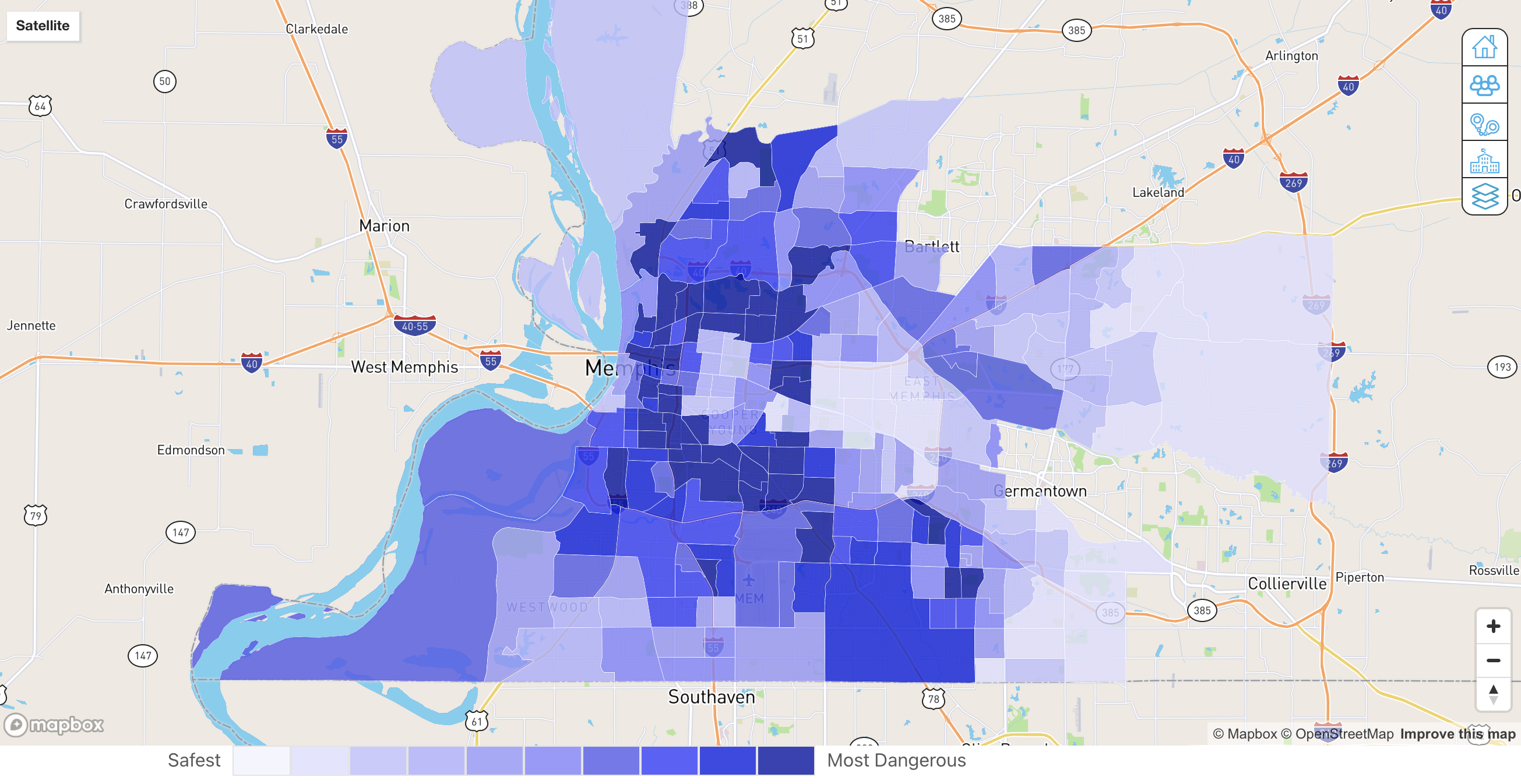
There were 327 homicides in Memphis recorded by the Memphis Police Department in 2021. Of these, 64 percent of homicides were perpetrated by blacks, whereas only 5 percent of homicides were perpetrated by whites, with the race unknown for 31 percent of perpetrators. Again, with 88 percent of homicide victims being black, the “race unknown” category is almost certainly mostly black. Memphis has a population of 621,056, 64 percent of which is black.
What explains these numbers? State representative Jones wants you to believe it’s guns. It can’t be guns. If it was merely the proliferation of guns, then not only would most murders and their victims be white, since whites comprise more than 78 percent of Tennessee’s population and, moreover, nearly 52 percent of Tennesseans have guns in their homes, but also because whites are far more likely to own guns than blacks (at least legally), as surveys over the last several decades consistently indicate. Yet it’s blacks who are perpetrating most gun homicides and who are most likely to be the victims of gun homicides.
The question that needs answering, then, is why are blacks, especially black males, so much more likely to perpetrate homicide? It seems rather racist to suggest that possessing a gun makes a black man more likely to kill another man. A black man is no more intrinsically impulsive than a white man. There is nothing in his genetics that would cause him to shoot at people after acquiring a gun. It must therefore be something other than his genetic makeup that finds him so drastically overrepresented in these statistics.
Is it poverty? No. Most poor people in Tennessee are white. There are 5,516,696 whites living in in the state. Of that number, 617,669 are poor (11.2 percent). There are 1,179,729 black Tennesseans. Of that number, 262,160 are poor (22.2 percent). This means that there are more than 2.354 times as many poor whites as there are poor blacks. Does it make sense to say that poverty affects blacks in ways it does not affect whites? Again, this sounds rather racist.
It’s not just a problem of disproportionalities in the statistics but absolute numbers. Leaving out the “race unknown” statistic, blacks committed at least 389 homicides, whereas whites committed at least 159 homicides. In terms of rates, that’s 345.15 per 100,000 for blacks compared to 31.4 per 100,000 for whites. That means the ratio of the homicide rates between blacks and whites is approximately 10.98, indicating that the homicide rate among blacks and the frequency of homicide perpetration is drastically higher compared to that among whites.
There is significant disparity between blacks and whites when it comes to single-parent families. Whereas 27 percent of white children live in a single-parent household, 71 percent of black children live in single-parent home. Most single-parent homes are headed by women. We know that single-parent families are largely associated with existence in inner-city urban areas where residents live in public housing and receive public assistance. Father absence is associated with public assistance, as well as higher rates of crime and violence. There is a cultural component to all this, not only in the single-parent household phenomenon, but in a milieu in which violence is normalized and experienced as an ordinary part of everyday life. This milieu is also associated with poor academic performance and poor labor force attachment.
The reality Democrats don’t want you to think about is the fact that the black population has been ghettoized over a period of many decades, a situation organized and sustained by progressive ale and policy. In other words, the very same politicians and policymakers who want to control guns are the same elites who created the situation associated with extraordinary high rates of gun and other violence. In order to cover for the results of their politics and policies, they want to deprive law-abiding citizens—black and white—of their firearms, their means of hunting, self-defense, and sporting activities.
Based on everything we know about gun homicide, it’s not gun ownership that’s the problem; the problem is a culture of violence associated with inner-city life organized by progressive politics and policies that undermine family structure, weaken self-discipline, and create and sustain an environment fostering the development and persistence of criminal networks involving traffic in drugs and stolen merchandise, conditions generating high rates of burglary, robbery, and other serious criminal offenses, and an associated gang life in which the ethic of tribal warfare reduces empathy and diminishes human worth.
There is moreover an associated popular culture that glorifies gang warfare and wanton violence, as well as an ideological system that misleads blacks into believing that the misery their attitudes and behaviors cause is somebody else’s fault, specially the whites whose targeting is then justified in light of rhetoric regarding reparation, systemic racism, and white supremacy.

 freedom and reason