
I think my favorite moment from the Oversight and Accountability Committee of the House of Representatives on July 19, 2023 was when Representative Timothy Burchett, who graduated with his undergraduate degree from the same university where I obtained my graduate degree, the flagship campus of the University of Tennessee, asked IRS whistleblower Joseph Ziegler (Agent X) how the harassment surrounding his exposing the conspiracy to protect President Joe Biden’s son Hunter Biden has affected him. In detailing his travails, Ziegler talked about his sexual orientation and his husband.
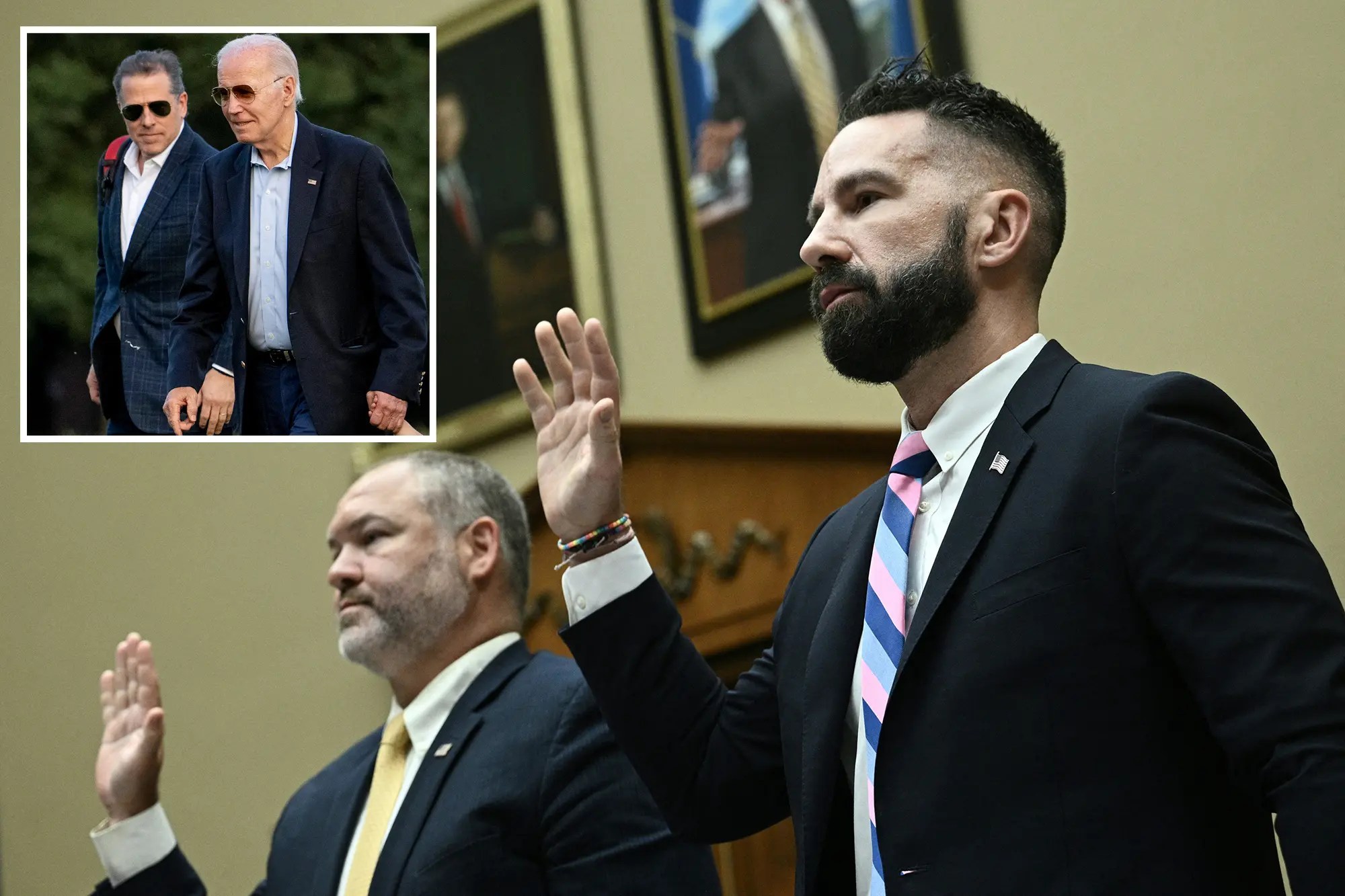
I had not known before then that Ziegler is homosexual. Of course, that doesn’t matter. People who know me know that doesn’t matter at all. Maybe not everybody knows me that well so there you go. But it did get my attention. Burchett, a good old boy from Tennessee, already knew this, assuming he had listened to Ziegler’s opening testimony (I missed that part of the hearing), but I appreciated very much that the congressman didn’t flinch in thanking Ziegler for his service to his nation and his devotion to the truth—and acknowledging what he and his husband had been through and expressing sympathy for their plight.
Here is what people don’t understand about the moment we’re in and the threat gender ideology—not a good old boy like Timothy Burchett—poses to the gay and lesbian movement. To be sure, before Obergefell v. Hodges (2015), Christian conservatives opposed marriage equality. But then so did leading progressives, including Bill Clinton, his wife Hillary, and Barack Obama.
To digress for a moment, Obama ran in 2008 on a platform opposed same-sex marriage. Why? Because “I am a Christian,” he said (Barack Obama: Doing the Lord’s Work). Obama finally supported marriage equality only a few years out from Obergefell. Obama’s change of heart came when it was clear that, if a case came before the Supreme Court concerning the matter, the court would rule it unconstitutional. Obama could see the writing on the wall; obsessed with his place in history, Obama got ahead of the decision. All those who say he only opposed it for political expediency (yes, Obama’s handler David Axelrod tried to take the fall for it) only testify to the shallow disregard Obama has for anything principled. For the record, Hillary Clinton didn’t change her position until well after Obama did—just in time to lose the presidency she was owed to Donald Trump.
Here’s the point: Once marriage equality had been achieved, conservatives (despite being Christian) left heterosexism behind, just as they had left white supremacy behind when the landmark civil rights act was passed during the 1960s. Indeed, with the end of segregation, southerners began their journey out of the party of segregation and into the party of individualism and limited government (see Republicanism and the Meaning of Small Government). These are the values that have always been at the heart of southern conservatism, anyway; that spirit is instinctively opposed to collectivism and big government. With the dismantling of racial hierarchy, there was no reason to associate with Democrats anymore.
“What’s about all this opposition by conservatives in the South to LGBTQ, then?” I can hear readers asking. Here we come upon an instantiation of the way progressives play the public, attaching the objectionable to the accepted and using the result to move the Overton window and then acting as if those who catch them are the bad people. The LGB part of the acronym is qualitatively different from all the rest of it. Sexual orientation is a natural fact; most humans are attracted to the opposite sex (necessary for perpetuating the species), but throughout history some humans are attracted to the same sex. Gender identity, in contrast, is an invention of a small number of sexologists, there crackpot ideas taken up and socialized by gender ideologues who use those ideas to normalize autogynephilia, pedophilia, and other paraphilias.
As gays and lesbians had substantially achieved equality rights, and the momentum clearly indicated that all major goals would soon be achieved, organizations such as the Human Rights Campaign enlarged their focus to perpetuate their bureaucracies and the benefits that accrue to them. Stonewall, the British LGBTQ+ rights organization did the same, including transgender issues in its mission and campaigns gained significant momentum in the early 2010s. Prior to this, Stonewall’s focus was primarily on advocating for the rights of gay, lesbian, and bisexual individuals. One of the major turning points came in 2015 when Stonewall launched its groundbreaking “Trans Rights Are Human Rights” campaign, demanding legal recognition of gender identity and corporate state policy focused on social inclusion, i.e., promoting trans-inclusive policies in public services, schools, and workplaces.
This phenomenon is often referred to as the “Iron Triangle” or “Issue Network” theory. According to the theory, certain interest groups develop a self-sustaining inertia or momentum due to such factors as financial interest, job creation, and political influence. The close and often cozy relationship between three key actors in the policy-making process, government agencies (executive administrative bodies), legislators (congressional committees), and interest groups (lobbyists) form a mutually beneficial and influential alliance, with powerful forces working together to advance their shared interests. The relationships within the iron triangle can lead to a significant impact on policy decisions, sometimes at the expense of the broader public interest. The Issue Network theory is an extension of the iron triangle concept, recognizing that policy-making involves a more complex web of actors beyond the traditional three (bureaucracy, legislators, and interest groups). In an issue network, multiple actors, including think tanks, advocacy groups, experts, media outlets, academics, and even the general public, engage in a broader discussion around a specific policy issue.
Here’s how it works. Interest groups advocate on behalf of specific causes and seek favorable laws, policies, and regulations that benefit their members. They often have significant financial resources and a strong influence over politicians and policymakers. Congressional committees and executive branch agencies responsible for implementing and enforcing laws, policies, and regulations are brought into the fold. Over time, they develop close ties with specific interest groups, seeking their input and expertise when developing policies. These committees play a crucial role in shaping legislation. They may develop working relationships with interest groups to gain insights into complex issues and receive campaign contributions, which can help them secure re-election. The role of corporate power in all of this ESG, etc. Through this iron triangle, interest groups can have a long-lasting impact on policies and regulations, even when they are nonprofit organizations. The relationships and influence they build with government agencies and congressional committees can perpetuate their existence and allow them to continue advocating for their interests effectively.
Neither articulation can by itself adequately capture the dynamics to explain fully why a special interest group changes or expands its mission to perpetuate its existence. To fully understand this we need to consider the following concepts. First, mission creep or drift for survival. Special interest groups face challenges in maintaining their relevance and financial viability over time, especially after they achieve their objectives. As the political climate, public opinion, and policy priorities shift, an interest group’s original mission may become less influential or less attractive to potential donors. To survive and continue receiving support, the group broadens its mission to encompass related or tangential issues that are currently more prominent.
Thus expanding the mission can be a strategic move to increase the group’s influence and broaden its base of support. By addressing multiple issues, an interest group can appeal to a broader coalition of stakeholders, thereby increasing its political power and fundraising potential. Members and stakeholders of an interest group push for an expanded mission to align with changing objectives or to address emerging challenges in their field, what is coded as “staying relevant.” Additionally, external pressure from competitors or opposing interest groups may necessitate a change in focus to maintain a competitive edge. Special interest groups often rely on financial contributions and resources from their members or donors; to secure ongoing funding, they modify their mission to align with the interests of their major donors or to attract funding from a more diverse donor base. As policies and regulations change, special interest groups adapt their mission to capitalize on emerging opportunities. Expanding the mission enhances the group’s legitimacy and reputation, making it appear more inclusive and responsive to a broader range of issues.
Conservatives accepted marriage equality. They do not accept gender ideology, which tells them men can be women thus opening a stream of raw commodities for the medical-industrial complex to stamp out synthetic sexual identities. It is the gender ideologues who insist that entirely disparate groups of people must be treated the same and push either for the destruction of sex-segregated spaces (which have zero relationship to the practice of segregating spaces by race) or the selective violation of those spaces by delusion individuals who imperil the achievements of the LGB community. If progressives cared about defending gay liberation, they would decouple from the pathological developments represented by the transgender phenomenon and the queer ideology.

 freedom and reason