
“Congress shall make no law respecting an establishment of religion, or prohibiting the free exercise thereof; or abridging the freedom of speech, or of the press; or the right of the people peaceably to assemble, and to petition the Government for a redress of grievances.” —First Amendment to US Constitution.
“Everyone has the right to freedom of thought, conscience and religion; this right includes freedom to change his religion or belief, and freedom, either alone or in community with others and in public or private, to manifest his religion or belief in teaching, practice, worship, and observance.” —Article 18 of the UN Universal Declaration of Human Rights
“Everyone has the right to freedom of opinion and expression; this right includes freedom to hold opinions without interference and to seek, receive and impart information and ideas through any media and regardless of frontiers.” —Article 19 of the UN Universal Declaration of Human Rights
The Rowling quote below brings us home to the rights those living in free societies necessarily possess—necessary if we are to keep our societies free.
As I pointed out in a previous essay using Scientology as an analog (see Dianetics in Our Schools), a man is in a free society able to say without consequence that there is such a thing as a “thetan,” which in his religious system is the authentic self of the individual. A man is free to undergo auditing in order to reveal his authentic self. To be sure, auditing is a bit less analogous to procedures used by the medical-industrial complex to sterilize children and create lifetime clients, but I trust you get the point.
Above is Addison Rose Vincent, the man who appeared on the Dr. Phil Show (January 19, 2022) who couldn’t answer Matt Walsh’s straightforward question about the definition of woman, i.e., an “adult human female.” Perhaps the most useful thing about this video, if you can pay attention to the words, is that you should now be able (if you weren’t before) to immediately detect those around you who’ve bent over for the gender cult. “Y’all,” “folx,” and several other stick-your-finger-down-your-throat-and-vomit terms are covered here.
The United Nations webpage on “gender-inclusive language” states: “Using gender-inclusive language means speaking and writing in a way that does not discriminate against a particular sex, social gender or gender identity, and does not perpetuate gender stereotypes. Given the key role of language in shaping cultural and social attitudes, using gender-inclusive language is a powerful way to promote gender equality and eradicate gender bias.” Note the constructs “social gender” and “gender identity.” Note the admission that language plays “a key role of language in shaping cultural and social attitudes.” Note that the United Nations has adopted gender ideology and its framework for speech regarding sex and gender.
Gender-inclusive language is more than nauseating virtue-signaling. Especially when imposed by law and policy, and especially in public institutions, gender-inclusive language is compelled speech designed to force individuals to accept an ideology to which they may not subscribe—indeed, ideology they oppose (and should oppose). Compelling individuals to use such language forcibly includes them in a group to which they neither belong nor wish to associate. It’s the same as making people affirm the slogan “There is no god except Allah and Muhammad is His Prophet.” (See NIH and the Tyranny of Compelled Speech; The War on Fact and Reason: More on the Problem of Compelled Speech.)
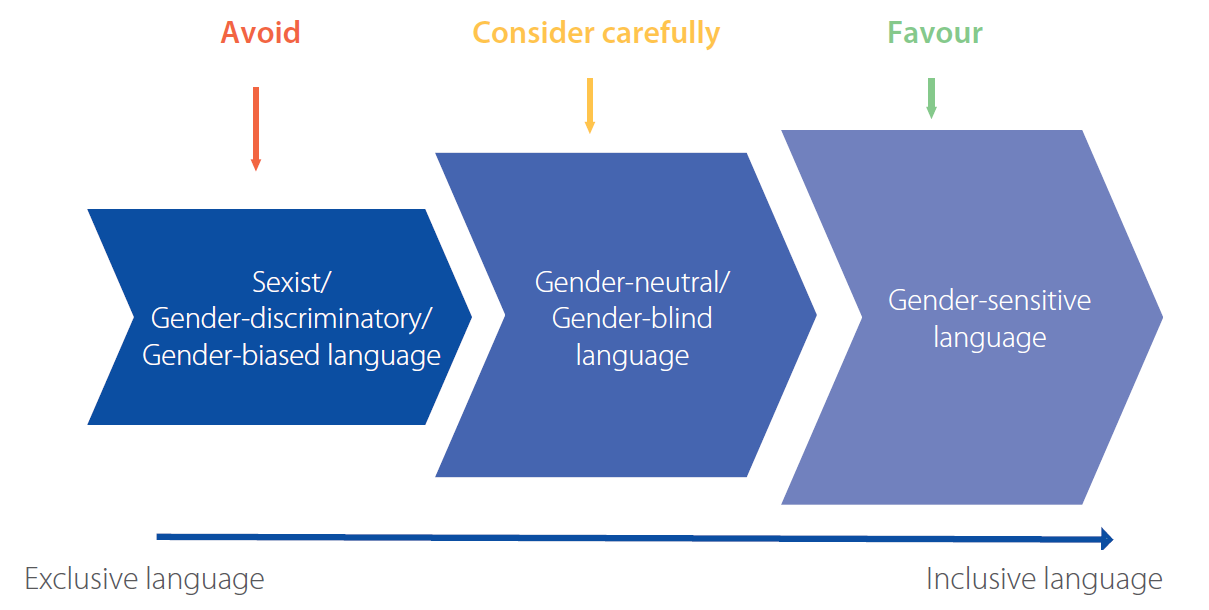
When the government imposes the language of an ideology, such as gender ideology/queer theory, on a population it’s behaving as a theocracy—just as much as it would be if it mandated citizens to use the assumptions and doctrines of Scientology or Islam. Not like a theocracy. As a theocracy. In these cases, the people are no longer citizens of a free society but subjects under the tyranny of an exclusive ideological system. As I have covered in numerous essays on Freedom and Reason, administrators are forcing people to undergo diversity training in which they have to learn the doctrines and repeat the scriptures of gender theory. (See There’s No Obligation to Speak Like a Queer Theorist. Doing so Misrepresents Reality.)
As such, compelled speech is a violation of the fundamental rights identified in the First Amendment to the US Bill of Rights, most obviously transgressing our freedom of conscience, speech, and association. It also violates Articles 18 and 19 of the Universal Declaration of Human Rights. These items, posted at the top of this essay, are among the most fundamental laws in Western society.
I reject gender ideology for the same reason I reject Scientology, Islam, and other religious systems and their crackpot ideas. Like those systems, gender ideology/queer theory is based on nonfalsifiable constructs, constructs invented by gender ideology (e.g., “gender identity”), as well as advancing a purported system of ethics, one demanding individuals to use the language of the state religion, a language designed to confuse ordinary understandings of gender.
The language of gender ideology/queer theory by its own lights is meant to disrupt normal understandings and replace them with a new doctrine that limits our ability to communicate ideas and exist freely in a relationship with objective reality. It is what George Orwell called “Newspeak” in his 1949 novel Nineteen Eighty-Four, his warning about about totalitarianism. Read it if you haven’t. Tell others what you found there. Organize resistance to this tyranny.
Gender-inclusive language is not actually inclusive, since it intentionally excludes the identification of discriminative relations fundamental to human society, such as father and mother, by removing from normative language such terms such as “dad” and “mom,” classes of people who differ from the other categorically. Moreover, the function of gender-inclusive language is to erase relations critical to the preservation of traditional cultures. We see this, for example, in the construct “Latinx,” which means to replace Latino, i.e., men and all Hispanics, and Latina, i.e., women, with a neologism robbing Hispanics of the gendered language they have used for centuries. (So much for multiculturalism.)
This is a totalitarian project and you have every right to resist it—and you ought to resist it. If we let governments impose an ideological language on us, they will control our thoughts, and we will no longer be a free people. The spread of the gender cult is an existential threat to freedom.
* * *
In a forthcoming essay, I dive deeply into sexology and queer theory and expose the pseudoscientific character of efforts to undermine scientific materialism and normalize the sexualization of children. Perhaps the best example of this deceit is the artificial separation of the terms sex and gender, terms that are synonymous.
John Ray in Methodus Plantarum Nova (1686) used the term “gender” to describe the different sexes of plants. Carl Linnaeus, who developed the binomial nomenclature system for classifying organisms in his Systema Naturae (1736) also used the term to refer to the sexual characteristics of plants, treating them as male or female entities. Charles Darwin, in both The Variation of Animals and Plants under Domestication (1868) and The Descent of Man, and Selection in Relation to Sex (1871) used gender and sex interchangeably to describe the biological differences between male and female individuals in various species, including plants and animals.
In the 1960s, psychologist Robert Stoller drew a distinction between gender and sex (see Sex and Gender: On the Development of Masculinity and Femininity, published in 1968). It was Stoller who proposed the concept of “gender identity” to describe an individual’s internal sense of their own gender, which may or may not align with their “assigned sex,” another construct of sexology. Psychologist and sexologist John Money played a significant role in popularizing the concept of gender identity through his work on gender development and his own construction “gender role,” presented in his 1972 Man and Woman, Boy and Girl: The Differentiation and Dimorphism of Gender Identity from Conception to Maturity. Money emphasized the social and psychological aspects of gender, arguing that it is not solely determined by biological sex.
That the term “sex” is typically qualified with “biological” by those advancing these ideas tells you that they assume (correctly) that sex is not strictly biological. One can just as easily talk about “sexual identity” and “sex roles” as one can about gender identity and roles. The terms are interchangeable. They use the term gender to construct these terms because they are perpetrating an ideological action designed to separate gender from sex in the popular mind in order to argue that a male (sex) can be a woman (gender). Is a man is an adult human male, then he cannot be a woman by definition. This is the basis to turning to the tautological definition that asserts that a woman is a person who identifies as such (see Scientific Materialism and the Necessity of Noncircular Conceptual Definitions). That this requires sex to be biological reductive and gender to be disconnected from biology is a trick to make the tautological sound scientific.
Prior to the redefinition of gender by a small group of ideologically-driven sexologists in the late 1960s and early 1970s, Title VII of the Civil Rights Act of 1964 was passed. The law specifically prohibited employment discrimination based on sex, which is obviously more than gametes, since the problems the act sought to address were discrimination and sexual harassment based on gender stereotypes. This provision aimed to address gender-based employment discrimination and promote equal opportunities for men and women in the workplace. Although gender does not appear in the law, sex is clearly presumed to cover sociocultural matters in the law. The inclusion of sex as a protected category in the Civil Rights Act represents a significant step towards combating sex-based discrimination in various areas of society. It provides a legal framework for challenging discriminatory practices and promoting equality in the workplace.
That equality is conceived of in terms of equity with respect to sex, which involves the recognition of grouped sex-based differences, thus justifying differential treatment to combat disparities that result from the organization of human societies around sex differences, is found in the relationship between the Civil Rights Act of 1964 and athletics in schools, primarily revolving around Title IX of the act. Title IX prohibits sex discrimination in education programs or activities receiving federal financial assistance. While Title IX covers a wide range of educational aspects, including admissions, treatment of students, and employment practices, it has had a significant impact on athletics in schools.
Under Title IX, educational institutions are required to provide equal opportunities for both male and female students to participate in sports and other athletic activities. Schools must ensure that their athletic programs offer equitable benefits, opportunities, and resources to both genders. This means that schools must provide equal funding, coaching, facilities, equipment, scheduling, and other support to their female and male athletes. Title IX has thus played a crucial role in promoting gender equity in school athletics. It has helped increase female participation in sports and address historical disparities and discrimination faced by female athletes. Schools and educational institutions must comply with Title IX regulations to ensure they are providing equal opportunities and treatment for all students interested in athletic participation. But today, the goals of equity are threatened by gender ideology. (See The Casual Use of Propagandistic Language Surrounding Sex and Gender; Is Title IX Kaput? Or Was it Always Incomprehensible? Why Are There Sex-Segregated Spaces Anyway? NPR, State Propaganda Organ, Reveals Who and What have Captured the State Apparatus.)
* * *
The same set of rights—conscience, speech, press, and association—that allows people to believe and speak and write about and gather to recognize ridiculous things at the same time gives others the right to deny and criticize, even condemn and organize against those things. It obligates all sides to tolerate the opinions of others, of course, but it’s also supposed to prevent some from imposing one others those ridiculous ideas and practices; the same rights that make it possible for one person to believe in absurdities is supposed to make sure other persons don’t have to.
At least this is the way it’s supposed to be considering the fundamental laws of the nation. That governments have moved to impose upon all of us what is clearly a quasi religious ideology, that is gender ideology, in the face of our right to be free from such an imposition is the surest indication that we exist in a totalitarian situation.
Let me put this as bluntly as I can: If you, the reader, can’t see that, then you’re a proponent of totalitarianism. You have an authoritarian mind. Don’t talk to me about civil and human rights if this is your mind. You openly abandon the principle of civil and human rights when you seek or support consequences for me when I resist ideology. I don’t want to mince words: you have become a fascist. That makes you my enemy. And this is where tolerance ends.

 freedom and reason