

The FAR Podcast: Explaining the Overrepresentation of Blacks in Crime
Subscribe to my YouTube Channel!

Update! See video at bottom!
“Belief in witchcraft didn’t disappear because science disproved it, but because it ultimately became something people couldn’t take seriously in the world of everyday life. Right now people take race seriously, they think it’s something that nature has bestowed.” —Barbara Fields.
“You have to actually start opposing the categories of race if you want to transcend the hierarchies and caste systems they impose.” —Thomas Chatterton Williams.
In a April 19 letter, “American Humanist Association Board Statement Withdrawing Honor from Richard Dawkins,” the AHA states that “Richard Dawkins has over the past several years accumulated a history of making statements that use the guise of scientific discourse to demean marginalized groups, an approach antithetical to humanist values.” On this basis, the AHA rescinded Dawkins’ 1996 Humanist of the Year Award.
I have not in the past been particularly fond of Dawkins and his reductionistic neo-Darwinian standpoint. For reference, see my 2013 blog Dawkins, Liberalism, and the New Atheism, as well as the text to a 2009 conference presentation The Myth of Extraordinary Evil in which Dawkins is mentioned. I have also defended him: Muslims are Not a Race. So why are Academics and Journalists Treating Them as if They Were?. As a humanist, I find the actions of the AHA deeply troubling. So I will defend Dawkins again.
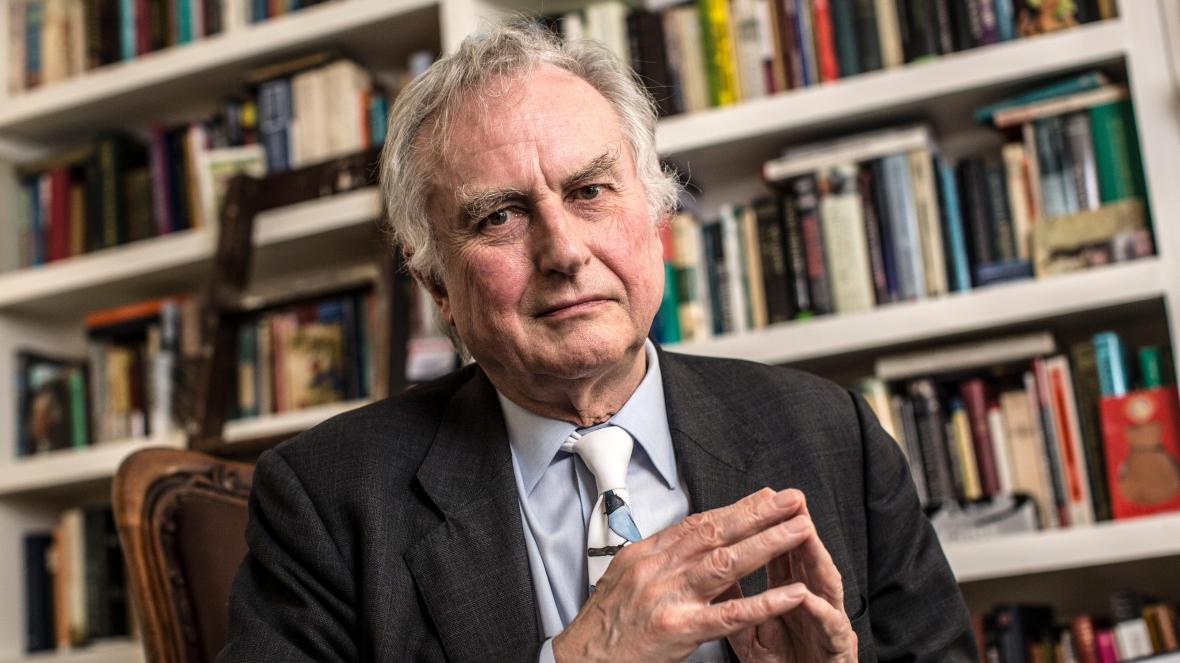
In discussing the controversy, I necessarily delve into the substance of these matters. Your patience and tolerance is greatly appreciated. I should emphasize (even though I shouldn’t have to) the difference between, on the one hand, agreeing with a man’s thesis, and, on the other hand, defending his right to advance his thesis without consequences. I should also remind readers (even though I shouldn’t have to) that, as a left-libertarian, I have no desire to stop persons from identifying as any gender they wish or no gender at all. I write about these things because I am dissatisfied by the answers to the questions such matters raise. In any case, as I hope will become clear, this essay is really about race, not about gender.
Humanism is system of thought emphasizing the practice of apprehending the world through rational and rigorous methods, with attention to empirical evidence and interrogating this apprehension in open dialogue. It is antithetical to humanist values to subordinate free thought and inquiry to ideology. It seems therefore that, in light of its decision to retroactively cancel Dawkins, the American Humanist Association is effectively not a secular humanist organization at all but an organization interested in adhering to a consensus reality authored by the Woke crowd and punishing those who deviate from its political-ideological line.
Attempting to cancel a biologist for addressing an issue about which he is preeminently qualified—sex is a biological matter and gender is only relatively independent of sex—is a clear indicator that the AHA is more concerned about gender ideology than about defending the principle of rational interrogation of claims made about reality. Whether its stand is because these politics have been taken to heart, or it is out of fear of the mob, it is either way an unfortunate development.
First, the AHA accuses Dawkins of using scientific discourse as a guise to demean marginalized groups. What evidence is there that Dawkins is being insincere? (I provide his tweet above for your consideration.) Second, the AHA has the matter precisely backwards. Humanism elevates the value of scientific discourse above those derived from other sources. A proper humanist would never prioritize the feelings of a marginalized group over the pursuit of the truth.
Why should the feelings of the marginalized be more sacred than the feelings of the majority? That sounds like religious dogma to me. Why is it okay for a trans person to feel erased by language denying that trans women are women but not okay for women to feel erased by language denying that there is no difference between men and women? Is this sides-taking warranted? On what rational grounds? For another thing, subordinating the pursuit of the truth to subjective feelings is a tactic used by authoritarians to silence debate and discussion.
Yet, without irony, the AHA argues that Dawkins’ “latest statement implies that the identities of transgender individuals are fraudulent, while also simultaneously attacking Black identity as one that can be assumed when convenient.” (Note that “Black” is capitalized. That is not an error. It answers the question of whether wokeness has been taken to heart. The AHA is working from decided conventions and slogans.)
By accusing Dawkins of suggesting that transgender individuals are fraudulent because Rachel Dolezal (aka Nkechi Amare Diallo), arguably the most notorious instantiation of transracialism, has been portrayed by the media and Woke activists as a fraud, the AHA is shirking the hard work of understanding Dolezal’s situation and taking on the problem of transracialism. The AHA is presuming as proved that which requires proving.
It is not difficult to provide a compelling explanation for Dolezal’s racial identification. The fact that Dolezal’s siblings (four of them) were black likely affected her own sense of racial identity. Identity is, after all, learned. Identity is the result of socialization. Dolezal came to identify more with their race than her own.
The Economist, in a June 2015 essay “Blurred Lines,” details Dolezal’s biography—her black husband, her Howard University education, her stint as president of a NAACP chapter—and concludes, “It’s hard to doubt her commitment.” Indeed. She continues to identify as black. Race is a social construct certainly no less than gender (really more so, since sex is a biological matter). Dismissing a complex matter as “fraudulent” is intellectually lazy and, moreover, presumptuous. It uncritically accepts a line of attack by those who advance the cause of race essentialism.
What does it mean to say that race is a social construct? Race is constructed by the ideology and system of racism. The phenomenon operates at two levels. The first is the ideology of racial classification and associated hierarchy. The second is social segmentation based on this ideology—or justified by it. Race does not exist apart from ideology and social system. Since the system of racism has been dismantled, it arguably exists now only as an ideological entity. One thing is for sure, however: in the typographic terms developed by racial science, race is not a natural historical category. It is not a discovered thing. It is an invented thing, a social and cultural imposition. Moreover race is a recent development. Emerging with capitalism, it was designed or at least functioned to control the working class by dividing workers along artificial lines and refocusing their discontent on something other than their common economic position.
Race was consciously created by the capitalist class in a dynamic Barbara and Karen Fields have usefully termed “racecraft.” The Fields argument is that race is a classification created by racism, an ideology that supposes the human species is meaningfully differentiated based on ancestry and phenotype. Colonial powers wrote laws defining and dividing populations and developed an ideological system that rationalized exploitation in terms of innate racial differences. Given this, instead of reifying race by treating it as a fixed and objective things, one should instead ask why those who claim to be moved by the demands of social justice are so keen on maintaining the system of racial caste by mocking, ostracizing, and punishing those who seek either to identify as a different race or as no race at all.
As if this wasn’t obvious (and for many it isn’t), critical race theory and gender ideology are crackpot theories that work at cross-purposes with the Marxist method of historical materialism and those engaged in class analysis and struggle.
Dawkins is pursuing a rather obvious problem prompted by his acceptance of the scientific materialist worldview: Why, if a person can deny her genotype, as in the case of asserting a change in gender or abandonment of gender altogether, and even in some cases the reality of sexual dimorphism, can she not also deny a classification developed on the basis of arbitrary and socially-selected phenotypic traits, namely race? (This is apart from the distinction between identity and identification. There is what one thinks of oneself and then there is what others think of him. And whether he passes. Dolezal passes.)
Whether citing similarities or differences between gender and race, there is a burden to show why switching or abandoning races is disallowed. It will not do to merely note opposition to transracialism by some black people. Some black people do not circumscribe speech or determine truth. Opposition to transgenderism by some women is dismissed as valid grievance. Indeed, women who oppose transgenderism are referred to a TERFs (transexclusionary radical feminists), and they—and anybody else who raises questions—risk a diagnoses of transphobia.
For the woke, Dawkins isn’t even allowed to ask the question.
An article for the feminist philosophy journal Hypatia by chair of philosophy at Rhodes College Rebecca Tuvel could have served as a warning to Dawkins.
In her article, Tuvel argues that “since we should accept transgender individuals’ decisions to change sexes, we should also accept transracial individuals’ decisions to change races.” Finding that there is no objective difference between the categories—that is, neither gender nor race are biological based (an arguable assumption)—it follows that “one’s ‘actual’ race is a matter of social definition.” Tuvel determines that “we treat people wrongly when we block them from assuming the personal identity they wish to assume.” (In her article, she knocks down four arguments uses against transracialism that could be used against transgenderism: whites do not suffer racism, reckoning of ancestry, harm to blacks, and expression of privilege.)
One might have expected that Tuvel would get credit for advancing the transgender cause, but by also advancing the transracial cause, she offended transactivists. She was accused of, to use a mouthful from Nora Berenstain from the University of Tennessee (from where I received my doctorate, by the way), “egregious levels of liberal white ignorance and discursive transmisogynistic violence.” Berenstain wondered where the black transwomen philosophers were in her references (at the time, there were only around a dozen professional black philosophers in a field of more than ten thousand). Berenstain was furthermore upset because Tuvel “deadnamed” Caitlyn Jenner, and her references to male-to-female transition promoted “the harmful transmisogynistic ideology that trans women have (at some point had) male privilege.”
A majority of Hypatia’s editorial board apologized for publishing the article, there were resignations (including the editor-in-chief), and the journal was restructured. Fortunately, Tuvel enjoyed wide support in the academic community. In the end, the attempt to cancel her failed. So will the attempt to cancel Dawkins.
I come back to this question: Why are antiracists so insistent that persons must remain identified by arbitrary classifications assigned at birth? And I have several additional questions: Why do those who act as if they want to radically expand personal freedom insist on attaching to those who wish to jettison an imposed identity that risks oppression? If being white is a privileged status, as the antiracists tell us, then why deny a black person access to a white identity? Will blacks will soon be allowed to identify as white (why would they, given the way in which whiteness is portrayed as the cause of all misery in the world?), with whites not having the option because, you know, the direction of power? If race switching erases race, why would that be a bad thing? Shouldn’t humanists be for the emancipation of individuals from the oppressive system of racial classification—just as they for the emancipation of individuals from the oppressive system of religious classification? Race is, as Fields tells us, an ideology. Why would one make the desire of a white woman to be a black woman a matter of “convenience”? Given that blacks are chief victims of systemic racism, why would people choose to subject themselves to such oppression?
What if Dolezal feels that her desire identify as a black women is her authentic self? I have had it put to me that a white person could not know what it feels like to be black, that worldview is tied to skin color, as if white identity is some substance that squirts out of a person identified as whites—and that substance allows in no blackness. How could we know whether this is true? The answer is circular: because the white person is white. How about because we are our bodies? If we are secular humanists, it is not as if we subscribe to souls.
Why is this not true for gender, then? How can a man know what it feels like to be a woman? If a white person cannot be black because white privilege is inescapable, then how is male privilege escapable? We allow men to escape but not whites? Are those able to detect authentic selves along lines of gender unable to detect authentic selves along the lines of race? Perhaps the science of the authentic self should be specified so we can explore the possibilities.
There is a deep scientific problem here that cannot be skirted by noting that there are some who take offense to starting the problem and, as best I can tell, after weeding out the postmodernist jargon, that is the only objection. I remain open minded, but I need a rational justification. By what authority are we disallowed from asking scientific questions? The Christian church? The Woke Church?
As for the moral question, as I understand it, while struggles remain, the transgender question is largely settled. No less a power than the United States government is behind the movement. If the principle at the core of the movement is that people should be in control of their identity, then who is anybody to tell Dolezal that she is not really a black woman (or a black man) if that’s how she feels?
The attack on Dolezal was vicious. Imagine calling a man “crazy” for thinking he is a woman. But that’s different, we are told. Why is the race lane so fixed? What exactly is the science here? I have yet to hear a compelling reason for why a person must identify as a particular race. Is that why one is not supposed to raise the question? (For more, see Adolph Reed, Jr.’s From Jenner to Dolezal: One Trans Good, the Other Not So Much, in Common Dreams.)
* * *
Update!
If the public only hears about white men perpetrating mass murder and never hears about black men perpetrating mass murder, it is likely that some portion of the public will come to believe that mass murder is an exclusively white male phenomenon. What they wouldn’t know is that, excluding gang killings, according to data posted by Statista, the racial distribution of mass shootings from 1982 through March 2001 shows that whites are underrepresented in mass murders. Whites are 76 percent of the US population. Excluding Hispanics, the US population is 69 percent white. If we include Hispanics in the white demographic (which artificially enlarges the white population, since not all Hispanics identify as white), and exclude other and unknown race or ethnic identity, whites commit 68 percent of mass murders. If we exclude Hispanics, 59 percent of mass murders are committed by whites.
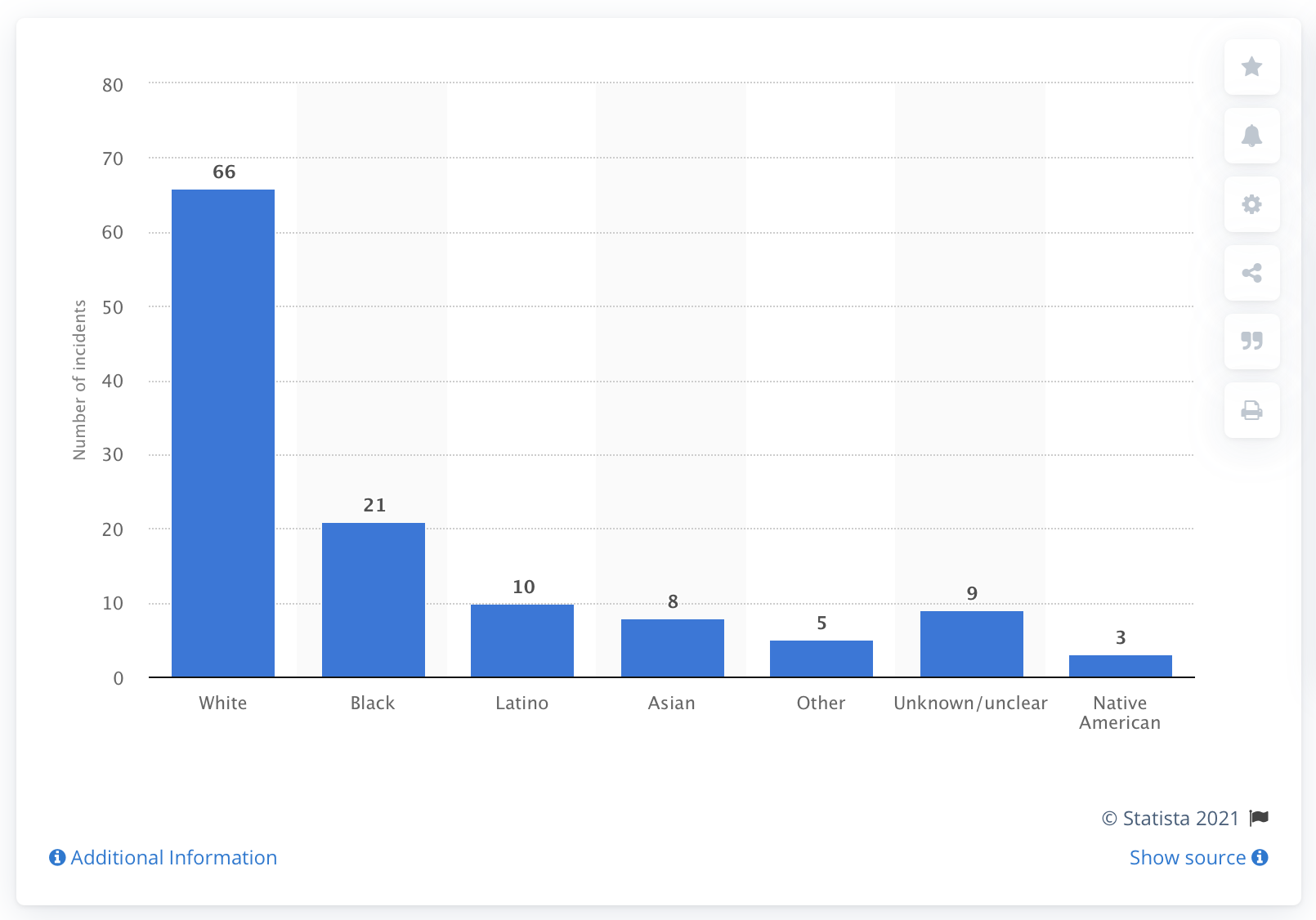
A question one might have is why the media manufacture the perception that mass murder is a white male phenomenon. A related question is why gang-related and other high casualty killings in black neighborhoods are excluded from the data of mass murder as typically reported by the media. This last piece is significant, because the data provided by Statista, even though it finds whites are underrepresented in mass murder, distorts the reality of mass murder in a way that is biased towards whites: it exaggerates white representation in mass murder. And not by a little.
Before Black Lives Matter, prominent publications such as The New York Times and The Guardian discussed the problem of excluding black victims of mass shootings by not counting mass shootings by black perpetrators in the context of inner-city violence. “Few of the incidents resembled the kinds of planned massacres in schools, churches and movie theaters that have attracted intense media and political attention,” The Guardian reported in 2016, reviewing an analysis conducted by The New York Times (which lies behind a pay wall once you’ve used up your few free articles). “Instead, the analysis, defined purely by the number of victims injured, revealed that many were part of the broader burden of everyday gun violence on economically struggling neighborhoods.”
What The New York Times found is that, counting mass murders defined as four or more people injured or dead, three-quarters of the victims of mass murder whose race could be identified were black. Homicide is for the most part intraracial, which means that it occurs within racial (and ethnic) groups. Simply put, blacks are mostly killed by blacks, while whites are mostly killed by whites, and so on. When interracial homicide does occur, considerably more whites killed by blacks than blacks killed by whites. I emphasize this because I do not want readers to get the impression that blacks are being mass murdered by whites. Blacks are being mass murdered by other blacks. For black victims of violent crime, the Justice Department shows that around 70 percent of those perpetrators are black and less than eleven percent of their offenders were white. In other words, the overwhelming majority of violent crimes against blacks are committed by other blacks.
Champe Barton, writing for The Trace, is one of the few persons speaking about this matter in the context of Black Lives Matter, albeit deceptively. Barton is reporting that high-casualty shootings have nearly doubled during the Pandemic. (We are in the middle of a 30-year high in violent crime thanks for Black Lives Matter.) He notes that “mass shootings only slowed under a commonly used but restrictive definition that leaves out most mass-casualty incidents. When defined as incidents in which four or more people were shot in a public or private space, there were more mass shootings in 2020 than in any of the previous years for which data is kept.” How many mass shootings? “Last year saw more than 600 mass shootings, almost double the average of the previous five years. The trend has continued into 2021, with more than 100 such shootings before the end of March.”
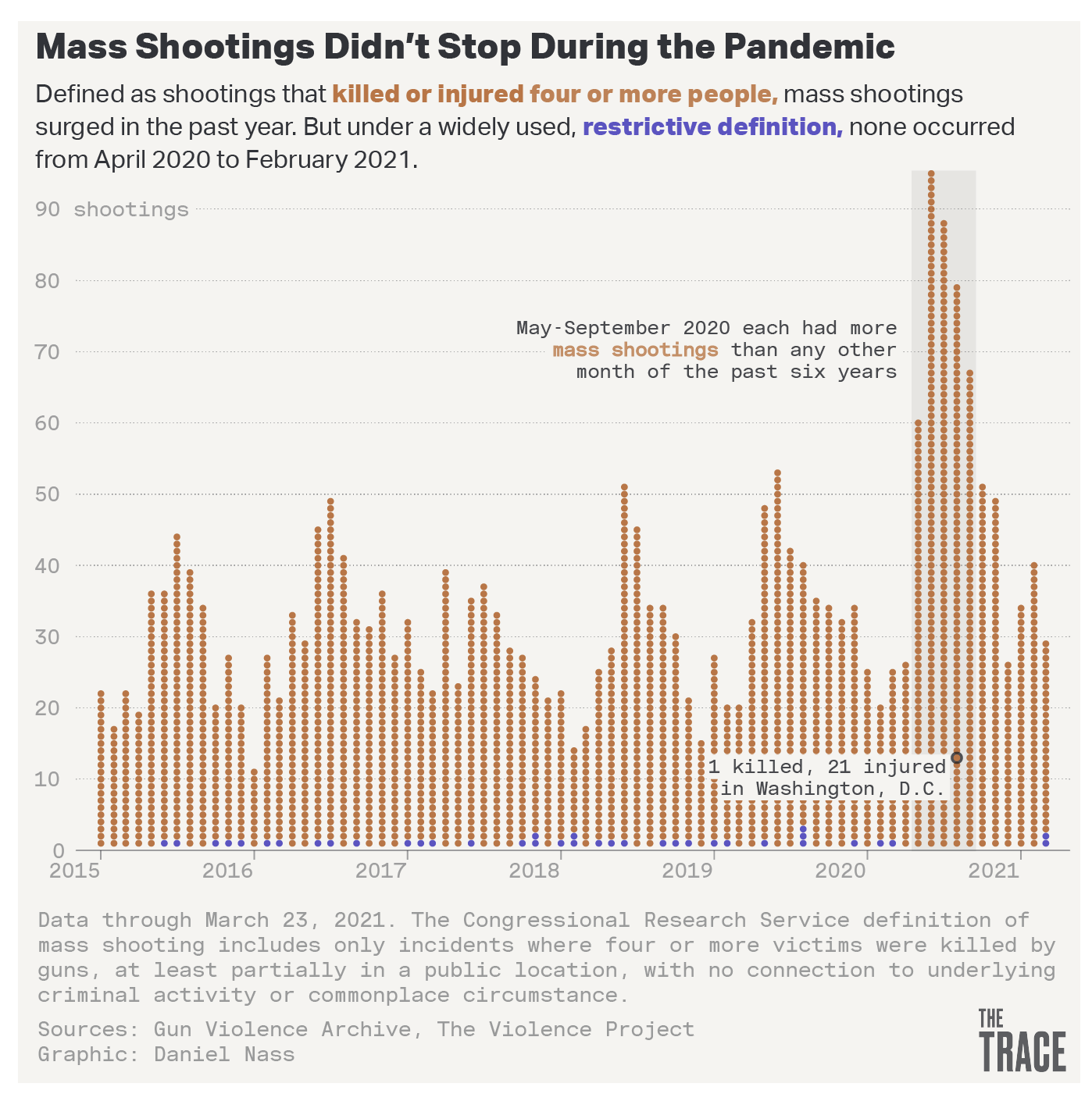
According to The Guardian, statistics show that the vast majority of high-casualty events occur in impoverished, disproportionately black and Hispanic neighborhoods. Roughly a third of the incidents with known circumstances were drive-by shootings or identified by law enforcement as gang-related. Barton reports “that many victims and community activists believe that the dearth of coverage of particular shootings owes, at least partially, to the race of the victims.” Pay attention to the framing. “In 2020, mass shootings disproportionately occurred in majority-Black neighborhoods. But even the highest-casualty incidents received limited national media attention.”
“According to a recent study published in the journal Sociology of Race and Ethnicity about shooting victims in Chicago,” reports Barton, “this pattern [of downplaying high-casualty events where the victims are black] held for local news outlets. It found that Black people killed in predominantly Black neighborhoods in the city in 2016 received roughly half as much news coverage as white people killed in majority-white neighborhoods.”
The first sentence from the article Barton cites, by White, Stuart, and Morrissey’s “Whose Lives Matter? Race, Space, and the Devaluation of Homicide Victims in Minority Communities,” begins with this sentence: “The recurring, horrific deaths of minority residents at the hands of police officers and vigilantes have led social movements and international protests to amplify the charge that whereas the loss of White lives is seen as tragic, the loss of Black and Hispanic lives is treated as normal, acceptable, and even inevitable.” The suggestion that there is systemic racism in lethal officer-civilian encounters, along with the method used, namely, “[b]uilding on and advancing theories of “‘colorblind racism’,” reveal the bias of the authors. Instead of seeing the exclusion of these events on the basis of the race of the perpetrator, they frame the argument in a way that blames white racism for ignoring black victims, while, at the same time, mystifies perpetrator race.
I don’t think it’s the race of the victim that causes reporters to hesitate in reporting these facts. I suggest that it’s the race of the perpetrator that lies behind the near total media silence on the issue. Because they are loathe to report facts that reflect poorly on black and brown communities, perhaps fearful of being branded racist, but also (and more likely) in light of the agenda to portray white males as the personification of the alleged Western pathology of white supremacy (the antiracism project), the corporate media present the data in a way that creates a false perception that whites are more likely to perpetrate mass murder.
The truth is that white men are much less likely to perpetrate mass murder than black and brown men. The narrative of white mass murder is a moral panic functional to the agenda to delegitimize Western civilization, a civilization paired with whiteness by the political left, which dominates American institutions. If academics, progressives, and reporters actually cared about black and brown men, then they must be concerned about this problem, since most of the victims of high-casualty events are black and brown men. But the corporatist agenda is more pressing.
In speeches, lectures, and debate, I have often rehearsed Henry Thomas Buckle’s (in)famous 1857 aphorism: “Society prepares the crime; the criminal commits it.” Karl Marx, impressed by Belgian astronomer Adolphe Quételet’s analysis of crime patterns and its associations, independently made a similar observation, actually just a bit before Buckle, in a 1853 article published in the New York Tribune.
Rejecting the practice of deterrence for its presumptuousness (by what right has the state to intimidate the herd by sacrificing the life and liberty of the one) and its inefficacy (the wrath Yahweh visited upon Cain for murdering his brother Able did not end murder), Marx writes, “From the point of view of abstract right, there is only one theory of punishment which recognizes human dignity in the abstract, and that is the theory of Kant, especially in the more rigid formula given to it by Hegel.”
What was this theory? Marx quotes Georg Hegel from the latter’s Philosophy of Right: “Punishment is the right of the criminal. It is an act of his own will. The violation of right has been proclaimed by the criminal as his own right. His crime is the negation of right. Punishment is the negation of this negation, and consequently an affirmation of right, solicited and forced upon the criminal by himself.”
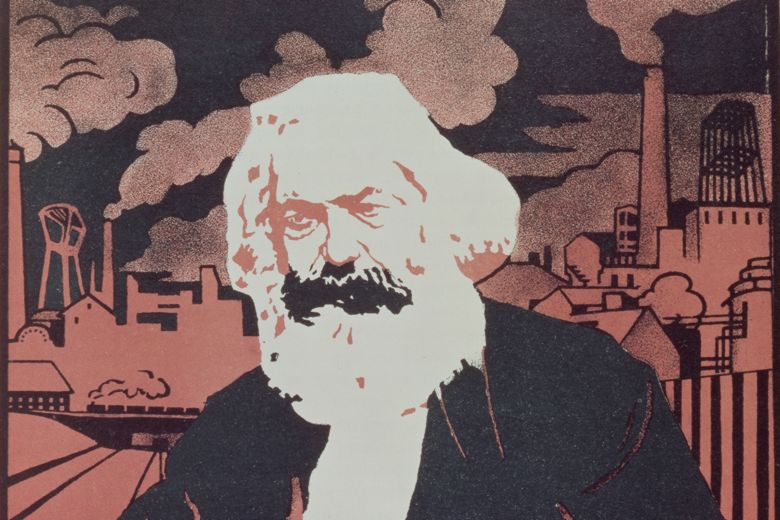
Never without a sharp critique ready, Marx asks, “Is it not a delusion to substitute for the individual with his real motives, with multifarious social circumstances pressing upon him, the abstraction of ‘free-will’—one among the many qualities of man for man himself!” Ordinary man has not, Marx contends, arrived at that state. He remains alienated from himself (and others).
Marx argues that “punishment is nothing but a means of society to defend itself against the infraction of its vital conditions, whatever may be their character.” To put this another way, the law is an instrument of power; power is asymmetrical and roots in class relations, which differentiate communities; the prevailing character of the law projects the interests of the ruling class. Elsewhere, Marx finds it difficult to accept the notion that those who do not belong to the same community as the bourgeoisie should be judged by bourgeois values. But he also detects in the lawbreaker “real motives.” Moreover, he and Friedrich Engels both recognize the futility of “primitive rebellion.”
Marx and Engels came to this position early on. In an 1844 letter to Marx from Paris, Engels sees in “the rapid increase in crime” among the proletariat, “robbery and murder” as “their way of protesting against the old social organization.” He describes, seemingly, at first, hopefully, “At night the streets are very unsafe, the bourgeoisie is beaten, stabbed and robbed; and, if the proletarians here develop according to the same laws as in England, they will soon realize that this way of protesting as individuals and with violence against the social order is useless, and they will protest, through communism, in their general capacity as human beings. If only one could show these fellows the way!” Then he laments, “But that’s impossible.” He leaves out what is true today and must have been true then, namely that most of those beaten, stabbed, and robbed by the proletariat, were other proletarians.
Must we blame society for the criminal’s actions? I cannot go with Marx and Engels if what they are saying is that individuals are for the most part animated by unseen social forces. This is too positivistic. How can the criminal possess his “own will” when he suffers amid the welter of alienating conditions, a situation described by Engels in his 1845 The Conditions of the Working Class in England? One cannot deny the objectivity of this situation. Deprivation is a hard and brutal truth. Yet, the criminal is responsible for the choices he makes. Unless he suffers from a mental defect, he did make a decision. Mens rea!
Few among us are entirely puppets on strings. We have agency. It’s what makes us human—however much estrangement keeps us from our species-being (Gattungswesen). To deny this agency is to dehumanize and deny the individual and the capacity of humans to collectively overthrow oppressive conditions. We each have a moral obligation to resist the urge and the opportunity to commit crime and other injurious actions whatever their source. Not a bourgeois obligation (to be sure, the force of law lies in wait), but a human obligation.
In a speech at the Republican National Convention Platform Committee Meeting, Miami, Florida July 31, 1968, future US president Ronald Reagan (in)famously said, “We must reject the idea that every time a law is broken, society is guilty rather than the lawbreaker. It is time to restore the American precept that each individual is accountable for his actions.” The quote is perfect for social media memes (and we get to see Reagan’s smiling grandfatherly visage), but it is a whopping expression of naïve idealism.
To the Reaganite conservative who scolds liberals for “blaming society” for crime and poverty, by which—from his standpoint of idealism—he means to commit the offense of rendering accounts for crime and inequality that go beyond the “abstraction of free will,” I have said many times that identifying the social forces that immiserate communities and increase the propensity to commit crime is not blaming society but explaining phenomena. This is what I think Marx means, his excesses in the opposite direction aside. Marx wonders whether there is “a necessity for deeply reflecting upon an alteration of the system that breeds these crimes, instead of glorifying the hangman who executes a lot of criminals to make room only for the supply of new ones?” Agreed! Grasping causes is empowering. It’s why the powerful don’t want the people to know about them.
What are the criminogenic social forces in our time? They are several, but the main ones are these: deprivation, disorganization, subculture, and family structure. They are intersecting forces, each caused by and causing the other. And, while these forces exist across ethnic and racial subcultures and the class structure, they are, for complex social, historical, and policy reasons, most pronounced in impoverished black neighborhoods. Although blacks comprise 13 percent of the US population, they have over the last several years accounted for more than half of all murder and non-negligent manslaughter arrests and more than half of all robbery arrests. Overall, black Americans account for more than a third of all violent crime arrests (which goes a log way in explaining why black American make up approximately a third of prisoners in the state penitentiary system). I n recognizing the significance of this it must be called to mind that the interracial nature of street crime means the majority of victims of crime committed by blacks are other blacks. In light of this, the lack of compassion for the victims of criminal violence in black neighborhoods refracted through the depolicing and prison abolition movements is really quite remarkable.
Confronting the criminogenic forces that encourage the wrongdoing that injures so many people requires human agency, and that means that those who live in crime-ridden communities have need to organize politically and change the conditions of their existence. This project is made difficult when progressives, who represent the interests of the “enlightened” bourgeoisie, control urban neighborhoods, depolice high crime areas, and infantilize black Americans by idling them and making them dependent upon government. A custodial state is not a peaceful state. We have decades of evidence showing that progressive politics and policies don’t work. I don’t think they’re supposed to.
The first steps are these I think: (1) hold individuals accountable for their wrongful and injurious conduct to their communities; (2) overthrow the political culture that disempowers those who live in those communities. For (1) to be effective, (2) needs accomplishing. But the people can wait for neither. They can no longer afford to listen to the paralytics of antiracism, critical race theory, and neo-Marxism. They will tell you my argument is victim blaming. It’s not true. It’s an argument for empowering the proletariat. Progressives want victims. The people want something else. The people want justice.
People are shocked to discover that the wealth of scientific research going back decades finds no evidence of racism in lethal officer-civilian encounters. So shocked, in fact, that many of them do not adjust their opinion in light of fact but keep repeating the myth (I can’t go a day without seeing the myth repeated in some hysterical meme or post). So shocked, in fact, that they are disenchanted with me for debunking the myth. Sorry. Not sorry. Debunking myths is what I do for a living.
Because it feels so counterintuitive in the face of antiracist hegemony, I have been explaining this to students in the following obvious way (and now I bring it to you):
Independent of race, males are overrepresented in police shootings compared to females. In 2020, men were more than 25 times more likely to be shot and killed than women. See attached chart. It’s quite a dramatic difference. Are we to conclude from this that police are therefore sexist? Of course not. No one would assume that police are biased towards men and therefore more likely to shoot and kill them. No one assumes this because it’s immediately obvious that males are overrepresented in serious crime, whereas females are underrepresented. And not by a little. By a lot. This has been true since we’ve kept records on sex and crime. And that has been a very long time (see the eighteenth century social physics of Belgian astronomer Adolphe Quételet).
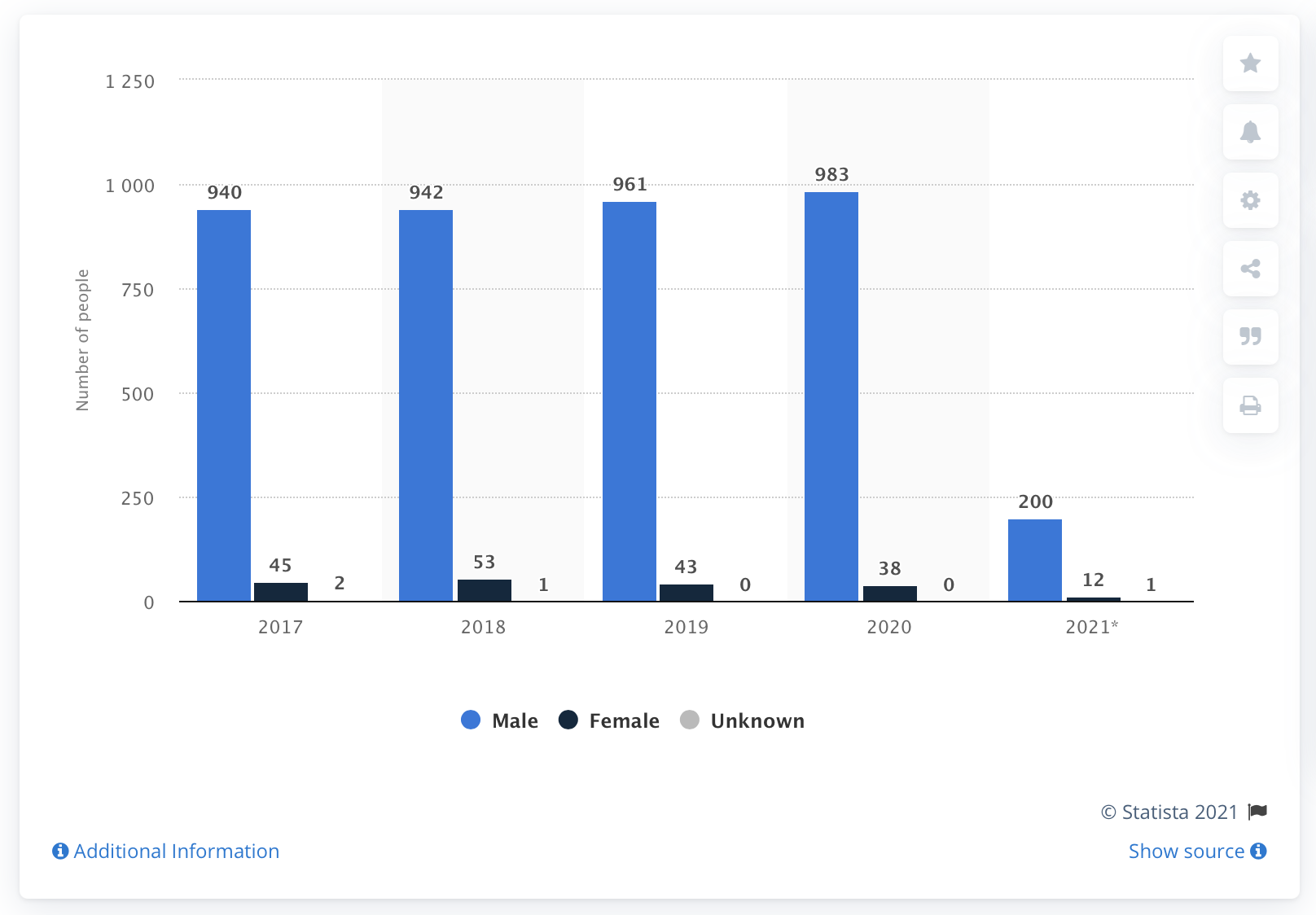
Do I even need to explain this? Here we go, anyway: Male overrepresentation in serious crime relative to women and this overrepresentation causes men to interact with police more frequently than women and, as result, the risk of a lethal encounter with police officers is greater for men than women.
So why are people so shocked to learn that the same dynamics holds for lethal officer-civilian encounters in the domain of race? Ideology. We’re allowed to believe that men are generally more likely to engage in crime than women. Nobody is going to accuse you of sexism for saying that men are more likely than women to be shot and killed by the cops because men are more likely than women to be involved in crime. However, we are not supposed to know, and therefore to believe that black men are more likely to engage in crime than white men, both absolutely (murder and robbery) and relatively (aggravated assault, burglary, and theft/larceny). We have been indoctrinated to reflexively perceive the statistics of race and crime as “racist.” It’s not racist, of course (no facts are racist), but ideology reigns in this area. You are not supposed to apply the same objective standard to social facts, people.
You’re supposed to think in identitarian terms. The line is this: “cops are racist.” If you deny that, you’re a racist, too. The rational person asks not only why a myth like this is manufactured (hint: race craft and hustle) and how it is disseminated (clues: academics, activists, pundits, and reporters), but also why one risks being called a racist for telling the truth (to stifle opposition to lies and propaganda).
Have you seen this story from NewsOne? (Nice touch with the air freshener.) If you search “truck,” “61,” “Minnesota” on Google, this is the first result returned. (I put “61” in there because I heard that was the age of the suspect.) The article, written by Bruce Wright, carries the headline “White Anti-Mask Driver Flees, Hits Minnesota Cop ‘Hanging’ From Truck With Hammer, And Isn’t Shot.” Is NewsOne suggesting the man should he have been shot? For those who are unfamiliar with this site, NewsOne is an explicitly black news channel with the tag line: “Latest news from a Black perspective with stories and opinions you won’t read anywhere else (but should).”
The opening paragraph sets the tone for the article: “In yet the latest evidence of police responses being predicated on the race of a suspect, a white driver who was shown on video fleeing from police, trapping an officer in his truck’s window and hitting the cop with a hammer was able to avoid being shot during his encounter with law enforcement in Minnesota on Wednesday.” Is this evidence for a claim of systemic racism? For objective observers, this is an anecdote. Anecdote for anecdote, show me a case of a police officer killing a black man in a particular way and I can show you a case of a police officer killing a white man in the same way. See Tony Timpa Can’t Breathe for example. Before you challenge me to provide more examples, here’s John McWhorter saving me time:
Can we be scientists? What does the totality of the evidence show? A wealth of empirical studies come to the same conclusion: there is no racial bias in police-civilian interactions when controlling for proportional criminal involvement and context. See my The Myth of Systemic Racism in Lethal Police-Civilian Encounters. (Here’s the FAR Podcast version with notes.) When I tell people this they either can’t hear it (most people and all progressives) or they are shocked (frequently shocked that I would even say such a thing). I have yet to meet anybody who knows this or who has tried to know it.
I have more shockers. First, there are many more white men shot by the police than black men.* In 2020, cops shot 457 white people. That same year, cops shot 241 black people. That’s almost twice as many whites shot than blacks. Did the media tell you that? No, I had to. That must be an unusual year, you say? COVID-19 had something to do with it? In 2017, 457 white people were shot by the police. Same year, 223 black people shot by the police. That’s more than twice the number of whites than blacks shot by the cops. It’s like this every year. So far this year? 50 whites shot by cops, 30 blacks. Where are the stories of whites dying at the hands of cops? Think race-hustling propaganda sites like NewsOne are going to share these facts? Not even the mainstream media will.

What about proportionality? I answered that in the previous paragraph (see blog and podcast). But to summarize here, a wealth of studies finds that racial disparity in police shootings is explained by involvement in crime and contextual factors. Blacks are proportionally more likely to have interactions with the police because they are proportionally more likely to be involved in serious crime compared to whites. Still, as you can see in the statistics, around twice as many whites are killed by the police than are blacks. Studies finding any potential bias at all find that it actually works in the opposite direction (at least the scientists cannot explain overrepresentation of whites in police shootings based on their involvement in crime and contextual factors.) I know it seems counterintuitive that, controlling for relevant factors, police would be more likely to shoot white men. But that’s what empirical studies show.
While you’re scratching your head or thinking about an angry response, here’s a second shocker: the vast majority of police-civilian interactions, including dangerous ones, do not result in the police shooting or killing suspects. This is true for black and white suspects. There are approximately 200,000 police-civilian interactions annually. The vast majority of people walk away unscathed. Do you have any thoughts about why that’s true? Because most people follow the commands of officers and do not resist. Consider this: There are 42 million blacks in America. In 2020, 0.00057% of blacks died at the hands of police officers. A tiny amount of those were unarmed black men. Should they have died? Perhaps not in every instance. Does this prove America is a racist country? Not in the slightest.
The man in the truck in the NewsOne story was not shot because he was white. He was not shot because the circumstances did not allow or call for shooting him. It’s that simple. He was not shot like most black men are not shot. Disinformation about police shootings is used to fuel a moral panic about race. Manufacturing a moral panic is a tactic: the rational use of irrationality. It’s part of an organized propaganda campaign to create the illusion of white supremacy.
* * *
* Many Hispanics self-classify as white. Around one-quarter of Hispanics identify as black. In 2020, 169 Hispanics were shot by the police. The statistics do not assign these individuals to racial categories. But it’s possible that the gap between white and black victims of police shootings is even greater.
It’s time again to make sure people know the rules for dealing with the police. I know you may feel humiliated during the encounter (you can take a shower later), but you want to stay safe and you want to avoid being arrested and charged with a crime. People love you and entering the criminal justice process is time-consuming, expensive, and harmful to your reputation. It is not an act of pride burial to cooperate with the police within the parameters of the Bill of Rights. You may feel like being defiant. The thing you should resist in this situation is the urge to be defiant. That and the urge to run your mouth. Don’t run your mouth.
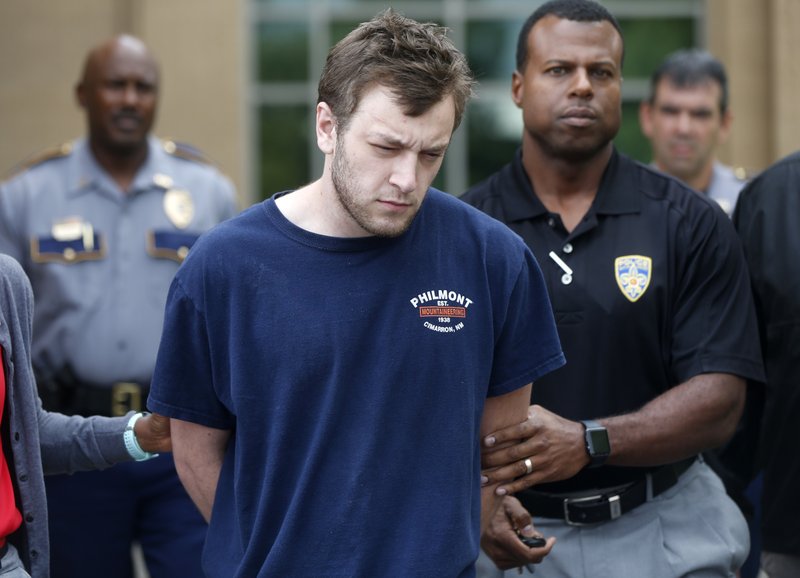
The first overarching rule is that you have rights (thank those dead white guys you’ve been taught to loathe for that). Do not give up your rights. Here are the specifics:
The second overarching rule concerns some of that I have said about about comportment. Don’t be an asshole and don’t resist.
The third rule is about not having to deal with the cops at all.
Violence is only morally permissible under certain conditions. There are essentially three reasons where violence may be just.
It seems that some folks think that (when the suspect is of a certain race) no force should be used in affecting an arrest, as if, when a suspect resists, the arresting officer is suppose to say, “Oh, you don’t want to be arrested. My bad. Be on your merry way.” The police have a duty to take a criminal suspect into custody. They are permitted in reaching this end to meet resistance with force. Force carries with it the potential for injury—as does resistance. If you are resisting lawful arrest, then the injury suffered may very well be your fault. Resisting is not the police officer’s fault. She’s doing her job.
If we are going to make policy that police officers can’t use force, we might as well give up and let criminals do what they want. What will we do with those who commit hate crimes against racial and sexual minorities? What about those who harm their spouse and children? Those who rape children? I don’t think some folks have fully thought this through.
Long overdue. Why ever fly a flag representing any part of a defeated nation, a nation that put central to its civilizational claims racialized chattel slavery? In a letter to the Great Emancipator, Abraham Lincoln, Karl Marx put it best:
“When an oligarchy of 300,000 slaveholders dared to inscribe, for the first time in the annals of the world, ‘slavery’ on the banner of Armed Revolt, when on the very spots where hardly a century ago the idea of one great Democratic Republic had first sprung up, whence the first Declaration of the Rights of Man was issued, and the first impulse given to the European revolution of the eighteenth century; when on those very spots counterrevolution, with systematic thoroughness, gloried in rescinding ‘the ideas entertained at the time of the formation of the old constitution,’ and maintained slavery to be ‘a beneficent institution,’ indeed, the old solution of the great problem of ‘the relation of capital to labor,’ and cynically proclaimed property in man ‘the cornerstone of the new edifice’—then the working classes of Europe understood at once, even before the fanatic partisanship of the upper classes for the Confederate gentry had given its dismal warning, that the slaveholders’ rebellion was to sound the tocsin for a general holy crusade of property against labor, and that for the men of labor, with their hopes for the future, even their past conquests were at stake in that tremendous conflict on the other side of the Atlantic. …

“While the workingmen, the true political powers of the North, allowed slavery to defile their own republic, while before the Negro, mastered and sold without his concurrence, they boasted it the highest prerogative of the white-skinned laborer to sell himself and choose his own master, they were unable to attain the true freedom of labor, or to support their European brethren in their struggle for emancipation; but this barrier to progress has been swept off by the red sea of civil war.”
Here’s what I heard Marx saying: the American proletariat did not die in the hundreds of thousands to free black people from bondage to see the flag of a slave nation flying at the capitols of defeated insurrectionists. The only flag worthy of the Confederacy is the white flag of surrender. So take down this flag, Tate Reeves. Be the good Republican Lincoln (and Marx) was and relegate the symbol of slavery to the museums.
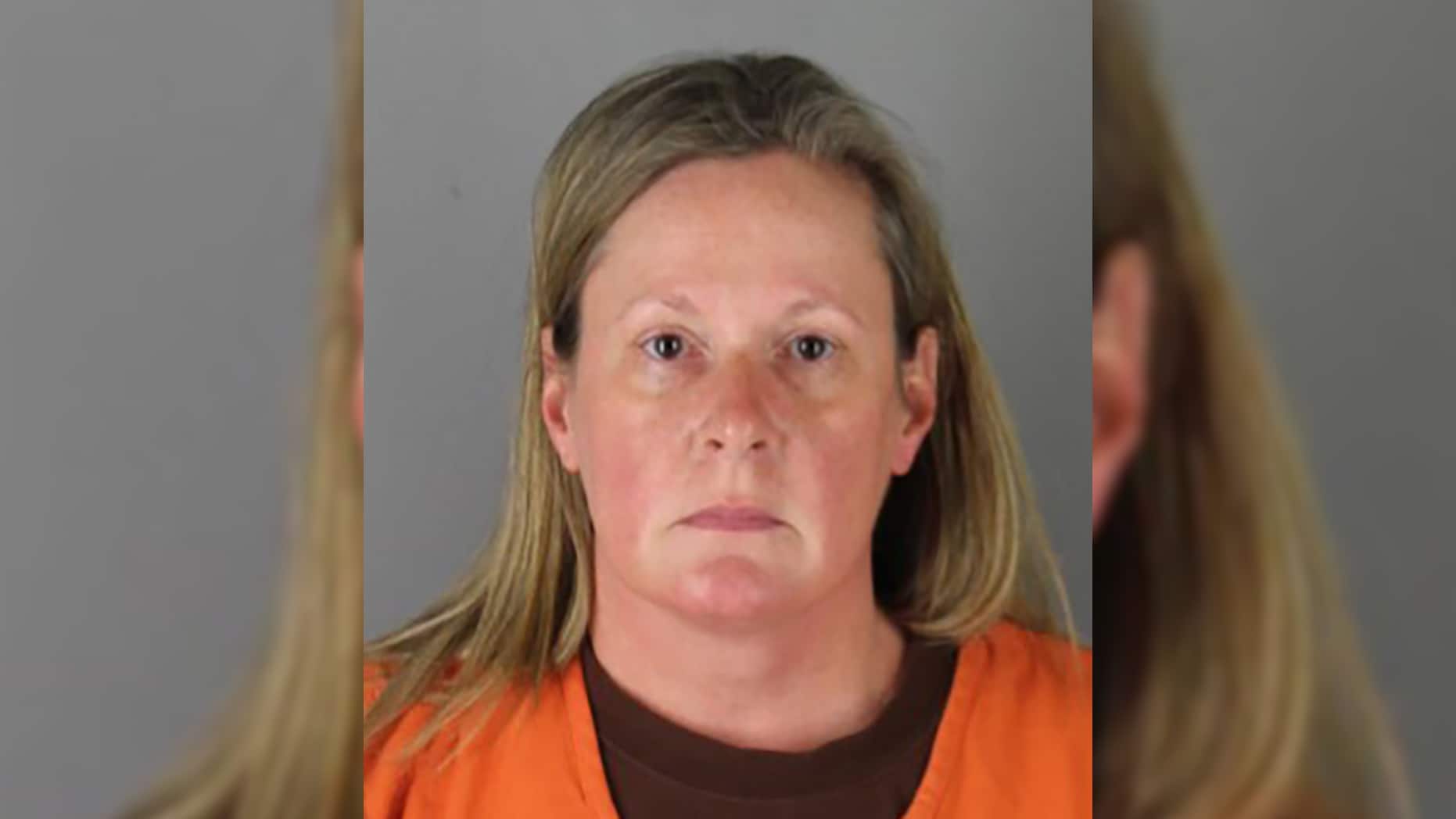
Kim Potter, police officer with Minnesota’s Brooklyn Center Police Department, has been arrested in the shooting death of Daunte Wright and is expected to face second-degree manslaughter charges, which, in Minnesota, is defined as “culpable negligence whereby the person creates an unreasonable risk and consciously takes chances of causing death or great bodily harm to another.” Potter earlier resigned from the force. Brooklyn Center Police Chief Tim Gannon also resigned. Potter and her husband were forced to flee their residence after their address was shared on social media and a mob gathered outside.
Brian Peters, former commander with the Brooklyn Center Police Department, and current head of Minnesota’s police association, says Wright would still be alive had he not “set off” a deadly “chain of events” Sunday in Brooklyn Center. “You have to look at this situation as a chain of events,” Peters said. “This is going to be an unpopular statement, but you know, Daunte Wright, if he would’ve just complied… He was told he was under arrest, they were arresting him on a warrant for weapons. He set off a chain of events that unfortunately led to his death.” Peters then put Wright’s actions in a larger context, noting that “what we’re seeing, policing in these days, is that non-compliance by the public. Police officers are tasked with enforcing the law, enforcing the law that legislators create. And it’s a very tough job right now. It’s been a very tough job and this situation unfortunately also makes it more difficult.”
Peters is suggesting that this is a case of victim-precipitated accidental homicide. I am inclined to agree. Kim Potter made a mistake, but she would not have been in a position to make that mistake had Wright obeyed her commands and the commands of the other officers. One can say, “Potter shouldn’t have shot him,” but since nobody reasonably thinks Potter should have shot Wright, it’s a rather useless observation. Clearly Wright doesn’t think she should have shot Wright. She instantly regretted her error, as we hear on her body cam. No doubt, she wishes she had that moment back. She will dwell on that moment for the rest of her life.
However, when Peters says that Wright should have obeyed the officers’ command, he is not making a useless observation. It is neither true that everybody thinks it’s wrong to resist arrest nor that victims may contribute to the chain of events, even including those the victims intentionally initiate, that ultimately leads to their death. Moreover, Wright created an extremely dangerous situation by getting into his car and driving away with law enforcement officers right next to the vehicle. His actions put officers in jeopardy of losing life and limb. He was behaving recklessly.
Recall what Peters said. We’re seeing an increasingly problem of non-compliance by detainees and arrestees. Police officers are tasked with enforcing the law legislators create. It’s their job and their duty to carry out that law for the good of the communities they serve and protect. A rise in non-compliance makes their job and duty more difficult—and more dangerous. The reason for the rise in non-compliance is a consequence of influential voices actively delegitimizing the institutions of public safety by perpetuating the myth that the criminal justice system is racist and unjust. This is how the Black Lives Matter is undermining public safety.
Let’s be clear: the chain of events that led to Wright’s death were not initiated by law enforcement. Kim Potter did not create a situation where Wright’s actions were reasonable. Law enforcement had reason to stop Wright and to take him into custody. Wright chose to resist and escape in a car thus creating a critical situation, authoring the circumstances that increased the risk of human error, as well of injury and even death. There is no evidence of racism in this case.

According to Hennepin County Court documents, on December 1, 2019, in Osseso, Minnesota, in an attempt to rob a woman of more than 800 dollars, Wright allegedly choked and held a woman at gunpoint, threatening to shoot her. This is aggravated robbery. Wright was out on bail when a weapons charge caused his bail to be revoked, hence the warrant for his arrest. Engaging in action that puts lives at risk does not appear to be novel occurrence in Wright’s biography.
A culture of resistance is undermining public safety, which has the effect of diminishing the quality of life in vulnerable communities. That members of the ruling class, political elites, and prominent voices in the culture industry are actively delegitimizing the institutions of public safety, not only by encouraging resistance to law enforcement, but also by failing to correct the falsehoods that the criminal justice system is generally, and law enforcement specifically are racist, suggests an agenda that serves certain interests, or at least serve a convergence of interests. Since, as a matter of economic and political commitments, these entities do not represent the interests of the working class, we must suppose other interests are at play.
Citizens have an interest in the ability of law enforcement to safely enforce the law. By sacrificing Kim Potter upon the altar of antiracism, by giving into the irrational mob, more detainees and arrestees will be motivated to resist law enforcement in the name of racial justice or out of a false belief that law enforcement are racist. This endangers the safety of both civilians and law enforcement.
 freedom and reason