Bernie Sanders Gets it on Open Borders Rhetoric—At Least He Did in 2015

“Open borders? No, that’s a Koch brothers proposal. That’s a right-wing proposal, which says essentially there is no United States.”

Bernie Sanders, July 2015

I just ran across this Bernie Sanders interview from 2015. I don’t know how I missed it at the time. But I have it now. It’s from a conversation between Sanders and Ezra Klein in Vox, July 28, 2015, a web magazine Klein helped found in 2014 (along with Matt Yglesias and Melissa Bell). In the clip, Klein asks Sanders about international poverty. Klein looks stunned by Sander’s answer. From a working-class standpoint, it is the correct answer.

On January 19, 2019, I wrote about the right-wing libertarian open borders push on my blog: The Koch Brothers and the Building of a Grassroots Coalition to Advance Open Borders. It’s one of many posts I have written to demonstrate what the actual working-class position on immigration looks like in contrast to the neoliberal denationalizing rhetoric championed by Democrats and the faux-left (i.e. progressives).

Progressives don’t know quite what to do with leftwing arguments hailing from the organic standpoint of social class. However it’s quite satisfying for these ears to hear Sanders saying things about open borders such as: It would make everybody in America poorer—you’re doing away with the concept of a nation state, and I don’t think there’s any country in the world that believes in that.”

Unfortunately, there are a lot of left-wingers who do believe in that. They want to dismantle security fencing and barriers, abolish Custom and Border Protection (CBP), Immigration and Customs Enforcement (ICE), and grant amnesty to millions of people who are in the US illegally. They call for decriminalizing immigration, which will open the floodgates. Open border folks are especially eager to recruit Catholics from Central America and Muslims from anywhere, who bring with them ideologies harmful to women, children, and gays and lesbians—ideologies that do not respect open and secular societies.

To be sure, Sanders is no socialist. But one doesn’t have to be in order to understand how immigration is contrary to the interests of the native-born of developed nations. The harm immigration causes was well understood by labor in the early twentieth century and the New Liberals of middle twentieth century United States, as well as their social democratic counterparts in Europe (see The Need for Limits).

“If you believe in a nation state or in a country called the United States or (the United Kingdom) or Denmark or any other country, you have an obligation in my view to do everything we can to help poor people. What right-wing people in this country would love is an open-border policy. Bring in all kinds of people, work for $2 or $3 an hour, that would be great for them. I don’t believe in that. I think we have to raise wages in this country, I think we have to do everything we can to create millions of jobs.”

Bernie Sanders, July 2015

Sanders is observing a basic economic principle that capitalists exploit to check rising labor costs: a surplus of the labor commodity (to which humans come attached) drives down the price of labor (wages). As Marx pointed out in the nineteenth century, the economic imperative of surplus value drives the population dynamic under capitalism (see The Urgency of Population Control).

Marx incorporated this understanding in his strategic proposals. In an April 9, 1870 to letter to Sigrid Meyer and August Vogt (who were in New York), Marx writes, Ireland constantly sends her own surplus to the English labor market, and thus forces down wages and lowers the material and moral position of the English working class.The contemporary analogs should be obvious. In case they are not, consider the Central American states, or the Muslim-majority countries of Central Asia and North Africa.

Marx grasps the function of Irish immigration: Every industrial and commercial center in England now possesses a working class divided into two hostile camps, English proletarians and Irish proletarians. The ordinary English worker hates the Irish worker as a competitor who lowers his standard of life. Anticipating WEB DuBois’ psychological wage enjoyed by white workers over black workers, Marx writes, In relation to the Irish worker he regards himself as a member of the ruling nation and consequently he becomes a tool of the English aristocrats and capitalists against Ireland, thus strengthening their domination over himself.” The English worker cherishes religious, social, and national prejudices against the Irish worker.

Of course, these antagonisms are not to be confused with racism, but they are exploited in much the same way by the capitalist class to disorganize the English working class. “This antagonism is the secret of the impotence of the English working class, despite its organisation,” Marx argues. It is the secret by which the capitalist class maintains its power. And the latter is quite aware of this. It is in other words a conscious strategy by capitalist elites.

As I note in that January 19, 2019 blog entry on the Koch brothers, the LIBRE initiative, which enjoys the backing of conservative mega-donors who stand to profit from the massive transfer of value that comes with immigration, strives to help immigrants (legal and illegal) come and live in America, learn English, and pass their drivers’ license tests. The goal of LIBRE is not only to gain access to cheap foreign labor, but to drive down the wages for all labor and disrupt worker solidarity. 

What did Marx believe was the solution to this antagonism? He argues that the national emancipation of Ireland is not a question of abstract justice or humanitarian sentiment but the first condition of their own social emancipation. Marx does not sink into the morass of social justice, but rather the practical politics of nationalism. As Marx and Engels insist in the Communist Manifesto: “Though not in substance, yet in form, the struggle of the proletariat with the bourgeoisie is at first a national struggle. The proletariat of each country must, of course, first of all settle matters with its own bourgeoisie.” Leftwing politics from a Marxist standpoint differs radically from the the politics of the identitarian left, which are in substance neoliberal.

Marx encourages Meyer and Vogt to forge a coalition between German and Irish works, as well as English and American workers willing to participate, to raise consciousness about the importance of Ireland’s national emancipation—to become an independent nation-state organized around Irish nationality. Marx’s argument in favor of ethnic nationalism have been warped in the service of aggressive pro-immigration politics. Sanders views have likewise been distorted. (See for example, David Wilsons Marx on Immigration in the February 1, 2017 edition of Monthly Review.)

Individual control over reproductive capacity in modern secular nations presents a problem for the bourgeoisie: lower fertility rates, fewer children, and longer inter-pregnancy intervals (or birth spacing) reduces the rate of population growth. The decline in the rate of population growth is welcome news for humanity: a population that is not growing or (even better) shrinking, means a higher standard of living with a reduced risk of exceeding the ecosystem’s carrying capacity (overshoot and collapse). But this situation is bad news for capitalists. It means rising wages, falling profit rates, and deepening class consciousness. This is why the governing elite opened the borders in the 1960s to import cheap labor from developing countries, namely to drive down wages for native-born workers through displacement and disadvantage and restore high rates of profit. The strategy carried an added benefit: by disorganizing the national culture—common language and values—it disrupted the formation of class consciousness and effective political organizing. The countermovement stopped socialist progress in its tracks and opened society instead to the New Right.

In his conversation with Klein, Sanders correctly ties the open borders strategy to the situation of workers in the United States: “You know what youth unemployment is in the United States of America today? If you’re a white high school graduate, it’s 33 percent, Hispanic 36 percent, African American 51 percent. You think we should open the borders and bring in a lot of low-wage workers, or do you think maybe we should try to get jobs for those kids? I think from a moral responsibility we’ve got to work with the rest of the industrialized world to address the problems of international poverty, but you don’t do that by making people in this country even poorer. We have native-born Americans who need jobs.”

Yes, Sanders said “native-born Americans.” We’re told that this terminology is nativist, xenophobic, even racist. But this is who the left is supposed to represent: the national proletariat. These politics are neither racist nor xenophobic; they’re pro-worker. They benefit not only white male workers, but black workers, Latino workers, women workers—all workers. We have enough people in the United States to do the work of the nation. We don’t need more people. On the contrary, we need fewer people (see “PBS and Immigration Apologetics”).

The denationalizing rhetoric of the progressive left represents a spectacular propaganda achievement by the bourgeoisie, in which the neoliberal globalists have masterfully deployed cultural pluralism and cultivated a popular desire to virtue signal in order to enlist political strata, cultural managers, and young proletarians in a project to undermine the working class in the West, to expropriate all that working people have built over the decades and leverage the social surplus to raise the rate of profit, all while politically disorganizing the masses. This is the neoliberal agenda, and progressive Democrats are among its major proponents.

Leftists need to ask themselves the question that conservatives (for example, Roger Scruton) have rhetorically asking for years: What is the point of having a democratic republic if the citizens who built it can’t depend on their own government to protect their interests? How could any activist, politician, or pundit claiming to speak for the interests of labor advocate and enable policies that benefit the capitalist class at the expense of working families?

As I have shown in numerous entries on this blog, the Democratic Party stands at the forefront of selling out the American worker. Alexandria Ocasio-Cortez is a paradigm of misdirection (see “The Democratic Party and the Doctrine of Multiculturalism”). History tells us that right-wing populism thrives in weakly social democratic moments. Right-wing populism fills the vacuum left by the abandonment of class politics by the left. Today, instead of focusing on inequality and poverty, liberal Democrats and progressives make a fetish of diversity and identity. They push false essentialisms and alienate working people with sterile politically-correct argot. The left needs a left-wing populism, not a globalism that feigns humanitarian concern. The United States needs to emancipate itself from the global capitalist order.

Progressivism is paradigmatic of a left-wing politics that allows right-wing politics to thrive. It is a politics that antagonizes workers and disrupts class consciousness by disorganizing national culture. However good somebody like an Ocasio-Cortez may sound on issues of social class and economics, advocacy of cultural pluralism betrays the rhetoric. Ocasio-Cortezs code-switching and tribal pandering pushes her to margins—and her devotees follow her into that marginalization. Millions of working-class Americans cant go where the multiculturalists mean to take them. Nor should they. Ocasio-Cortez and her ilk represent the wrong direction for Democrats if they want to reclaim the mantle of champion of working people (I know, this was never organic, but for a few decades, there was an opportunity there). The identitarians who see a moment for their anti-class politics to shine are destructive to the proletarian movement. 

When Democrats return to the politics of class and popular economics of Roosevelt and extol the founding liberal values of individual liberty, secularism, and the open society, then the rightwing in America will run into a wall. The political and cultural right will stand alone as practitioners of such atavisms as religionism and tribalism.

In the final analysis, the Democratic Party appears to be a dead-end. Working people need a viable socialist party rooted in the Marxist theoretic, a working class movement focused on equality and championing individuals liberties and rights that brings all people together around their common class interests. This occurs in a national context with a common language and a government that defends the needs of the majority of its people.

The Northern Triangle, the Migrant Flow, and the Risk of Criminal Violence

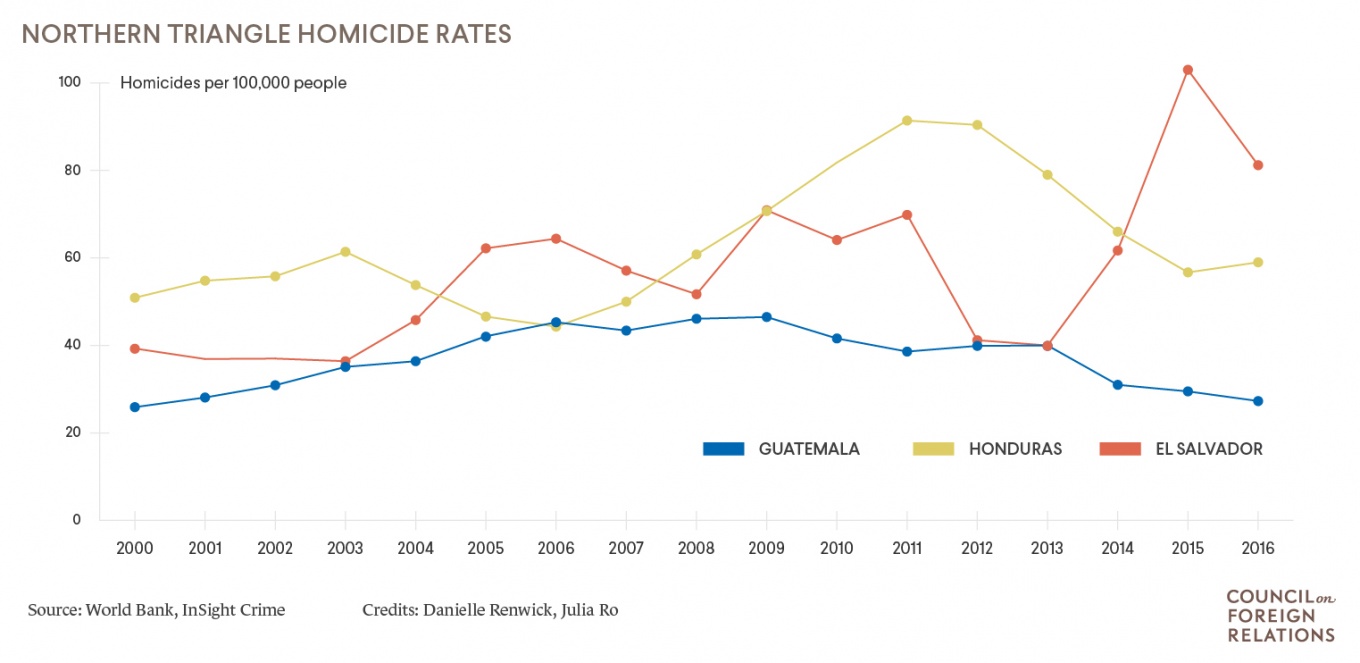
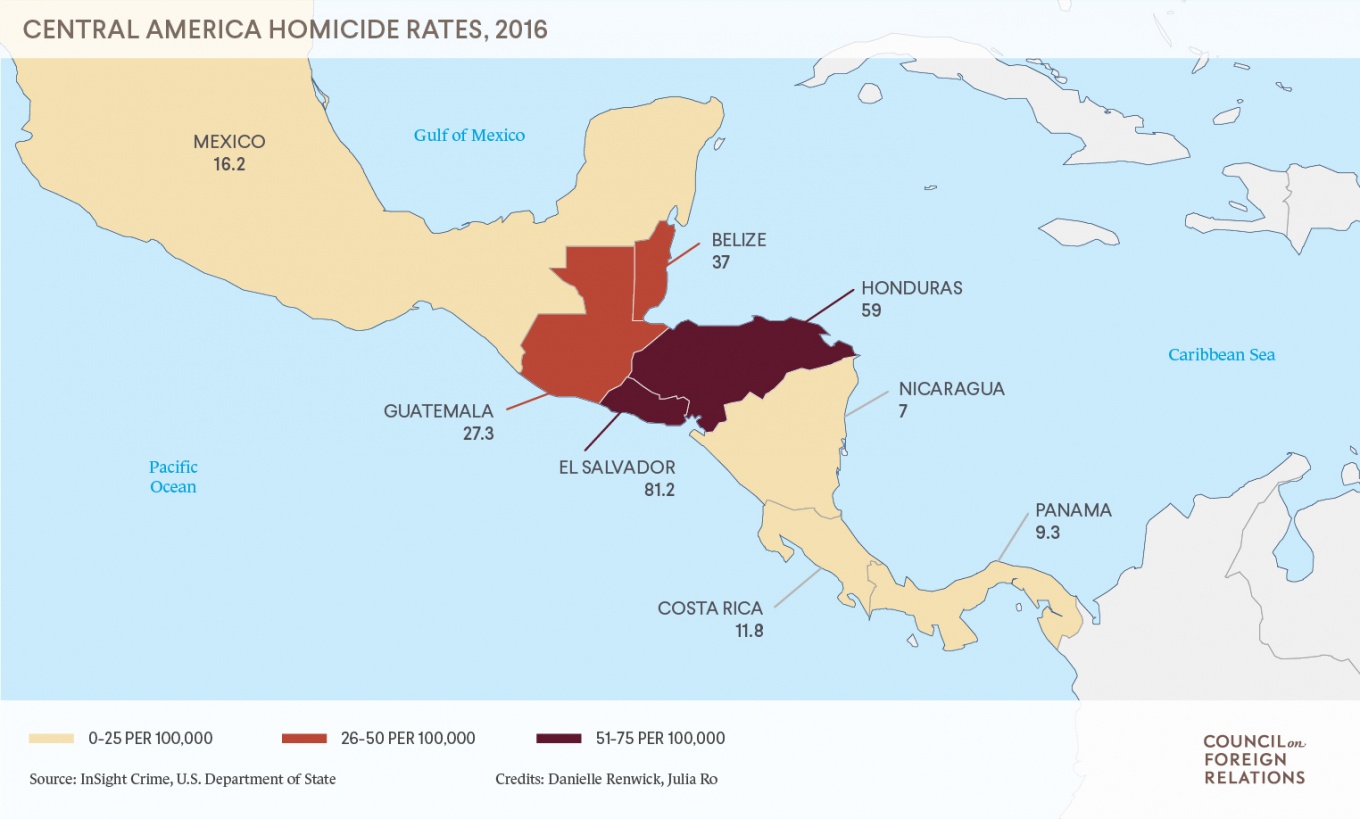
Tens of thousands of Guatemalans, Hondurans, and Salvadorans, migrants from the three countries comprising what is known as the Northern Triangle, have for decades been pushing into the United States. The Northern Triangle is remarkable for the extraordinarily high levels of criminal violence that persist in the face of government attempts to combat it and despite billions of dollars in US security and economic development aid. Alongside stark inequality and lack of opportunity, migrants cite organized crime and gang violence as reasons or seeking residence in other countries. Neighboring states of Belize, Costa Rica, Nicaragua, and Panama have seen flows sharply increase over the last 15 years. But most migrants have set their eyes on the United States as their destination. As of 2015 (the most recent statistics), some 3.5 million Guatemalans, Hondurans, and Salvadorans live in the United States. That figure represents a more than doubling of persons from that region over the decade. More than half of them are in the United States illegally. 

It is important to note that the surrounding countries of Belize, Costa Rica, Nicaragua, and Panama do not exhibit nearly the levels of crime and violence as the countries of the Northern Triangle do. Part of this is explained by the historical circumstances of these countries. Between 1979 and 1992, in fighting that left some 75 thousand dead, the population of El Salvador was pulled into a struggle between leftist guerrillas and government forces. Between 1960 and 1996, fighting in Guatemala resulted in the deaths of some 200 thousand persons. During the US government’s campaign to destabilize the Sandinista government in Nicaragua in the 1980s, the United States used Honduras as the forward staging area for the projection of death squads, called Contras, into Nicaragua. As these conflicts came to an end, the large supply of weapons and conflict-hardened men, many of whom had been raised in the service of illegal clandestine operations, coalesced into organized criminal networks. There is evidence that both the international drug enforcement activities and the use of drug networks to supply clandestine funding for counterrevolutionary operations created the context for the drug trafficking that represents the business interests of organized crime in the region.

These networks operate both domestically and transnationally, involved in extortion, drug and human trafficking, and other illicit activities. Domestic street gangs, or pandillas, are part of the daily experience of local populations. Transnational gangs, or maras, have a much wider reach. The Eighteenth Street Gang, more popularly known as M-18, and Mara Salvatrucha, the notorious MS-13, enjoy an estimated 85 thousand members. Mexicans formed M-18 in Los Angeles in the 1960s. MS-13 was the work of Salvadorans in the 1980s, also in Los Angeles. In the 1990s, responding to extraordinarily high rates of gang violence, the Clinton Administration and local law enforcement authorities pursued large-scale deportations of illegal aliens with criminal records (an estimated 10 thousand remain in the US). It is likely that, while reducing gang violence in the United States, relocating large numbers of gang members had the opposite effect in the Northern Triangle. The depth of the depravity of gangs has made it difficult for law enforcement to contain the crime and violence in the Northern Triangle. Moreover, the mano dura (“heavy-handed”) police tactics and use of mass incarceration may have helped gangs in their recruitment efforts. (See Clare Ribando Seelke’s Gangs in Central America, Congressional Research Service, August 29, 2016, as well as the report Crime and Violence in Central America’s Northern Triangle by the Woodrow Wilson Center, 2015.)

The new millennium brought with it a surge in crime in the region. In 2005, migrants, in part fleeing the violence, but also seeking the higher standard of living and social services built by US workers, sought to enter the United States to live and work. The Bush Administration responded with Operation Streamline, a “zero-tolerance” policy that criminally prosecuted and deported those who illegally crossed the US-Mexico border. Alongside aggressive law enforcement efforts, Bush introduced the Merida Initiative, a security assistance package that funded expanded law enforcement efforts. Congress appropriated money to extend physical security barriers along the border, construction pursued under the Obama Administration. Obama reorganized and rebranded the Bush programs as the Central America Regional Security Initiative (CARSI). As with Bush, Obama pursued economic development strategies. All told, the US government spent billions of dollars to help the region combat its crime problem. However, illegal immigration increased, reaching a crisis point in 2015. If violence explained the increase, then it was clear that El Salvador was the main problem. Violence, as measured by homicide rates, had been declining in Guatemala since 2009. And violence using the same measure has been declining in Honduras since 2011. Whatever the cause, Obama responded by ordering mass deportations of all migrants with denied asylum claims. The express reason was to deter migration to the United States.

Assuming power in 2017, the Trump Administration pursued strategies similar to his predecessors. Most notably, Trump sought to expand construction of physical security barriers and step up prosecutions of those who crossed the border illegally. Trump’s initial efforts produced a sharp drop in attempted border crossings in 2017 (not surprisingly, more than half of those apprehended were from Northern Triangle countries). However, sharp criticism of Trump’s policies from the corporate and leftwing media, religious organizations, and libertarian groups, have weakened his legitimacy. I have written about the organized efforts to challenge the US border in previous blogs so I will refer you there. The point I wish to leave you with today is the danger of allowing large numbers of people from the Northern Triangle to enter the US without a legitimate reason or without supervision. The transnational character of the criminal networks described in this blog reflect a deep culture of violence. The US has made great strides in reducing criminal violence in our nation. There is a very real risk of reversing that success with lax immigration controls.

Note: I benefitted from Rocio Cara Labrador and Danielle Renwick’s “Central America’s Violent Northern Triangle,” published in Foreign Affairs on June 26, 2018. The charts used above are from their work.

The Democratic Party and the Doctrine of Multiculturalism

I do not support the Democratic Party for many reasons, but chief among them is its advocacy of the doctrine of multiculturalism, which Alexandria Ocasio-Cortez puts at the center of what she identifies as her desired public school curriculum, as seen in the video below. After welcoming the audience with the standard Islamic salutation of As-salāmu ʿalaikum, she speaks to the debate between integrationism and separatism. She explains how she opposed assimilationism and valued pluralism from a young age, linking directly bilingualism with multiculturalism, the former not so much as possession of an advantage, but more as an expression of the right to exist in a culture apart from the United States mainstream. This perspective sees integrationism advocacy as a racist project to strip people of their core identities, not as individuals in a democratic republic, but nations defined in ethnical terms.

Alexandria Ocasio-Cortez. Public Education Town Hall: A Bold New Vision for Public School Equity and Justice. Jackson Heights People for Public Schools (Jackson Heights, Queens) March 16, 2019

Ocasio-Cortez’s words are an unambiguous expression of identity politics. She says that halal food should be available in every school because it tells children “you matter.” Halal meat is from animals that have suffered Islamic ritual slaughter, or dhabihah, in which the animal is bled to death while a blessing, typically “Bismillah,” is said. “Even down to thing you eat,” Ocasio-Cortez says, “we are not going to make you feel invalidated.” But this practice does not tell children “you matter.” It tells children “Islam matters” — and that as a matter of government policy, the state will uphold Islamic dietary requirements not chosen by the child or by any rational criterion, but imposed by the superstitious beliefs of an imagined community. Put another way, even down to what a child eats, the state will serve as a proxy for an oppressive ideological system. Multiculturalists want to make sure that there is no place a child can go where Allah won’t have control her body. Ocasio-Cortez is calling for the state-enforced negation of religious liberty.

Ocasio-Cortez’s desire for the state establishment of religion is anticipated in a speech given by Sharifa Alkhateeb on August 5, 1989 at the Muslim Americans Political Awareness Conference session “Politics and Contemporary Social Issues.” C-SPAN preserved the conference presentations and I am providing the clip of Alkhateeb’s speech below. For those of you who do not know this person, Alkhateeb was the managing editor of the International Institute for Islamic Thought’s American Journal of Islamic Social Sciences (a journal presenting an alternative “scientific” framework rooted in Islamic superstition). She died in 2004. In her speech, she lays out the strategy to use public schools to proselytize Islam and move the United States towards an Islamic state.

The project of mainstreaming Islam has targeted public schools. Muslim appreciation days. Acceptance of extreme does of religious dress. Cultural sensitivity curriculum. Disruptive prayer exercises. It has become reflexive to criticize Christianism (progress of a kind). But Islamism is being normalized under the rubric of cultural pluralism. I have heard objections that Muslims are but a small minority. That the concerns are overwrought. But we don’t need to be a Muslim-majority country for Islam to be a problem in public school. We have communities in the United States that are Muslim-majority. Religious liberty must be protected for everybody. We cannot allow religious enclaves to skirt the First Amendment. Besides, the problem of Christian religious ideas and practices in public schools does nothing to obviate the problem of Islamic ideas and practices in public schools. We also must acknowledge that, whereas some Christian sects push state religion, Protestantism is a source of church-state separation. This is in sharp contrast to Islam, which sees all institutions and behavior under divine command. Remember, rational Protestants established the premise of the First Amendment. As I have documented, it was for this reason that so many native-born Americans opposed Catholic immigration. And now the Supreme Court is a majority Catholic which is decidedly not a good thing for reasons of doctrine. Finally, the proof of Islam’s colonization of public space lies in the trends I am identifying. It is already a problem. There is nothing abstract about my point.

In a previous blog entry, The Work of Cultural Hegemony in the Immigration Debate, I discuss the postmodernist implications of Horace Kallen’s (eventually) highly-influential 1915 essay “Democracy Versus the Melting Pot” organized under “cultural pluralism.” Kallen argued that cultural diversity would strength national unity. Yet the argument opposed to national unity the doctrine of multiculturalism. Others were less deceitful in their formulations (I name names in that blog entry). Kallen and his ilk lost the fight at the time, the working class finally winning restrictions on immigration in the mid-1920s, ushering in the most socially democratic period in American history, with declining inequality, high union density, civil rights, second wave feminism, speech/expression rights, and rising socialist consciousness representing just some of the social advances during that period. But the globalist opening of the country in the mid-1960s, followed by the 1970s business class war on labor and the left, was accompanied by a reframing of the value of assimilationism as a form of racism and an extension of (“internal”) colonialism, a reframing enabled by the introduction of New Left modes of academic thought and street -level politics. These countermovement politics, hailing from across the ideological spectrum, mark the emergence of the era of neoliberal capitalism which has shattered the worker movement, the logical core of social progress. In place of the politics of equality and unity, a reflexive rhetoric of equity (defined as group privilege) and diversity emerged. The rhetoric is ubiquitous in management strategy, from the corporate board room to the administration of colleges and universities. A cosmetics of inclusion replaced actual integration of individuals, where the emphasis on maintaining cultural difference became fetishized and those who sought the integration of individuals into the political and civil structures of the republic — by democratizing personal access to resources — were accused of cultural erasure.

At the popular core of neoliberal multiculturalism lies a monumental confusion about the relationship of individualism to civil, political, and social rights. The confusion stems from the logic substituting group rights for individual rights. Cultural pluralists see the individual not as an autonomous rational personality, but as the personification of an ethnic image, thus obviating individual liberty from group control as the core definition of personal liberty and instead redefining freedom as the right of groups to mark individuals for differential treatment based on tribal stigma. In a bizarre inversion of the truth of personal freedom, forms of oppression, such as the compulsory wearing of the hijab or the nonconsensual mutilation of the genitals, become transformed into the expressions of democratic freedom. As Marxists, we know that the Young Hegelian Ludwig Feuerbach provided us with a methodological antidote to this distortion: his transformational method. But the left isn’t Marxist anymore. It’s postmodernist. And so the method lies outside popular leftwing consciousness… or it is considered to be the method of old dead white men who have nothing to contribute to a “woke” society.

The elite notion of cultural pluralism, one that does the work of the bourgeois desire to more effectively exploit human labor and disorganize the working class, is the bane of modern socialist development. It causes the masses to forget or never know that the beauty of the historical arc of the rational and secular nation-state — of republicanism and civic nationalism — is the promise of personal emancipation from the limiting scope of tribal life, to create the conditions that can bring about the end the practice of submerging the person in tribal identity. Liberation of the tribe (the nation defined as ethnicity) from the rule of law, enabling tribal leaders to mold individuals born in the ethnic enclave in light of irrational custom and tradition, is a deviation from the emancipatory thrust of modernity. The devolution of the commonwealth amid neoliberalism and globalization is at the same time the devolution of civic nationalist institutions and practices, erasing the political framework suited for the emancipation of the individual from tribal associations (as well as from religion, property, and business relations). This contradicts the promise of liberalism Karl Marx writes about in his 1843 essay advocating the incorporation of Jews in the citizenry of the German state. To be sure, Jews didn’t need to convert to Christianity to be citizens of what should be a secular state. At the same time, forcing conditions of secularism advances the conditions for transcending tribal identification. Such an advance is a threat to capitalism, as irreligious criticism and conditions creates the preconditions for the emancipation of the individual from bourgeois property relations.

Far from usefully problematizing the truth, postmodernism represents an atavistic desire for the pre-modern, for the tribal; as such, it is a regressive force. The value of modernity for human progress is the disintegration of tribal identities and the reintegration of individuals into a sociopolitical order that allows human rights to manifest on a fully individual, and therefore actually materialist basis, one that treats all individuals not as members of the imagined communities whose moral entrepreneurs strive to control their thoughts and behaviors through myth and ritual (instantiated in the expressed desire to keep eternally those marked as Muslim so that Islam can project its past and present into the future), but as all equally members of the human family — that is, according to their species-being. Only then will people see the material divisions that allow for the exploitation of our labor by our common oppressor and find the solidarity to politically organize on the basis of that unity.

Ocasio-Cortez claims to be a “democratic socialist.” The popular response to this self-identification is that she is really a social democrat (based on the substance of her policies). But even if she were to push her policy ideas into socialist territory, she could not authentically represent socialism because of her militant advocacy of multiculturalism. Osacio-Cortez, like most progressive political voices, is the result of political campaign that separates individuals into groups, limits them in terms of a false essentialism, to drains off their political energies. In reproducing this ideology in her speech and action, she does the work of the bourgeoisie. Indeed, the Democratic Party’s function is to bury the class struggle under the hegemony of cultural pluralism, and thus steer the left away from socialism. This politics mirror the fascist strategy of giving workers not their right to change property relations but a political aesthetic. It is a species of the politics that Walter Benjamin specifies in the epilogue of this The Work of Art in the Age of Mechanical Reproduction. It is, what Sheldon Wolin theorizes in Democracy, Inc. “inverted totalitarianism,” a method of mass control that uses corporate logic of capitalism to de-democratize the population.

The Work of Bourgeois Hegemony in the Immigration Debate

A troubling aspect of the popular and effectively denationalizing rhetoric calling for an end to border control and deportations is reckless disregard for public safety. Some of this heedlessness stems from ignorance about our situation in the West, which is exacerbated by mass immigration, in which particular cultural orientations are correlated with overrepresentation in crime and violence. In the United States, the problem is primarily associated with immigration from Mexico and the various Central American states. In Europe, African, Eastern European, and West Asian immigrants are overrepresented in serious crime and violence. To clear up any misunderstanding, this has nothing to do with race. There is no relationship between race and crime because race is not an actual thing. However, there is a relationship between culture — defined as patterned ways of thinking and acting — and propensity to commit crime. Put another way, beliefs and habits are criminogenically variable. State and mass media systems enable popular nescience by misleading the public on the facts of immigration and crime, by lumping together groups with variable associations with crime and violence or failing to differentiate serious from less serious criminal offending, as well as obscuring the greater detrimental effects of immigration on working class families, such as declining standards of living, neighborhood overcrowding, and strains on public resources. They mislead by framing claims about the relationship between culture and crime as racism.

The denationalizing rhetoric is presently at a fever pitch as the crisis at the US border that the Democratic Party has denied for months for political gain (and in deference to the needs of their benefactors) has become undeniable even to the liberal media establishment. Law enforcement is overwhelmed by the organized campaign to flood the US border with Central American migrants. However, in admitting there is a crisis, the establishment endeavors to redefine its causes. It is not the de facto coalition of pro-corporate libertarian activists, the Catholic Church, virtue-signalizing cultural leftists, and immigration lawyers that the evidence indicate, but a consequence of the very actions aiming to control the border in the first place. Put simply: it must be Trump’s fault. And so what we are seeing are not processing centers swamped by irregular border crossing, but “concentration camps.” That calling detention facilities, however makeshift the crisis forces them to be, “concentration camp” is insulting to those who actually suffered in concentration camps seems not to trouble the establishment in the least bit. For those readers struggling with the obvious, the overblown rhetoric translates to a call for open borders.

It is helpful in understanding the motive behind media disinformation and misrepresentation in the United States to keep in mind what the American media is, namely a network of mostly privately-funded public relations firms advancing the capitalist mode of production. Corporations strive to keep the immigrant flow at high levels for economic and political reasons: superexploitation of vulnerable workers expands surplus value production (the source of profits); maintaining a surplus of labor power across labor-intensive and capital-intensive sectors puts downward pressure on wages for all workers; disruption of class consciousness impedes the formation of democratic politics and sensibilities; a fractionalized polity makes for a more manageable population. In Europe, where the media system is not as much a mouthpiece for capitalists as it is for governments, the state apparatus, captured by corporate power, does this work, engaging in subterfuge to derail immigration concerns. Many governments there hide the relationship between immigration and crime from the media by refusing to record demographic information on offenders or allowing researchers to conduct detailed demographic analyses of patterns of crime and violence.

In this entry, I want to theorize the deeper ideological structures and processes that work underneath the lockstep march of the corporate media with respect to the immigration issue. This is class warfare and in the context of the present density of hegemonic clouding the tactics are not apparently to a large segment of the audience. Whether it’s corporate or government propaganda distorting the picture, an anti-worker ideology is at work, one hoisting the flags of identity over the red banner of class, replacing the struggle for individual equality and justice with demands for equity and diversity. (When I use equity, I am not referring to considerations of individual needs, which are variable, but distributional demands based on group identity.) The politics of diversity, the center of gravity of contemporary political mainstream culture, is something of a mirror image of the rightwing authoritarian method of control, which also extolls the virtues and superiority of a racial, ethnic, or religious majority or minority. Let me explain:

In rightwing authoritarian mode, elites tamp down the class struggle not merely through domestic terror, which is the immediately accessible historical memory of human experience with this approach, but also by giving the masses a politics of race, ethnicity, and gender to substitute for their right to struggle for equality. In his observations of the character of Fascism, German philosopher Walter Benjamin writes,

The growing proletarianization of modern man and the increasing formation of masses are two aspects of the same process. Fascism attempts to organize the newly created proletarian masses without affecting the property structure which the masses strive to eliminate. Fascism sees its salvation in giving these masses not their right, but instead a chance to express themselves. The masses have a right to change property relations; Fascism seeks to give them an expression while preserving property. The logical result of Fascism is the introduction of aesthetics into political life. 

The Work of Art in the Age of Mechanical Reproduction (1936)

Benjamin is describing what today we recognize as identity politics. Identity politics is a superstructure conditioned by the substructure of material production. Benjamin writes: “The transformation of the superstructure, which takes place far more slowly than that of the substructure, has taken more than half a century to manifest in all areas of culture the change in the conditions of production. Only today can it be indicated what form this has taken.” Benjamin is carrying over into his critique of fascist aesthetics an understanding of the then-prevailing conditions of production (this is what makes his theory of art different from the bourgeois approach to the subject matter). Fascism was, during a certain period and in certain locations, the expression of capitalism transcending limitations imposed by the world capitalist situation, the state of class antagonisms, and the strength and character of democratic structures and processes. In the now-prevailing conditions of production, the superstructure takes a form appropriate to navigating through contemporary barriers and limitations. The ideological and political superstructure is not monolithic; the presence of rightwing authoritarianism remains part of the suite of options available to various class fractions. However, the force of historical inertia and prevailing mode of mass consciousness make the rightwing authoritarian option less effective from a control standpoint. What is more, the fractional character of the bourgeoisie means that different strategies are more or less viable based on which fraction or set of fractions is presently hegemonic. Today that is the culturally progressive corporation.

In its leftwing manifestation, the prevailing hegemony assumes a form akin to that which Sheldon Wolin adumbrates in Democracy, Inc. as “inverted totalitarianism”: a method of control “driven by an ideology of the cost-effective rather than of a ‘master race’ (Herrenvolk).” We must more explicitly add to the corporate bureaucratic dynamic the Kulturindustrie (“culture industry”) described by Theodor Adorno and Max Horkheimer in the Dialectic of Enlightenment (1944). In their formulation, the standardization of culture via mechanical reproduction manipulates the masses into passivity. Similarly, in One-Dimensional Man (1964), Herbert Marcuse shows how late capitalism bends all alien cognition to its line of rationality, which is in the service of reproducing the mode of production (and irrational for that reason). The central idea in both of these arguments is that authentic human needs of autonomy and creativity are supplanted by false needs only supplied by the culture industry. This theory requires a bit of a clarification for present circumstances: the stifling of authentic needs produces a popular unease that, estranged from the politics of class struggle, finds its expression of industry-directed activism, mini protestations and rebellions organized around the travails of imagined communities. Misdirection drains off the transformative potential of popular angst into activities that won’t accomplish much (because they are designed not to). These activities thus represent more a form of wasted energy than docility. Even better; it’s not wasted energy from the standpoint of the capitalist, since it is part of capitalist reproduction that secures the conditions for his life of leisure.

Neoliberalism and managed democracy are historically appropriate means to the same ends the rightwing authoritarian seeks: to transcend (however temporarily) the international contradictions of capitalism and restore optimal levels of accumulation by appealing to manufactured loyalties associated with imagined communities. This is reductive identitarianism. Right or left, identity politics makes a fetish of cultural differences, hypostatizing non-essential symbolic and semiotic expression as essential features of human being. At its core, from whatever ideological side it hails, identity politics either aims or functions to divide the working class by denying the individual and sorting persons into groups with incommensurable worldviews that must be appreciated in terms of themselves, which necessarily leads to legitimating and privileging some persons over others. The asymmetry of group power discourse is designed to obscure the actual power core: class segmentation. This is a postmodern condition: truth is determined by standpoint. There are now plainly different truths. So it becomes about power — not power to keeps society free for individuals, but power to impose one totalitarianism over another. In the leftwing manifestation, non-white cultures are good, whereas western culture, defined as “white,” is imperialistic and inherently problematic. It follows that features of western society, free speech, the rule of law, even science, should at the very least be suspected of serving racist and sexist ends. The view that we should preserve the culture that carries in it respect for free speech, the rule of law, etc., thus becomes problematic, even reactionary.

With respect to the immigration debate, open borders propaganda marginalizes conservative and traditionalist concern over immigration by smearing them as “nativist,” “racist,” and “xenophobe.” At the same time, cultural managers of the political strata, typically leftist and centrist intellectuals and activists, inculcate in the young the virtues of “multiculturalism,” what, in his highly-influential 1915 essay “Democracy Versus the Melting Pot,” published in progressive news magazine The Nation, Horace Kallen called “cultural pluralism.” Kallen, in the face of the daily experiences of working class people, argued that cultural diversity would strengthen national unity not weaken it. (Others during that period advocating similar views were Louis Adamic, Randolph Bourne, and Leonard Covello.) The following passages from an unsigned essay, “The Right to Be Different,” found at Harvard University’s Pluralism Project, capture the spirit of this standpoint: “To [those who opposed the ‘melting pot’ metaphor] freedom meant to be oneself, with all one’s differences and particularities.” Putting the matter this way conflates individual differentiation with group beliefs and habits, as if each member of an ethnic group is or should be a personification of the group in which he enculturated and not a distinct personality. If it was not clear there, then it is clear here: “In the wake of the most intensive decades of massive immigration to America that brought an unprecedented diversity of people to American shores, there were those who argued that the distinctive ways of immigrant communities did not need to be melted down or stripped away for them to become Americans.”

But the beauty of the historic arc of the rational and secular nation-state is the promise of personal emancipation from the limiting scope of tribal life, from standpoint-based truth. To get stuck at liberation of the tribe (the nation so defined) from the rule of law, liberating tribal leaders to mold those individuals born to various ethnic enclaves in the atavism of irrational custom and tradition, or to sink back into the morass of tribalism, is a deviation of the emancipatory thrust of liberalism. Tribalism is antithetical to liberalism. Thus multiculturalism represents arrested development in the progressive evolution of society. It is regressive. The strategic value of this would have been well-understood by Antonio Gramsci, who recorded in his prison notebooks (1926-1935) that the ruling class achieves cultural hegemony by marginalizing the opposition while leading the masses, by determining and shaping the beliefs, explanations, mores, perceptions, sentiments, and values to guide popular consciousness. In the current phase of control, the velvet glove is preferred as the strategy from above. Bullying is left to the masses. And the cultural left has been worked into a position where they are taking taking it up.

The doctrine of the accepted parameters of the immigration discourse is a master class in ideological hegemony. When a American talks about the wide and deep culture of violence in Mexico and the countries of Central America, he is portrayed or perceived as a bigot. The reality is that the top four most violent cities in the world are located in Mexico, with Tijuana, just across the US-Mexico border, topping the list. The criminal violence associated with this culture rages across the US-Mexico border, which is porous and insecure. The organized crime networks that traffic in human beings — only a small part of human trafficking involves sex workers — are sophisticated and determined. The businesses on the US side of the border that exploit foreign-born labor are not effectively policed, nor do they suffer the negative consequences of illegal immigration, or immigration more broadly; on the contrary, they benefit to the tune of hundreds of billions of dollars annually. The Catholic Church, which sees itself as a borderless world government, organizes caravans of migrants to challenge US border authority (and to replenish its stores of aggressively faithful devotees).

Meanwhile, immigration authorities have been sounding the alarm about the number of migrants crossing the southern border. NPR is reporting that the daily average of migrants apprehended by federal agents is greater than any time in the last 15 years. The commissioner of the Customs and Border Patrol has warned that the “breaking point has arrived.” “CBP is facing an unprecedented humanitarian and border security crisis all along our Southwest border,” the commissioner said. Trends will push higher. It is expected that the total number of migrants in March will be 100,000. So many are flooding in that there is no way to hold them. And the media takes pictures and the left screams “Concentration camps!” The CBP has warned that will be releasing migrants into the country with a notice to appear in immigration court. Experience tells us most will disappear into the vastness of the United States and live and work here illegally. CBP will release apprehended migrants in cities in the Rio Grande Valley, and they will expand the practice to San Diego, Yuma, Del Rio, and El Paso. What’s behind this? “The increase in family units is a direct response to the vulnerabilities in our legal framework, where migrants and smugglers know that they will be released and allowed to stay in the US indefinitely pending immigration proceedings that could be many years out,” the commissioner said.

Resistance to the Trump Administration’s efforts to control the tide of migrants has been determined (although the House of Representative failed to override a veto that sought to end Trump’s emergency order to strengthen border security). Why the resistance? It ultimately goes back to economics. Beyond the political value in disorganizing the proletariat, elites are desperate to restore the rate of profit, which has been in decline since the end of the neoliberal boom in late 1990s. US elites of the 1980s-1990s believed that with globalization, union-busting, deregulation, and pumping up the credit market they had solved the problems of the declining rate of profit and effective demand, both problems emerging from decoupling compensation from productivity in the late 1960s in the United States. If it wasn’t clear during the Bush Junior years that these changes hadn’t solved their problems, the 2008 crash and subsequent years of stagnation certainly made it obvious. Ignoring, or, more accurately rejecting the lessons of the golden years (1948-1965), in which the West pursued social democratic and highly-restictive immigration policies to great success across the income structure (albeit, of course, at the risk of rising democratic consciousness — the “crisis of democracy”), elites looked instead to the period of wide-open immigration to the United States (late-19th to early-20th centuries), a time when capitalists enjoyed unprecedented profit rates. Lawmakers had changed course on immigration in 1965 with disastrous results, results obscured by the Reagan-Clinton boom associated with intensive globalization. Today, elites are doubling down on a failed economic strategy. Maybe not failed for the financiers, of course.

The success of the business class at getting leaders and actors on the left to carry out this agenda is one of capitalism’s more spectacular propaganda achievements. While the left is capable of expressing some understanding that moving production overseas to take advantage of cheap and vulnerable labor is designed to discipline labor in the western world in order to reap mega-profits for transnational corporations, they seem to have no recognition that importing cheap and vulnerable labor to work in the West is part of the same globalist project. Again, this ignorance represents the work of an elitist ideology that substitutes the virtues of identity and diversity for the politics of social class and individual equality. Multiculturalism has become the water the left swims in. It has turned potentially progressive-minded individuals, especially among the young, into virtue-signaling automatons who vilify their working class brothers and sisters. In Europe, teary-eyed young Scandinavian women hold up deportations with acts of civil disobedience, refusing to sit down on planes or preventing passengers from boarding, oblivious to the problems migrants bring to their nations. Folks around me, confessing to and seeking redemption for white privilege, expressing cultural self-loathing, and accepting responsibility for deeds they could not have possibly committed, reflexively list among the evils of so-called rightwing populism growing opposition to illegal immigration and mass immigration. There is no understanding on the left of the political economy of all this or the fact that rightwing populism is the result of neoliberal multiculturalism. This naiveté explains the shock of Donald Trump’s 2016 victory in the race for the American presidency. The hysteria that followed (recall that some universities even provided grief counselors to students traumatized by the election) represented the nightmare par excellence of anomie–of not understanding what is going on or how to effectively respond to it. The recent disappointment with the Mueller investigation and the lost chance to use extra-democratic means to overturn a democratic outcome adds to the frustration. (Perhaps more grief counselors?)

Of course, as should be obvious, there is nothing intrinsically racist about immigration law and enforcement or seeking limits on immigration, and we need to be more strident in making this point. Moreover, there is nothing intrinsically racist about nationalism, and by conflating the two, globalizing elites means to deprive those on the left of a means of defending the working class. It is in the nation-state that the proletariat finds the machinery to reorganize society. So let’s clarify: An immigrant is a civilian who lives in a country she wasn’t born in or isn’t a citizen of. An immigrant can be of any race (ethnicity, religion, etc). And so they are. Immigrants in the US come from all over the world. And there are lots of them. More than a million come to the US legally every year. While people have a right to leave their home country, they have no right to live in another. They only have a right to seek asylum. And even here, they have no right to receive it. Asylum seekers are a small portion of the millions who leave their homes every year. Most immigrants come seeking access to the educational systems, jobs, and social welfare systems of developed economies. Outsiders have no right to these. Yet, to listen to the left these days, the demand is for the United States to accept everybody who “only wants a better life for themselves and their children.” They insist that it is a human right to live in the United States, that Americans either honor that selective moral imperative (the native-born be damned) or be smeared as heartless bigots for skepticism or concern. Reducing the number of immigrants coming into the United States is not ending immigration. But the panic does not really represent a reaction to a nation abandoning immigration. The panic is a reaction to the desire that the nation be more discerning about who comes to America and in what numbers they come. The character of the reaction testifies to the desire to throw open the borders to everybody who wants to come. And the logic behind this I have already made plain: it is a capitalist strategy to increase exploitation of and disempower the working class.

All of this has caused a profound ignorance about the importance of maintaining a free republic. This is why we have nation-states: to represent and defend the rights and freedoms of those who legally live in them. Americans are not subject to the theocratic laws of Islam because we live in a secular America. That others are not so lucky doesn’t mean that we should relinquish what makes us superior by defending the practice of transplanting backwards cultural ideas here. The republic exists so that the people do not sacrifice their standard of living and way of life to those who are not a part of that republic. When conservative philosopher Roger Scruton points out that, after all, what is democracy if not a people’s ability to collectively affect their lives? That is the point. Transnational capitalism takes that away. It has been puzzling to me for a very long time why the left has had such a freak out over Brexit. When I studied international political economy in the 1990s (my other area of specialization is political economy) it was well understood among Marxists that the EU was a massive cluster-fucking of the worker. Regionalization and globalization puts these decisions in the hands of technocrats who serve at the direction of corporate power. It was wrong to buy into this monstrosity and it’s never wrong to leave a monstrosity — although at a certain point you may not be able to. And then Brexit happens and everybody was like, “Stupid Brits.” “Xenophobes!” “Racists!” To be sure, Britain is capitalist. But, as Marx pointed out, proletarians have to settle accounts with their national bourgeoisie. When Marx says working men have no country, he means they have not yet won their country. That’s the work of class struggle! And workers can’t accomplish that without solidarity. And solidarity depends on a common interests and a common set of ideas and clear means to communicate them. Transnationalize everything and the worker loses the state machinery and the common core he needs to win the state in order to transform society. There is no worker state without a state. But even if the worker never overthrows the bourgeoisie, at least it’s his country to a much greater extent than if the central banks of Europe run it. 

The left has it so wrong on immigration. And it’s tragic when a conservative thinker gets the labor question better than huge swaths of the left who no longer do because they’re lost in reductive identitarianism, when they all out to out-racialize the racialists. Of course, Scruton is no ordinary conservative (which is why it’s stupid not to pay attention to him). But just imagine a left that actually represents the collective interests of their countrymen. A left that isn’t doing the work of capitalists by alienating a huge chunk of the working class by calling them “deplorable” and “nativists” because they want to have a decent standard of living and pass on their culture to their children — because they want to live in a free society where it is possible to abandon ideas if they want to. I have a lot of conservative friends. I know the reason they reject a lot of leftwing ideas is because the left treats them like shit, belittles them and trashes their culture. Why would anybody want to hook up with people who look down at them? Who blame them for things other people did who look like them? The Preamble to the US Constitution states: “We the people of the United States….” It does not say, “You the people of the world….” It does not say that the union is established to “secure the blessings of liberty to everybody in the world and their posterity,” although we certainly stand as a model for the rest of the world to emulate — yet another reason to preserve the American Republic, what Christopher Hitchens call the last best hope for humanity. We established a nation that suits us and we are better for it. If people want a nation like ours, then we urge them to build it. And if they come here in manageable numbers with the desire to join our national community, then we will welcome and work with them. But they cannot all live here and they surely can’t expect to supplant our culture with theirs. Beyond an ulterior motive, why would this even be controversial? That’s what the Brits who voted for Brexit wanted.

Americans can be any race or any religion (or no religion at all). But to be an American requires an America, a place where freedom of speech and religious liberty, from arbitrary detention and search and seizure, and a myriad of other liberties and rights are enshrined in law. People in many parts of the world, a planet marked by religious oppression and authoritarian personalities, don’t enjoy these rights and liberties. Moreover, it is a mistake to assume they want to enjoy them given the depth of their indoctrination in anti-humanist ideology. The truth is not obvious — even less so under conditions of extreme alienation. Our rights and liberties are something unique to the western way of life (and the West is unique visàvis the rest of the world), the result of leaning on science more than religion, an enlightened worldview that is harmed by reflexive toleration of alien cultures that not only resist assimilation, but would rather see their culture in place of ours. Human rights is not a western invention, but a discovery by the western mode of thought. People in the West have the obligation to scrutinize those who want in, to take an interest in their ideologies, to be mindful of the tendencies of their manner of thinking. Yet folks are too busy virtue signaling to pay attention to the threat to our freedom and democracy. They practice the soft bigotry of believing that others are incapable of becoming enlightened beings in their own lands, masked by their belief that there is no such good as enlightenment, and thus enable the moral entrepreneurs of oppressive cultures to keep the people shackled in mental chains. Even when they live in the West.


Chicken Little

When Chicken Little (or Henny Penny for my English friends, or Kylling Kluk if you’re old and Danish) would do his thing, he believed the sky was falling. Why did he believe this? There are various accounts, but generally it was because something random happened, for example an acorn fell onto his backside, and Little had this tendency to hysterically over-read the situation. “The sky is falling!!!” Sadly, Little had friends. Ducky Lucky. Turkey Lurkey. Little and his friends couldn’t seem to figure out that Little’s hysteria was just that.

What happens in the end? In a typical ending, taking advantage of the situation, Foxy Loxy promises to protect them and eats them one by one.

These type of stories have a point. Let Chicken Little represent the leftwing outrage culture, the tendency to overreact to everything, to misunderstand the significance of everything. “Trump’s a fascist!!!” “The Russians hijacked our democracy!!!” “Trump colluded with Russia to try to hijack out democracy!!!” “Barr is lying about the Mueller report, that’s why he isn’t releasing it!!!”

Let Foxy Loxy represent the capitalist, that clever predator who depends on the skittishness of Chicken Little and the other birds. He will offer them safety from the coming holocaust. It doesn’t matter that it’s not real. It only matters that they believe it is.

The other character in the story is the narrator. He’s over here watching all of this. He’s not anxious at all. At least not about acorns. He knows the sky isn’t really falling. He’s yours truly. He says: Pay attention to what’s really going on.

As a White Person I Could be Anything Ideologically—Even a Muslim

Op-eds about rampant Islamophobia are piling up and on in the wake of the Christchurch massacres in New Zealand. Yesterday, I commented on three of them published in just two papers—The Guardian and The New York Times. One op-ed was not enough for The Guardian. Not to be outdone, The New York Times commissioned a second op-ed for today’s Sunday edition of “The Gray Lady”: Omer Aziz’s “Our Brother, Our Executioner.” The tag—“Racism begins with ideas”—continues the category error of conflating religion with race.

Aziz, a law student at Yale (and hypocrite), writes “Islamophobia is not a fringe problem: It is embedded in much of Western society. For over two decades now—the span of an entire generation—the whole Muslim community has been forced to accept collective guilt and punishment for every act of terror or violence committed by one of its members.” 

Quite the contrary, politicians and pundits go out of their way to distinguish between persons who perpetrate violence in the name of Islam and Muslims who practice their religion in relative peace. How many times have we been told that Islamic terrorism is a “perversion” of that faith, that Islam is “a religion of peace”? Indeed, the tenor of the coverage of the Christchurch massacres testifies to the willingness of mainstream media to accept and even advance the Islamist line on the cause of the killings (while, as noted in my last blog entry, obscuring the motives of Muslim terrorists such as Omar Mateen). The truth is that the West has been extremely welcoming and more than accommodating to individuals clinging to an ideological system that is not only out of step with modernity but resistant to assimilation with western culture. Just about everyone around me applies and insists others apply a double standard with respect to Islam: unlike other ideologies, we’re expected to treat Islam as if it is an essential thing, as if opposition to a religious ideology were akin to race prejudice.

The balance of Aziz’s op-ed is absurd not only in light of the systematic conflation race with religion, but in its obfuscation of agency and motive. He means to hold all non-Muslims accountable for the Christchurch massacres, and he goes about it by bizarrely defining all of them as “white.” “Never would, or should, this standard [collective guilt and punishment for every act of terror or violence committed by one of its member] be applied to white people, who seem to have kept the privilege of individual differentiation for themselves,” he writes, assigning collective guilt for a privilege enjoyed by whites to define themselves as individuals! Presumably he is not writing about those whites who are Muslim. Or is the promise here that becoming Muslim liberates a person from whiteness? What about black non-Muslims? Etcetera.

Viewed charitably, Aziz’s argument is hopelessly confused. “White” is an ideological imposition created by a racist ideology, a strategy developed by capitalists to dissimulate class oppression by substituting for the worker’s right to struggle for equality with a politics of aesthetics. This lumping, which includes Arabs, not all of whom are Muslim, is used by Aziz to claim all people so lumped enjoy a collective privilege. In his ignorance (or dissembling) he leaves hidden in history the fact that mulattos in the United States often legally passed as white by inventing for their lineage a North African heritage. He leaves out the fact that, in both the US and British census, Arabs are racially cataloged as white and have been for decades. Also so classified are those who identify as Persian. (Note: In the US, there is a movement to create the so-called MENA designation, a census category that would treat Middle Easterners and North Africans as a racial designation.)

The fallacy committed here should not be that difficult to see. I’m an atheist. So, how am I like a Muslim? Muslims subscribe to an irrational belief system, one in which they see themselves as part of a collective, the Umma (or “community”). I don’t subscribe to a belief system like that. I belong to two collectives: the human family (I am a member of the species Homo sapiens) and the proletariat (I add value to human commodities in the production of college degrees). These are material and objective realities, not imagined communities. Moreover, only the class category is exclusive because I really am not a member of the capitalist class. I can imagine that God is my master. But the capitalist really is. the sociology of this is clear: Religion is sustained as long as people believe in the reality of unreal things. To be sure, the Thomas Theorem applies; imagination is a very powerful thing. But false consciousness is still a subjectivity.

Let’s keep the logic flowing. I’m an atheist. Does that make me raceless? I was born with a skin color and other superficial physical features that mark me as a white person. What are the physical features that mark a man as a Muslim (aside from the post-birth removal of his foreskin)? The same features that mark him as a Christian at birth: nothing. We are all infidels at birth. And a free society would allow and encourage human beings corrupted by their parents religion to be born again to that enlightened state (which is why circumcision should be a criminal offense).

Reasonable persons don’t blame whites for violence committed by white persons because there is no ideology at work in that designation. Rather the designation “white” is itself the work of an ideology. If the person is a neo-Nazi, do we not blame fascism? If we don’t, we should. After all, fascism and mental illness are not mutually-exclusive. Ah! There’s the metaphor people can’t see: Islam is not analogous to race; it’s analogous to fascism, racism, and the myriad of other “isms” that divide humanity in order to justify their mistreatment.

Let me put a fine point on this: Whiteness is a caste designation. A white person cannot shed her race (ask Rachel Dolezal). Religion is a choice. It is escapable. I escaped it—more accurately, I avoided it. Not entirely, of course; those who have yet to abandon faith-belief routinely disturb my existence with their hatred and violence and incessant whining about being oppressed. And for all my religious suffering I am to pay back my tormentors with tolerance, if not love, and accept the blame for the actions of those with whom I share no common belief system. It’s as if I am mistaken for the member of a flock of sheep. But I am an individual. Not by privilege. By choice.

What lies behind this category error of Aziz and others? It’s simple. Activists want to define Islam not as an ideology but as a race because they see advantage is claiming minority status; they hope that one day they will be able to claim with the US government at their backs that criticism of Islam is racism and they are a persecuted minority and can thus make demands on society. This desire exists in the plain fact that Muslims come in a myriad of ethnicities and races. In addition to Muslims in the US who are white (a category that includes European, Middle Eastern/North African, and Persian), a large share of foreign-born Muslims are Asian, and many US-born Muslims are black or Hispanic.

Without shame, Islamists agitate to piggyback on the real suffering of African-Americans or American Indians in order to make their ideology inviolate. Make no mistake about it, participation in this project marks a person as an Islamist or a fellow traveler. Just as the Christianist seeks to use his religious identity to extract privileges and immunities from the society in which he desires to spread out, wishing he could decry “Christophobia” in the face of resistance, the Islamist invented the propaganda term “Islamophobia” and pushed it—with the assistance of the capitalist establishment and its cultural managers—into the mainstream of western consciousness where it is now reflexively called to mind whenever a criticism of Islam or a Muslim is made.

As is plainly obvious from everything I have ever said and written, I don’t subscribe to Christian nationalism—or even to Christianity. I draw attention to this fact to make the point that, as a white person, I can be anything ideologically. I could even be a Muslim. This fact alone exposes the false conflation of religion with race.

Leveraging the Christchurch Massacre to Marginalize Concerns About Islam and Immigration

The 15 March 2019 attack on two mosques in Christchurch, New Zealand, in which Australian neo-Nazi Brenton Tarrant shot to death 50 persons and injured 48 others, is an act of rightwing terrorism that demands government action across a range of fronts. Those who planned and perpetrated this action should never again freely move about society and governments must redouble efforts to teach their publics about the problem of ideologies that teach division and hate.

Unlike the 12 June 2016 Pulse massacre (Pulse was a gay nightclub in Orlando, Florida), in which media sought to obscure the ideology that inspired Muslim Omar Mateen to murder 49 people and wound 53 others (see Orlando and Religion), mainstream media is readily identifying the ideology that inspired Tarrant’s actions. However, the same agenda that instructed the media to gloss Mateen’s motives is giving a platform to those who reach far beyond the actual causes of the Christchurch killing to implicate rational concern over Islam.

Attorney and playwright Wajahat Ali, writing in The New York Times (15 March 2019), declares: “All those who have helped to spread the worldwide myth than Muslims are a threat have blood on their hands.” Ali, backed by the New Democrat Center for American Progress, produced the documentary Fear, Inc.: The Roots of the Islamophobia Network in America (2011). In his NYTimes op-ed, Ali claims the Islamophobic network, made up of think tanks, media personalities, grassroots groups, and right-wing politicians, is global.

In his op-ed, “The Islamophobia that led to the Christchurch shooting must be confronted,” published in the (15 March 2019 edition of) The Guardian, HA Hellyer goes further, arguing that the massacre reflects an broad antipathy that “runs throughout the west.” Recalling the mass killing in Norway perpetrated by ultranationalist Andres Breivik, Hellyer also characterizes anti-Muslim sentiment as “Islamophobia,” a form of hatred with “a long pedigree in western societies,” one he insists “is not restricted to the political fringes.”

Then, today, Nosheen Iqbal, writing for The Guardian, insists that Islamophobia is an “ugly form of racism” and complains that Mark Rowley’s statement that conflating Islamophobia and racism is “clumsy thinking” reflects how “it is far game to diminish the lived reality of Muslims.” She goes on to present two completely irrelevant facts: (1) “the majority of Muslims are not white” and (2) they “have roots in formerly colonized countries.” That there are Muslims that are not white doesn’t make Muslims a race. And, while most Muslims have roots in formerly colonized countries, those countries were colonized by Muslims. It certainly wasn’t Europeans who brought Islam to Indonesia which boasts of the largest population of Muslims in Southeast Asia.

I should pause for a moment and remind the reader that the term “Islamophobia” is an invention of Iranian fundamentalists who designed the term specifically to shame women who refused to submit to the practice of hijab and, more generally, “to declare Islam inviolate,” as Pascal Bruckner put it in his 2011 essay, “The Invention of Islamophobia.” By manufacturing the perception that loathing of a hateful and divisive ideology are racist in character, this despite the obvious fact that “Muslim” no more connotes a member of a race (or even an ethnicity) than “Christian” or “Fascist” does, the term “Islamophobia” is rhetorical weapon used to smear those engaged in irreligious criticism as bigots. “This term,” writes Bruckner, “is worthy of totalitarian propaganda.” Indeed.

It is crucial in our response to rightwing terrorism that we in the West don’t get bogged down in hyperbole or allow ourselves to be sucked into a political project that does not have our interests in mind. To be sure, the threats of rightwing ideology and violence are very real and I take these matters very seriously. In my college course, Freedom and Social Control, I devote a series of lectures to the problems of authoritarianism and hatred, taking to heart UN General Assembly resolution A/RES/43/150 (8 December 1988) calling “upon all governments to pay constant attention to educating the young in the spirit of respect for international law and fundamental human rights and freedoms and against Fascist, neo-Fascist and other totalitarian ideologies and practices based on terror, hatred and violence.”

However, is it more than unhelpful to suggest, as Ali and Hellyer do, that concern over the character and spread of Islam is responsible for mass murder. The argument implicates those who criticize Islam consistent with their opposition to authoritarian and hateful ideology in the actions of Christian nationalists. It is obvious and despicable that Ali and Hellyer are attempting to leverage the Christchurch massacre to marginalize and delegitimize concerns over Islam and Muslim immigration.

There are powerful forces behind the presence of Ali and Hellyer. I have already identified Ali’s backers (the Center of America Progress spends nearly $50 million a year influencing opinion). Hellyer is no less well-connected, affiliated with the Atlantic Council, an elite planning body associated with the globalist project to transform the interstate system into a transnational capitalist order backed by a global security apparatus. The Atlantic Council receives millions of dollars in donations, including from several foreign countries, to advance their agenda. Hellyer also has a history with Demos, a New Labour organization closely associated with the neoliberal politician Tony Blair. There is a lot wrong with arguments hailing from these quarters and understanding their agenda, which is shared by the media outlets in which these writings appear, sheds light on the motives behind pro-Immigrant and pro-Muslim rhetoric and the frame that reduces criticisms of immigration and Islam to racism and xenophobia.

To be sure, Muslims are not uniformly bent on Islamization of the West, but there are some who are, and Islamization is the overall effect of mass immigration in the same way that European colonization of the world involved the Christianization of societies across the world. Put another way, there is a reason so much of the planet (frighteningly, about half) is Christian or Muslim: these groups have spread their irrational and divisive ideologues worldwide and, on balance, while they have not carried the same effects everywhere, the proselytizing and oppressive traditions of the Abrahamic faith have been bad for human freedom and forward-marching societal development. There is a history here. Religion is not just a personal choice. Religion carries consequences that have proven devastating to humanity.  

This is particularly true for Islam. Islam, when fully embraced, is an extreme worldview that sees all human thought and action properly driven by deceit and violence under divine command. As such, it is a threat to individual rights and liberties, democracy, and the open society. It is the right of freethinkers to express opposition to the spread of Islam in the same way they openly express opposition to the spread of Christianity. I trust it is obvious to all the absurdity of leveling the charge of “Christophobia” against opposition to the Christianization of society. Indeed, a westerner can go on record dedicated to the proposition that Christianity should be marginalized and hardly expect to suffer accusations of bigotry. Yet westerners find themselves attacked relentlessly over consistently holding themselves to the same standard of critique with respect to Islam.

The attacks on the critics of Islam, are not merely rhetorical. In 1988, Salman Rushdie’s The Satanic Verses was met with protests from Muslims in several countries and death threats made against his person. The British government had to place Rushdie under constant police protection. In 2004, Dutch filmmaker Theo van Gogh was assassinated for his film Submission, the killer leaving a note pinned to van Gogh’s chest threatening Ayaan Hirsi Ali, the author of such works as Heretic and Infidel, with death. Like Rushdie, Ali required constant police protection for many years. In 2005, the Danish newspaper Jyllands-Posten published cartoons depicting Muhammad. Violence erupted in many Muslim-majority countries and in the West, including attacks on the Danish and other European diplomatic missions. Christian churches and Christian were targeted with violence. In 2015, men raided the offices of the French satirical weekly magazine Charlie Hebdo and killed a dozen people for publishing cartoons offensive to Muslims.

An authentic progressive attitude is instantiated by an explicit desire to see the world leave to history superstition and supernatural belief systems and take up a humanist and scientific worldview. This attitude is sorely missing on the left, a politics that has come to be defined instead by postmodernist and deep multiculturalist attitudes towards human freedom and morality. Until the left stands up for free expression and represents the interests of working families, until governments eschew neoliberal restructuring of developed economies, return to a social welfare orientation, and defend religious liberty, the political and cultural right will continue to gather strength. Data show that one of the major sources of new devotees to rightwing populist groups and parties are disaffected social democrats. Rightwing populism thrives in the vacuum left by a impotent left and government failure to meet the needs of its citizens.

It is well known that concern about immigration, especially Muslim immigration, is mostly associated with rightwing populism. This is not because immigration concern or opposition to Islam are intrinsically rightwing. Rather it’s because the left, having substituted for the politics of class the politics of identity, is not speaking to the problems that immigration generally and Islam in particular pose to working class communities in the West. Mystification surrounding the origins of these problems notwithstanding, people know when things aren’t right, and a percentage of them will seek answers to explain their anxiety. When they find rightwing and neoconservative voices to be the only ones speaking to their concerns, they gravitate towards those politics.

To seek a world in which rationalists resist criticizing Islam for fear of being smeared as bigots is to clear the way for further Islamization of the West. A moral people have an obligation to oppose irrational and hateful ideologies. Islam is an ideology with this character. Anti-theism expresses a deep concern for all of humanity — that individuals should be free of the chains of religious doctrine and practice. The attacks on mosques in Christchurch are the projection of the ideology of Christian nationalism, not an expression of anti-theism. Christian nationalism is a hateful ideology analogous to the ideology that drives the Islamic State. It is not analogous to popular concern for, or reaction to the project undermining the material, political, and cultural interests of national proletariats through globalization.

Hellyer’s op-ed in The Guardian is a propaganda piece that seeks to exploit the massacre of human beings to push a pro-Muslim politics. Ali’s NYTimes op-ed, albeit a bit more restrained in substance, nonetheless seeks the same ends. The agenda is keeping the West open to mass immigration and to mischaracterize opposition to Islam. It is wrong to accuse, as Ali does, those who express concern about the problem Islam poses to the West of having “blood on their hands.”

The Left is at a Low Point

Homosexuals enjoy more freedom in Israel than anywhere else in the Middle East. Homosexuals are a persecuted minority in Muslim-majority countries and in their communities throughout the world. Women enjoy more freedom in Israel than anywhere else in the Middle East. Women are second-class citizens in Muslim-majority countries and in their communities throughout the world.

The cause of these differences? Islam. Yet a certain brand of leftism adores Islam, especially the more fundamentalist species, while apparently finding nothing redeemable about Israel. Now they are defending anti-Semitic expressions uttered by Islamists. This is the fruit of identitarianism and it is paralyzing the worker movement. I publicly dissociate myself from this brand of leftism. For the record, I will not support any cause or vote for any politician who supports Islamism (and that includes mainstreaming propaganda terms like “Islamophobia”) or tolerates anti-Semitism. These are hateful ideologies and sentiments.

It’s not that there is nothing to criticize with respect to Israeli state policy, the structure of Israeli society, or the situation of Palestinians, especially the occupation. I have been a vigorous critic of all of these things all of my life. The problem is a worldview that carries at its heart loathing of Jews as a people. That insinuates, if not claims explicitly, that Jews possess such power that they steer world history while pulling the wool over western eyes. The problem is a worldview that finds it easy to condemn Christianity while celebrating Islam – condemning patriarchy and heterosexism in one while demanding toleration of patriarchy and heterosexism in the other.

Suspicion, confusion, and hypocrisy are not benign states of being. They feed popular anti-Semitism, which is the motive behind hate crimes throughout the West, are disruptive to working class politics, and destructive to the popular sense of human rights. Moreover, by tainting legitimate criticism of the many with the anti-Semitism of the few, they are counterproductive to the cause of Palestinians.

Over the last several decades, I have watched the trajectory that led so many leftists here. It tracks with the abandonment of real working class politics and the embrace of a multicultural worldview. Some feel like we’re in a moment of promise. But, really, we are at a low point. And low points feed the populist right.

Let the Jury Do the Wrong Thing

The number of police officers killed by guns is extremely small. Policing doesn’t even crack the top ten most dangerous jobs (groundskeeping was more dangerous in 2018). The Blue Lives Matter rhetoric is propaganda designed to given police officers license to kill. And kill they do, around a 1000 people every year (and maim hundreds more). And blacks are significantly overrepresented in those killings (just as they are in traffic stops).

Reflexive defense of police-precipitated murder leads to bizarre conclusions. How does a cop believing somebody has a weapon justify killing a person? How does this work for me? Can I shoot my wife in the back multiple times in my backyard and then tell the cops I thought she had a gun? Let’s make my wife a black man. Does that change things? Are cop allowed to kill people for irrational beliefs but not other people? What is the rational basis for this immunity from reason and decency? (Hint: there is no rational basis; it’s contrary to rational person standard by which we determine mens rea in the law. Indeed, it is especially egregious when cops do it because their job is to protect and defend.)

Six bullets in the back. Chances of conviction at trial: irrelevant. Let the jury do the wrong thing.

Thinking About the End of Imposed Identities

Homer Adolph Plessy was the son of French-speaking Creoles. By racial classification standards, he was an octoroon, meaning that he was one-eighth black. His phenotype was white, and he could move about his life as a white person, riding white only train cars, etc. In an effort to strike down racial segregation laws, Plessy was recruited by to Comité des Citoyens to ride in a white-only train car. The group arranged for him to be arrested. 

As we know, in Plessy v. Ferguson, 163 U.S. 537 (1896), the Supreme Court upheld segregation laws (7-1). But Plessy’s situation raises an important question about the racial straitjacket and an individual’s freedom of movement. Plessy could pass for white, but his birth certificate identified him as gens du couleur libre, or a free person of color. Because of what it said on his birth certificate, despite what he looked like or how he may have felt, he was not white by law. 

Decades later, the Supreme Court reversed itself, but the notion of race as essential has remained. When people see a person they have trouble classifying, they are often curious to know what the person “really” is. And when a person attempts to cast off the straitjacket of racial classification, especially when they are deemed not to pass, they suffer repression at the hands of both majority and minority communities. Such is the investment in racial classification by the majority of persons, regardless of racial status. 

When a man wishes to use the men’s room, regardless of what his birth certificate says, there is no problem unless observers doubt whether he is “really” a man. A man born female who can pass for male is in a similar position to Plessy. If there is a system in place that says he cannot use the man’s bathroom because he was born female then there will have to be some law that allows authorities to determine what he “really” is and compel him to use the “appropriate” bathroom (in many Muslim societies, as well as among Orthodox Jews, it would be necessary to know this in order to properly segregate public spaces). 

One solution would be to eliminate segregated bathrooms along lines of gender, just as we have eliminated segregated bathrooms along lines of race. Another would be to allow persons to identify as they wish regardless of what it says on their birth certificates and use whatever bathroom they like. Both are liberating in their own way. 

A person who is able to cast off the straitjacket of assigned gender and choose whatever gender he or she desires—or choose no gender at all—without fear of negative consequences enjoys the power of personal liberty. And it should be the same with race if this is what the person desires. But the final liberation comes when de jure and de facto gender and racial classification systems are eliminated altogether, and individuals can exist as persons independent of imposed identities.