Today, the concepts of “white privilege” and “white fragility” are portrayed as facts of modern life. In truth, these are, ontologically speaking, little more than religious-like constructs—phantoms with no sociological reality. But, as practice, they are powerful political weapons.
That is not to say that there is no race prejudice or race discrimination. These are very real phenomena. To which this essay will attest.
Let’s define “privilege” in the standard way: a special right or immunity granted or available only to a particular person or group. Now consider a white man who doesn’t get pulled over by the cops while going about his business in a law abiding way.
In her influential essay, “White Privilege: Unpacking the Indivisible Knapsack,” Perry McIntosh famously uses this example: “If a traffic cop pulls me over . . . , I can be sure I haven’t been singled out because of my race.” But that is not an example of privilege. Not being singled out because of one’s race is the way things are supposed to go. As a straightforward matter of definition, not being pulled over is not a special right or immunity. It’s a liberty all individuals enjoy under the law.
McIntosh’s essay proceeds in this way. It is built upon a false premise. If there is a law that says only white people can use a certain facility, and that facility is superior to the facility black people are permitted to use, then justice demands opening access to the superior facility to persons regardless of race. Separate is not equal and thus separate facilities violate principle. The United States dismantled apartheid because equality demanded the abolition of segregation laws. If however, after granting access to all regardless of race, a white person tries to block the way for black people, then justice demands disciplining or punishing that individual.
In either case, if an individual is not enjoying a right or an immunity, and there is no legitimate reason to deny him his right, then he is the victim of an injustice. But these are different situations. In the first instance, white people enjoy a privilege: race-exclusive access to a public resource. This is a violation of the principle of equal treatment. In the second instance, white people do not enjoy an exclusive privilege; everybody enjoys the privilege. The white person denying the black person access is not acting on a privilege—he has been granted no such thing—but is engaging in an act of race discrimination. He is in fact illegally violating the black person’s privilege.
In today’s America there are no special rights or immunities based on race. The United States has determined in principle that race-based privilege is illegal (the specter of reparations haunts us, of course). Indeed, to claim there is white privilege is to assert fiction as fact. It is to act as if the previous order is the present order. To be sure, discrimination and bias are wrong, and they still exist, but they are not the result of privilege; they are its violation.
In the absence of any legal structure that privileges white people, the rhetoric of white privilege portrays a just state of affairs—a state of affairs achieved by Americans of all races—as an unjust state of affairs. An ideology transmogrifies the privilege of all law-abiding persons to go about their day unmolested—a universal right articulated in law—as a special right or immunity. In doing so, it deviantizes the status quo, a normality based upon equality, falsely portraying it as a racial privilege that implicates all whites, and then uses this false claim to demand remedies that necessarily construct a special class of persons based on race. The move commits the injustice it condemns.
Instead of focusing on the injustice of discrimination when it does occur, the pretense that apartheid exists in a different form makes the absence of prejudice and bias appear unjust. Clever language shapes this perception. The situation is de facto, we are told, even while admitting it is not de jure; its existence does not depend on what people do (there is no need to identify perpetrators in this standpoint) but rather to point to statistical averages used to construct a myth of group advantage and agency and therefore collective—and even intergenerational—responsibility.
Because this is neither rational nor constitutional (perhaps they are not always the same thing), the strategy resorts to emotionalism to gain popular support. The goal is to make those who are not likely to experience prejudice and bias in their lives (disproportionately white people) feel guilty and ashamed for enjoying the privilege all share as citizens of the United States, paradoxically but especially in light of the suffering of others they had no part in inflicting. Even the deeds of the dead are said to work through the demographics of the living.
As somebody who grew up in a Christian community in Tennessee, I understand the lure. I understand it sociologically, as well. This is powerful stuff. A man signals virtue to others in confessing his sins. Virtue signaling is morally praiseworthy. Man is a moral creature, if not always a rational one. It’s a very old attitude, one strengthened by the appeal of brokenness. After all, how can a man enjoy the ecstasy of salvation unless he is first fallen? Satan sets man back so man can transcend the barriers Satan emplaces and thus demonstrate the unfolding of righteousness. Never mind the circularity. It’s the way religion works. A man admits his privilege—his collective and inherited transgression—because he has finally seen the light and he wants others to hear his upright message. Have you heard the good news? Hallelujah! I was blind but now I see! I was asleep but now I am woke!
Like prayer, it’s a performance that imposes no costs, a soothing ritual that comes with powerful strokes and a sense of belonging. Amen, brother! Let’s make some placards and stand at the back of the crowd to show our continuing inadequacies in the face of authentic suffering. The fallen always fall shot of the glory of the righteous. Maybe later we can punch a Nazi in the nose to prove just how devoted we are (or at least defend the zealot who does). It’s amazing to be a congregant in a community of fellow travelers possessing a received doctrine revealing great and transcendent truths spoken in a ritual vocabulary that only the awakened can truly understand.
More “us” versus “them.” Being part of a religion or a religious-like movement means you get to look down on all the people who don’t get the elusive truth that you specially possess. The infidel. The heretic. The deplorable. They are weak (fragile). That’s why they resist the gospel. They’re not ready because Satan (racism) has hardened their heart. They have first to admit their problem. Only then can they get well. Their denial is proof of their sin. They need convincing. Shaming. Castigating. Call them out. And isolate them.
Such a world especially prizes is the testimonial of the stubborn man who finally came around in Bible study (the diversity and equity seminar). This is the most effective technique in brainwashing: one of your comrades, already broken, passionately tell you that your country really is the Great Satan. And since the church of white privilege is a secular religion, there is no First Amendment to protect you. They can force you as a condition of employment to come to the Jesus meeting, to memorize and chant the dogma (or mouse click boxes on computerized tutorials with contrived scenarios), and then look for signs of faith-feigning. You didn’t you use the ritual words. Rinse. Repeat. We need your eyes and ears. Dissent and risk ostracization, disciplinary action, even excommunication and banishment. If a man isn’t broken, break him. So you can fix him. Make him sick. So you can heal him.
McIntosh’s invisible knapsack is invisible for the same reason Abraham’s God is invisible. And that’s what makes it so powerful as a political movement.
It must be troubling to postmodern types to recognize—as you can tell they do at some level given how shrill they have become—that Omar and the Squad will fade in time, not because of racism, but because they do not really stand with working people.
If they did, their politics would look very different. And the masses would be behind them.
Photo from The Independent. The associated story presents the “Squad” and mischaracterizes Trump’s notorious “love it or leave it” tweet as racist.
You cannot be for working people and push identitarian politics. You cannot claim to be a democratic socialist while confusing the proletariat with deep disuniting cultural pluralism—unless of course “democratic socialism” is just a ruse to confuse the masses. The politics of division is characteristic of all fake socialism—and actually-existing capitalism.
No genuine socialist fails to grasp this truth: that racial, ethnic, religious, and other divisive ideologies fracture the proletariat. When a woman tells “black faces” that they must be a “black voice,” and “Muslim faces” that they must be a “Muslim voice,” she is instructing people oppressed by capitalism to abandon the historic mission of the proletariat—which must necessarily be against racialism and theism to be genuine—and instead adopt the bourgeoise tactic of distracting the masses and diverting the class struggle. Such rhetoric is not merely a dead end. It is a reactionary progressive strategy to subvert the right of workers to collectively control their destiny. (You only need to study the history of progressivism to know what I am talking about.)
Omar (deformed by Jew-hatred) and her ilk (racialists through and through) operate from a bad theory of history because they not only fail to put social class central to their analysis-such-as-is, but they reject materialism itself. Their politics are unscientific. Their thought undialectical. They are ideologues when we need scientists. Demagogues when we need dialecticians.
They fail to heed the communists’ admonition that the proletariat must first settle accounts with its own national bourgeoisie, an admonition issuing from a firm grasp of history that the worker movement must build through the interstate system an international socialist movement from a position of strength—that this cannot happen without solidarity rooted in a common culture, shared values, and the struggle to achieve a worker state in the most powerful capitalist nations, the most advanced democratic systems, those systems with protections for individual liberty and human rights.
Third worldism (albeit here really more of a posturing) is not just a failure. It’s a disaster. You only need to ask: Where is power’s center of gravity? Answer: It’s in the belly of the beast.
Newt Gingrich thinks Omar and the Squad exhibit anti-American communist sentiment. The Georgian is only half right. There is no communism (or socialism) here. Only anti-Americanism—a deep contempt for secularism, individualism, and for working people, whom they regard as reactionary and stupid. The people see this. It’s why they elected Trump over Clinton. The Squad only guarantees more of the same.
Without class analysis, without a commitment to a common culture, to democracy, to civil liberties and rights, there is no actual proletarian politics—there is not democratic socialism.
Those who support identitarianism inevitably make a poor choice of comrades because they suffer from a deep false consciousness, a profound misunderstanding of the way the world works. Tragically, the rest of us suffer with them.
Objectively, Omar and her ilk are allied with the neoliberal corporatist even if this is not their intent. They prize diversity over justice, equity over equality, political correctness over free thought, open borders over the republic, and the administrative state over democracy.
Our allies are the working people of secular societies—democracy, however flawed, as it nonetheless is at the highest level of social development.
Marx and Engels were right: Capitalism spawns its grave diggers. But identitarians are digging in the wrong graveyard. They are not digging a grave for the capitalist class, but for the worker struggle.
Omar and her ilk, whether by aim or by function, subvert the ground upon which a successful counter-hegemonic movement could be made. They function as sheep dogs for the bureaucratic corporate elite (again, whether intentionally, who can tell). They are celebrated by the establishment media because they serve the interests of the establishment.
Of course, they are up against the masses of Americans who love their country and love their freedom (but who suffer from their own false consciousness, which I need to critique here).
The Squad will fade away. But they will buy time for the bourgeoisie by keeping America divided—time the bourgeoisie desperately need to think up new ways to keep the proletariat away from class analysis and populist struggle.
In his 1943 essay, “Looking back on the Spanish War,” George Orwell expressed the following concern about the pervasive use of propaganda to achieve political ends: “This kind of thing is frightening to me, because it often gives me the feeling that the very concept of objective truth is fading out of the world. After all, the chances are that those lies, or at any rate similar lies, will pass into history . . . . Yet, after all, some kind of history will be written, and after those who actually remember the war are dead, it will be universally accepted. So for all practical purposes the lie will have become the truth.”
Today, in the postmodern identity wars, lies in the form of confusion and conflation are, in the hands of leftwing propagandists, made into new truths. Concepts—racism, chauvinism, ethnicism—referring to different things in reasonable accounts, are, as propaganda, melded together, one becoming the other, with determined persons wielding the term that enjoys consensus in place of the term that shouldn’t, depriving opponents of a legitimate standpoint of criticism. Control of language allows for the construction of false understandings. False understandings are used to shape politics.
Consider the notion of “cultural racism.” Cultural racism is said to be a form of racism in which individuals criticize the culture associated with a race of people. As I explain below, racism is the belief that individuals identified with racial categories are differentiated by abilities and dispositions that organize them into superior and inferior types. Culture is not an expression of a biological thing. It is symbolic system learned by individuals and then acted upon for good or ill. Indeed, paradoxically, part of racist theory is to suppose culture is attributable to the race of persons associated with it. Yet we have people accusing others of racism because they criticize symbols and rituals. Leftists steer clear of criticizing the culture of violence in American inner cities because it is associated with black and brown peoples. To ask why black people murder other black people at an astronomical rate is to ask a racist question. In any case, white people are to blame. Cultural racism is a propaganda term designed to delegitimize criticism by making it appear as a contemptible form of speech.
George Orwell (1903-1950)
Prejudice refers to a type of opinion, a preconceived notion about some one or some thing without basis in fact or reason. When it is about an individual, it is an opinion about that person based on some ascribed characteristic of that person—race, sex, sexual orientation, nationality, ethnicity, religion. Crucially, to be prejudice, it must be substantially without basis in fact or reason. Discrimination refers to a type of action in which persons are treated differently based on race, sex, nationality, or religion. It must be an action or, with great caution exercised in making such determinations, a circumstance. For example, the opinion that a person sees the world a certain way because of his skin color is an expression of race prejudice. How could skin color reveal such a thing? An action that keeps a person out of a restaurant because of his skin color is race discrimination; there is no rational reason for excluding persons from pubic accommodations on account of skin color.
Sociologists have long recognize that prejudice and discrimination can operate relatively independently. A person can hold a prejudice without discriminating against other persons. For example, a man may believe another man is inferior to himself because his skin is of a different color, while at the same treat the man just as he would treat a man of his own skin color. Such a man is a prejudiced non-discriminator. It is also possible to be a non-prejudice discriminator. To be sure, often discrimination is based directly on prejudice, but this is not always true. Rarely is popular thought this reflective.
Of the two phenomena, discrimination is the more serious offense because it affects another person in some substantial way, by, for example, denying him some good or experience to which he is entitled. Prejudice by itself, while it may provide a motive for action, mostly remains opinion, not action. As such, it is not really an offense at all, although it can certainly be offensive. To punish persons for opinions is to practice thought crime, the sure mark of an unfree society. So, as offensive as race prejudice may be, the appropriate response to it is tolerance (which does not rule out criticism). The modern leftist is more concerned with prejudice than with discrimination. And they misunderstand of the former.
I am using race prejudice and race discrimination as examples. These are manifestations of racism. Racism as prejudice is the belief that individuals identified with racial categories are differentiated by abilities and dispositions and that the human species can be rank ordered into superior and inferior types according to these. Racism is a species of ideology. (See “Race, Ethnicity, Religion, and the Problem of Conceptual Conflation and Inflation.”) Racism as discrimination occurs when individuals are mistreated or excluded on the basis of this ideological species. In its worst form, racism is a system of law and policy the structures human behavior in accordance with it. The United States and European societies have abolished the worst manifestations of racism. However, today, the left uses the logic of racism as the template for all types of prejudice and discrimination, which leads to deeply flawed judgment, reckless accusations, and disproportionate action—as well as to the illusion that western society is deeply morally flawed. The West is not, in point of fact, racist. It is the most open and free civilization in world history, the wellspring of human rights.
Of course, racism does not encompass all forms of prejudice and discrimination. Prejudice and discrimination with respect to sex is common. We call this sexism. Sexism as prejudice is the belief that men and women have abilities and dispositions that can be ranked ordered into superior and inferior types. Sexism is different from racism in character in that men and women are physiologically different, whereas there are no real differences between members of different races. However, the opinion that women can be rank ordered in a general way is not based on fact and is therefore substantially irrational. Treating men and women differently in a way that disadvantages one or the other is sex or gender discrimination. Related to sex and gender discrimination is discrimination based on sexual orientation, what is often called “homophobia.” I prefer the term heterosexism since this type of discrimination disadvantages same-sex relations while privileging opposite-sex relations. This terms avoids the psychiatrization of a form of oppressive social relations.
Another form of prejudice and discrimination is chauvinism. Chauvinism is an exaggerated or belligerent belief in one’s nationality as superior to other nationalities. For example, when France refused to join the United States in George W. Bush’s invasion and occupation of Iraq, American chauvinists expressed chauvinism against the French (manifested in such silliness as renaming French fries “freedom fries”). Chauvinism is different from racism in that belief in the superiority of one’s nation may be based on valid reasons, whereas opinions based on race can never be based on reason or facts. Racism is entirely irrational. Claims of national superiority are by degrees rational to the extent that they are based of facts. For example, the United States is a better country in which to reside if one is homosexuals compared to the country of Iran. From the standpoint of human rights, the United States is superior to Iran (the United States is superior to Iran for a number of reasons). Knowing a person is white tells one nothing about that person’s attitudes, beliefs, behaviors, or dispositions. Knowing a person is a man might indicate something. Knowing a person’s nationality indicates even more. Knowing his religion (which I get to below) is to know him rather well. It is prejudice given degree of irrationalism.
To the extent that nation is conveyed in an ethnic sense, the term chauvinism can be used to cover ethnicity, but it is not ideal. That doesn’t make ethnic prejudice a species of racism. The concept of ethnicity covers more than nationality in a world organized as nation-states. For example, a Palestinian can claim to comprise a nation in an ethnic sense. If there were a country called Palestine, then ethnicity and nation might be coextensive. But ethnicity and nationality are rarely so. A nation-state can be made up of many ethnicities (for example, the United States, which is one of the most ethnically diverse countries in the world). Moreover, many nation-states are ethnically Arab-majority. While an Egyptian man is Egyptian in terms of his nationality, he is Arab in terms of his ethnicity. He can suffer discrimination for either or both depending on the form that discrimination takes.
Because of these issues, ethnicism is an ideal term to capture prejudice and discrimination based on ethnic category. Crucially, chauvinism and ethnicism are not forms of racism; they are when irrational forms of prejudice and discrimination, but they are not based on race ideology. Chauvinism makes judgments on the basis of nationality, while ethnicism makes judgments on the basis of culture, for which facts may be produced for both prejudices. That is, they may not be completely irrational. Racism makes a judgment on the basis of biology for which there are no facts. Racism is entirely irrational. Concern for the Arabization of a European community is not the same thing as opposition to the presence of black people in Europe. Concern for Arabization is ethnicist, and this may be a bad thing, but it is not a racist thing. Opposing the presence of persons because they are black is racist. Are Africans racist for worrying about European colonization? Perhaps they are ethnicist. They are not racist unless they oppose this because they loathe white people.
One might wonder why such distinctions matter if its prejudice that is being expressed. Distinctions matter because truth matters. Common understanding depends on terminological precision. Not everything is an expression of racism, and it is ideological to condemn something as racist when it is not even if it is bad. It is an attempt to make one thing as bad as another. Ethnicity is a real thing, a cultural system with a common language, traditions, customs, norms, and so on. There is something to judge here. What are a culture’s attitudes towards women? Homosexuals? And so on. Race is not a real thing; it is a category invented by race ideology. There is nothing to judge. It has no agency. Racism is on the level of heterosexism; there is no fact one can produce that justifies concern over homosexuality.
Finally, there is religious prejudice and discrimination. For example, a Christian might view every Muslim with suspicion. This is often called religious bigotry. Religious bigotry is the least irrational of the prejudices. Knowing a person is a Muslim tells one a lot about what the person who identifies as such thinks and does. If the doctrine is objectionable, given that dogma comes in the form of persons, one may have cause to worry about the devotees. Rational antitheist opinion is an expression of the desire to prevent religious bigotry from harming others. Indeed, religion is analogous to racism and other oppressive ideologies, such as fascism. (See “Muslims are Not a Race. So Why are Academics and Journalists Treating Them as if They are?”)
At the same time, excluding individuals from access to institutions on the basis of their religious beliefs is discriminatory, since this a form of thought control. A free society allows people to hold opinions however offensive and objectionable. Yes, that includes even fascists. What a free society does not allow is the imposition of offensive and objectionable opinions as actions affecting people. For example antifa. You crush them. Indeed, western society could do a much better job of defending the right of people to be free from religious practices. As well as cultural practices. By the time we get to religion on our prejudice cotinuum, we have established a qualitative gulf between passive demographic categories as race and sex, on the one end, and religion on the other end. Nationality and ethnicity resemble much more religion since they are ideational and practical products of social relations.
All of these forms of prejudice and discrimination must be kept distinct because they involve different things and because conflating them is propaganda aiming to intellectually and morally disarm rational men. Yet there is a tendency on the left these days, as well as in the establishment media, to conflate chauvinism, ethnicism, and even antitheism with racism. Again, this is done in order to make lesser prejudices appear as more serious ones. This is why the term fascism is so easily thrown at people who are not fascist at all but merely conservative (patriotic working people worried about the fate of the country and way of life they love). The way to check ones rhetoric is to ask whether conflating sexism with racism makes any sense. One would have thought that checking rhetoric with religion was a useful method, but the way in which Islam has been racialized is making that an increasingly difficult proposition, a fact that illustrates the very problem I am tacking in this essay.
Insisting on conceptual clarity and linguistic precision is a prophylactic against various projects gas lighting populations. For example, while immigration restrictions may be motivated by racism, there is nothing about opposition to immigration that makes it intrinsically racist. To level a charge of racism, one must first establish the motive. There is nothing racist about concern over the Islamization of western society. Islam is an oppressive ideology that degrades women and persecutes homosexuals. To shame those who are concerned about Islam by calling them racist is an attempt to make Islam immune from criticism. It is to leave oneself completely incapable of making rational argument in defense of freedom to allow the conflation of irreligious criticism with the charge of racism. This disarming rhetoric has been weaponized by the postmodern left.
We find another example in the reaction to a recent tweet by the President of the United States is telling members of Congress known as “the Squad”—one assumes he was referring to Ilhan Omar, born in Somalia, Rashida Tlaib, born to Palestinian refugees in Detroit, Alexandria Ocasio-Cortez, whose mother was born in Puerto Rico, and possibility Ayanna Pressley, the descendent of African slaves—to go back to the countries from whence they came. He found it “interesting” that these person “who originally came from countries whose governments are a complete and total catastrophe, the worst, most corrupt and inept anywhere in the world (if they even have a functioning government at all),” were “now loudly and viciously telling the people of the United States, the greatest and most powerful Nation on earth, how our government is to be run.” Somalia, which has generated a stream of refugees over the decades, and the Palestinian territories, ruled by the Islamist group Hamas, are among the more corrupt and inept governments anywhere in the world. Omar is fond of using her Somali roots and Muslim identity as a calling card. Tlaib proudly identifies as Palestinian. It was probably with this in mind that the president suggested, “Why don’t they go back and help fix the totally broken and crime infested places from which they came. Then come back and show us how it is done.”
Trump’s comment was not unprovoked. The congresswomen have portrayed his government as fascist and racist, Border Patrol agents as cruel and heartless, and immigration detention facilities as concentration camps where women are forced to drink from toilets. Tlaib once gleefully announced their goal of impeaching the “motherfucker.” Their identitarian standpoint is unambiguous. On the day Trump was tweeting his controversial comments, Pressley, speaking at the Netroots Nation conference, sandwiched between Omar and Tlaib, nodding and smiling in agreement, said to Uncle Toms and secularists, “We don’t need black faces that don’t want to be a black voice. We don’t need Muslims that don’t want to be a Muslim voice.”
Trump’s words are chauvinistic, a variant of the “Love it or leave it” rhetoric conservatives hurled at Vietnam War protestors. The next day, Trump made this clear when he told White House reporters that “if somebody has a problem with our country, if somebody doesn’t want to be in our country, they should leave.” Nonetheless, the establishment media relentlessly avoided the word chauvinism while manufacturing the perception that Trump’s comments were racist. In doing do, they continued the project to expand the concept of racism to encompass other types of prejudice for propagandistic purposes. (The president’s comments were problematic enough without mischaracterizing them.)
One might ask if the same thing were said about the president’s wife, Melania, who is an immigrant (born in Slovenia, then part of Yugoslavia), would anybody find it racist? The response I get when I point this is out: “She is white.” But why does that matter? Whites can be victims of racism, too. (Two of four members of the Squad are white.) What all this is about is the cultural managers changing the perceived character of a chauvinistic expression in order to find more evidence that the president is racist. But of course, the president is racist. Hasn’t this been rather obvious since at least the 1990s? Watch the video below which is highly suggestive of a racist worldview.
Trump talks about his “German blood”
Not only did cultural managers work to manufacture a perception of a racist tweet, on July 15, the US House of Representatives passed with 235 votes a lengthy nonbonding resolution that officially determines what language is to be considered racist, attributes claims to the president that go beyond the evidence, and sketches an official (and childlike) version of United States history, replete with certainty about what the founders intended (“a haven of refugees for people fleeing from religious and political persecution”). No dissenting views were included in the story. No reference was made at all to the decades of sharp restrictions on immigration that marked the years of greatest growth, prosperity, and progress in the country’s history.
In his 1843 essay, “What is Fascism?” Orwell writes, “It will be seen that, as used, the word ‘Fascism’ is almost entirely meaningless. In conversation, of course, it is used even more wildly than in print.” He laments that no precise definition of the term will be forthcoming because ideologues of various types will not permit it. Imprecision is too useful for the production of propaganda to hold oneself to a falsifiable proposition. “All one can do for the moment is to use the word with a certain amount of circumspection and not, as is usually done, degrade it to the level of a swearword,” writes Orwell. The same can be said for the word “racism.” And while I recognize that I cannot as one person stop the rampant misuse of language, I can as a social scientist insist on using the language correctly.
Finally, it’s not about determining what race really is. That’s like trying to determine how many angels dance on the head of a pin. There are no such things. The task of social science is to determine the character of ideological and practical oppressive systems and not fudge their conceptual and empirical boundaries to save them for propagandistic purposes. If you do not understand that the former is the task for Freedom and Reason: A Path Through Late Capitalism, then you need to work a lot harder at trying to understand the arguments.
New York Congresswoman Alexandria Ocasio-Cortez believed she had found a smoking gun when she introduced into the Congressional Record an April 23, 2018 memo advocating “zero tolerance” signed by Thomas Homan, former Acting Immigration and Customs Enforcement (ICE) Director (2017-2018). She clearly didn’t know what she was getting into when she called out Homan in a Congressional hearing on border zero tolerance policy held on July 12, 2019. Homan, a former police officer in West Carthage, New York, and then an Immigration and Naturalization Service officer, where he served as a border patrol agent, an investigator, and a supervisor, schooled Ocasio-Cortez on the law and the obvious.
Homan referenced 8 United States Code 1325, the law of the land establishing criminal offenses relating to improper entry into the United States by an alien. The text of the law is unambiguous: “Any alien who (1) enters or attempts to enter the United States at any time or place other than as designated by immigration officers, or (2) eludes examination or inspection by immigration officers, or (3) attempts to enter or obtains entry to the United States by a willfully false or misleading representation or the willful concealment of a material fact, shall, for the first commission of any such offense, be fined under title 18 or imprisoned not more than 6 months, or both, and, for a subsequent commission of any such offense, be fined under title 18, or imprisoned not more than 2 years, or both.” First offense is a misdemeanor. Second offense is a felony. Both are criminal offenses.
The 8 USC 1325 was enhanced in 1996 by Congress attaching lengthy entry bans for violators similar to those found in European countries. For example, if an alien is found to reside in the United States without authorization for more than a year, he is deported and barred for entering the country for a decade. The 1996 amendment was necessary to empower immigration officials in the face of a sharp increase in the number of apprehensions on the US-Mexico border. The Clinton Administration aggressively enforced immigration laws, deporting 12 million illegal aliens during his two terms, as well as investing in barriers, personnel, and detention facilities.
The nation entered the new millennium with more than 1.6 million apprehensions along the southern border annually. This ebbed considerably after that until 2004 when the number again passed the one million apprehensions mark. This promoted more legislation in 2006 to tighten border control. More barriers, more personnel, more detention facilities. During his two terms, President George W. Bush deported 10 million illegal aliens. This strategy, which Obama continued, with six million deported during his two terms, resulted in substantial reduction in apprehensions.
Because of aggressive immigration policy, which enjoyed bipartisan support during this period. Trump entered office with the lowest level of apprehensions along the southern border of any recent president. However, the numbers began to grow again during the first full fiscal year of his presidency. Anticipating a new crisis, Trump moved aggressively to stem the tide. I discuss this in a series of blog entries written over the last few years. I have also spent considerable time explaining why national borders are integral to democracy and the worker struggle. I became aware that the subjectivity created by neoliberal globalization was making my points increasingly difficult for persons I regard as comrades to grasp.
A burgeoning migrant crisis is the context of Homan’s tenure as Acting ICE Director (a position he would resign in June of 2018). In that position, Homan was asked to implement policies that were hardly novel. Indeed, these measures, however muted under Trump (previous administrations have been far more aggressive), were nonetheless in keeping with the path established by US governments decades before. Homan informed Ocasio-Cortez that he was acting under the guidance of then US Attorney General Jeff Sessions with respect to the law. The memo he had signed was an endorsement of zero tolerance in an attempt to deter persons from attempting to cross the border. Family separation is a consequence of enforcing zero tolerance, he explained. If you have not already, watch the exchange at the top of this entry.
Homan is right. On September 27, 2018, I said the same thing (read the first two paragraphs of my blog entry “Law Enforcement and Family Separation”). I wrote that entry because I was surprised that so much was being made of family separation given the routine nature of the phenomenon as law enforcement practice. Of course, nobody wants to see families separated. But the media was not only not explaining the policy to the public in a forthright manner, they were twisting facts in an attempt to delegitimize a president they did not believe should hold office. I did not want Trump to be president, either. But he was fairly elected. This was establishment-manufactured fear. They knew they were creating a false perception.
The establishment media and cultural managers kept repeating that, whereas family separation was a Trump Administration policy, family separation was never an Obama policy (Obama was, after all, a “class act”). But either family separation was policy under Obama or it wasn’t policy under Trump. The logic behind this claim is straightforward: if you believe that the effects of policy detaining or deporting immigrants who are illegally here is part of the policy, then Obama’s policy was to separate families. Family separation under Trump was an effect of his policy. Do you see? Put another way, whether some effect is policy depends on whether you include the effects of policy as part of the policy itself. You can’t have it both ways. (It doesn’t matter what I think about this.)
If one is consistent, and intent and effect is what they mean by policy, then this follows: given there is a significant likelihood that when a person is taken into custody in the United States, whether it is for illegally crossing the border, domestic violence, burglarizing a home, or any other criminal offense for which an arrest is effected, and the person taken into custody has children, family separation is by consequence policy throughout the United States, occurring on a daily basis, and occurring far more often to citizens than to immigrants.
Given this fact, why are politicians like Ocasio-Cortez neglecting families being separated everywhere every day in the United States? It’s happening in the communities of color that they claim to care so much about. Of course, it’s happening in white communities, as well. Why is Ocasio-Cortez advocating a double standard that discriminates against citizens and legal residents by advocating non-enforcement of the law against illegal aliens?
Let me say this again: Politicians and establishment media focus on the tragedy of families being separated at the border while completely ignoring the tragedy of families being separated every day in America, in our cities, our suburbs, our rural communities. You know what I am talking about if you have ever watched Cops. Yet this escapes the progressive gaze. Why? Frankly, because there is nothing there that makes for good virtue signaling. News organizations could take their cameras and ride along with police officers and record disturbing video of family separation all day long. But that’s not newsworthy. Because there’s no agenda.
Doubt me? Nobody is suggesting that we should stop the police attempting to take a man into custody for breaking and entering because he will be separated from his children. Even as a child screams in terror as law enforcement rips her from the arms of her father and puts the man in the back of the police car, we understand that this is happening because of what her father did. She can’t be detained with him. That would be cruel. An adult male facility is no place for a little girl. She may be turned over to CPS. She may enter the foster care system. Everybody recognizes that it’s the father’s fault this is happening to her. He shouldn’t have been breaking the law. The officers are doing their duty in effecting the rule of law in a constitutional republic. This is not controversial.
Progressives don’t want you to worry about family separation per se. It’s never been a big deal to them. Or to you, frankly. It’s ordinary. It’s a matter of course. Progressives want you to support their agenda for open borders, and so they use emotionalism and propaganda tactics to shape your perception and cultivate your opinion. They want you to believe that family separation is only something that happens at the border, that it is not normal. They want to make family separation appear extraordinary. Then you will think, “What monster separates families?” Well, the law enforcement officials who protect you and your communities — and they do it every day as a matter of procedure.
Why are immigrant detention facilities portrayed as concentration camps when they so obviously aren’t? (“Migrant Detention Facilities are Not Fascist Concentration Camps.”) Progressives need you to associate border control with the worst possible thing imaginable, so they pick the Holocaust. Timothy Snyder’s recent piece in Slate: “It Can Happen Here” is paradigmatic. Snyder, a history professor at Yale and member of the Council of Foreign Relations, a neoliberal / neoconservative think tank at the center of the denationalization project, expresses disappointment with the Holocaust Museum chastising those who hijack the Holocaust for their political ends. He calls it a “moral threat.”
But what Ocasio-Cortez and her ilk (and Snyder) are really doing is exploiting the Holocaust to create a moral panic. There is no relationship between border control and genocide, yet they drag the horrors of the Nazi death machine into their polemics to shape public perception. In their bizarro world, CBP and ICE are morphed into the SS and Gestapo. The President becomes a nascent fascist dictator. Transporting families for deportation conjures images of Jews forced onto train cars. The goal is to get you to ask yourself false guilt-engendering questions like “Did we really mean it when we said ‘Never again’?” We’re on a slippery slop to something like the Judeocide in their telling. Yet we have yet to see even the first step. Because it’s not at all like the Holocaust.
In the 1920s, the United States sharply restricted immigration, turning away millions, deporting scores more — no Holocaust. President Bill Clinton built barriers and camps, deported 12 million illegal immigrants — no Holocaust. Bush and Obama built more barriers and more camps, between them deporting 16 million illegal immigrants — no Holocaust. Trump’s border control policy is anemic in comparison. Why is this comparison being made in the first place? Why did the Holocaust Museum have to check the hyperbolic rhetoric of TDS sufferers with plain truth?
Part of this is the false belief that history repeats itself, that we can use the past as a guide to predict the future generically. Bad historical theory begets bad politics. The world is a very different place than it was in the 1920s-1940s. Even if we supposed history gave us some ability to forecast, the facts of previous paragraph are not helpful for those who wish to push the second-coming-of-Hitler line. It’s mass manipulation in spite of the lessons of history. It comes off as a form of gas-lighting, an effort to make the public believe something is happening that isn’t really happening — all for the sake of an open borders agenda.
From the very beginning I thought, because of how crude it was, that this would never work. Why open borders is desirable is because labor markets are tightening with the long economic expansion and tightening labor markets risk a fall in the rate of profit. Capitalists need cheap labor. They don’t care about borders or workers. The nation-state is not integral to them. Profits are. And profits depend on the exploitation and marginalization of labor everywhere. What leftwing mind doesn’t grasp this? But I had not fully understood how far the left has moved away from class-based political analysis and struggle and how much they have fallen for the trick of neoliberal-styled cultural pluralism and emotionalism.
This is what neoliberal propaganda in the age of identity politics looks like. Ocasio-Cortez and her posse are functionaries for the transnational power elite in tune with the message of the cultural managers. At the same time, the Democratic leadership of both the House (Pelosi) and the Senate (Schumer) shut down the government to avoid doing something about a crisis they initially denied was a crisis at all before claiming it was a manufactured crisis. Even when the party leadership had to come around (if only because 2020 is looking disastrous for them), Ocasio-Cortez and her crowd refused to vote for aid to help migrants. Then Ocasio-Cortez pulled her stunt at the border (“Ocasio-Cortez and the Powers of Expectation and Identity”).
This is fake humanitarianism. What matters is making the president look bad in order to advance open borders and gain power in 2020. For this, migrants suffer. But I don’t think Americans are going to fall for it. I think Ocasio-Cortez lives in a small universe with a weak gravitational pull. The Democratic Party is posed to fly apart. The downside is that this keeps voters away from Bernie Sanders. Ocasio-Cortez and crew have claimed the label “democratic socialism.” They taint him.
The world is organized politically as an interstate system, as a global system of nation-states with integral boundaries. In regionalized arrangements, for example in the case of the European Union, member states may relax borders to allow free movement of citizens and residents across them. Nonetheless, all the states in this system, more than 190 of them across the planet, have immigration rules. There is a popular expectation that safety and welfare of citizens and residents should be a top priority of responsive states.
It is well known that the corporate practice of offshoring production to take advantage of cheap labor exposes citizens of developed countries to competition, disorganizes their communities, weakens labor unions, and lowers wages and living standards. This is the effect of globalization.
What is less well known, at least popularly, is that immigration is a globalization strategy; instead of seeing their jobs leave their communities, native-born workers face competition from cheaper foreign labor in their communities. As a result, there are fewer good paying jobs and wages and living standards suffer. Public services are overextended by a larger proportion of the population utilizing them. Housing shortages and neighborhood overcrowding compromise the quality of life. With inequality there is more crime and violence and general disorder. Community disorganization results.
As part of the system regulating the pace and volume of immigration, North American and European states, which have historically been the most generous in allowing migrants into their countries, the United States in particular (admitting more than one million immigrants annually to live, work, and go to school), have detention facilities in which migrants irregularly crossing borders are processed in order to determine their status. Even the most progressive social democratic states, such as Sweden, a country I am currently studying, have detention facilities similar to the ones found in the United States.
It is necessary to vet immigrants to a country, and those that irregularly cross borders are of special concern as they have not been pre-approved to enter. Many migrants do not have legitimate claims of asylum. In the United States, for example, the ratio of illegitimate to legitimate claims is 10:1. Only half of those who are released from detention before being fully processed return for their hearings. This means that a large number of those irregularly entering our country with no legitimate reason to be here are disappearing into the vast population of the third largest country in the world. A significant percentage of migrants criminals and gang members, especially those coming from the Northern Triangle, the world region with the highest rates of criminal violence.
The alternative to migrant detention facilities is to open borders and allow migrants to freely enter countries and go wherever they wish. If one country compared to another country has superior infrastructure, public education, social welfare services, etc., then people from the country with inferior conditions will migrate to take advantage of the conditions other people built for their communities.
The United States, the third largest country in the world, currently has more than 320 million people living within its boundaries. It is projected to add 100 million more by 2050. Just the environmental impact of such a large number of people alone will create widespread social problems.
A slow, orderly pace of immigration avoids the problems associated with large-scale immigration. Therefore, while detention facilities are undesirable, just as any types of confinement is undesirable, the alternative creates more and greater problems.
Source: Human Rights Watch
The solution is not to abolish immigration rules or the institution of border control and migrant care, but to reform the system. Many of the problems associated with detention are a result of the pace and volume of the flows. When migrant flows are heavy, detention facilities experience overcrowding and migrants may endure periods of prolonged confinement. The pace and volume of the flows is what border control systems grapple with everyday. We can reduce overcrowding by more comprehensively securing borders and expanding the network of facilities taking care and processing migrants.
The quality of the facilities and the process thus depends on the support of governments and the quality of leadership and personnel. The system also benefits from restraint on the part of politicians and opinion makers to not mislead the public about what policies entail.
For example, children who are allegedly separated from their parents are often not the children of the persons claim to be their parents. Moreover, when criminality is involved, it is inappropriate for children to accompany adults into more restrictive environments. Sensational reports of family separation leave out critical information about what the process of protecting children involves. Preying on emotionalism, such as portraying as maltreatment crying children in unfamiliar circumstances, is propaganda not information.
Even in well-funded and well-operated facilities, there will be some discomfort for detainees. Detainees are surrounded by people they do not know, having to exist in a manner with which they are unfamiliar, deprive the freedom of movement human beings desire. Uniformed and speaking in a command voice, CBP personnel can be intimidating.
The manner in which migrant safety is secured is necessarily a form of confinement if we agree to integral national borders. Detention is temporary, but any amount of time spent in confinement and uncertainty will be an unpleasant experience. This is true everywhere.
I am not fan of penal slavery. I routinely criticize forced labor programs in my criminal justice courses. I am skeptical of the modern prison generally; too many people confined for too long for offenses that do not rise to the seriousness that a prison term should signal.
However, to the extent that prisons are not forced labor camps, productive work by prisoners may be beneficial — for them and for society. Done the right way, prison labor is simultaneously rehabilitative, restitutive, and restorative. An effective antidote to the isolation that exacerbates the problem of prisonization, work can help prisoners transition to life in a free society.
Because of the relationship between prison and labor markets, increased use of prison labor signals improving economic conditions. Historically, improving economic conditions enhance the social worth of prisoners. This is due to the unique character of the labor commodity: people come with it. Rising commodity prices make persons more valuable.
The political economy of modern carceral institution may be conceptualized as a pendulum oscillating between amplitudes of repression/retribution and rehabilitation/restitution. Amplitude is correlative with long economic waves of contraction and expansion. When the economy is in a slump, punishment is more repressive/retributive. Law and order become harsh and prisoners are warehoused. Rehabilitation is associated with a booming economy.
These swings are associated with popular moods. A conservative mood accompanies the swing towards repression. These moments tends towards the authoritarian and feature rightwing politics. A swing towards rehabilitation is associated with a more liberal mood, marked by tolerance and an emphasis on liberty. Ideological selection of social scientific theories about crime and violence shifts in the oscillation, as well. Economic dynamics produce a deep intersubjectivity that is often remote to personal consciousness; attitudes are swept up and carried with the currents.
The United States today is in the thrall of an optimistic, libertarian mood. Many states, along with the federal government, are reforming or moving to reform their carceral systems. Some states are sending delegations to Norway to learn about that country’s extraordinarily low rates of recidivism. The Drug War is drawing down, marked by the legalization of cannabis and growing sympathy for those affected by opioids.
All this suggests a decarceration trend and the need for work for those formerly warehoused in the vast US prison archipelago. However, there is a countervailing force, prompted by misguided humanitarian sympathy and a project of denationalization, that could slow the rate at which the surplus surplus labor force is shrinking: the desire to maintain high levels of immigration to the United States.
* * *
We have seen in the leftwing press concern about the use of prison labor in agricultural production, for example, “Convicts are returning to farming – anti-immigrantpolicies are the reason,” in The Conversation. The story frame is that the reduction in migrant workers flows compels farmers to utilize prison labor as substitution. Estimates of the market find that as much as seventy percent of farm labor is comprised of migrant workers. There are an estimated eleven million illegal aliens in the United States, a large proportion of them from Central America and Mexico. Around a million and a half of them work in agriculture. Because of the vulnerability of this population, the average wage remains low, around $10 per hour. Farmers seek an alternative source of labor for this price or less. They are turning to prison labor.
Two concerns of the left thus intersect. First, because of widespread poverty and criminal violence in Central American and Mexico, access to markets and social services in the United States is proffered to migrants as a humanitarian gesture. A movement calling for governments to relax enforcement of national boundaries has been gathering for a number of years. At its extreme, the movement calls for closing immigrant detention facilities, halting deportations, and even abolishing law enforcement agencies. This movement is supported by forces on the political right representing business interests (such as the Koch brothers), as well as religious groups, in particular the Catholic Church, which runs more than 120 shelters along the migrant trail through Mexico, providing shelter, food, and clothing, as well as legal assistance, to hundreds of thousands migrants annually.
Second, because of its well documented cruelty and racial character, prison labor is a badge of slavery. With the collapse of Reconstruction after the Civil War, the nation saw the practice of convict leasing become widespread in the South. Former slaves and their offspring were transported in mobile cages to perform difficult work. Discipline in the labor camps was harsh. During its heyday, around ninety percent of convicts leased by governments were African American. For misdemeanant chain gangs, the black percentage approached one hundred. The conditions under which convicts were treated prompted historical David M. Oshinsky to title his 1996 book on the subject Worse than Slavery.
Convicts leased to harvest timber in Florida circa 1915.
Although I am of the left, I disagree with the demand for open borders. Moreover, while we must reckon the effects of race on labor markets, in bother the past and the present, we cannot assume a priori that prison labor is a manifestation of racial caste. Instead of relying on foreign labor, farmers could hire populations prone to higher incarceration rates. Instead of ghettoizing African Americans and Latinos in socially disorganized central cities with few opportunities and substandard housing, racially integrated communities could be constructed around sites of agricultural production. Reorganizing social life in this manner could reduce crime while providing dignity to hundreds of thousands of marginalized, disproportionally black American workers. Such a development would likely be disruptive to the culture of violence that presently marks inner city communities.
This approach to crime could go a long way to solving the problem of mass incarceration. today, the United States confines in its jails and prisons more than two million persons. At least two-thirds of incarcerated persons are unemployed or earning less than $5,000 a year when they commit the crime for which they are sentenced. The remaining third are typically only marginally better off. Strong labor force attachment is powerfully crime preventive, particularly for the types of crime for which prison are more likely, i.e. the Index Crimes of aggravated assault, burglary, homicide, motor vehicle theft, and robbery. Gainful employment not only allow people to meet their material needs and wants, but also promotes law-abidingness. It has been known for more than a century and a half that economic insecurity demoralizes members of the working class, who are then more likely to turn to crime and violence to get the things they need and want and to vent their anger and frustration. There is a famous saying in criminology, attributed to historian Henry Thomas Buckle, who wrote in 1840, “Society prepares the crime, the criminal commits it.”
Economic insecurity is produced by several forces, including changing preferences in commodity markets, the automation and mechanization of work, organizational efficiencies, offshoring of production, and immigration. Offshoring and immigration are two aspects of the same strategy; capitalists can either move factories and farms to where desired labor supplies are or they can import labor to the factories and farms. Both practices displace workers and disorganize communities. Currently, the United States allows some one million foreign-born persons to legally enter the country annually to live, work, and go to school. The proportion of foreign-born persons in the United States is presently around 13.5 percent of the population, approximately the same proportion of foreign-born in the early twentieth century that compelled the government to emplace sharp restrictions on immigration in the 1920s.
Although rarely acknowledged by governments, whose structural function is to facilitate economic growth and development, capitalist exploitation of transnational labor flows is a source of inequality and joblessness in the United States. Even less acknowledged is the evidence showing that inequality and joblessness are sources of crime and violence. There are other forces that militate against the criminogenic effect of labor market conditions, such as the degree to which modern life is virtually lived, but this does not remove the criminogenic conditions. Economic planning with a focus on the fortunes of native-born workers could greatly enhance the social life of working people.
The exciting news is that we are in the midst of a long economic expansion, with an associated drop in the unemployment rate. The popular mood associated with economic expansion fosters a general liberal attitude towards punishment in which the public is more responsive to reforming the system in the direction of rehabilitation over repression. This situation has produced a willingness among politicians in several states to reduce the severity of criminal penalties, dismantle or roll back enforcement of drug prohibition regimes, and open up their carceral institutions to treatment and rehabilitation regimes, including models of restorative justice. As the United States moves along this path, prison-prone populations may transition into the workforce, especially with concerted government action.
But if the country continues the current pace of immigration, or increases the flow, the positive effects on prison-prone populations will be limited and even reversed, especially when the economy contracts again. Boom and bust, the respiration of the beast, are intrinsic features of the capitalist economic system. We are probably close to the exhale.
* * *
In their landmark work Punishment and Social Structure, first published in 1939, and based on Rusche’s 1933 analysis of labor markets and penal sanction, Georg Rusche and Otto Kirchheimer develop a critical political economy of punishment and rehabilitation based on the dynamic of capitalist labor markets (I discuss this briefly under “Myth #2” in a November 2018 entry “PBS and Immigration Apologetics“). Rusche and Kirchheimer observed that prison conditions improved in times of labor scarcity because the price of the labor commodity rises and along with it the relative worth of the bearer of that commodity, which is in turn associated with a turn in penal philosophy and practice towards reform/rehabilitation over against repression/retribution.
One of the key elements of their thesis is that, under capitalism, the price of commodities (labor is a commodity in the capitalist mode of production and its price is the wage) is a function of supply and demand. When there is a surplus of labor, the price of the labor commodity falls; with labor scarcity, the price of the labor commodity rises. Since the labor commodity is value producing, the cheaper the labor commodity, the smaller proportion of the total value of the commodity is taken up by variable capital (the labor input) and the greater the surplus value, which, if successfully realized, generates greater profits. Because the labor commodity comes with the laborer, the conditions of the latter improve with the rising price of his commodity. This is why labor unions impact the rate of profit: collective bargaining secures higher wages. This is the reason Wall Street doesn’t like strong job reports, and major shifts in investment are promoted by reports of rising wages. To compensate, central bankers increase the price of money to slow investment that may result in more and better paying jobs.
Capitalism uses the variable size of the working population as a mechanism to regulate the price of the labor commodity. Capitalists desire a growing population during periods of economic expansion. Functionaries of this class are concerned when women regulate their reproductive capacity for personal rather than public (as the bourgeoisie defines it) ends. When domestic fertility rates are low, capitalists promote immigration to push down the price of labor by creating surpluses in the labor commodity. This strategy works in both low-wage labor-intensive and high-wage capital-intensive industries across agricultural, manufacturing, and services sectors in private and public enterprises.
Labor surpluses come with problems. They generate inequality and poverty, and these are correlative with social disorganization, political unrest, and crime and violence. Thus prisons appear in history alongside industrialization and the appearance of large surplus population — and all the attendant problems these entail — as means of population control.
* * *
The United States is in the midst of an unusually robust economic expansion. Jobless has fallen to levels unseen in decades. This expansion threatens to produce upward pressure on wages. The decimation of labor unions over the last fifty years has kept wages from rising rapidly, but capitalists remain concerned. They are always on the lookout for signs of inflation, that growth in prices that erodes their return on investment. Indeed, the decimation of labor unions was the result of an organized effort by concerned capitalists, beginning in the late 1940s with legislation that weakened unions, initiating the spread of “right-to-work” laws to numerous states, and followed by the government opening the US economy to world trade and immigration in the 1960s-70s. Met by popular opposition to immigration, the government periodically cracks down on illegal immigration, throwing the working class a bone while maintaining an high annual rate of legal immigration. But they desire a change in popular opinion back to one of apathy on the national question.
Popular opposition to immigration, focused by the election of Donald Trump, is making it difficult to keep the nation open to the free flow of illegal immigrants for low-wage agricultural work. When they aren’t denying that there is a problem, Democrats strive to turn public opinion against Trump’s immigration stance by generating propaganda about the conditions at the border. Their argument is that the crisis at the border is not because migrants are lured to the United States by big business in search of cheap labor and religious organizations in search of congregants prone to dependency, but because of government efforts to slow immigration. The desire of the former is antithetical to the public good as defined by working class interests.
In the meantime, as the labor force continues to shrink relative to demand, we are seeing a drive to reform the prison system in order to utilize the labor it contains. Just as Rusche and Kirchheimer predicted, labor shortages are increasing the worth of prisoners. So, while prison labor is less than desirable (albeit better than warehousing human beings in Supermax prisons), the need for it is a positive indicator of improving conditions for working people. We need to keep to this path, the path supported by democratic populism.
Alexandria Ocasio-Cortez, the freshman Congresswoman from New York who has claimed that United States Custom and Border Patrol is running concentration camps in the southwest United States while simultaneously refusing to vote to appropriate funds to provide humanitarian assistance to migrants, visited immigration detention facilities in El Paso, Texas as part of a large delegation of lawmakers organized by the Congressional Hispanic Caucus and afterward made sensational claims about her experience. The Congresswoman saw exactly what she wanted to see. For starters, this case illustrates the power of belief in shaping perception.
One of Ocasio-Cortez’s more dramatic claims is that Border Patrol agents are forcing detainees to drink water from toilets. Initially I thought the Congresswoman was being deceitful; the claim is incredible. Learning more about what happened from multiple eyewitness accounts, a lengthy interview Ocasio-Cortez conducted with Mother Jones magazine, and the video explanation by Chief Patrol Agent of the Tucson Sector Roy Villarea, I now believe she made an embarrassing error, one she should own and for which she should apologize.
Ocasio-Cortez made her error because she is ignorant of standard facilities in prisons and detention centers. In the video, CBA Villarea demonstrates for the viewer the function of what Ocasio-Cortez thought was a toilet. It isn’t a stand-alone toilet but a sink-toilet combo (these units are sometimes combined with showers for even greater efficiency). The sink-toilet combo is widely regarded as more eco-friendly than the separate sink and toilet arrangement typically found in the more spacious bathrooms of American and European abodes (sink-toilet combo units are common in Japan where space is at a premium).
For most of you, the sink in your bathroom is next to the toilet and uses the same water line. If your bathroom is small, the space between sink and toilet may be a couple of feet or less. In the type of sink-toilet combo one might find in a prison or a detention facility, the sink is raised above the toilet and built into the same metal, porcelain, or plastic structure. Again, both use the same water line. In addition to being more eco-friendly, a facility can maximize space in a room by using this design. This design provides clean water for drinking and other uses. Migrants in these facilities learn what these are and how to use them.
Ocasio-Cortez grew up in a house in suburban Yorktown Heights, New York. Her father was an architect. She claims to be from the Bronx, but her family left the Bronx when she was only five years old. Yorktown Heights is 35 miles north in Westchester County. There she benefitted from good public schools and went to Boston University on a scholarship. Her diversity experience is rubbing elbows with fellow identitarians. Her wardrobe and accessories are high end. Her biography is not the hard-scrabble story she tells. She exploits her birthplace to manufacture that perception. But the reality of her life means that facilities at immigrant detention facilities are beyond her range of experience. Indeed, given her lifestyle, institutions caring for migrants would seem like harsh places by comparison. Her self-righteousness precluded her preparing for the visit.
Trusting that she saw or heard something that looked or sounded like detainees drinking from a toilet, Ocasio-Cortez did not see what she thought she saw or heard. (It should be noted that those who desire to enter the United States have a motive to lie and exaggerate to those they believe are sympathetic to their plight. Many of them are coached on how to act like refugees.) She thought detainees were being forced by CBP to drink out of toilets.
Ocasio-Cortez was primed to think this. She went into the experience expecting to see inhumane treatment. Her worldview frames the current government under Trump as fascistic and law enforcement professionals as authoritarian and cruel. This is why she believes immigrant detention facilities (which can be found in the most progressive and social democratic European states) are concentration camps and why she calls for the abolition of Immigration and Custom Enforcement, or ICE. She is on record actually saying: “According to concentration camp experts, people begin to die due to overcrowding, neglect, and shortage of resources.” She and her colleagues are accusing immigration authorities of killing children. In fact, CBP has saved thousands of people, many of them children, by taking them into custody and giving them water, food, and shelter. In her hyper focused state (eyewitnesses describe her demeanor as agitated and aggressive throughout her visit to El Paso facilities), informed by agenda and assumptions, uninformed about facilities and procedures, Ocasio-Cortez misunderstood what she saw and heard. Ocasio-Cortez confirmed what we already knew, namely that her psychology is that of the demagogue.
Ocasio-Cortez tells her story to Mother Jones (“The Whole Facility’s Culture Is Rotted From the Core”): “This was a cell that had no running water. This was the cell [where] the woman said she was told earlier today that the toilet water’s drinkable.” She admits that “CBP officers were like, ‘Oh, no, we have water out here, outside the cell, and if they need water they can tell us.’” So there was water in the sink or persons could ask for water. Ocasio-Cortez says that “women told me that they had drunk from the toilet.” What the women are told is that they can drink water from the sink. CBP agents speak Spanish, so there is no language barrier. Many migrants come from small villages and are unfamiliar with advanced technology. But human beings learn quickly through communication, observation, and participation. Ocasio-Cortez didn’t know what a sink-toilet combo looked like.
Other visitors to these facilities (with little fan fair) do not see or hear what Ocasio-Cortez thinks she saw and heard. The vast majority of Americans do not believe the United States government is a fascist state and so they do approach CBP with Ocasio-Cortez’s expectations and agenda. Samuel Rodriguez, a Christian minister currently serving as president of the largest Hispanic Christian Protestant organization in the world (the NHCLC/CONEL), was one of those who visited the same border detention center that Ocasio-Cortez visited. His testimony can be seen in the video below. It bears no resemblance to Ocasio-Cortez account.
Ocasio-Cortez should admit that she hadn’t studied the centers, the technology, personnel, training, etc., before visiting. She should correct the record about what she observed. This is embarrassing for her and potentially damaging to the credibility to the Democratic Party (which is not my concern, but a observation for those who might worry about such things). However, for the most part, the corporate media apparatus and bourgeois intelligentsia are defending her interpretations because they promote the goal of denationalization and free flow of cheap labor across nominal borders (see “The Koch Bothers and the Building of Grassroots Coalition to Advance Open Borders”). They, too, are accusing the United States government of running concentration camps.
The level of coordination in manufacturing false perceptions about the US government’s efforts to control borders and address a humanitarian crisis should be a wakeup call for those who believe the Democratic Party has the interests of workers in mind. I have written quite a bit on this. Two essays I encourage you to check out are “The Situation at the Border and How to Respond to it” and “Smearing Labor as Racist: The Globalist Project to Discredit the Working Class.” To summarize, generous immigration policy has devastated worker wages and organizations over the last several decades and, given Census Bureau projections of massive population growth over the next thirty years (if nothing is done to stem the tide of immigration, 100 million or more person will be added to the 320 million that already make us the third largest country in the world), in light of job loss from automation and globalization, things will only get worse. Of course, they will get worse for working people. The top echelon of the capitalist class have never been as rich as they are today.
A brief aside, watching all this, I can’t help but think about a recent cringe-worthy BBC interview of Naomi Wolf in which the host called Wolf out on a fundamental error she made in her latest book, Outrages: Sex, Censorship and the Criminalization of Love, concerning laws against same-sex relations. Wolf’s ideological frame, which runs rather antigovernment, primed her for falsely interpreting historical developments because she assumed what a convenient nineteenth century legal terms meant. I call this a Trump-level errors, after the US President’s penchant for not bothering to check whether what he is about to say is correct or not. He goes with what he believes is true, not with what he knows. Ocasio-Cortez can avoid the second-step in the Trump-level error process: refusing to acknowledge you fucked up. But I doubt she will. Narcissists resist admitting error. The more humble and reflective Wolf immediately owned her’s (in her defense, it was over the esoteric matter of the nineteenth century legal term “death recorded,” albeit still a fatal error for her thesis).
So far, my account of Ocasio-Cortez’s reflections on her experience has hailed from a place of charity. I am assuming she is mistaken not dishonest. But the problem goes deeper than the power of belief in shaping perception. There is dishonesty in the way House Democrats are approaching the migrant crisis (which they first denied and then claimed was manufactured before admitting to it). A concrete example of dishonesty was the stunt Ocasio-Cortez pulled last fall (before Russiagate made dwelling on the migrant crisis a distraction). She was photographed “weeping” while supposedly viewing children in cages (a popular Democratic Party meme). A wider shot revealed that there were no children. The Congresswoman was actually “crying” in front of a parking lot with a few law enforcement officers on the other side surrounded by a chain link fence.
Dishonesty disguises the goal of the Democratic Party to shrink the share of the population they believe bolsters conservative Republican representation in Congress and state government. Democratic Party politics are profoundly shaped by an obsession with race and ethnicity. I say this with no love for the Republican Party. At no point in my life have I ever supported or voted for a Republican in a partisan election. I am troubled by Ocasio-Cortez antics because I find politics based on race and ethnic concerns abhorrent. My politics revolve around individual liberties and rights, concerns over against which identity politics is antithetical.
Identity politics is what lies behind the Democratic party’s opposition to Trump reinstating the citizenship question on the decennial census. The constitutional basis for conducting the decennial census is to reapportion the US House of Representatives. Those states with large proportions of legal and illegal immigrants, who are disproportionately Hispanic, tend to be Democratic-majority states. State leaders do not want the federal government to differentiate between citizens and noncitizens because they are convinced this will change representation in Congress. Just as the antebellum South increased their number of seats in Congress by a third by counting three-fifths of slaves, the more than eleven million illegal aliens and the millions more legal immigrants if not differentiated from citizens greatly expands Democratic representation in Congress. Likewise, Democrats want open borders to counteract Republican electoral success.
Furthermore, there is evidence of delusional and paranoid thinking among Ocasio-Cortez and her colleagues, a group that includes representatives Norma Torres, Ilhan Omar, Rashida Tlaib, Veronica Escobar, Pramila Jayapal, and Ayanna Pressley. The worldview expressed in their rhetoric strikes me as gleaned from the reading lists that once adorned the Rage Against the Machine website back in the band’s heyday (for the record, I am a huge fan). While I appreciate the work of Noam Chomsky, William Blum, and others so listed, in the hands of such demagogues as Ocasio-Cortez, a generation raised on poststructuralist/postmodernist/postcolonialist epistemology, whose politics lack the sophistication to grasp critical theory beyond rank conspiracism, these ideas become the constituents of a paranoia mindset. The Congresswomen operates on a Manichean moral view of the world as good and evil. Ocasio-Cortez is one of the good ones. Those who disagree are evil. Moreover, circumscribing critical theory at the boundaries of Chomskyan political thought, a framework hostile to Marxism while sympathetic to anarchism and its cynical antigovernment orientation, makes a person appear woke without having to acquire the tools necessary to advocate for the proletarian masses. Ocasio-Cortez claims to be a democratic socialist but she expresses the cultural sensibilities of a neoliberal progressive. Ideology before theory is a fog machine. She is not good for the worker movement.
In her interview in Mother Jones, Ocasio-Cortez demonstrates a penchant for being uncertain about reality while proclaiming her moral virtue. She damns her own behavior by telling the magazine that Congressional Democrats went in attacking CBP for a news story that ProPublica had just broken concerning a Facebook group (called “I’m 10-15”) allegedly organized by past and present border patrol agents in which members shared offensive images and memes and made offensive comments about migrants and about Ocasio-Cortez and colleagues (calling them “scum buckets” and “hoes”). House Democrats had no information indicating that the Facebook group involved anybody at the facility, yet they raised the issue in the briefing room and insinuated that CBP agents present were responsible. CBP officials responded that there would an investigation and personnel would be disciplined if they engaged in misconduct. Norma Torres of California asked CBP if the Congressional delegation was safe, implying that CBP might harm members of Congress. Ocasio-Cortez fueled the hysterical mood saying, “We’re not talking about a couple of people planning this. There’s 9,500 current and former officers.” Planning what? This is what I mean by rank conspiracism. This is delusional thinking.
Later, when a CBP worker attempted to take a selfie with the delegation in the background (I have no opinion on whether this was appropriate), Ocasio-Cortez claims she said loudly to everybody in the pod of rooms, “It is extremely clear that you all have lost all control over the culture here in these facilities. You have lost complete control of the culture. Clearly they do not respect your authority or your leadership. It’s either that, or they just think or know that you are not going to do anything. And that you are just going to turn the other cheek as soon as we leave if they feel this bold and brazen to do something so egregious in front of their superiors. Multiple levels of superiors.” I can almost feel the room spinning around Ocasio-Cortez’s supreme confidence in her own acumen. We knew before this that Ocasio-Cortez was prone to histrionics. And we saw for ourselves the tone of her rhetoric from inside the car before it pulled away from the facility. She then tells Mother Jones: “And I was like, ‘You all have lost all control of this facility. And to tell us that we need to check our phones, and then to have this happen [referring to the border control agent taking a selfie]. Well, you—all rules are out the window.’” A CBP agent taking a picture of a Congressional delegation for the Congresswoman means that the facility was without rules. This is the person in whom a generation of young leftists have invested their confidence.
In its oversight capacity, the Inspector General of the Department of Homeland Security has identified problems at some of the facilities. These problems are due to a large influx of people crossing the southern border, some via illegal border crossings, others by presenting themselves to border control officers at a port of entry, housed in facilities not designed for long-term detention, and a political party controlling the House that resists adequate funding of border control, including humanitarian aid, and is dragging its feet on immigration law reform because they believe doing something about the crisis will harm their electoral fortunes. Of course very few people want to see people detained. But keep in mind that half of those released into the United States do not return for their immigration hearing. Nine of ten of those whose cases are heard are ineligible to enter the United States. There is no doubt in anyone’s mind that, of those who do not return, the rate of legitimate asylum claims is even lower. There has to be a vetting process if there are to be borders. Detainees have access to food, water, and other essentials of life. While some endure prolonged detention, detention is nonetheless temporary for everybody. They are waiting to be turned over to the Department of Health and Human Services, Immigration and Customs Enforcement, or the criminal justice system.
I want to close this entry with two pro tips for social science students (although the general public can benefit from this, as well). I have a Ph.D. in sociology with specializations in criminology and criminal justice. I am a tenured professor who teaches and researches these subjects. I am an expert on confinement and carceral facilities. So these really are pro tips.
Pro-tip #1: When you tour a detention facility or any other facility, consider what the guide isn’t telling you. For guides, the daily experience is understood and routine. They often work from a FAQ script. Guides cannot always know what visitors don’t know or understand, especially when what visitors don’t understand is a rather ordinary thing that others hadn’t thought to ask about since they are likely to already know what that thing is.
Ocasio-Cortez apparently did ask some questions but did not understand the answers. In the Mother Jones interview, the Congresswoman said, “It was hard to suss out exactly what they [Border Control agents] were describing, but it seemed like their showers are inadequate, too, like they’re not normal showers.” It is a detention facility. From her privileged standpoint, she was horrified that detainees had “no conditioner for their hair.” Many of the women detained in these facilities were literally saved from dehydration, drowning, and heat stroke (see “Words and Pictures” and “The Border in 2014…. and Now”). They came hundreds of miles away, from villages without sewer systems or running water. They’re not looking to condition their hair.
Pro-tip #2: If you stow preconceived and ideological notions about what you will see and what it means, you will improve your powers of observation. And not by a little. This will allow you to make better informed judgments and avoid making embarrassing mistakes. This assumes you care about such things. Of course, if one is primed to think these facilities are concentration camps, then the video clips secretly recorded by Joaquin Castro in defiance of CBP policy will be seen as evidence bolstering the claim. When I watch that video, I see people in detention. Why they are in detention is the question that interests me. The answer to that question tells me what I am looking at.
I would like to believe that Ocasio-Cortez’s error is a rookie mistake. She was there on a “fact-finding” mission yet unprepared for finding facts. Or unwilling to accept them. House Democrats were really only interested in acquiring fodder for their anti-American propaganda and open-borders campaign (see “Immigration, Rule of Law, and the Peril of Ideology”). Ocasio-Cortez is not interested in presenting an objective account of her experience. She is a demagogue.
Let me actually close with this: Ocasio-Cortez is being presented as the future of the Democratic Party by her adoring fans. But she portends the party’s death. She and her colleagues are a disaster for the party. Whenever I get the attention of Democrats, I tell them that either they get behind Bernie Sanders and push his candidacy to the hilt, or they might as well vote third party. That’s what I do. It Bernie or bust for me. Sanders is the only person in the Democratic Party universe who can bring the party back to the interests of working people. And the last time we had a Democratic politician who represented working people, Americans elected him four times.
I know that, for a lot of people, because Crenshaw is a Republican and because this is Fox News, the views presented in this interview are wrong and bad. I know that, because my opinions don’t check partisan boxes in the ideologically prescribed manner, that I’m a problematic leftist. My views are heretical from a dogmatic point of view. For some, my nationalism comes as a surprise. They made assumptions based on the partisan ideological checklist. But I don’t work from a partisan ideological standpoint. I am partisan, of course, because I am pro-worker; but I work out my positions from evidence, logic, and principle. And that means that the judgments at which I arrive do not conform to dogma. I am not a fan of received opinion. It wouldn’t be dialectical.
So I have to express my frustration at seeing opinions that are so obvious and rational, as well pro-worker (even if that is not the intent—since, in the end, what is pro-worker is determined by objective assessment), being disregarded while a narrative is advanced intended to make immigration laws the work of white supremacy, the enforcement of those laws akin to fascism, and plant the assumption that supporters and enforcers of law and order are motivated by racism. Congressman Dan Crenshaw is right: Alexandria Ocasio-Cortez and her crowd don’t want any enforcement of immigration laws. Her supporters bristle when accused of wanting open borders, but that is what she wants. It would be, at least, the result if her desires became policy. And he is right, and I can find no polite way of putting it, that Ocasio-Cortez has left sane ground.
My view on all this is straightforward and I am not ashamed to say that, except for his position on private charity (albeit it would make for a good exercise in hypocrisy detection), it substantively aligns with Crenshaw’s. I believe in nation-states and the interstate system. I am not a globalist. I’m an advocate of national boundaries, national sovereignty, and the rule of law. On matters of law and government I am a liberal secularist, a proponent of civic nationalism and the democratic-republican form of self-governance. On matters of economics I am a socialist who makes judgments of policies based on assessments of working class interests using a method derived from historical materialism, the approach to critical political economy developed by the communist Karl Marx (who was himself a refugee). I make no apologies for being a Marxist and a socialist. Obviously Crenshaw would disagree with my views on political economy. But ultimately his argument is pro-worker because illegal immigration is harmful to working class communities as I have demonstrated in several entries on my blog.
I prioritize the interests of American workers in my analyses because, even though the proletariat has yet to capture the government machinery and establish a worker state, a democratic-republic is responsive to its citizens and this provides the grounds upon which workers can in principle organize. However bourgeois the United States and other western nations are, they are more free and democratic than illiberal and theocratic arrangements. Concerns for liberty and democracy converge in a rather simple rhetorical question: What is the point of having a sovereign country if the government that derives its consent from the governed not work to secure the interests of those governed? his is not an ideological position. Conservative philosopher Roger Scruton, when asked what is wrong with the market principle that rationalizes a situation in which an English worker loses his job to a more highly qualified foreign worker, responded by pointing out that the benefit of the nation-state to the English worker is protection of his interests against such a thing and that this is a perfectly reasonable expectation. After all, he has himself, his family, and his community to preserve. What does it mean to be a citizen of Great Britain if your government sacrifices your livelihood for the sake of global capitalist interests?
This is what so many on the left fail to recognize about the politics of Ocasio-Cortez and her ilk: they advocate the most extreme form of capitalist globalization, the form most devastating to the working class, where capital and labor go wherever the capitalists direct them for profit maximization, and then, wielding the assumed values of diversity and multiculturalism, accuse those who object to the destruction of their livelihoods and disorganization of their communities of racism. Identity politics is anti-proletarian, yet I see many self-proclaimed Marxists embracing its tenets, a false consciousness testifying to the power of the corporatist subjectivity created by the neoliberal ordering of cultural, economic, political, and social life.
Tomorrow we will celebrate the symbolic moment that established in principle the purpose of the United States of America. I feel very patriotic about this day because I love my country. I love my country because it is founded on principles I embrace as a secular humanist. It is because I am committed to human rights that I am committed to the promise of America. Despite its deist rhetoric, the Declaration of Independence is a demand for secular and democratic-republican government. It recognizes that we have rights and that, to secure these rights, governments are instituted among men deriving their just powers from the consent of the governed. Inherent in this call is the establishment of an independent nation-state under the rule of law that is responsive to the people for whom it is established. The promise of the Declaration was realized in (as Christopher Hitchens liked to put it) a godless constitution with a bill of rights that announced a system of rights appropriate to a secular nation. America stands as an example to the nations of the world to put these principles to work in their own countries. It illustrates how a devotion to ideals, evidenced by a long struggle for justice, can improve the human condition.
The Declaration of Independence
The United States has always been a nation to which people from around the world have wanted to come. Tens of millions have immigrated here over the decades, many of them becoming citizens. I support legal immigration to the United States. I know you have heard me say this before, but my wife followed the rules. She is one of many who followed the rules, some of whom, like my wife, are no longer immigrants but now US citizens. It was one of the happiest days of my life to watch Mona take her citizenship oath. I thrilled to see how excited she was to vote in her first election. There are tens of thousands of rule-following persons who currently wait for permission to enter the United States (or other countries—people seem to not recognize that every country on the planet have immigration laws that they enforce).
If the United States officials decline a person’s request to enter the United States, either provisionally or finally, that person breaks the law if they enter the United States. If some harm befalls him crossing rivers or seas or claiming over or under security barriers, that not the fault of the laws or structures that restrict entry into the United States. The idea that because people want to come here so badly they will break the law and endanger their lives does not mean that law should be suspended. If a person who does not have permission to be in the Untied States, after assessing their circumstances, is found to have no legitimate reason to be here, he should be deported. Of course, there are extenuating circumstances. But to say there should be no effective intervention in lawbreaking is to effectively advocate for the end of immigration law. And, then, we do not have a country.
I am a humanitarian. I want to see an end of needless human suffering. I want sufficient resources devoted to immigration control in order to resolve the problem of overcrowding in detention facilities while making sure that those who have not yet been given permission to stay in America are not released and disappear into a nation of more than 300 million people (where half will not show up to honor their end of the bargain—in a population where 9 out of 10 are found to not have a legitimate reason to be here). There is no right to come to America to live, work, or go to school. There is a right to leave one’s home country, but it a privilege to be in a country that is not your native home. There are obligations imposed upon those who seek that privilege.
I am more than happy for my government to accept and review requests to work and go to school or seek refuge here. Supporting immigration law and an orderly process of immigration is not anti-immigrant. But a lot of people have substituted humanitarian concern for virtue signaling. They operate with a Manichean identitarian agenda that has at its core a loathing of the United States and a belief that the national interests reflect white supremacy. They see immigration control as automatically nativist, racist, and xenophobic. In this light, immigration enforcement officials become fascists and detention facilities become concentration camps. Ideology thus makes people see and say things that have no basis in reality. Crenshaw is justified in his characterization of this point of view.
Michael DeAdder cartoon portraying US president Donald Trump as a heartless perpetrator of migrant death illustrates the hyperbolic character of partisan politics in the current era.
According to the CNN article “Senate, House headed for confrontation over border funding bill,” “Four liberal Democratic freshmen voted against the [border control/aid] measure: Reps. Alexandria Ocasio-Cortez of New York, Ayanna Pressley of Massachusetts, Rashida Tlaib of Michigan and Ilhan Omar of Minnesota.” The Senate and House overwhelmingly approved versions of the Bill. The House Democrats relented to the Senate and Trumped signed the bill into law. The migrant crisis did not allow time for reconciliation.
Let me begin with a complaint. One would expect these four to vote this way. But why are their politics characterized as “liberal?” The rule of law, equality of opportunity, individual rights, freedom of speech, secularism and freedom of religion, all core features of liberalism, are hardly the ideals embraced by persons who call for the abolition of law enforcement agencies, believe in equality of result, assert group rights, demand political correctness, and condemn irreligious criticism as bigotry. Efforts to mainstream Islam can hardly be accurately characterized as a liberal political interest (see “The Democratic party and the Doctrine of Multiculturalism”).
I raise this issue as an imperfect liberal. I am a socialist. That means that I disagree with the liberal value of capitalist markets. But I am committed to liberalism’s other values (these ones I listed above) and have explained elsewhere (see “The Contradiction in Liberalism”) that liberalism suffers from an internal contradiction (capitalism is at odds with personal liberty) and that resolving that contraction brings liberalism’s other values in line with freedom and justice. The George Orwell in me bristles when I see leftwing identitarians identified as such. But CNN is a propaganda outfit. Not just CNN, though. The New York Times and The Washington Post do this same thing. In fact, this labeling trick is rampant in corporate media. This is part of what is allowing conservatives to claim for themselves a liberal value such as free speech. And without apparent contradiction.
But I am writing this entry not merely to bitch about the corporate media misusing a word. The partisan character of the establishment media, not just party-wise, but, more crucially, establishment-wise, by which I mean a configuration of bourgeois fractions, uses this language to deepen a subjectivity that promotes politics that work against the interests of the working class. This CNN article illustrates this problem quite well. It shows how the habitual use of certain types of framing connect popular perception to elite agenda.
Perhaps nothing illustrations this better than the crisis at our border. I will begin with some facts. On the matter of deaths at the border, according to US Customs and Border Patrol, under the Obama administration there were 313 deaths in 2014, 251 in 2015, and 329 in 2016. In 2012, the remains of 463 migrants were found, a figure approaching death toll of 2005 (when close to 500 bodies were found). If those numbers surprise you, that doesn’t surprise me. There was little coverage of it in the media and no associated hysteria.
To compare, there were 294 deaths in 2017 (since these are fiscal year numbers, which begin on October 1, some of these deaths occurred on Obama’s watch) and 283 deaths in 2018. The media dutifully threw these numbers into the echo chamber and now the public is registering concern. (Rarely reported is the fact that, in 2017, the rescue/death ratio was 11:1, a fact I a reporting here because of the way CBP is being depicted as causing deaths rather than preventing them.)
The way the media puts faces to the statistics is with pictures and video (the ones they choose to share, of course). Photographs and videos are important records of human tragedy. The picture of the Syrian refugee Alan Kurdi who drowned in the Mediterranean Sea after human smugglers crammed his family onto a tiny inflatable raft haunts me still. Because information indicated that Kurdi’s final destination was Canada, his death became an issue in the federal elections there, even though no Canadian had anything to do with the little boy’s death.
How these images are framed depends on agenda. When viewed in humanitarian terms, these pictures are a reminder of the risks associated with migration. Migration is a millennia-old human story and the elements can be deadly barriers to freedom and slavery. The leading causes of death at the southern US border are dehydration, drowning, heat stroke, and hyperthermia (the last is the most common cause). This is why it is always important to remember that encouraging migration can be a deadly invitation.
Much of the establishment media, however, framed the image of the bodies of Óscar Martínez and his daughter, who drowned attempting to illegally cross into the United States, as the fault of Donald Trump and its immigration policies. CNN and MSNBC are very clear about this: It is because Trump does not open the borders and let everybody cross that people die.
Yet the United States, like all other countries, has national borders and, like all other countries, regulates immigration for the sake of its citizens, who expect policies in the national interests to be enforced, not abdicated because other people recklessly attempt to illegally cross the border. The reasonable approach to solving the problems of people who leave their home countries is to help them in their home countries, not encourage them to embark upon a perilous journey to migrate to other countries.
For this reason we should applaud recent remarks by El Salvador’s president Nayib Bukele, reported by the BBC, admitting that it is his country’s failures that are responsible for Óscar Martínez and his daughter’s deaths. We should also applaud the BBC for reporting the story in an objective manner that avoids falsely blaming the United States government in a way that inspires more migration. (To see that the BBC is engaged in a pattern of responsible reporting on this subject, see the article “US Immigration: Drowning exposes risks to illegal border crossings.”)
In the wake of the tragic drownings of bodies of Óscar Martínez and his daughter, Bukele told the BBC his government has to fix the issues that force people to migrate in the first place.
“We can blame any other country but what about our blame?” he said. “What country did they flee? Did they flee the United States? They fled El Salvador, they fled our country. It is our fault.” Bukele promised he would work to make El Salvador a safer and better place.
Bukele has more respect for the truth than a lot of Americans. Unless evidence could be brought to bear sufficient for believing otherwise, I didn’t hold the Obama Administration responsible for the hundreds of migrant deaths annually that occurred on his watch (neither did those now complaining about Trump) and I don’t hold Trump accountable for the migrant deaths that occur under his administration.
However, the conditions in El Salvador are not the only thing responsible for migration. Those are push factors. But there are pull factors (see “The Situation at the Border”). Betraying their humanitarian claims, the Catholic Church and other religious groups play a major role in encouraging migration to the United States. The truth is that they seek congregants and opportunities to signal virtue. Business advocates, like the Koch brothers, play a major role in the movement of population (see “The Koch Brothers and the Building of a Grassroots Coalition to Advance Open Borders). They seek cheap labor and low wages to raise the profit rate. Immigration advocate and attorney are self-interested. And progressives must also take responsibility for encouraging Central Americans to defy an administration they obsessively desire to embarrass and delegitimize. Americans workers deserve better than this in their own country.
The debate over the border depends on one’s choice of comrades. The questions I ask myself: Do I stand with the working class or do I stand with exploiters and moral entrepreneurs? Do I want migrants dying needlessly in the desert or in a river or do I want to see efforts made to improve the conditions of native existence? The progressive left is wrong on so many levels on this issue. And their errors are indicative of a much deeper problem, namely the tacit acceptance of neoliberal assumptions about open borders and market forces, which have created a subjectivity deceiving the rank-and-file into working at cross-purposes with the interests of those they are supposed to be fighting for. They have made a poor choice of comrades.
Perhaps, then, tagging social democrats and identitarians as “liberal” is designed to keep them close to bourgeois sensibilities, to keep them in the fold, and away from a position on the left where the contradiction between deep multiculturalism and globalization, on the one side, and the conditions for worker solidarity, on the other hand, can be resolved in a way that produces the grounds for a leftwing populist movement that threatens capitalist power.
“American exceptionalism does not merely connote cultural and political uniqueness. It connotes moral superiority. Embedded in exceptionalist discourse is the belief that, because America has a special devotion to democracy and freedom, its sins are mostly incidental. The greatest evils humankind has witnessed, in places such as the Nazi death camps, are far removed from anything Americans would ever do. America’s adversaries commit crimes; America merely stumbles on its way to doing the right thing. This distinction means that, in mainstream political discourse, the ugliest terms—fascism, dictatorship, tyranny, terrorism, imperialism, genocide—are generally reserved for phenomena beyond America’s shores.”
Beinart also writes: “Ocasio-Cortez’s ‘concentration camps’ comment questions an old orthodoxy: that only other countries—and not the U.S.—are capable of evil.”
To begin with, people are guilty or innocent. It’s odd to say this about a country or a state. The confusion is analogous to the error of “state’s rights.” States don’t have rights. They have powers. People have rights.
Beinart’s rhetoric is a good example of the reification that haunts popular discourse. Such rhetoric can have dramatic consequences. Speaking this way makes bombing people easier. You aren’t bombing innocent people; you’re punishing a guilty country. The moral leader calculates collateral damage (soldiers call it “bug splat”) in a surgical strike; dehumanization is the consequence of personifying country and region. Remember Bush wrecking Afghanistan to get at al Qaeda?
But to say that America is exceptional is not the same thing as saying it is innocent. Nation-states, like people, can be exceptional. From the git-go, Beinart’s op-ed is problematic.
Secondly, American has a complex history. It’s hardly alone in that fact. But there’s a difference between recognizing that complexity and loathing America or routinely not appreciating what’s great about it.
If America were a person it’s hard to see any appreciation on the identitarian left for its remarkable history of reformation, a curious sentiment in light of a rhetoric of redemption, the legacy of Christian logic that, typical of that particular faith-belief, is only selectively and superficially observed. In truth, the framework AOC and her ilk deploy in reckoning justice for America is an essentially racialist one.
Demagogues like AOC are convinced that history obligates (albeit only some of) the living. In her telling, it’s as if nothing has ever really been achieved. Nor could it be considering who founded it and for whom it was founded. Its founding in genocide and slavery is its purpose. It needs replacing not reforming.
America-bashing has become the left’s pastime. It’s not a critique of capitalism—it’s not scientific socialism. It’s not a critique at all. Rather, it’s dogma conceiving of an America that is intrinsically evil because white European rational Protestants built it upon a foundation of reason. And so the desire to defend that foundation is nativist, racist, and xenophobic.
The identitarian left is comprised of progressives who deprecate progress. A godless constitution, with a bill of rights separating church and state attached, establishing the basis of scientific work and rapid development in technology, is no great moral achievement. Emancipating people from the centuries-old inherited system of chattel slavery, leading much of the West in recognizing the right of women to participate in their government, and of the right of men to marry other men and women to marry women, of shackling the police to the demands of liberty, of defending opinion from censorious desire, and a myriad of other accomplishments—if these are appreciated (certainly freedom from religion and speech are not), they must result from resistance to the idea of America, not as the progressive realization of American ideals.
But America is an exceptional country. The West is an exceptional civilization. People are freer in the West than anywhere else in the world. And the progress made, for example on the race question, is not because we refused the founding principles of our democratic republic, but because we challenged ourselves to honor them.
It is untrue that the imperialism of the capitalist class, enabled by the governments of the West, goes unrecognized, then and now. But what does seem to go unrecognized on the left is that opposition to imperialism is a western value. Our history books admit past slavery and genocide. Abolitionism and conventions against genocide and torture originated in the West. It is untrue that the US government is fascist and that, therefore, antifascist action is justified (anarchists will always find justification for “propaganda of the deed”).
The West established humane treatment of refugees and opened its countries to immigrants. The United States is the most generous country in the world when it comes to welcoming immigrants. It’s absurd to claim that borders and border control indicate evil by virtue of their existence or their existence in the West, that the immigration processing centers found in the US, Norway, Sweden, and elsewhere in the civilized world are “concentration camps.” But just as for anticommunist propagandists every prison in the former Soviet Union must carry the horrific tag of gulag, and every death the result of some decision Stalin made, so immigration processing centers must be concentration camps. Because the United States is a wicked nation.
To be sure, a great task remains: overthrowing capitalism. Capitalism is the source of modern imperialism and war. More fundamentally, it’s the contradiction keeping liberalism alienated from itself (for example, restricting the free exchange of ideas with the institution of copyright). But it is the very exceptionalism of the West that produced the United Nations and the recognition of human rights bringing peace and progress to its nations. That a project has problems does not condemn the project.
It’s often said that, from the vantage point of the North Pole, everywhere is south. Using this metaphor, Harvard psychologist Steven Pinker has noted the existence of a “Left Pole,” a vantage point from where any belief that doesn’t conform to dogma must be rightwing and therefore bad. AOC and her crowd live at the Left Pole.


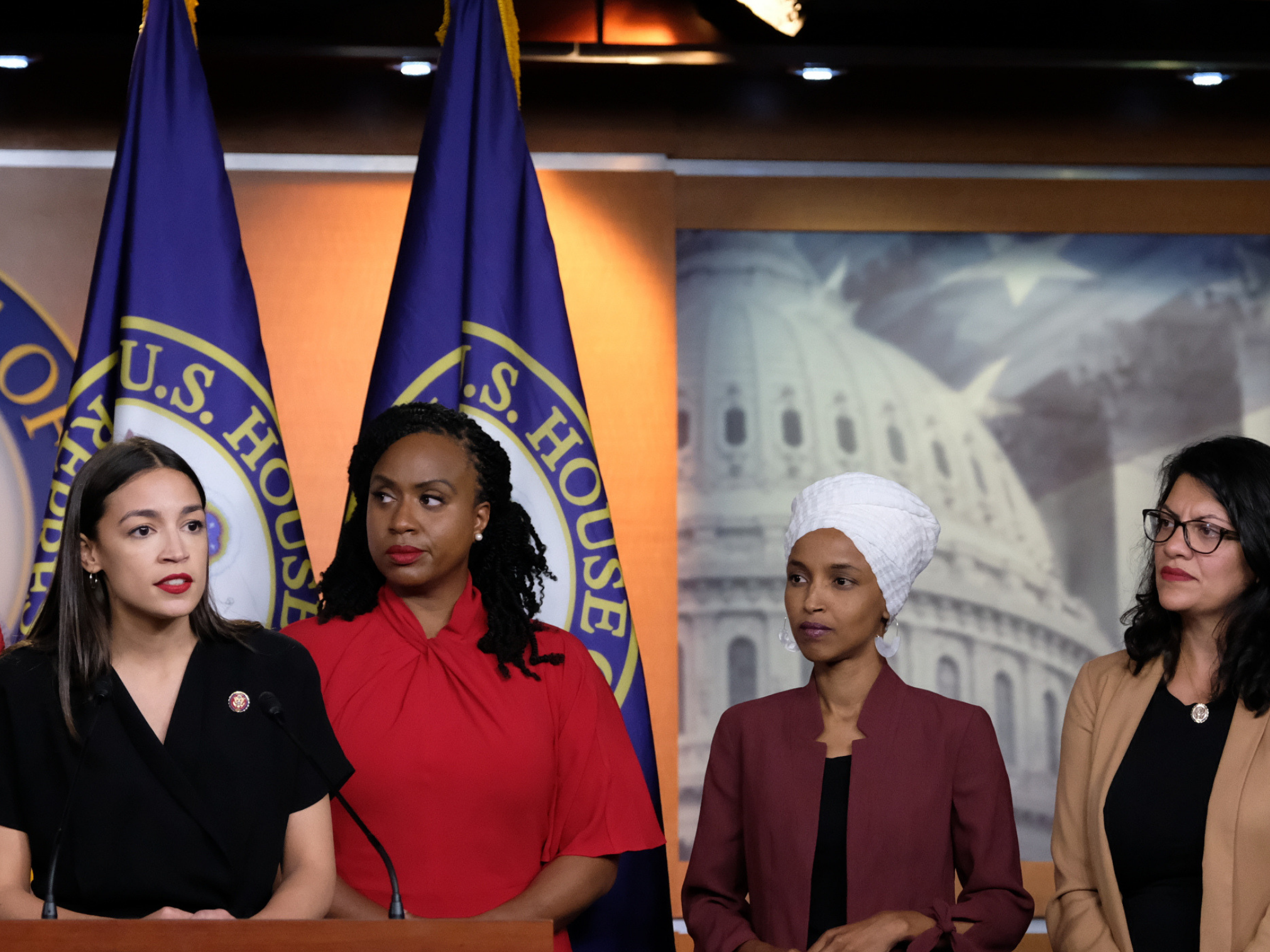








 freedom and reason