Hate Crimes, Hoaxes, and Identity Politics

There are individuals who see opportunity in manufacturing victimhood around identity. At a personal level it’s prestige-seeking behavior. As victims they become the center of attention. But it’s more than narcissism that inspires hoaxes like the one Jussie Smollett, star of the popular TV show Empire, recently perpetrated. To be sure, being black and gay, the potential prestige was for Smollett substantial in a culture that values identity over accomplishment. In orchestrating a context for a fake hate crime by faking a letter telegraphing its details, Smollett could star in his own mini-drama, a compelling story about personal sacrifice in the epic struggle against the ubiquitous forces of whiteness and heterosexism. He could do his bit to support the narrative that America, always problematic, is, with the election of Donald Trump, now in the throes of fascist reaction. In the end, however, authorities couldn’t suspend their disbelief. Neither could I.

Identitarians, on the other hand, took the bait hook, line, and sinker. The story slotted too perfectly into the logic of their brand of politics. Democratic presidential hopefuls Cory Booker and Kamala Harris wasted little time in characterizing the hoax as a “modern-day lynching,” Booker telling reporters that “bigoted and biased attacks are on the rise” and using the incident to tout anti-lynching legislation he and Harris introduced in the US Senate (which passed unanimously on February 14). Booker repeated the meme that “since 9/11 a majority of the terrorist attacks on our soil have been right-wing terrorist attacks, a majority of them white supremacist attacks.” Amplifying the senator’s profile as an impressive force in the black community, USA Today implied that Booker’s notoriety made him a potential target of white supremacist violence. “Booker’s social media celebrity has turned him into a household name,” the outlet noted; “with that he became a focus for those unsettled at the sight of an educated, ambitious African-American unapologetically pledging an inclusive, post-Trump America.”

Manufacturing group oppression is an age-old tactic in the area of ideological warfare. Simulating victimhood is part of dissimulating ambition for privilege. Christianity is a useful example. Through the ages, Christians have been deft at weaving a story of persecution and martyrdom to disguise their power. Their big lie was unraveled by Notre Dame professor of New Testament and early Christianity Candida Moss (a practicing Catholic) in The Myth of Persecution: How Early Christians Invented A Story of Martyrdom. In her book, Moss writes that “the prosecution of Christians was rare, and the persecution of Christians was limited to no more than a handful of years.” Meanwhile, Christianity established itself as the hegemonic ideology of the Roman Empire, a degenerate system then sliding into a fascistic state; Christians used a rhetoric of victimhood and persecution to depict those they marginalized as hateful and oppressive. Christians weren’t fed to lions. They weren’t executed for refusing to deny their savior. They invented a history to advance their authority over others.

The New Church of Identity works with the same playbook. In Smollett The Resistance™ had a would-be martyr whose sacrifice would stand as a testament to the truth that the red MAGA hats worn by Trump supporter represent the new Ku Klux Klan hood. So, on January 22, Smollett received a threatening letter from “MAGA,” which contained crude drawings of a lynching and a hand gun. On January 29, two men, wearing red hats and yelling “MAGA country,” put a noose around Smollett neck and splashed bleach on his clothing. He paid them $3500 up front, plus cash to buy rope, red hats, and bleach, and promised to pay them $500 after the job. The police easily tracked them down and got to the truth of the matter.

Less than two weeks earlier there was another hate crime hoax involving MAGA hats. On January 18, 2019, in Washington DC, a band of American Indian activists led by Nathan Phillips attempted to intimidate a Covington Catholic high school student wearing a MAGA hat. Phillips is a notorious self-promoter and hoaxer who had repeatedly lied about his war record (claiming he served in Vietnam) and, in 2015, claimed Eastern Michigan University students, dressed as American Indians, attacked him. I wrote about Phillip’s latest scam in Sacred Drumming versus the Covington Catholic Kids: Shark Jumping or the Death of Truth? so I won’t recount the details here. It will suffice to say that, not bothering to vet Phillips, the media flipped the story, depicting the student as the perpetrator. More than just this one student, actually. It was a large gathering of high school students waiting for their bus at the Lincoln Memorial. They were condemned en masse, portrayed as a Trump-inspired lynch mob. In the face of all evidence to the contrary, Moveon.org described the situation this way: “A group of teenagers in MAGA hats surrounded and harassed an elder Native American veteran yesterday at the Indigenous Peoples March in Washington, DC.” Anne Helen Peterson, holding a doctorate in media studies no less, evoked Eichmann, tweeting: “It’s the look of white patriarchy, of course, but that familiarity—that banality—is part of what prompts the visceral reaction. This isn’t spectacular. It’s life in America.” Reza Aslan, a professor of creative writing at UC-Riverside, invited violence against the teenager, tweeting: “Honest Question. Have you ever seen a more punchable face than this kid’s?” Actor Alyssa Milano tweeted: “The red MAGA hat is the new white hood.” And thus it appears an scheme was hatched in Smollett’s mind.

Fake hate crimes are a small percentage of hate crimes identified by the FBI. However, the claim that Trump’s election and rhetoric has sharply increased hate crimes is not obvious based on the statistics. The FBI defines a “hate crime” as a “criminal offense against a person or property motivated in whole or in part by an offender’s bias against a race, religion, disability, sexual orientation, ethnicity, gender, or gender identity.” The bureau clarifies that it does not treat hate itself as a crime, being “mindful of protecting freedom of speech and other civil liberties.” A hate crime is thus any crime with an added element of bias. Most hate crime is directed at individuals. By substantial margins, the main targets of racially-biased crimes are blacks, of religious-biased crimesJews, and of sexual-orientation biased crimes gay men.

The FBI has been publishing reports on hate crimes since 2011. In that year there were 7713 victims of hate crimes. In 2012, there was a 7.4% decrease in hate crime victims (7164). In 2013, a 1% increase (7242). In 2014, a 7% decrease (6727). Thus over a four-year period, the nation enjoyed a 13.6% overall decrease in the victims of hate crimes. However, this trend was reversed the following year. In 2015, there was a 6.4% increase (7173) and in 2016, a 5% increase (7615). Thus from its 2014 low of 6727, the nation saw a 12.4% rise in the victims of hate crime rise by the end of 2016. The latest published statistics are from 2017 and indicate a continuation of this trend, showing a 10.9% increase in hate crimes (8,493) from the previous year. Trump’s policies and rhetoric have been blamed for the increase, however the upward trend in victims started in the last two years of the Obama Administration, and it isn’t clear to what we should attribute this increase. Moreover, the percentage of those crimes classified as anti-Hispanic or Latino bias remained unchanged over 2017, as did the number of victims from transgender bias, and the percentage of those classified as victims of anti-Islamic hate crimes decreased by 28% over Trump’s first term as president. One might expect given the president’s rhetoric that the proportions would shift in the other direction.

The sharpest increase in hate crimes involves Jews. Again, it’s not clear what in the president’s rhetoric would inspire that, as he has expressed sympathy and deference towards Israel and the Jewish people. Perhaps his support for Israel—recognizing Jerusalem as the capital, for example—is what has provoked that increase? I discuss the contradictory place in which the Trump phenomenon finds itself with respect to antisemitism in The Trump Mood and Political Violence. Perhaps Trump is more of an effect of the rise in hate than a cause of it? We need more data. While 2018 numbers may tell us a different story, we will have to wait on the FBI to release those data.

Update 9/17/2019: Wilfred Reilly, who holds a Ph.D. from Southern Illinois University and a law degree from the University of Illinois College of Law and is on the faculty of Kentucky State University, finds that of the fewer than one in three high profile hate crime allegations are genuine. His examples are Air Force Academy, Eastern Michigan, Hopewell Baptist, Yasmin Seweid, Jussie Smollett, and Yasmin Seweid. He published his findings in Hate Crime Hoax: How the Left is Selling a Fake Race War (published February 2019, the month I posted this entry). For the book, Reilly assembled a data set of hundreds of hate crime allegations (focused on the past five years), and finds that most of them to be hoaxes on the basis of reports in mainstream national or regional news sources. See this Wall Street Journal article to read more about this. His basic argument is that because racism and bias crimes are actually quite rare, there is a motive to manufacture the illusion that they are problem in order to advance the identity grievance industry.

Wilfred Reilly, Kentucky State University political science professor

What is a Religious Fanatic?

We say that a person filled with excessive zeal, especially for an extreme religious cause, is a fanatic.

If you are always in religious garb, pining for your next moment to pray or supplicate, choosing your foods according to religiously approved dietary rules, avoiding music and dancing because it’s too worldly, pining for the day when the world bows before the dictates of your religion, or comes to a fiery end, then you are a fanatic.

Resistance to Border Security Triggers Trump

Trump has declared a national emergency in order to appropriate money from the Defense Department to fund further construction of the security barrier at the Mexico-United States border. The security barrier is a decades-long bipartisan project to control the flow of people and other things entering the United States. Presently, there exists nearly 700 miles of fencing, much of it constructed during the Obama Administration, the result of implementation of the Secure Fence Act of 2006, a bill passed by both parties and signed into law by President George W. Bush. However, construction of the network of barriers started in the early 1990s. The barrier is comprised of chain link, concrete walls, post and rail, sheet piling, and wire mesh structures. (See Democrats are Being Disingenuous on the Role of Security Fencing in Reducing Illegal Immigration and Crime for a history of this.)

There are similar walls going up around the western world. For example, the Syria–Turkey barrier, a system of fences and walls aimed at preventing illegal crossings and smuggling from Syria into Turkey, people and contraband that then make their way across Europe, enjoys funding from the European Union. Mass migration to Europe has raised crime rates and fueled the rise of rightwing nationalism, a countermovement disruptive to establishment hegemony the neoliberal agenda. But it’s more than this. Migration pressure are growing worse with continued population growth and the coming catastrophe of climate change. The world population is on a path to reach 9-11 billion by mid-century, and almost all that growth will occur in developing countries, especially where pro-birth religions prevail (Islam and Catholicism). (See The Urgency of Population Control and Appreciating the Accomplishments of the Developed World for an in-depth analysis of the problem.) European elites realize that uncontrolled immigration is contrary to their long-term interests. Uncontrolled immigration is also contrary to the interests of the proletarian, so it is a relief to see the establishment coming around to the importance of immigration control. Unfortunately, as I discuss in this essay, US elites are late in coming around to the same understanding.

Those areas along the southwestern border of the United States where security barriers have been emplaced experienced substantial reductions in illegal immigration and significant reductions in associated crime. Despite claims to the contrary, security barriers are highly effective in reducing illegal border crossings. (It is rather curious to see people on the left ape the fallacious argument of the rightwing gun rights crowd that people serious about breaking the law will not be deterred by government efforts to enhance public safety.) But serious problems remain. Immigration and Customs Enforcement arrested 266,000 criminal illegal immigrations over the last two years, including 4,000 homicides. Based on these statistics, 3.5% of the population is committing nearly 12 percent of homicides in the United States every year (see a detailed analysis here: What is the Relationship of Immigration to Crime?). Considering that central and east Asian populations are underrepresented in violent crime, the disproportionality is largely attributable to immigrants from Central America and Mexico. In other words, demographic realities mean that an even smaller proportion of the population is responsible for a large number of homicides.

It is important to consider why there is so much reluctance among Democrats to appropriate money for more comprehensive border control (such was their opposition that they participated in the longest government shutdown in the history of the nation). For establishment Democrats, reluctance admits the neoliberalism they have advanced for decades. Immigration is a tool capitalists use to undermine the standard of living of and politically disorganize native-born labor. Marxist economist Melvin Leiman documents this history in Political Economy of Racism. “[B]y constantly changing the composition of the working class,” he writes, “[immigration] very effectively prevented the establishment of a stable organizing base.” Leiman shows how this tactic in particular interferes with efforts to forge labor solidarity across racial lines. (For a critical summary of the literature concerning the economic and political impact of immigration see Smearing Labor as Racist: The Globalist Project to Discredit the Working Class.) The period of immigration control between the mid-1920s and mid-1960s, the result of rank-and-file labor fighting for its class interests, marked by a stretch of growing and widening affluence for ordinary Americans, led to the emergence of strong worker solidarity and class consciousness. Opening the country to large-scale immigration in the mid-1960s was part of a business strategy, working through the Democratic Party, to undermine labor strength and disrupt worker consciousness. Public pressure to control immigration has therefore been crucial to political enthusiasm for border control measures. At the same time, the appearance of controlling illegal immigration is a propaganda element in legitimizing legal immigration, which presently approaches late-18th/early-19thcentury levels.

For the new crop of Democrats, the so-called “democratic socialist,” the push for open-borders and the hostility towards law enforcement reflects the power of leftwing identitarianism in muddling thought, paradoxically providing support for globalism, a result of the successful socialization of postmodern conceptions of power. This development functions to advance capitalist interests by recasting worker interests as reflective of white privilege, thus disrupting class consciousness and worker solidarity. As I am sure most readers of blog know, racism is a very old strategy used by bourgeois operatives to defang the working class. Throughout the 19th and 20th centuries identity was used by the far right to disrupt leftwing politics. Fascism is the most obvious species of this type of strategy. Walter Benjamin observed in “The Work of Art in the Age of Mechanical Reproduction” that “the growing proletarianization of modern man and the increasing formation of masses are two aspects of the same process.” Here he is referring to the process of divorcing individuals from the means of production under conditions of mass production creating the potential for workers to realize their collective situation of exploitation. “Fascism attempts to organize the newly created proletarian masses without affecting the property structure which the masses strive to eliminate,” he writes. “Fascism sees its salvation in giving these masses not their right, but instead a chance to express themselves. The masses have a right to change property relations; Fascism seeks to give them an expression while preserving property.” This expression takes the form of fetishes for race and various other identities that divide populations rather than unite them in common struggle. The suppression of the worker’s right is thus obtained via aesthetics, “the production of ritual values,” values and practices that eclipse class (the marketing of Barack Obama’s 2008 presidential campaign is illustrative of this dynamic). Consciousness inverted, the progressive Democrat embraces the same sensibilities, albeit on opposite sides of the identitarian divides; and while the politics of the left are not nearly as destructive as fascist politics, they press in the same direction with respect to the harm they cause to class politics. As a result, the cosmetic politics of diversity replace the substantive politics of class. Propagandists then easily slot immigration into the logic of bourgeois antiracism and multiculturalism, which, pushed since the early 20th century (for example by cultural pluralist Horace Keller of the New School, who claimed that cultural diversity and national pride were compatible and strengthened America), has become status quo consciousness, conflating working class interests with nativist sensibilities.

Thus, the Democratic Party appears between neoliberal establishment and leftwing identitarian types, but types that nonetheless support open borders over against the interests of working class families. Moreover, the election of Donald Trump as president in 2016 inspired something the left calls “the resistance,” which, born in hysteria, and deftly pushed by the corporate media, committed itself from the outset to categorically oppose Trump’s agenda, even when articulating traditional values of the marginalized authentic left, such as skepticism of imperialist and militarist ambition. Of course, the Trump presidency is straightaway an affront to the establishment. To be sure, Trump is a capitalist, but he is not a globalist. His patriotic sense of nationalism instinctively guides him to oppose endless war, transnational capitalist hegemony, and open immigration policy because these are bad for his country. Thus Trump is disruptive to the smooth hegemony neoliberals have endeavored to emplace, a hegemony that facilitates the dismantling of nation-state and national cultures, replacing them with supranational political-economic authority and multiculturalism. Because western society has achieved the highest standards of living in the world, in part because of the work of the labor movement, and enjoys a political-legal system open enough to allow for democratic sensibilities and practices, it has become the primary target of neoliberal adjustment, a project that devolves popular public functions to elite private control. This project was developed and led by Democrats in the 1960s. For example, in 1964, President Lyndon Johnson, John Kennedy’s successor of John F. Kennedy, signed into law what was at that time the largest tax cut in U.S. history and followed it with the Immigration and Nationality Act of 1965 (the Hart-Celler Act), both measures that undermined working class power and affluence and concentrated wealth in the hands of the capitalist class. The project has enjoyed bipartisan support since then. Out of step with the times, Trump is an obstacle to the adjustment of the modern capitalist republic (and it is a failure of the left and concerted efforts by the Democratic Party that it does not have its own representative in that office). Since Americanism is, for many, synonymous with white supremacy, it has been easy to enlist young progressives in the neoliberal and globalist project to discipline the working class. This is not just an American phenomenon. The entire West is yielding to neoliberal ambition and identitarian politics.

This is the ideological backdrop. In the foreground of the dispute are pragmatic-sounding and faux-political objections to Trump’s actions. One objection rests on the claim that there is no crisis worthy of a national emergency. Border crossings are down, opponents claim. What is the emergency? Thanks largely for security fencing and more border control assets, border apprehensions are down since 2000, when 1.64 million were crossing the border annually; however, total southwest border apprehensions climbed from just over 300,000 in 2017 to 400,000 in 2018, representing more than a 33% increase. Crucially, the social profile of illegal immigration has changed, reflecting an increase in families and children. Family unit apprehensions at the border have almost doubled, climbing from 75,000 in 2017 to nearly 110,000 in 2018. “In Arizona,” NPR recently reported, “the number of migrant families and children crossing the border more than doubled last year, straining resources in the U.S. and Mexico.” Apprehensions of unaccompanied children are up 25%, from 40,000 in 2017 to 40,000 in 2018. The changing migration profile requires updates to US border control strategy, especially in making it harder for smugglers to dump families and children in the most dangerous parts of the southwest. The pattern of families traveling in large groups reflects their understanding that crossing in larger groups makes the journey safer. However, the Mexican side of the border is controlled by cartels, and they are leading families to remote spots to avoid detection. Humanitarian work is taking agents away from their law enforcement duties, which gives the cartels more opportunities to smuggle drugs and people into the US. Thus Trump’s motive for building more security barriers echoes the work of progressive European elites in providing funding for security barriers at key points of entry on their own continent. Are these efforts also considered fascist and racist? This is one of the ideological objections to Trump’s declaration of a state of emergency: it’s fascist and racist. Is Sweden now a fascist and racist country because it moved to restrict immigration after the troubles the recent migrant crisis brought its citizens? Hardly. Such hyperbole is meant to prevent the citizens of the United States from demanding what is in their best interests.

As implied above, without economic development and secular institutions in the developing world, migration pressures will only grow. A survey of the situation in these countries tells the observer that the possibility of such developments in the near term are remote. Fencing therefore must be central component to any effective strategy of immigration control. From the NPR story cited above: “Despite the recent influx of migrant families, the Yuma sector is widely considered a border enforcement success story. The number of illegal border crossings in Yuma today is just a fraction of what it used to be in the early 2000s.” Yuma is not the only success story, as I have documented on this blog. Indeed, the reduction of illegal border crossings and the continue problem of illegal immigration supports the argument for stricter border controls. Persons who believe their chances of illegally crossing the border are slim are less likely to make the hazardous journey. The difficulty of getting into the United States reduces the number of persons seeking entry. A recent The New York Times headline reads: “With Trumps Tough Deterrents, Many Asylum Seekers on the Border are Giving Up” (the vast majority of asylum seekers are found to have no legitimate claims to asylum). Leftwing identitarians for whom every migrant is a refugee will read this headline with horror, but it is good news for the American working class. Moreover, illegal border crossings, beyond their inherent criminality, are associated with other forms of crime. A porous border is exploited by drug and human traffickers. Individuals who attempt to illegally cross the border are at risk for exploitation, injury, and death. Border control agents describe a much better situation today a decade after extensive fencing. Before, to use the words of one agent interviewed by NPR, it was “out of control.” Another agent interviewed stated that they were “unable to stop the thousands of trucks filled with drugs and humans that quickly crossed a vanishing point and dispersed into communities all across the country.” (See The Border in 2014 … and Now for details.)

The threats to personal security, working class interests, and a concern for human rights makes illegal border crossings a crisis. A more comprehensive approach to border security, including extending the security barrier, will reduce illegal border crossings (see The Situation at the Border and How to Respond to it). This will save lives and jobs and reduce crime. If not stopped, Trump will extend the barrier using dollars that would otherwise be spent by the military for purposes the public has been conditioned to believe represent true “national security” interests. And while national emergencies are unusual events and should be rare (keeping in mind that, between presidents spanning Carter to Trump, 58 national emergencies have been declared since 1976, with 32 of these still in effect), inaction by Democrats to address the problem at the border is partly responsible for the president’s drastic action. Contrary to the interests of working families, Democrats exploit the president’s unpopularity to obstruct efforts to strengthen border security. They are concerned that any success Trump will have on strengthening US borders will put immigration control in a positive light, and this could very well lead to growing consciousness about the harm of immigration on the standard of living and personal security of working people (for an analysis of the harm see The Immigration Situation) and the need for immigration restrictions.


Leave the Dead to Their Graves: Identity Politics Curses the Living

Be wary of language. It helps identify and communicate features of our shared reality. But it also constructs and reifies unreal things and associations. 

Seeking status and power, people make claims based on manufactured realities. Under the guise of “justice” they assign guilt and responsibility for personal advantage and privilege. They claim special judgment and wisdom based on argot and identity. They disappear the individual into aggregates and assumed associations based on socially constructed identifiers. 

Magic works to the extent that one suspends his disbelief. Inter-generational guilt and demand-making on individuals based on race or other socially-constructed identities are forms of magical thinking. Such notions and practices are primitive and superstitious. They’re atavistic. They’re backwards. They’re rooted in retribution. As such they are not ways forward.

Justice demands addressing the wrongdoings of the living for the sake of the living. Leave the dead to their graves. The deeds of the departed, however explanatory, are not punishable. No child should be called upon to account for the deeds of her ancestors. Enough with these hateful biblical attitudes.

The Limitations of Standpoint and the Secular Humanist Fix

That some areas may be gray doesn’t mean that all areas are gray. There is situational and emergent morality and there is fundamental universal morality. Both must ultimately be reckoned beyond standpoint. I cannot conceive of a situation in which compelling a person to continue a pregnancy is just. My inability to conceive of such a situation is not due to standpoint (I am a man) but rather on recognition—a recognition available to anybody who is prepared to think beyond their cultural, ideological, religious, social position—of universal human rights, specifically the right of persons to own their body and their mind. 

We know slavery is wrong not because some people don’t want to be slaves but because no rational and free person would be if given a choice—but even more than that, because slavery makes bodies sick. There is no standpoint that makes slavery good, only ideologies that justify and rationalize it. Compelling a woman to have a baby is a manifestation of slavery. That the target of this practice is the human female should not change our reckoning of that. Victims don’t determine right and wrong; they are victims because they have been wronged.

So, while I insist that understanding the patriarchy is necessary for understanding why we must continue to fight for women’s rights (which are of course human rights), I cannot agree that the fight should be limited by standpoint, which I am defining here as claims of epistemic privilege by virtue of identity. Indeed, it cannot be without violating other rights, such as the right to think and speak freely and critically. 

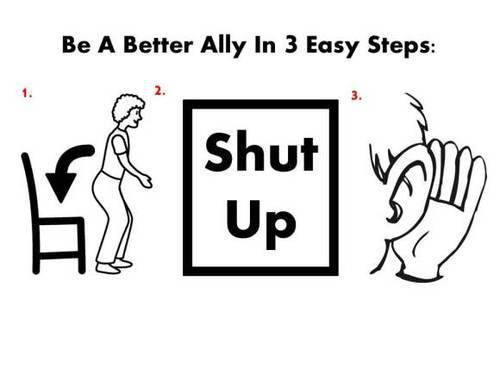
This is why I don’t like the rhetoric of “allyship.” I am not an ally in the struggle against racism. I don’t take a backseat in the struggle on account of my skin color or my ancestry. I have no less moral authority on account of these impositions. I am an individual who opposes racism because of its effects on my brothers and sisters across our species, effects that limit them—and that includes me, as well. Just consider the role racism plays in weakening the class solidarity necessary for a mass movement against capitalist exploitation.

Typical disempowering messaging from allyship advocates

When a black person objects to being asked what black people think, that person is articulating a very important standard: demographic categories do not manifest as human agency. To treat a person’s identity as the prime signifier of truth, correctness, or justice is to reduce persons to, to reify abstractions. When a white person purports to tell people what white people think, the person is assuming authority he does not actually have. He is also assuming an impossible task: conjuring thought from a demographic category. What white person can speak for me? Identity politics is a terrific example of why we tell students in statistics classes that averages and aggregates aren’t people. How did this fallacy become operational in our political and moral struggles? What is real are unjust social relations and oppressive social structures. The truth of those lie outside our points of view. In fact, we need to get on the same page about them if we want to effectively deal with the problem they pose to human freedom. 

To claim that power, culture, or standpoint determines truth and justice reduces ontology to epistemology. This is an error. Denying the facts of reality, this claim falsely reduces reality to subjective impressions of it. So while power, culture, and standpoint can make falsehoods and injustices appear true and just, that does not make them so, and part of the truth of this is the relativity of power, culture, and standpoint. If a black person knows things a white person can’t because segmented experience, then that means a white person know things a black person can’t, yet both of blacks and white people exist in the same system of social relations and have access to the same means of ascertaining the truth of that system. Both are members of the human family with limiting racial identities imposed upon them without their consent. Standpoint doesn’t validate one’s view, it limits it. Making a fetish of subjectivism and relativism doubles down on the self-limiting nature of group identities, impoverishing knowledge of the truth of our collective situation. Secular humanism and materialist science provide an objective view of human relations that transcend the limitations of standpoint (which is why I suspect they are marginalized in discussions of morality).

The truth of morality is easy to see in studying nonhuman animals; other animals are not deceived by ideology (since they don’t have any), and, as long as we’re not also so deceived in observing them, they tell us a lot about the truth of our world. Wolves and bears don’t do well in cages. They are stressed and prone to illness. They want to leap and bound about with their wolf and bear brothers and sisters where the neurotransmitter mix is right so they can feel joy and love. That’s where their coats and noses are shiny. For humans, unjust social arrangements are our cages. They limit us. Unjust social arrangements are the sources of our alienation, stresses, and illnesses. 

To compel a person to be part of a tribe by permanently marking his sexual organ limits him. It denies him the full experience of natural history by blunting sexual pleasure (the full extent of joy he could otherwise experience in his one and only life). Justice demands we stop the practice. Religion is not a valid excuse for violating the individual’s right to consent to such a thing. This is what makes religion so poisonous and why multicultural demands to tolerate it are so odious. Such things cannot be culturally negotiable. The person did not choose to be born into an sexually repressive culture. 

Telling a woman she has to bear a child puts her in a cage. To be sure, because of our big and complex brains we can suffer from the illusion that our cages are freedom. After all, without these brains there could be no gods or devils or divine prescription (because these don’t actually exist). But the truth of this unfreedom does not depend on the illusions these unjust systems weave to oppress us. It depends on objective reality of situations and their effects, and the truth of these exist independent of subjectivity created by power, culture, or standpoint. The critical thinker must go beyond his situation, his culture, and all the rest of it in order to access moral truth. Socially constructed morality must always be checked against what we can know trans-culturally/ historically, and we must always strive to know more. Science is the universal system that makes this knowledge possible. And while science may be misused, its practice is progressive, in contrast to religion which, when faithfully followed, is regressive.

Our species-ties are the product of natural history. Just as they are for any other living system, the conditions for self-actualization and well-being are objectively ascertainable. This is why postmodernist and standpoint epistemologies, as well as deep multiculturalism or cultural pluralism, are so troubling to human rights. Either human rights are universal, objectively determinable, and inhering in each individual, or the very possibility of human rights is negated by a multiplicity of power, cultural, and standpoint-dependent clusters making demands on those who have been or whom they designate as existing under their authority.

We won’t get very far arguing about which identities have rights to make claims. We all have a right to make claims as individuals. To illustrate this with a recent example of progress (rather than dwell on the many examples of paralysis), marriage equality didn’t happen because people were prepared to let a group determine the law for themselves. It happened because the principle that no individual should be denied equal access to a social institution on account of their sexual orientation prevailed. It was the appeal to the universality of a right that won the day. The claim that heterosexual couples were entitled to a special right on the basis of their identity folded. Identity politics lost and individual liberty triumphed. We have to defend abortion on the grounds that it violates the universal right of all individuals to control their bodies. The patriarchy in this case is like heterosexism: it is a barrier to individual liberty. That’s something we must together tear down.

Human Rights versus Group Rights in Law and Reason: Checking Postmodern Creep

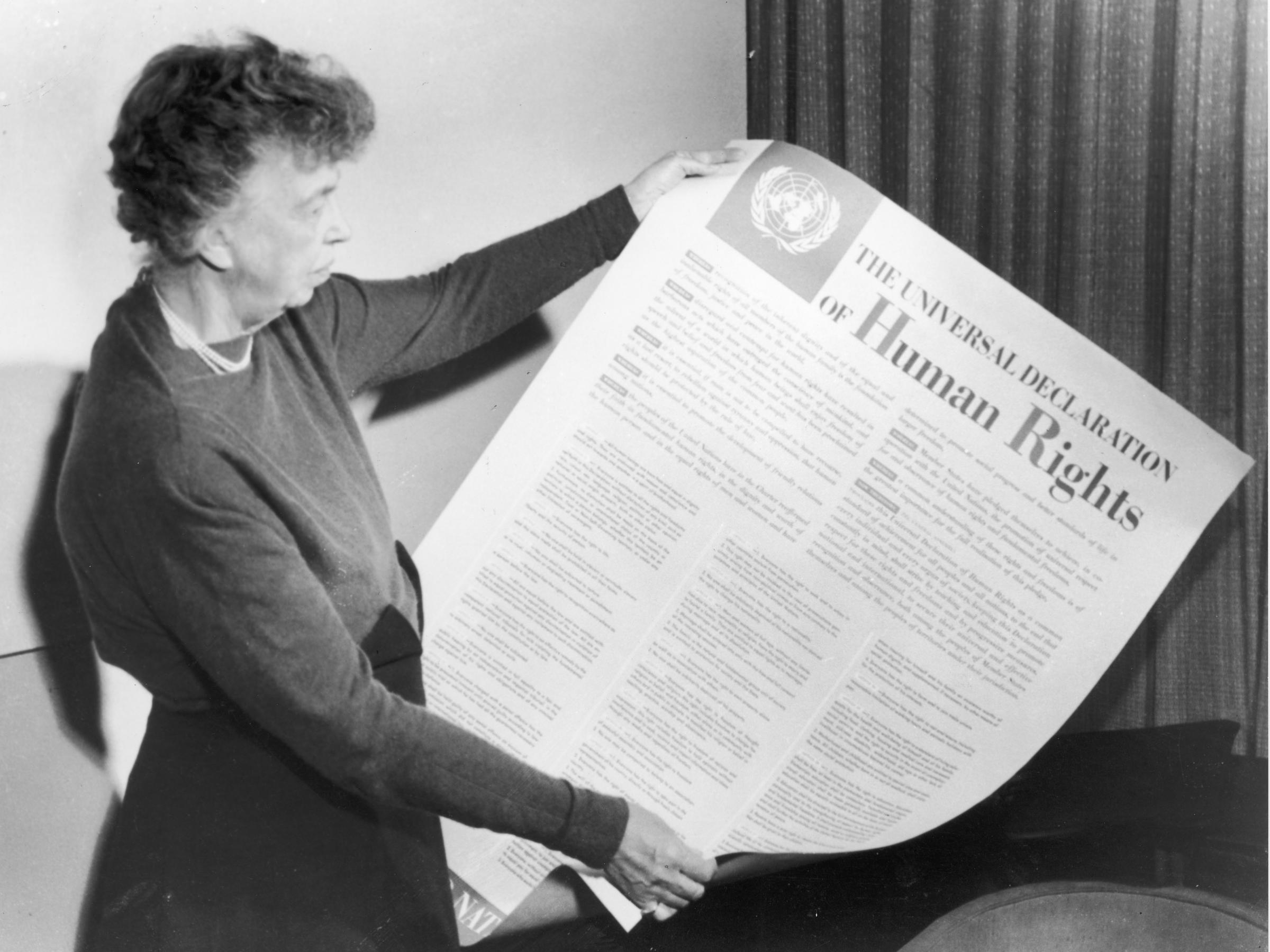
The Universal Declaration of Human Rights recognizes in its preamble: “the inherent dignity and of the equal and inalienable rights of all members of the human family is the foundation of freedom, justice and peace in the world.” By “members of the human family,” the document means individuals. Human rights adhere in each individual as the birthright of our species ties and therefore demand equality. Article 1 states: “All human beings are born free and equal in dignity and rights. They are endowed with reason and conscience and should act towards one another in a spirit of brotherhood.” Humans are reasoning and moral beings and should regard each other thusly. Article 2 states that the Declarations enumerated rights are entitlements “without distinction of any kind, such as race, color, sex, language, religion, political or other opinion, national or social origin, property, birth or other status.”

Elenor Roosevelt displaying a copy of the Universal Declaration of Human Rights, adopted by the United States in December 1948

Crucially, being a member of a group gets you no more or no less of the rights to which everybody is entitled. While the Declaration makes reference to collective entities, such as the nation-state, the associated right, the right to a nationality, resides in the individual. Indeed, there is no logical basis for organic group rights in the Declaration. A group right as distinct from the rights of individuals could abrogate human rights by allowing immunity from the right to not be a slave. To allow the group to control individuals outside of human rights is respect for tribalism, a primitive and oppressive religious construct quite out of line with human rights. Article 6 states: “Everyone has the right to recognition everywhere as a person before the law.” This in principle obviates tribalism.

This principle is embraced in the United States tradition. Indeed, more than other countries, the United States aligns its ideals with these principles—indeed it anticipates them in its Bill of Rights!—and the logic of these rights proceeds on the basis of equality. If every individual is in principle a person before the law, then each person has in principle a right to speech, assembly, and all the rest of it. A white teenager from Kentucky standing at the Lincoln Memorial is as equal before the law – a law that regards silence as indicating nothing – as an elderly American Indian activist banging his drum in protest against the presence of white people on what he claims as his sacred lands. In principle, they both have a right to exist in that space and for whatever purpose they decide as long as that purpose is not to physically harm (some would add harass or intimidate) others.

Because each person is endowed with reason (albeit that capacity is still developing in the young of our species because of our long path to maturity), the arguments and claims a person makes—if he is making any—must be reasonable, which means reliance on secular facts and logic. Gender, race, religion, or other identities are no more reasons that arguments are true or false, right or wrong as they are for claiming privileges before the law. Just as an individual in principle should enjoy no special dispensation for the fact that he identifies as an American Indian or is identified as a white person, so his arguments gain no gravity on that basis. He stands as an individual and his reason and conscience shoulder the same burdens as that of every other mature person. The reality that power or identity can make falsehoods and wrongs appear true and right does not change the objective standards for reasoning though arguments and claims made about the world.

What about empathy? Empathy is about understanding what moves a person. It is not a method for determining the truth. Our shared reality is not a matter of perspective or standpoint. To believe otherwise is to do ideological work.

The extent to which postmodern epistemology—in a nutshell, the method that holds that what a person is determines whether she is right or wrong and that how she feels about something determines the truth of a situation or thing—has become accepted by so many people on the left is a testament to the ability of approved cultural managers serving in establishment institutions to shape popular thought, to mislead people from the path to justice. How else would so many persons claiming to speak to justice embrace the irrational and superstitious ethic of intergenerational and collective injury, guilt, and punishment? How else could reasonable and conscientious people assign blame to individuals or excuse their actions with no evidence or justification other than they are members of a group, that they “belong” to an historically imposed or embraced social construction? How else could intelligent people turn the logic of racism into a virtue signaling politics of the left? All this over against the beautiful and obvious logic of human rights.

In a review of Mistaken Identity by Asad Haider in The Guardian, Ben Tarnoff writes, “Collective self-emancipation doesn’t require abandoning one’s identity—if that were even possible—but linking it with those of others in widening circles of solidarity.” Some identities can be left behind. Some can’t. But the widening circles of solidarity is a start. However, one can get there a lot sooner by recognizing the following:

There are two things that either bind all of us or most of together. The first is species-ties. We are all members of the human family. This means that human rights exist in the individual and all individuals simultaneously. The second is our economic position, which for the vast majority of people is proletarian. So while it is true that racism explains why blacks as a group trail whites as a group in every significant social category, the plight of poor black and poor white individuals is an economic system that exploit human labor. This is why lumping by race or some other demographic category and viewing everything through its lens obscures more than it illuminates, something captured well by Valerie Tarico, in an essay published today in AlterNet (“Here’s why Evangelicals and social justice warriors trigger me in the same way”).

As I argued on this blog yesterday: Those of us on the left who still cast our lot with the struggling proletarian masses have to start speaking out against identity politics as its currently manifested (frankly, even if salvageable, I am not convinced of its utility) and that means looking at ourselves. The process of critical self-reflection begins with recognizing this essential and universal truth: If our politics make assumptions about who people are, what they believe, what they do, what they’re responsible for, and what they deserve on the basis of the color of their skin or some other socially constructed category, then our politics aren’t just wrong, they’re antithetical to premise of human rights and the interests of working people.

Sacred Drumming versus the Covington Catholic Kids: Shark Jumping or the Death of Truth?

On January 19, 2019, at the Lincoln Memorial in Washington DC, Nathan Phillips, American Indian activist and star of the Skrillex and Jr. Gong Markley’s dub step video “Make it Bum Dem,” accompanied by a small band of protestors, having just finished participating in the Indigenous Peoples March rally, marched into a crowd of teenagers, who were at the Capitol in their capacity as Covington Catholic High School students, singled out one teenager and pressed extremely close to him while chanting loudly and banging a drum in his face. The teenager responded by occasionally smiling and making sure that his friends did not agitate Phillips’ group. Nearby a group of men identifying as Black Hebrew Israelites—a recognized hate group by the Southern Law and Poverty Center—were harassing the students by calling them “crackers,” “peckerwoods,” “faggots,” “niggers” (the students were not monolithically white), and other derogatory names.

Nathan Phillips and a Covington Catholic High School student

Initially, a heavily edited version of the encounter was broadcast on Twitter from an anonymous account subsequently deactivated for violating the rules of that social media platform. The edited version (which left out the role of the Black Hebrew Israelites, as well as the aggressive actions of the Phillips’ group) made the encounter appear as if the teenagers—to be presumed racists because they were white, with some wearing “Make America Great Again” hats, the campaign slogan of current president Donald Trump and past president Ronald Reagan—were harassing and mocking an American Indian Vietnam veteran and “religious leader” (as federal prisoner Leonard Peltier referred to Phillips in an open letter carried in Counterpunch). The audience was told that the teenagers were chanting such things as “Build the wall,” a reference to Trump’s campaign promise to build more security barriers along the United States border with Mexico. In the context of a federal government shutdown, with the problem of illegal immigration the core contention, the edited version served as propaganda for the identitarian left to delegitimate advocates of greater border security and to advance its own agenda of open borders.

The irony that a group claiming injury from the mass immigration of Europeans into North America could be symbolic of open borders appears to have escaped everybody. At any rate, the edited video was anything but representative of the actual event. When the full video came out and revealed that Black Hebrew Israelites had been antagonizing the high school students and that Nathan Phillips and his group had piled on by getting in the teenagers’ face (violating the western cultural sense of personal space), those who had pushed the initial account lost a piece of powerful propaganda, powerful because it did not rest on explicit claims around identity but rather took advantage of implicit assumptions long enculturated in the masses by the postmodern politics of identity. It was a dramatic test of the efficacy of multicultural programming in framing political discourse in America. (Why go home? We’re becoming more European every day.) But the truth of the event did not stop left identitarians from continuing to pound the drum of white privilege and guilt. Purveyors of this species of politics quickly developed and disseminated several positive heuristics to defend the failure of negative core of their argument, which is to say that the heart of the argument—that the boys were to blame because of their racial identity—was not revisable (albeit flipped) and other claims were necessary to sustain the initial narrative. Much of the approach was rhetorical (e.g. the deployment of academic jargon such as “centering whiteness”), but the most impactful was the practice of alleging confirming evidence.

One of these alleged pieces of confirming evidence is the reason the boys were there. They were bused to the Capitol to support the March for Life rally held that day. They shouldn’t have been there in the first place, we are told, since the anti-abortion cause is illegitimate (its advocates seek to enslave women—which is true!) and the boys are males who are justly denied an opinion on the subject because they cannot have babies (subtleties and other fights are glossed in warfare). I could spend some time discussing the absurdity of this position (especially the essentialist claptrap), but since the reason they were there is immaterial to the situation, it would be a digression. They could have been there for a myriad of reasons. Only one reason would be relevant, namely had they been there to protest the Indigenous Peoples March rally, and only then if they were the ones who provoked the confrontation.

Another alleged piece of evidence is a brief and shaky video of a group of boys, said to be from Covington Catholic High School and from that same day, yelling at a couple of young women who are walking by. This is held up as proof of malice (and depends to some degree on the fumes of the Kavanaugh outrage). The absurdity of denying common knowledge of the obnoxious reality of teenage boys and girls gathered around park benches to malign the character of the individuals harassed at the Memorial illustrates well the penchant for rationalizing that lies at the heart of the method of identity politics. It would be charitable to say such heuristics are hardly compelling as arguments. But they aren’t arguments at all. 

Those insisting on a racial interpretation of the incident share video footage and images of Covington Catholic students in 2012 (probably on November 27 according to Snopes, which is always on the case) that they insist indicate blackface worn by students at a basketball game. Coventry has a tradition of students painting their entire bodies a solid color. One of the colors used is black. It is associated with what they call “black out” games. Some argue that intent doesn’t matter, and, apparently, that some colors are never to be used by white people as body paint; anybody who is sensitive to the plight of African Americans knows that painting a white body black is offensive and therefore forbidden. Trying to find reason in this argument is difficult. If somebody does or says something that offends you or that you believe is offensive to somebody, but the person intends no offense and has a plausible explanation for/or you can charitably recognize a plausible alternative for why he did/said what he did/said that has nothing to do with offending you or being offense to others, yet you still hold that person accountable for some wrongdoing, then what you’re really saying is that another person should be responsible for your perception of what he did/said, that he should acknowledge your power to define his actions in a particular way (which just happens to serve your agenda) and enlist others in vilifying him.

What authority does a person have to define for somebody else the meaning of an ambiguous action or an action with a contrary intention? It can’t be because that person is black or speaks for black people (pick any race), since an appeals to the authority of identity is not a rational justification for accepting a claim. I hope we all recognize the power of perception and the act of harassing, defaming, and mobbing people who self-appointed authorities think acted wrongly. History has given us dramatic examples. The Spanish Inquisition comes to mind. And while losing one’s reputation is not as bad as losing one’s life, it is not a negligible injury. In light of the vast history of examples, why should anybody cow to those who are so self-righteous that they think they have moral permission to ruin the reputations of teenagers by insisting on particular (and self-serving) interpretations of at best ambiguous events? Moreover, supposing that students wore blackface back then, how is a teenager today responsible for what other people did when he was nine years old? This makes no rational sense. This is the way religious people think.

Yet another angle is to suggest—by way of some temporal-defying modified deLorian-jujitsu move—that the event was orchestrated by professional conservative operatives the services of which the teenager’s family had retained: RunSwitch, a public relations firm run by Scott Jennings, Steve Bryant, and Gary Gerdemann. Jennings, for example, served in senior positions in Mitch McConnell’s re-election campaigns and was senior adviser to Mitt Romney’s presidential campaign. He also worked for Jeb Bush’s presidential campaign and was special assistant to former president George W. Bush. This attempt to save the narrative is as absurd as the others and tells us a lot about the politics in play. But there is also a deep moral failing expressed here: This teenager is being tried in the public court of standing his ground while being bullied. His parents are to be his only immediate advocates? They are expected handle this without any help? Who established this rule? Here’s where empathy comes in handy. Imagine you and your family are attacked for something somebody else did. You’re 16 years old. Your whole life is in front of you and it’s possible that you will always be wrongly known as that white supremacist punk who mocked an American Indian war veteran. You’re being defamed. Your parents—who love you very much—contact a PR firm with political savvy to help you get your story out to the public. Sounds like a smart plan. But, no, that makes you guilty of something else. 

How can people find untoward a family seeking expert help in crafting a message to counter the overwhelming press of national and social media forces determined to wreck the reputation of their teenage son? If they sued any of them for defamation, would they not turn to a legal expert? Do people really think that ordinary people are equipped to defend their kids from the modern media assault? The response I get is this is no ordinary family. They are white and therefore privileged. They are already guilty by virtue of being members of the “oppressor race.” Nonsense. I am white and I am neither privileged nor an oppressor. Nor is this teenager. A person cannot possibly be responsible for anything somebody else may have done in the past. Guilt by virtue of demographic designation is a thoroughly immoral doctrine (on par with vicarious redemption). If it were my kid being hammered like this and I did not have the ability to help him craft a response, I would seek out professionals, just like I would a lawyer if he were in legal trouble or a doctor if he were sick. People sometimes need advocates.

The hysterical left is determined to make sure the teenage can’t win for losing. Anything he does to try to get some semblance of his life back short of validating a warped interpretation of his nonaction by admitting wrongdoing and apologizing (the pseudo-left loves confession and apology) is going to be used against him—and even that will help this wretched species of destructive politics to continue thriving. So it’s my job—and hopefully yours—to assert his innocence and to tell the truth: people are either embarrassed or desperate because they judged a situation based not on what happened but on what they wanted to be true, and they will use anything to save face and make this thing fit their political agenda. For many of you that means taking a long hard look at yourself. Why do you hate this kid so much? Have you still not gotten over high school?

And then there’s Nathan Phillips, a man who, according to Vincent Schilling (the associate editor of Indian Country Today), told him in previous interviews about being spat on when he returned home from Vietnam yet was never in Vietnam. That’s doubling up on mythology! Some have it that we’re supposed to agree that Phillips and his drum have something special to offer humanity (the Great Spirit is just like every other religious claim: nonsense). The talk centers on the need to respect him as an elder. A woman with the band said she was raised to treat her elders with respect so it hurt to see them treat Phillips so badly. But assuming that we are supposed to respect elders even when we disagree with them, the fact is that he wasn’t treated badly. Watch the video. Nonetheless, today he is in the press forgiving the teenager. For what? This is wisdom? (I wonder how much the mass display of reflexive faith in the claims of a shaman is rooted in the penchant among progressives to fetishize the exotic. They do the same with the hijab, treating the obligatory modesty rules of the most extreme interpretations of Islam as expressions of authenticity.)

And what about Phillips’ comrade? The man who said to the teenagers, “You white people should go back to where you came from. This is not your land.” When the teenagers note that it is in fact their country, the man says, “Not it’s not. You have been here two or three generations. Compared to us. We’ve been here a million fucking years.” The politics of social justice warp things in such a way that “woke” people are expected to reflexively deny the racism of an individual of one race telling an individual of another race to go back to a continent he likely never resided in as long as the person being told to “go home” is white. When the man refers to “us” being in the US for “a million fucking years,” he enters the realm of mythology. To be sure, it is a matter of historical fact that there were humans in North America before Europeans migrated there (albeit not a “million fucking years”). But it has no bearing on the right of citizenship, a right guaranteed by Article 15 of the Universal Declaration of Human Rights.

A couple of days ago we might have charitably suggested Phillips didn’t understand what was happening. Self-righteous people are notorious for not bothering to find out what’s going on before they throw down. However, the fact that Phillips agrees with the hateful views of the Black Hebrew Israelites (they speak the truth, according to Phillips), and then today obnoxiously forgives the teenager, gives the game away. Phillips wasn’t trying to calm anything down. He walked into a crowd of boys to confront them because they were white, the same reason the Black Hebrew Israelites were harassing the students. Phillips’ comrade tells us why they were confronting the boys: to blame them for something they didn’t do, a crime no living teenager could be responsible for. The teenagers were being harassed by people who operate on the basis of a confused cosmic and moral paradigm, absurdities the identitarian left enables—absurdities that even find purchase in the halls of the academy.

Those of us on the left who still cast our lot with the struggling proletarian masses have to start speaking out against the nonsense of identity politics and deep multiculturalism. This process of critical self-reflection begins with recognizing this essential and universal truth: If our politics make assumptions about who people are, what they believe, what they do, what they’re responsible for, and what they deserve on the basis of the color of their skin, then our politics aren’t just shitty, they’re antithetical to premise of human rights and the interests of working people. Perhaps the most disappointing development in my 56 years on this world is watching the left embrace the politics of identity that the capitalist class constructed to perpetuate the core system of exploitation and oppression: the appropriation of the social surplus for private enrichment. The notion that an individual is to be regarded in terms of the group to which he is said to belong should lie on the trash heap of history. Instead, it has been weaponized and taken up by the very people whose interests it undermines. If the left had been pursuing the politics of class this whole time, the right wouldn’t have much of anything to stand on. As it is, it enjoys the attention of tens of millions of disaffected working class people who are tired of being blamed for the sins of others.

For the advocates of identity politics, their “truths” rests on the basis of group membership, not on what is actually happening. Such is the cognitive rot of postmodernism. Everything Phillips’ comrade said to the boys is utter nonsense, but because he is American Indian, and therefore the eternal victim of white western man (a crime in which I am implicated by virtue of my skin color), his words are to be received as wisdom. Denying his wisdom is said to be an expression of white supremacy. Of course, his identity is not what makes him wrong—but by the same token it also cannot make him right. And it is this nonsense that is fracturing the proletariat. Explaining the world through racial categories obscures the class dynamic and frames political solutions around something other than the class struggle. The hegemonic strategy of the capitalist class depends on the proletarian fractions carrying out the plan. Getting the victims of a scheme to herald the virtue of the scheme is the gold standard of Astroturf. The left today has been transformed into a bulwark against socialist ambition. Neoliberalism is crafty indeed.

If the future of the West is to fight things out along left and right identitarian lines, then the West doesn’t have much of a future. I know for some that would be a welcome outcome. But it would be a disaster for humanity. The abuse of the Covington Catholic High School kids is a microcosm of the political error of our times.


The Koch Brothers and the Building of a Grassroots Coalition to Advance Open Borders

There is a lot of ignorance on the left about what drives the pro-immigration agenda. I have had many discussions lately with left-wing folks and supporters of the Democratic Party (whose lines they robotically take up) who are startled when I tell them that a major proponent of pro-immigration is a coalition of right-wing anti-labor individuals and groups. “But right-wingers are anti-immigration,” they object. “They’re fascists.” No, they’re not. Many conservative Republicans are reluctant to openly join pro-immigration Republicans in pushing for open borders because they depend on political support from the rank-and-file workers, workers who have been abandoned by the Democrats and labor unions.

Blue collar workers increasingly make up much of the popular base of the Republican Party because they don’t want to see their standards of living decline any more than they have and they recognize that immigration is one of the causes of why they struggle to make ends meet. This is why Trump waltzed through the primaries and won the election in blue collar states: his stance on immigration appeals to blue collar workers, the same blue collar workers Democrats used to court (and still claim to represent). But Democrats no longer worry about the working class because they have major backing from globalists and enjoy the support of a coalition of identity groups that neoliberal cultural managers have knitted together over the years. Democrats and their supporters now claim to represent the “middle class” while disparaging workers in heartland as “white,” “privileged,” “racist,” “xenophobic,” and “deplorable.” 

Two right-wing individuals pushing hard for immigration are the powerful billionaire brothers Charles and David Koch. Their LIBRE initiative, which enjoys the backing of conservative mega-donors who stand to profit from the massive transfer of value that comes with immigration, strives to help immigrants (legal and illegal) come and live in America, learn English, and pass their drivers’ license tests. Learning English and being able to drive is critical for getting immigrants into the workforce where they can be pitted against native-born labor. This is a strategy to suppress wages and disrupt political organizing. It’s class warfare Koch brothers style. As is expected, the Koch bothers are supportive of the Democrat’s pro-immigration agenda.

Charles and David Koch’s LIBRE initiative for open borders

A related Koch strategy is pushing public school vouchers as a strategy to defund the public schools working class kids go to. They’re particularly keen on organizing Hispanics to push for school choice. The goal is clear: the undermining of US national culture, a culture that has been supportive of public education and labor unions. Like today’s Democrats, the Koch brothers are globalists, aggressively pushing for open borders and open trade, pitting native-born workers in the US against cheap labor around the world. They dream of a completely open world in which workers in developed countries have to compete with workers in developing counties. For example, LIBRE refused to back House Republican’s compromise immigration legislation because it lowered immigration.

The Koch brothers have dispatched Daniel Garza, a veteran of the George W. Bush administration and son of a migrant farmworkers, to lobby Congress for open borders legislation. Garza complains that immigration restrictions are unacceptable because they “hinder the ability to address market forces and the private sector to hire who they need to hire.” Yes, they are that explicit about their goals. Garza, like the other Republicans pushing for immigration, are opposed to efforts by Donald Trump to reduce the flow of illegal immigrants across our southern border. Why? Because it reduces surplus population which in turn pushes wages higher.

There is a Time magazine article on this—”Koch Network Mounts Grassroots Effort to Support Immigration”— that is sweet on Koch’s efforts. There is nothing in the Time article about how immigration hurts native-born workers in America. Time’s parent company, Time Inc., was acquired by Meredith Corp. in a deal partially financed by Koch Equity Development, a subsidiary of Koch Industries Inc. However, given the favorable coverage of this across the corporate media, it appears that one does not need to be indebted to the Koch brothers to push for open borders.

The Urgency of Population Control and Appreciating the Accomplishments of the Developed World

The world capitalist system, which can now boast of nearly eight billion humans within its boundaries, is pressing against global ecological limits. Present and expanding rates of economic growth and consumption are environmentally unsustainable, evidenced by the rapid pace of climate change. The world cannot wait to tackle this problem.

Dhaka Bangladesh

I mention the nearly eight billion people who live on this planet because the mass of humanity is a big part of the problem. World population exploded after 1960s, growing from 3 billion to 7.7 billion today (the growth rate began its staggering climb after the world crisis of capitalism in the 1920s), and it is expected to grow to nine or ten million by 2050 (these are median projections). The rate of growth is decreasing, but the problem remains: the impact of billions of people today and in the coming years, almost all of whom will be born in developing countries. The fact that the projected near-zero population growth projected for 2100 comes with more than eleven billion people gives us no space to breathe a sigh of relief. It’s time for alarmism. 

Rather than helping the world’s public grasp the significance of the human population overshooting its planet’s carrying capacity, political and economic elites tell the developed world a different and egoïstic story: rising life expectancy and declining fertility rates are producing rapidly aging societies that will not be able to sustain their progressive structure of human services without some sort of intervention to restore integrity to the system. Life expectancy was 52 years in 1960; many people did not live to see retirement. Today, the population in the developed world has doubled and life expectancy extended to 67 years. By 2050, life expectancy will be 75 years. Many more people are living to see their golden years.

Twisting the good news that developed societies are at or below replacement rates, elites advocate importing from the developing world bodies to sustain the social structures of the developed world. They never mention the capitalist need for more bodies to suppress wages and consume goods and services. They never suggest redistribution of property as a means of securing future living standards for the mass of their citizens. They never appear concerned about the problems of overextending resources, environmental degradation, diminished social services, declining standards of living, the well-being of the native born, or political, cultural, and social disorganization. There is no talk of national strategies for creating a well-functioning societies that serve the interests of their citizens; instead, the best we can do is react to the changing demographic profile by patching it with peoples from other countries.

When the problem of overpopulation is raised in leftwing circles, either the conversation goes nowhere or the person introducing the topic is suspected of eugenics or racism. To be fair, much of the fear on the left of critical discourses concerning the matter is due to its perceived Malthusian implications. Thomas Robert Malthus, the English cleric and political economist, whose book, An Essay on the Principle of Population, first published in 1798, and undergoing numerous revisions over the next couple of decades, posits a relationship between population and the social surplus in which greater food production only temporarily improves the welfare of a people because surplus in turn triggers population growth, is rightly viewed as reactionary. 

Malthus insists that the rate of population increase tends to exceed the rate of increase in food production, which ensures a class of impoverished individuals, and can result in what later observers dubbed “Malthusian catastrophe,” where people at the bottom suffer famine and disease. His formula, posited without proof: the arithmetic increase in food production is swallowed up by the geometric increase in population. Crucially, overpopulation is not a future problem for Malthusian theory; overpopulation is an ever-present dynamic that drives human societies.

One implication of the Malthusian argument is that helping poor people through public intervention perpetuates the problem of misery by producing more miserable people. And so his theory was used to justify rolling back government assistance to the poor. A more general implication is the ideologically view that poverty is the inevitable and indeed natural result of progress; thus, the argument provides ideological cover for inequality and neglect. On a positive note, Malthus’s insight—a general law of population across the spectrum of life—was exploited by both Alfred Russell Wallace and Charles Darwin, co-founders of the principle of natural selection, for their paradigm-shifting theory of natural history. However, human beings build their environments; so the Wallace-Darwin principle does not apply to humans (which did not stop social Darwinists from claiming it did).

But the logic of Malthus does not encompass all possible thinking on the population question. Karl Marx, the great revolutionary communist and radical political economist, also developed a theory of population, one explicitly at odds with Malthus, who Marx regarded as representative of the crude style of the vulgar British economist.

Operating on the basis of a material conception of history, Marx recognizes the inapplicability of natural selection to the human situation and inverts Malthus’ causal order, theorizing political economy as the driver of demographic change, not the other way around. As such, Malthus’ theory applied to humans amounts to a “libel on the human race.” Malthus’s claim is, Marx contends, “an apology for the misery of the working class.” Marx writes in Capital: “Every method of production that arises in the course of history has its own peculiar, historically valid, law of population,” which he distinguishes from the general law of population for plants and animals for which there a law “in the abstract”—“only in so far as man does not interfere with them.” 

The problem of the surplus human population, which is the source of human misery among the ranks of the working class, is tied not to an abstract and general Malthusian principle but is the concrete consequence of the capitalist mode of social production and its conditions. It is the result of capitalist accumulation, specifically the organic composition of capital, a term denoting the ratio of constant capital to variable capital, or the price of labor power. The dynamic proceeds thusly: maximizing surplus value production in pursuit of profit using the method of relative production, i.e. the introduction of labor-saving machinery and organization, systematically generates a surplus population, a redundant mass of labor, workers with no productive function. 

Marx thus proposes a law of progressive decline in the relative size of variable capital. At the same time, the capitalist system promotes population growth to maintain at its disposal a ready supply of labor power and a lever on the price of labor. Surplus population functions to suppresses wages, which is why, Marx argues, the price of labor-power never consumes the surplus. At the system level, this situation creates a contradiction in which capitalists fail to realize the results of expanded surplus value production as commodities as profit in commercial markets, thus triggering periodic realization crises, which lead to other crises until the system either resets and innovates its way out or collapses. 

There are two types of surplus population. The first is the traditional population characterized by a culture of high fertility rates (a bad thing) but for which modernity has reduced the mortality rate (a good thing), with the result a high natural rate of growth (a bad thing). Thus, the transition from pre-capitalist to capitalist modes of production, or the impact of capitalism on societies peripheral to it, create a situation where extraordinary population pressures mount. China and India represent two examples of this problematic, where the development of productive forces outstripped the development of a culture conducive to optimal fertility rates, leading to a population explosion in those countries; both are the most populous nations in the world (1.4 billion and 1.3 billion respectively). The second type is in part the process described by the problematic of the organic composition of capital: workers have a functional role in capitalist production only to the extent that they can provide capitalists with useful labor power. As labor becomes more productive (more production with fewer workers), it is inevitable that there will be individuals who are no longer useful to capitalism, and thus will fall into the surplus population or, if lucky, suffer marginal engagement with the labor market. 

One suggested method for dealing with the problem is to tolerate a high mortality rate among the surplus population. Even if this were an effective strategy, humanitarian sympathies rightly prevent people from tolerating such a thing. Species ties require those with means find some way of at least ameliorating the conditions caused by overpopulation, which I am defining here as a mismatch between the needs of social productivity and the mass of people in a society. Thus, the standard solution is to compel the population that derives an income from either work or the exploitation of work to pays taxes that can be used to support a system making it possible for those who do not have an income or whose income is meager to continue consuming goods and services, thus subsidizing capitalism by recycling income (earned and unearned) through the system. The welfare system associated with the modern capitalist state, while often successfully ameliorative (more so in some developed European states than in others and in the United States) is not a vehicle for self-actualization for those at the bottom of the class structure, but rather is a functionalized system for managing their predicament. And without progressive taxing systems, there is a real question as to how secure this system is, with neoliberal restructuring by the transnational capitalist establishment shrinking the quantity and equality of the social welfare provisions. 

There is another solution. Recognizing that the capitalist class is less concerned with the problem of the surplus population than it is with economic growth, it falls to the world proletariat to limit the numbers of people in their respective nations by maintaining low fertility rates and restricting immigration from developing countries. Sharply limiting national population growth, ideally reducing the size of the population the long term, produces several benefits. First, it reduces the problems of overextending resources, environmental degradation, diminished social services, declining standards of living, and political, cultural, and social disorganization. Second, it reduces the surplus population which in turn shrinks the class of the unemployment thus pushing wages higher. This means that there is a smaller mass of people to be managed by government, which allows for more generous social provisions for those still or permanently in need of public assistance. Third, as I have written about in other essays on this blog, economic empowerment and cultural homogeneity contribute to social solidarity and strengthen support for the achievements of enlightened society: civil, political, and social rights.

When Marx published Capital, the world’s population stood at around 1.2 billion. Marx did not reflect on the impact of this mass of people on the ecosystem because the problem of surplus population was a political economic question; whatever the size of population, capitalism would see to it that there would always be too many people. Therefore, the solution was the overthrow of capitalism and the creation of a socialist society in which all the needs of the people—even the desire to engage in creative work—would be met.

To be sure, socialism is still the solution to the problems of humanity. However, we are facing a problem that a world of 1.2 billion did not face: there are now nearly eight billion humans, and to make a world that allows all of them the comfort they deserve, while observing the principles of sustainable economics, is a daunting task the accomplishing of which is rapidly receding from the realm of possibility. The problem is not solved by redistributing the trillions of dollars currently hoarded by the global bourgeoisie. While they consume more per capita than the average people on the planet, they are small in number; meeting the normal needs of this group does not require very much of the world’s productive output. The real problem is elevating the average Asian or African to the same standard as my family enjoys here in the United States. 

My parents’ generation warned the world about the problem of overpopulation. Perhaps Paul Ehrlich of The Population Bomb fame was the wrong messenger, but the generation’s instincts were right: there are limits. My home country, the United States, is the third largest county in the world population-wise. Americans consume a lot. We should be this comfortable. I deserve it. Indeed, every American deserves to be as comfortable as I am. But the world is not able to support a world population of ten billion people consuming the West’s average level of consumption. It’s not just meat (the most recent effort to distract the public about the actual problem). It’s population.

We in the West can at least do our part: no more people. Indeed, we need fewer people. In a November blog I shared the thoughts of ecohumanist Karen Shragg’s on this subject. In her essay, she explains how it is not just a matter of radically reducing the consumption levels of the West. Total population numbers matter. So even though the average American adult impacts the environment more than the average Chinese adult, the Chinese people’s impact on the environment is twice as great as the impact of the American people. Imagine matching consumption on a per capita basis. 

The West overall has done a good job reducing fertility. And its people are more free as a result—especially women. But to many other cultures have not done this work and many of them aren’t prepared to. Moreover, some are worse than others. In a November 2017 article, The Atlantic complained that the myth of Muslim overpopulation won’t die. But there’s a reason for that: the world’s Muslim population is growing twice as fast as the non-Muslim population. Muslims have the highest fertility rate in the world. There are 1.8 Muslims worldwide, a population that far exceeds China’s entire population. Because this growth is occurring in developing countries (and they are to a substantial extent still developing because of the overbearing nature of their religion), mass migrations are going to grow in size and frequency. Some folks think Europe and North America represent the cornucopia into which population pressure can be relieved. Our spaces cannot be allowed to serve these ends. We must not willingly suffer on account of other peoples’ recklessness and irresponsibility and backwards cultural sensibilities. And we must not help capitalists in their desire for cheap labor. I see good-hearted people eager to open our space to the world. They should know they are serving the interests of capitalism.

Knowing that nothing is so obvious as to obviate straw man objections to argument, I hasten to clarify that the arguments in this essay have no basis in the net-malthusian and eugenicist theories of Garrett Hardin or Fairfield Osborn and William Vogt before him (which is not to say they were wrong about everything). I do not celebrate death as a means of restraining overpopulation. I abhor population control strategies that select reductions of groups based on race (as I have written about). I am advocating reducing fertility worldwide (which, to be sure, means some population groups require greater levels of intervention) and equitably redistributing resources as means of preventing deprivation. Even those harshly criticizing the neo-Malthusians, for example Marxist environmentalist John Bellamy Foster, recognize that, to quote Foster, “population growth is one of the most serious problems of the contemporary age.” And Bellamy wrote the words in 1988, when the world’s population was 5 billion. Population is tied to historical conditions, conditions driven by what Amartya Sen demonstrated long ago to be the result of differential entitlement radiating from capitalist market dynamics. To grasp the reality of population pressing upon society, one must understand how population is a result of the capitalist dynamic. But this is no reason to forget that “population growth is one of the most serious problems of the contemporary age.”

In these essays, I am advocating for the working class. The national proletariats in the developed world must resist the call for their countries to serve as the pressure valves for global population problem. They should not fall for false rhetoric about the need to import bodies to sustain entitlements, an argument designed to undermine the demand for redistributive policies to shore up the living standards of those who produce the value in society. Nor should the working class fail to recognize that the surplus population problem is a strategy capitalists use to suppress wages and create a culture of uncertainty that pits workers against each other and makes them thankful for the jobs capitalists “create” for them. A million and more immigrants a year keeps wage-killing competition going (as we have achieved low fertility in the West, which promised higher wages and stronger bargaining power). Half a trillion dollars in wages lost annually to the capitalist class because of the wage differential between native and foreign born labor. Should American workers start begging capitalists to pay them less so they can have a job? The national proletariats should not be expected to suffer diminishment in their standard of living because capitalism and overpopulation create crises in the developing world. We have tens of millions at home who need work. Constrain the labor supply and you raise wages and create jobs. There is no proletarian interest in increasing the population of their respective nations, either in the developed or the developing world. 

No More Deaths and the Righteousness of Civil Disobedience at the Border

Fences stop illegal border crossings. Not entirely; some people go over or cut through the fence. But, extraordinary efforts notwithstanding, fencing deters around 90% of illegal border crossings. These reductions are associated with reductions in crimes in those areas where fencing is emplaced. This benefit is typical of security measures, such as padlocking shed doors. To be sure, padlocks can be removed with bolt cutters. But most people who find locked doors go no further than that.

Some have suggested that, since fencing is not maintained where there are few or no people, this security measure drives migrants to where the terrain is most perilous. There, they say, people are at risk to die from the elements. As reported on this blog (“The Border in 2014 … and Now“), illegal border crossings are associated with a high human cost. Ergo, they contend, fencing is immoral. The same argument can be made about watchtowers and watchmen, of course. People who intend to break the law avoid authority and its structures. If people engage in dangerous behavior to avoid being detected while breaking the law, then who is responsible for that?

For most people making the trek to the US on their own, seeing miles of fencing in either direction is an effective deterrent. They only knew to avoid ports of entry (since they have no legitimate reason to cross, they knew to avoid authority); not really knowing what to expect, they could not have expected security fencing. The amalgam of fences, steel barriers, and concrete walls, sometimes with razor wire crowning their tops, is an impressive sight. Fencing and walls are unwelcoming and many migrants turn back. However, many other migrants never encounter these structures because human traffickers lead them to where there are few people in order to avoid detection. That means to the gaps in the fencing and the roughest terrain. Human traffickers are interested in moving bodies, not usually with what happens to people once they feel their job is done. Sometimes human traffickers on the US side of the border—sooner or later—welcome migrants into the network of criminal companies where their labor will be superexploited. Other times traffickers on the US side don’t show and traffickers from the Mexico side abandon the migrants to the elements.

Enter humanitarians who seek to help migrants in this situation. One such group, the faith-based No More Deaths, provides aid and shelter to illegal immigrants on the southwest border. Last years nine members were charged by federal authorities for various offenses. Four of the nine are currently on trial for dropping off food and water for migrants. At least this is the way their crimes have been characterized in media supportive of their actions. Tagged the Cabeza 9 (conjuring civil rights imagery), they have become a cause célèbre on the identitarian left.

It is important to consider what is involved in leaving food and water for migrants. Rationally, there must be knowledge that migrants will be at a certain place at a certain time to receive the assistance, otherwise leaving food and water in the wilderness is like expecting an exhausted, hungry, thirsty individual to find a needle in a haystack. Serious people don’t engage in haphazard action. These are big spaces full of brush. Supposing no coordination, leaving large amounts of plastic and aluminum in a protected wilderness area (those on trial were issued citations in August 2017 by a US Fish and Wildlife Service officer in a protected area west of Ajo) is ecologically irresponsible. Of course, one cannot rule out naiveté even among serious people.

It is also important to consider that the offenses are misdemeanor charges: operating a vehicle in a restricted area, not having a permit for being in the area, and abandoning personal property inside the Cabeza Prieta National Wildlife Refuge. In light of the fact that Cabeza Prieta is one of the deadliest corridors migrants transverse, and that expectations of American assistance risks encouraging migrants to take this route, and, moreover, that the activists are aiding and abetting criminality, the charges may seem rather minor. Moreover, if the past is any indication, they will likely be dismissed. (One of the nine, Scott Warren, is facing a separate felony charge for harboring illegal immigrants. This is a more serious charge.)

Activists protesting the charges characterize No More Deaths’ work as “humanitarian.” Their slogan: “Humanitarian aid is never a crime. Drop the charges.” Subjectively humanitarian, perhaps. I’m sure they feel like they are doing the right thing. I’m sure they feel like they’re part of the second coming of the Underground Railroad. Objectively, however, facilitating the dangerous practice of crossing the Cabeza Prieta is not humanitarian action, but action contrary to federal laws designed to protect persons, the environment, and the integrity of the Mexico-US border. Dropping the charges sends the signal that, if migrants chart a path through the wilderness to avoid detection, humanitarians will be there to assist them, thus giving migrants false hope. With the amount of media attention, a lot of potential migrants will likely hear about the work of No More Deaths. With more caravans on the way, these is a dangerous message to send.

It is revealing that the defendants in the case called upon John Fife to testify on their behalf. Fife is a Presbyterian minister of Tucson, Arizona, who, in defiance of federal law, organized over 500 churches over several decades to help migrants illegally cross the border and find sanctuary in the United States. Fife was convicted in 1986 of violating federal immigration laws and sentenced to five years’ probation. He is retired, but works closely with No More Deaths. It is not uncommon for religious leaders to believe the work their god has called upon them to perform takes priority over the rule of law of a secular nation. It is also not uncommon for them to engage in what they believe is moral action only to endanger people’s lives. Religious ambition isn’t usually governed by reason and facts. I’m sure they believe the Lord guides their actions. What would Jesus do? Probably not this.

This is not to say that I disbelieve in civil disobedience in principle. There are reasons to break the law (albeit no valid reason hails from religious doctrine except accidentally). At the same time, disobedience comes with a cost. If your actions are illegal, then criminal sanctions are the price you pay. Martin Luther King, Jr., reminded his followers of this fact: while the law was an obstacle to racial justice, and individuals were therefore right to disobey segregation ordinances, for example, they were nonetheless breaking the law. Responding to civil rights activists failing to wait for the proper permitting, the Supreme Court in Walker v. Birmingham (1967) commented: “This Court cannot hold that the petitioners were constitutionally free to ignore all the procedures of the law and carry their battle to the streets. One may sympathize with the petitioners’ impatient commitment to their cause. But respect for judicial process is a small price to pay for the civilizing hand of law, which alone can give abiding meaning to constitutional freedom.” You cannot expect those who enforce the law to excuse you from any consequences because you feel strongly about what you are doing.

I also believe in the legitimacy of the US federal government—the Supreme Court spoke powerfully to this in its 1967 ruling—and therefore expect that acts of civil disobedience will be clearly justified on legitimate moral grounds. Helping people illegally enter a country that has the most generous immigration laws in the world is not a legitimate reason for violating the law. It is hard for me to feel sympathy for the situation these nine created for themselves by violating the law to these ends. Indeed, it is hard for me to shake the feeling that people who do this harbor contempt for the nation and the will of its people. At the same time, I am feel some pity for them that their religious belief have so confused them about what is in the best interests of both the country and migrants. I would like to believe that people who probably mean well are also harmless. However, either intentionally or functionally, No More Deaths play a role in perpetuating human trafficking.

When I have these conversations with pro-migration folks, I often hear the sympathy claim that all migrants want is a better life. The following things are all true: there are people who seek to come to the United States to work and send money home and then return; there are people who seek to permanently move to the United States to live and work; there are people who are fleeing violence who seek asylum in the United States. However, in all those cases there is a process. The person arrives at a port of entry and requests the US government consider their case. There is a backlog of people who have sought entry into the US in a legal fashion. More than a million people are allowed into the United States every year to live and work or go to school. So while these may be reasons to seek entry to the United States, they are not reasons to illegally enter the country. Nor are they reasons for Americans to help people illegally enter the country. The so-called Cabeza 9 are not being unjustly treated.