The Neoliberal Assumption of Educational Programming

I read this essay at the Wisconsin Sociological Association Meeting in La Crosse, Wisconsin the morning. 

One of the chief objectives of the neoliberal program to devolve the public sphere and weaken democratic institutions and traditions is the elimination of progressive and creative educational programming committed to cultivating “thought leaders” concerned with broad community interests.

Imparting the skills of identifying complex problems and bringing into focus their many and interconnecting dimensions by teaching people to think across disciplines and consider multiple perspectives, as well as encouraging faculty, staff, students, and graduates to work with communities to develop comprehensive solutions to those problems is too disruptive to the corporate command of society.

Pushing back against the ideological notion that solutions to the societal problems of joblessness, crime, and addiction are to be found in personal adjustment and adaptation, and instead teaching people to see collective circumstances and undemocratic power as barriers to autonomy and well-being, problem-focused programming promotes an engaged and vigorous public life, fuel for the democratic movements that challenge the hegemony of the corporate bureaucratic control.

In contrast to classical liberal and social democratic conceptions of education, neoliberal and conservative forces seek to transfer the commonwealth function of public institutions to technocratic machinery governed by business and administrative elites, a narrow and specialized bureaucratic framework generating fragmented and siloed knowledge for the benefit of the aristocracy of capital.

Neoliberal “reformers” envision education as a network of business platforms with interchangeable and exclusive program codes that homogenize and commandeer expertise to stamp out workers for employment in ever more rationalized systems.

The neoliberal tendency is not just about profit maximization. Entrenching bureaucratic rationalization fuels the growth of authoritarian control. Bureaucratic state capitalism has little tolerance for democracy except as a symbolic exercise in manufacturing consent.

The steps being undertaken to affect this transformation are seen in, among other things:

  • the assault on faculty (or shared) governance, tenure, and academic freedom;
  • efforts to undermine educator prestige (teacher bashing) and waging war on public teachers unions;
  • aggressive intervention of business class representatives in the decision-making process of educational institutions;
  • taking, in part or in whole, control over programming and pedagogical method and format away from faculty (for example in textbook selection committees);
  • the homogenization and interchangeability of programming and the manufacture of distinctiveness in signature programs tailored to business and business-serving governmental ends;
  • the reduction of general education to cultural literacy and skills development;
  • the shifting of the costs of education from the taxpayer to students and their families;
  • the cooptation and grooming of members of the professoriate and academic staff to carry out the neoliberal agenda on the ground.

The last bullet point is the consequence of the effect of neoliberal reform, but its existence moves the agenda forward. By substituting the needs of the community with the needs of business dressed up as community interests, neoliberalism cultivates a different type of academic: the entrepreneurial-minded operative drawn into circumscribed associations and professions tied to and subservient to and uncritical of elite power. Deferential to corporate power, the entrepreneurial academic, uncontroversial and adept at making small talk, stands down his principles for the sake institutional advancement and personal enrichment.

As neoliberal logic and practice invade and occupy our social space, its emergent subjectivity threatens to colonize the lifeworld of the academic, separating individuals from the group and assimilating them in projects that undermine the university’s historic mission: to impart and transform knowledge for the benefit of the commonwealth. Resistance to the forces of neoliberal requires critical praxis and solidarity work. Unfortunately, life training in the capitalist values of hierarchy and obedience prepare many individuals for alienation from their peers and cooptation by neoliberal forces.

This is not to say that the work of the administrator cannot be for the good of the community. Many of us have counted on allies in administration. But power tends to select those who advance its goals and filter out those who resist them. The question of who is in power remains a relevant one. Indeed, this is why faculty governance is so crucial to the preservation of the university as an institution for the public good and not an instrument of corporate power.


Crime Blotter: A Mixed Bag

Some (preliminary) good news on the UCR violent crime front. We have to wait to see if this is a trend, but after growing significantly over the second half of the Obama presidency (I use this mark for periodization) by percentages of 6.2 and 5.2 overall, the violent crime rate shrunk in the last cycle (2017/2016) by -0.8%. Significantly, rape is down (-2.8%) and so is robbery (-2.2%). Murder continues to increase, but the annual increase of 1.5% is significantly less than the previous two cycles (2015/2014 6.2% and 2016/2015 5.2%). Aggravated assault is down, but only slightly. These declines are likely due to robust economic growth improving the conditions of those demographics associated with higher violent crime rates. This would also explain the drop in property crime (-2.9%) with significant decreases in burglary (-6.1%) and theft-larceny (-3.0%).

Murder is stubborn for various reasons. African Americans are six times more likely that European Americans to be murder victims (approximately half of all homicide victims are black), while Hispanics are almost three times more likely to be homicide victims than non-Hispanics. Crime for both of these demographics is overwhelmingly a within-group phenomenon. A big piece of this is gangs, not just surrounding the drug trade, but generally violent intragroup dynamics. One reason for the high rates is that insufficient resources are deployed to catch and punish the killers of black and brown people. Blacks and browns are, as Harvard’s Randall Kennedy puts it, racially selective under protected. But the main reason remains persistent inequality in our inner cities and the culture of violence it generates. Inequality is the chief predictor of violent crime, especially murder. Murder and our inner cities—Baltimore, St. Louis, Kanas City, New Orleans—continues at alarming levels, between 10 and 19 percent for cities of 250 to 999 thousand. This is true for cities throughout the western world.

You Cannot Hide Your Crimes in the Past

Those defending Brett Kavanaugh make a lot out of time between when his alleged actions took place and when his accusers came forward. They claim this speaks to his innocence. Is Bill Cosby innocent because his sixty victims didn’t come forwards years ago? Think about it for a minute: Cosby was able to drug and rape women, the earliest known cases dating to the mid-1960s, without a lot of people suspecting him of these heinous crimes. A hardcore life-long sexual predator and it took years for his crimes to surface. That his crimes went effectively undetected is a reason he was able to keep repeating them. He is finally a convicted rapist and he is going to prison for it, but prison is not what makes his drugging and raping real. It was real long before he was brought to justice.

Catholic priests have been molesting children for decades. It took years for that to come out, too. And it’s still coming out. How could these priests and their superiors have hidden thousands of victims for so many decades in so many churches without very many people knowing? Bishops and other leaders of the Roman Catholic Church in Pennsylvania covered up child sexual abuse by more than 300 priests over a period of seventy years (Catholic Priests Abused 1,000 Children in Pennsylvania, Report Says). Why did those who did know not come forward? These were children being criminally violated. How does this happen? How do rapists hide repeated sexual assault from parents? Should we think of priests as innocent of these heinous crimes because their victims didn’t come forward?

Why are people defending sexual predators by asking questions that any person with even a passing knowledge of victimology knows the answer to? Criminologists have known for a very long time that sexual predation flies under the radar screen because women are scared of being ruined for telling the truth. Their fear is reasonable. Look at what conservatives are doing to Christine Blasey Ford, one of Supreme Court nominee Brett Kavanaugh’s victims. The way she has been treated is Exhibit A for why women are reluctant to come forward with their experiences. There are those who wish to keep sexual assault and harassment quiet and continuing, so they keep the victims in the shadows through shame and intimidation.

But we are having a popular awakening to the fact that sexual assault has been rampant in US history and that perpetrators cannot hide their crimes in the past. Fear is contagious, but so is courage, and here comes the boomerang.

Brett Kavanaugh and Gynophobia

The same people who want to control the womb are very often the same people who don’t really have a problem with men forcing themselves on women (unless it’s his woman) – indeed, who are likely to be the men who force themselves on women. Kavanaugh represents what they’re about: the boy’s club. Their motto: “Boys will be boys.” They desperately want #MeToo to go away because they know that, while fear is contagious, so is courage, and Kavanaugh is their magic boy to stick it to all the sexual assault victims coming forward – perhaps before their own pasts are exposed.

What are they so afraid of? Women. They’re terrified of women. This is why they treat the accusations as if they amount to witch hysteria. What lies at the heart of the freakout is gynophobia, a deep and pathological fear and loathing of women. Eve gave Adam the forbidden fruit. The woman conspired with the serpent to deceive the man, the first human, to ruin paradise. But for her, he’d be pure and living at the foothills of Heaven. Women have a penchant for falsely accusing men of rape; their souls manufactured below, women use sex as a weapon. They are the corrupters of men. Their sexuality must be controlled and regulated for Heaven’s sake. When it comes to matters of the flesh, men are weak and manipulable. They can’t help themselves. Such is the lure of the siren. Men are the true victims – the victims of manifestations of Cathy Ames of John Steinbeck’s East of Eden. Psychic monsters with malformed souls.

Projection is at the core of the Abrahamic traditions. When the abusive father is having his authority questioned there is a crisis. This is contempt of natural power – the natural order of things! So desperate are the boys to preserve the patriarchy – and so many stand alongside them rationalizing it all the way, including the girls – that they can deny with a straight and angry face the truth of what compassionate and empathic observers can plainly see.

And then there is this: the keg and quaalude cohort was large in the early 1980s. They reflect on their Kavanaugh pasts, the red cup and PGA punch world they still high five over, and think “That was rape?” There is a large reserve of organic support for Brett. If he was wrong, then they were wrong. All those nights they don’t remember. It’s a lot more satisfying to sit back and think, “I could have sat on the Supreme Court.” Bart absolves them of their sins – if they were to suppose that that’s what they are. 

This is why feminism is still relevant: it is the frame that demystifies the power of the father – the power that makes boys special.

Law Enforcement and Family Separation

When there is probable cause that a crime has occurred, or in effecting an arrest warrant, law enforcement will attempt to take the subject in question into custody. In making an arrest, officers often find it necessary to do so with family members present. Officers should secure the subject in the safest manner possible while respecting due process; however it is not uncommon for children to be separated from parents in the process. Children will remain separated from parents during periods of confinement. For obvious reasons, children cannot accompany parents to jails, prisons, or, typically, detention facilities. Family separation is thus a commonplace occurrence in societies with a modern law enforcement apparatus. Emotional distress is neither unlikely nor unexpected in these situations and, unfortunately, there is often very little that can be done to avoid it, albeit there are ways to minimize it (which is not the subject of the present essay).

Family separation during deportation proceedings is a common experience in communities with large numbers of immigrants who have entered the country illegally or overstayed their visas. Total deportations by Immigration and Customs Enforcement (ICE) hovered around 400,000 persons annually in each of the first four years of Obama’s presidency. In many of these cases, there were children who were separated from parents while their cases were adjudicated and, in some instances, remained in the United States after their parents were deported, either turned over to relatives or placed in foster care. Obama also stepped up border controls, apprehending and detaining tens of thousands before returning them to the other side of border. Obama deported more immigrants than any other president, which effectively makes him a leader in family separation. In total, 2.5 million immigrants were deported during the Obama presidency. Obama pursued his strategy of certain and swift deportation in order to deter immigrants from Central America. The strategy was effective, sharply reducing the numbers of those attempting to illegally cross the border. There was little opposition to Obama’s policies by Democrats.

What motivated Obama’s aggressive policy of deterrence? There are at least eleven million persons in the United States who are here illegally (probably more) and their presence is associated with significant social injury, including lower wages and displacement for native-born workers and those with valid work visas, overburdened public services, neighborhood disorganization and overcrowding, and, for urban areas, higher levels of crime and violence (for more on this see The Immigration Situation). Citizens and residents who are legally in the country rightly expect the government to enforce immigration laws to protect jobs and public services and keep neighborhoods safe and orderly. Again, if this can be done in a way that minimizes fallout for families, this should be inform policy; but if there is a desire to control immigration—and immigration control makes sense from the standpoint of the interests of labor—then some some mixture of action that includes deportation will be the appropriate federal policy.

Yet we are seeing an attitude on the left, from those who presume to speak for working people, that manufactures depictions of law enforcement as unjustly oppressing a community by detaining and arresting immigrants who are here illegally as if they were members of a minority targeted on the basis of ethnic or racial identity. The comparisons are hardly subtle; analogies are being drawn between law enforcement and the Nazi SS. There are calls from the left for local and state governments to interfere with law enforcement efforts by providing sanctuary for undocumented workers. There are even calls to abolish critical law enforcement agencies, such as Immigration and Customs Enforcement (ICE). To be sure, because the perception that immigration is dominated by Mexicans and other Latin American nationalities, those with brown skin or who speak Spanish are suspected of being illegal immigrants and stopped and harassed. These  reasons do not rise to the level of reasonable suspicion. Discrimination of this sort does not negate the principle of immigration control. 

The social injury caused by illegal immigration requires remedy, and one way to advance just redress of grievances in any domain of criminal violations is to identify those who break the law and hold them accountable. In the case of immigration, the desire to see law enforcement fail in their duty or the call for agencies to be abolished in order to prevent the law from being enforced is tantamount to calling for open borders. Sweden opened its borders in 2015 with terrible results. Tens of thousands entered the country overwhelming Sweden’s capacity to provide for its citizens and causing a sharp increase in poverty, crime, and violence. The proportion of foreign-born in Sweden now exceeds eight percent. Without open borders, the situation is worse in the United States. This nation hasn’t seen the percentage of foreign-born at it current levels (around 14 percent), since the late nineteenth century. Pushed by working class concern over wages and living conditions, the government passed laws tightening our borders in late 19th and early 20th centuries (see The Need for Limits), reducing the percentage of foreign-born persons to five percent by the 1960s, a period of unprecedented prosperity for American workers. Since then, as the proportion of foreign-born has grown again, the material circumstances of working people has deteriorated and the class has become politically disorganized.

Second, family separation is not a special reason to refrain from enforcing the law. If it were, then this would bring enforcement of any criminal statute into question, since those also result in family separation. More than 1.5 million children under age 18 have a parent in state or federal prison. That represents more than two percent of the total US child population. Only a portion of those arrested and convicted are sent to prison, so the number of children separated from parents at other stages of the criminal justice process is much greater. It would be strange to hear a cry in favor of abolishing the city police because taking property offenders into custody causes children to be separated from parents who break the law. Indeed, we don’t hear such cries.

Third, the idea of sanctuary is contrary to the doctrine of federal power central to the logic of Constitution of the United States. Immigration and Customs Enforcement is the law enforcement agency in charge of this domain of criminal activity.  Because of the Supremacy Clause in the US constitution, federal agencies have authority over local and state law enforcement agencies and jurisdictions. Article VI, Paragraph 2 of the US Constitution establishes that federal law supersedes state laws and constitutions. Crucially, this article prohibits states from interfering with the federal government’s exercise of its constitutional powers. A local or state government cannot compromise the safety and security of US citizens by standing in the way of federal law enforcement agencies. We are first citizens of the United States. We depend on the federal government to defend our safety and security however irresponsibly state and local governments may behave. As much as I loath the drug war, federal drug laws supersede the drug laws at the state and local level. 

Finally, opposition to immigration enforcement typically uses rhetoric falsely equating immigrants to members of a minority group in the way that concept is applied to racial or ethnic groups. Immigrants are not a racial or ethnic group but an aggregate made up of many races and ethnicities. Immigrants do not represent a group-in-itself. Immigrants tend to settle in racial and ethnic communities as they seek familiar surroundings. This is as true of Swedes as it is of Mexicans. But an illegal immigrant in either community is subject to detention or arrest on the basis of the violation of the law, including residing in a country he is not legally authorized to reside in. Treating immigrants who are breaking the law as if they constitute a minority group and are being arrested on that basis is like treating those who perpetrate property or violent crimes as if they are members of a protected minority. This is why, as Peter Skerry notes, the traditional civil rights language applied to the black struggle for equality does not apply to immigrants. It is a confusion of categories.

Immigration refers to movement of non-citizens from one state or territory to another state or territory. Illegal immigration is in contravention of a country’s immigration laws. Neither Republicans nor Democrats advocate stopping immigration enforcement. And while a minority of Democrats calls for the abolition of ICE, most Democrats do not. Polls of registered voters find that nearly two-thirds express the view that immigration control is inadequate and eighty percent want secure borders. Some might suppose based on this that a majority of Americans are anti-immigrant, but the desire for immigration control and secure borders is not a reflection of anti-immigrant sentiment. It is not nativist, racist, or xenophobic. It is a recognition of the importance of borders and immigration law to the wellbeing of a nation. At the same time, the United States is the most generous nation in the world with respect to immigration. It is the first choice of immigrants and, because of this, and because of relaxed immigration control, it has the largest proportion of foreign-born persons of any country. Indeed, more progressive countries, such as Sweden, have more restrictive immigration and naturalization policy (such as the principle of sui sanguinis).

It is difficult to develop a sound immigration policy and enforcement strategy when calling for a rational approach to the problem, which will necessarily involve restrictions and deportation, are reflexively smeared as prejudice and discrimination. As Peter Skerry notes, “complaints [about immigration] get branded as anti-immigrant, bigoted and racist, as if there’s no rational basis for them at all. I would submit to you, that there’s often a rational basis for them.” He continues: “there is some reason for the strains that we’ve had, but we don’t want to face up to them because we constantly place them in this racial category and denounce those who are voicing them as racist.” Elsewhere Skerry writes that the attempt to restrict immigration “is invariably out- organized by well-funded and sophisticated immigrant advocates, allied with business and others elites who benefit from on-going high levels of immigration.” Columbia University economist Donald Davis, an immigration advocate, admitted that “there are aspects of discussion in academia that don’t get sort of full view if you come to the wrong conclusion” (“How the Democrats Lost Their Way on Immigration“).

Therein lies the problem. Capitalist elites depend on immigrants as a super-exploitable labor supply to secure higher profits, a strategy that comes at the expense of working people. Elites have spent decades shaping how the public thinks about this issue, and they have recognized that recruiting to their side progressive multiculturalists who are affluent, well-connect, and in a position to shape the narrative for a highly-motivated strata of people who truck in virtue signaling is an effective way of building hegemony in this area. By connecting immigration to the language of civil rights struggles, that is, by recoding immigrants as a racial and ethnic minority (in the same way activists are reframing Islam as a racial category), they have marginalized national proletarian interests for the sake of capitalist advantage.

Demographics and People

In New Orleans, chef Tunde Way opened a food stall asking whites to pay $30 and nonwhites $12 dollars for Nigerian food to see if he could change the way people think about racial wealth disparity in the United States. The two-and-a-half-times differential purports to represent a statistical fact about the disparity between white and black households. Way tells white customers that the extra price paid by whites will subsidize the food for nonwhites. He estimates that 80% of white people pay the extra price.

Tunde Way

Does Way explain to customers that the statistical disparity between grouped means based on selected phenotypic feature does not indicate the actual ability of individual customers to pay? It is entirely possible that some of his white customers will have less money to spend on food than many of his nonwhite customers and, therefore, poorer customers will be subsidizing richer customers. Without knowing the wealth and income of each individual, Way has no way of knowing whether a customer is subsidizing a rich person’s meal – or making a poor person pay an amount that is larger relative to wealth and income. When a poor person pays more for her meal on the basis of skin color, Way is levying what amounts to a regressive tax.

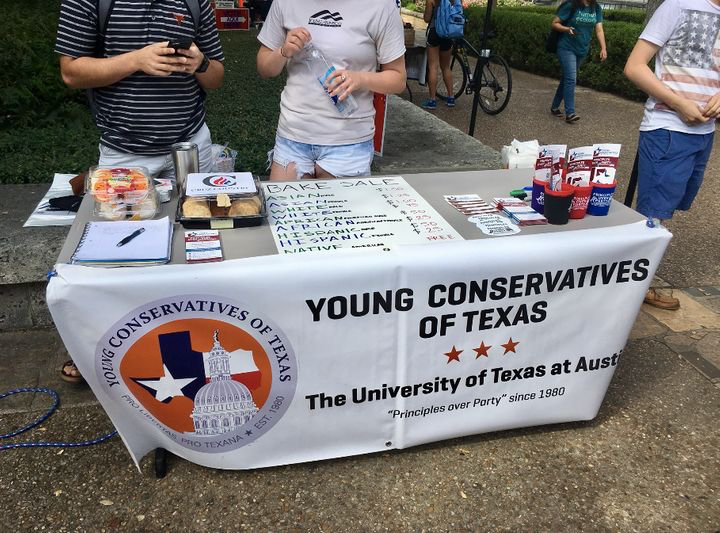
Ironically, Way’s experiment mirrors from an opposite standpoint an experiment conservative students are fond of running at universities: the “affirmative action bake sale,” where customers are charged more money depending on their race, claimed to be an indicator of ability to pay, with Asian customers charged the most and black students charged the least. A variation on this is the “white privilege popcorn giveaway” where white males are given a full bag of popcorn, while persons perceived to lie at other intersections receive less than a full bag. Such social experiments crudely attempt to critique policies that treat concrete persons on the basis of their demographic identity.

Affirmative Action Bake Sale

Way is crudely attempting to educate people by owning the conservative complaint, attributing to individuals social harm and privilege based on demographic identification. Of course, demographic categories do not have such attributes. Moreover, they don’t come with attitudes, beliefs, motives, and actions. His experiment skirts the difference between abstract notions of aggregates and grouped means, on the one hand, and the concrete facticity of individuals and their actual situations, on the other hand. Although the principle of this view of things is dressed up in the language of statistics and social scientific truths, it is the same principle that lies behind collective and intergenerational guilt and punishment. It punishes people for things other people do, for things their ancestors did. 

Take poverty as an example. At the aggregate level, we may indeed note that as a group black people are more likely to report being poor than are whites. In fact, in the aggregate, blacks trail whites in every significant social and economic category, from educational attainment to household income and personal wealth. But at the level of concrete facticity, the black people one encounters may actually be richer than the white persons one encounters. Indeed, since most blacks and whites are not poor (black poverty is around 27% of that demographic), the next random black or white person one meets is unlikely to be poor at all.

An important question in all this is what explains the group disparity. It is in exploring this question that group statistics are important. The sources of the problem are already well understood: the disparity results from racism, defined as a social system with structures and processes that advantage one or more groups over other groups on the basis of an ideology that differentiates people on the basis of ancestry and selected phenotypical characteristics. The advantages are found in patterns of inheritance and institutional behavior that result from history (e.g. slavery, segregation) and on-going social dynamics (e.g. discrimination, over-policing, mass incarceration). We are able to identify causes and effects in part because we collect demographic data on persons.

However, the patterns and dynamics of racism do not tell us about the particular situation of an actual person and they tell us nothing about the guilt and responsibility of individuals. A black person may not have been affected by racism, at least not in any significant or limiting way. It depends on his biography and those of his parents. At the same time, white people are also confronted by history and biography, and these explain their personal situation as much as they do for black people. There are 200 million non-Hispanic whites in the United States. Eighteen million of them live in poverty.

In the age of left-wing identity politics, there is little sympathy among progressive elites and intellectuals for poor whites who are lumped with affluent whites. Nor is there much recognition on the left that benefits may accrue to affluent blacks via government policies that at the same time neglect poor whites. However, when confusing the concrete facts of individuals with the abstract demographic categories with which they are identified functions to harm the fortunes of nonwhites, elites and progressives express a different point of view.

Consider the following real-world example. In capital cases in the state of Texas, juries can either impose the death penalty or impose a penalty of life in prison with the possibility of parole. There is no sentence of life in prison without parole in the state of Texas. One strategy prosecutors seeking the death penalty can pursue is convincing a jury that the defendant is at high risk to repeat his crime and capital punishment removes that risk. Enter Walter Quijano, a psychologist working for the Texas prison system as an expert witness, Quijano testified in several cases that, because of the higher rate of recidivism among blacks compared to whites, black defendants should be subject to the death penalty.

Walter Quijano

At best, “race” describes a constellation of phenotypic characteristics that can be used to classify individuals as belonging to groups. Race does not indicate a propensity of an individual to perpetrate crime. Aggregate statistics tell us nothing about what an individual – black or white, male or female – will or will not do. Indeed, to make this leap is an indication of the presence of race prejudice. It’s what we call stereotyping. To treat individuals of demographic groups on the basis of aggregate statistics is discrimination.

The courts get it. In the case of Duane Buck, who received a sentence of death instead of life imprisonment in a crime of passion, in part because Quijano testified that Buck’s demographic identity made him a greater risk to reoffend, the Supreme Court returned the case to the Fifth US Circuit Court of Appeals in New Orleans citing discrimination as a factor. Seventeen years earlier, Quijano saw six death sentences, achieved in part with his testimony, repudiated by state attorney general John Cornyn, five of which were concluded with new sentences.

Duane Buck

Let’s consider another example. African American males represent less than six percent of the US population. African American men are responsible for more than half of all homicides recorded by the FBI every year. Yet white anxiety upon seeing a black man approaching is irrational; that black men are overrepresented in homicide does not tell us whether the black man approaching is violent or criminal. When a police officer targets a black man on the basis of race, he may claim to be doing so because of what statistics show about overrepresentation of blacks in crime, but he is engaging in racial profiling. He should be policing on the basis of reasonable suspicion and probable cause. Being black and male is not the reason for black male overrepresentation in homicide and violent crime. It is also true that being white and male does not explain mass shootings. “Black male” is a descriptive category. As such, it has no agency. The same is true with the construct “white male.”

Such category errors are rampant in our society. They are the work of identitarian politics and essentialist thinking. It’s the way racists think. We expect it from racists. We should expect better from ourselves. 

The Immigration Situation

Some of those who seek entry into the United States or who enter and stay here illegally are fleeing from danger for reasons that align with international convention. However, most are not. They are economic migrants, lured across the border by employers who seek to exploit their labor at the expense of native-born workers. Some immigrants come to the United States for the promise of a better life, but others do not intend to stay; they plan to return to their country as soon as they feel they’ve made enough money here. As terrible as criminal violence can be, this is a reason to change the circumstances in one’s country, not flee it.

The effects of immigration on native-born labor is not trivial. When the supply of labor increases, the price of labor (i.e. the wage) decreases. Over the last half century, wages for the most vulnerable native workers have fallen with the increase in the labor supply, and workers in those sectors that absorb the most immigrants have suffered the most. While immigrants come with variable skill levels, it is the low-skilled immigrants that have the biggest impact on native-born workers because they crowd out low-skilled labor, those at the margins of society who are disproportionately black and brown, and who are most likely to be the targets of the agents of coercive control.

The United States absorbs a far greater number of immigrants than other countries, and in the past two decades alone immigrants without high school diplomas have increased the low-skilled workforce by around 25 percent. It’s not just low-skilled sectors; studies of abuse of the H-1B visa program find that tech firms fire native-born workers if cheaper immigrant labor is available. But the working poor suffer the brunt of, in part because they are less able to pivot to something else. Regardless of skill-level, as Professor of Economics and Social Policy at the Harvard Kennedy School professor George J. Borjas points out, “Immigration redistributes wealth from those who compete with immigrants to those who use immigrants—from the employee to the employer.”

The debate over the economic impact of immigrants is typically framed in terms of whether it is a boon or a detriment to the economy. However, this obscures the economic impact of immigration in a manner similar to how per capita GDP figures obscure economic inequality. For the working class as a whole, the presence of immigrant labor results in the transfer of half a trillion dollars from the working class to the capitalist class every year, disproportionately impacting those workers with lower skill levels. The winners of this massive transfer are capitalist firms, who pay significantly less in labor costs, and immigrants, who could not command the same level of pay or enjoy the same living conditions in their home countries. The losers are native-born workers. They not only lose income and livelihoods, but the quality of the conditions of life, while seeing consciousness and the political formation of their social class disrupted. 

Focusing the debate on economics also obscures the social and cultural impact of immigration. The elites who exploit immigrants for super-profits do not care about the crowded living conditions, compromised social services, or the other problems caused by illegal and large-scale immigration. The rich don’t live in those communities so they don’t have to suffer the material and cultural fallout from mass immigration. Working people have to pay for the social problems capitalist create in their pursuit of profit. Immigrants utilize government assistance at higher rates than natives, yet they pay lower taxes (because they have lower earnings), and, in the case of illegal immigration, pay little to no property, payroll, and income taxes. This means that every year a multi-billion-dollar burden is placed upon the shoulders of the native-born population.

Where is the today’s left on the problem of immigration? Only a decade ago I wouldn’t feel so alone in my support for immigration restrictions. Progressive folks on the left were then speaking up on behalf of native-born workers. Glenn Greenwald of The Intercept wrote on his blog in 2005, “Illegal immigration wreaks havoc economically, socially, and culturally; makes a mockery of the rule of law; and is disgraceful just on basic fairness grounds alone.” In 2006, Paul Krugman, professor of economics at the City University of New York, and columnist for The New York Times, wrote, in “Notes on Immigration,” that “immigration reduces the wages of domestic workers who compete with immigrants” and noted that “the fiscal burden of low-wage immigrants is also pretty clear.” He concluded, “We’ll need to reduce the inflow of low-skill immigrants.”

But Greenwald has walked back the sentiments expressed in that blog entry, chalking it up to youthful carelessness and a penchant for provocation. And, in a June 2018 op-ed, Krugman, contradicting his early statement about the impact of low-education immigration on the wages of low-education native-born working, appeals to the fallacy of reductio ad Hitlerum, pairing popular complaints about immigration to the antisemitic blood libel. In the same paragraph wherein he admits to disagreement over the effect of low-skilled immigrants he next characterizes such concerns as “just sick fantasies being used to justify real atrocities.” He writes, “There is no immigration crisis; there is no crisis of immigrant crime. No, the real crisis is an upsurge in hatred.” (Maybe it is not a crisis for Krugman when immigration results in the transfer of $500 billion annually from the working class to the capitalist class. While I cannot take this up here, it should suffice to note that claims about the neutral impact of immigration of crime lump all immigrants together; a significant proportion of immigrants are from the Asian world, the least criminogenic cultures on the planet. And while there is an upsurge in hate in the United States, to an extent driven by right-wing rhetoric, the rhetoric works upon the ground of widespread frustration among the working class with US immigration policy.) 

The shift among progressives from defending the interests of native-born workers to advocating open borders and smearing those who dissent from the agenda has a lot to do with the psychological fallout over the election of Donald Trump, which has reframed the uncontroversial policies of the Obama Administration and redefined them as right wing and nativist. Remember when the left opposed war in Iraq when Bush was president, but fell silent as Obama bombed Libya and instigated civil war in Syria? Or #MeToo outrage over Donald Trump’s misogyny yet silence in the face of allegations of rape against Bill Clinton? The cause of the phenomenon—the pendulum swings from hysteria to equanimity to hysteria—is the mass psychological condition under the two-party political apparatus. The politically active do not focus their politics on class analysis and moral principle as much as on identity politics and virtue signaling these days. Whether something is wrong depends on the identity of the wrongdoer not the nature of the wrongdoing. This is what lies behind Krugman’s about face on immigration’s harmful impact.

Analysis of immigration requires seeing beyond the ideological subjectivity of emotionalism and partisanship. The facts are striking. There are approximately 43 million foreign-born people living in the United States: 21 million naturalized US citizens and 23 million noncitizens. Of the latter, approximately 13 million are permanent residents, 11 million are here illegally (although that number is likely higher), and two million hold temporary visas. The number of foreign-born persons in the US has more than quadrupled since 1965. In 1965, foreign-born persons represented 5 percent of the US population. By 2015, they comprised 13.5 percent of the population (this is not much below peak immigration in 1890, when the foreign-born population was around 15 percent of the total population). The desire to come to the United States is very great. In a June 2017 poll, Gallup found that as many as 37 million people in Latin America desire to relocate to the US permanently. One-third of all Hondurans express a desire to come live in the United States. In total, 150 million people—or 4% of the world’s adult population—would move to the U.S. if they could. If everyone who wanted to move to the U.S. had their way, the country’s total population would increase by almost 50%.

Significantly, the period of mass immigration 1890-1930 moved Americans to demand restrictions on the flow of immigrants, not so much out of nativism or racism (the immigrants were white Europeans), but because steam ships allowed for the mass introduction of low-skilled labor who were used by industrialists to suppress the wages of native workers. Mass immigration was behind marked deterioration of neighborhood conditions, with rising inequality, poverty, and crime. So is it really that surprising that the topic of immigration would return as a political topic when the numbers again approached that level? Yet the experiences of ordinary Americans are pitted against the multiculturalist attitudes and cocooned life of affluent Americas on the east and west coasts that accuse those who complain of the worst possible motives. Failing to see the left come to their defense, working Americans are seeking out new leaders and checking out different politics.

The pace of illegal immigration has been slowing. The Obama Administration was aggressive in controlling immigration and the Trump Administration has continued these policies—in the fact of tremendous resistance. The strategies used by Obama and Trump include tighter border controls, stepped-up deportations, and more frequent prosecutions for unlawful re-entry. The decline is also attributable to the economic crisis of 2007. At that point, the illegal proportion or the US population exceeded 12 million. Half of all illegal aliens in the United States are Mexicans, which is why the problem often gets defined as the problem of Mexican immigration, but here, too, the numbers are declining. From 1980 to 2014, the number of Mexican legal residents in the US grew faster than their illegal counterparts. However, numbers from Central America’s Northern Triangle, El Salvador, Guatemala, and Honduras are growing, outpacing growth from elsewhereMore than illegal border crossings, immigrants who entered the United States legally (on nonimmigrant visas) are overstaying their visas. Illegal immigrants are overrepresented in the workforce, so they carry a disproportionate economic impact relative to the presence in the population. Many of those who are being deported are those who have overstayed their visas.

What about refugees? During the 1990s, most refugees were from the former Soviet Union and the Balkans. Most refugees today come from Syria, Afghanistan, Somalia, and Sudan. Most of the rest come from other African countries. Comparatively few refugees come from Central and South America, but given the proximity of the United States to the southern western hemisphere, we see more of them than do other countries. The number of those leaving the Northern Triangle, number in the tens of thousands. It is a very dangerous journey, especially for unaccompanied children, which comprise a large proportion of the total. They risk human trafficking and death from starvation, thirst, and exposure. Signaling open borders puts more of them in danger. Many of those claiming to be refugees cite criminal violence as the push factor. However, this, as well as the claim of domestic violence, have not been historically considered legitimate reasons to seek asylum. Such claims are hard to verify. Moreover, on principle, they do not align with the principle of asylum seeking. Criminal and domestic violence are rampant throughout much of the world. There is broad consensus internationally that these are legitimate claims: nationality (ethnicity), political opinion, race, and religion. Criminal violence that does not target members of groups on the basis of that association is considered interpersonal and does not confer refugee status.

Although it is worse in the US than elsewhere in the world in terms of the proportion of the population that is foreign-born, the problem of mass immigration is not unique to the US. Europe is experiencing a migrant crisis. There are crucial differences. In Sweden, for example, a country I have looked at closely, 80% of those who entered Sweden in 2015 were young men, whereas half of immigrants in the United States are women, a long-standing shift in gender representation. As in the US, most of those who cross the border or overstay their visas in European countries are not refugees or asylum seekers but economic migrants. As with many European countries, Sweden does not have housing and jobs for immigrants. The consequence of this is strain on the social supports Swedes (mothers, children, the elderly, the disabled) depend on, and a rise in crime and poverty. This is not only unfair to Swedes, but to the refugees and asylum seekers who need critical services, as well as to immigrants who are following the rules to legally enter the country (yes, persons who illegally enter a country harm the chances of those who are seeking to legally enter). 

I am in favor of following the international convention on refugees and asylum seekers. The Convention Relating to the Status of Refugees, or the 1951 Refugee Convention (with amendments) defines who is a refugee, delineates the rights of persons granted asylum, as well as the responsibilities of nations that grant asylum. The Convention is rooted in Article 14 of the 1948 Universal Declaration of Human Rights. The 1967 protocol defines a refugee thus: “A person who, owing to a well-founded fear of being persecuted for reasons of race, religion, nationality, membership of a particular social group or political opinion, is outside the country of his nationality and is unable or, owing to such fear, is unwilling to avail himself of the protection of that country; or who, not having a nationality and being outside the country of his former habitual residence as a result of such events, is unable or, owing to such fear, is unwilling to return to it.” Crucially, refugees have substantial legal obligations in the Convention, principally, they must abide by the laws of the nation hosting them.

There is a basic truth in all this: if you don’t have borders, you don’t have a country. There is nothing immoral or oppressive or reactionary about drawing borders and defending them. Our foremost concern must be about justice. It is not fair to native-born workers to undermine their livelihoods and communities for the sake of capitalist profit. If we enforce immigration law, fewer people will come to the United States, and those who do will come via an orderly process and bring with them the knowledge and skills that will improve communities in the United States. The United States is not here to police the world or save the world, and it troubles me that those who support rational immigration policy are smeared as “nativists” and “racists.” The reality of enforcing the law is no reason for ignoring the law. Instead of demanding the abolition of ICE, the left should insist on due process and humanitarian treatment of those who cross the border or overstay their visas.

(Note: Readers may object that Borjas’ politics lean conservative. However, as The Miami Herald points out, while he supports increased restrictions on immigration, “he doesn’t believe a wall—built by Mexico or anyone else—does any good. He opposes the mass deportation of undocumented immigrants as inhumane. And he advocates a tax on businesses—high-tech, agricultural and all the rest—that profit from cheaper immigrant wages, and giving that money to Americans displaced by the immigrants.”) 

Censorious Desire

Offense taking is one of the motives behind a desire to censor opinions and images. There are people who find things people say offensive and want those who hurt their feelings held accountable and offensive opinions and images taken down.

A feminist, uncompromised by multiculturalism, criticizes the Muslim community for the expectation that women wear the hijab or the chador. According to the feminist standpoint, the hijab and the chador represent the modesty rules of a patriarchal religion designed to regulate sexuality on grounds that woman tempt men with their bodies and, seeing how each woman is meant for a particular man, women must be to some extent hidden (sometimes completely) from the male gaze. Feminists are correctly opposed to the notion that women should be subject to male control, so demand and expectation to cover are subject to criticism. An imam may describe the feminist attitude as “Islamophobic” and deem it offensive. In this case, what is offensive is criticism that challenges a system of sexual repression, and the desire to censor such criticism is motivated by a desire to perpetuate patriarchal arrangements.

I could provide many more examples, but it will suffice to note that expressions people find offensive are in theory infinite in number. In many of these cases, such as in the present case, the desire to censor is about protecting an unjust power – controlling what other people say and do because it challenges hierarchy and privilege. The underlying desire to prohibit speech critical of Islamic practice is a perceived need to prevent others from receiving ideas that may bring the legitimacy of that practice into question and, more broadly, shake their faith and undermine their traditions—which is what enlightenment is all about. The feminist challenges the patriarchy with her criticism. The claim that her words are offensive represent a tactic to silence her for the sake of the imam who believes others should not hear her words. This is no different than a desire to censor speech critical of white supremacy on the grounds that racists find such speech offensive.

The desire to control not only what people say, but also what others hear, to control what they think and believe, should compel each of us to become more fierce in our free speech advocacy. How could anybody who believes in freedom stand by silently while speech critical of oppressive practices is suppressed—or, worse, join with the offensive-takers and express their censorious desire? When people tell me that certain forms of speech should be restricted because they are offensive, I wonder when and how they acquired the authority to speak for other people. Who are they that they should control the thoughts and expressions of others or deny individuals the opportunity to hear the opinions of others or to receive their expressions? And who are you to stand idle while they attempt to do this? You invite your own oppression.

Restricting speech on the grounds that it may offend members of a group robs members of that group of the opportunity to hear speech they might find useful, enlightening, funny, liberating. Is speech critical of the Islamic prohibition on homosexuality offensive to homosexuals in Muslim communities? It doesn’t stand to reason that it would be. Might they find such speech useful in their struggle against stifling heterosexuality? Indeed, they might. As a supporter of gay rights, I have an obligation to stand with homosexuals everywhere. Who is your choice of comrades in that struggle? Gays and lesbians or Muslim clerics? Do all women in Muslim majority communities believe in Islamic modesty rules? Might there be women who do not want to wear the hijab but are scared or don’t know there is another opinion to hold on the matter? The latter is most certainly true. Might they welcome opinions that support their desire to exist uncovered or to at least have the conversation without being censored? I feel confident they do. And that is why I stand in solidarity with the victims of patriarchal oppression, not with the men who oppress them. Who is your choice of comrades in this struggle? Women or the imams? Are there no Muslims who find cartoons of Muhammad funny? I bet there are.

Why are the conservative and traditionalist voices of Islam allowed to set the terms of freedom for everybody? How could an atheist or a Christian ever accept being bound by the blasphemy rules of Islam? For that matter, why should a Muslim be bound by Islamic blasphemy rules? Would you tolerate this attitude coming from the Christians around you? I hope not. If an ideology doesn’t promote free thought, then of what use is it to a free people? I would have to think very lowly of people identified as Muslims to believe they were all incapable of seeing through the lies of their religion or that they were undeserving of the same rights I enjoy.

By falsely defending the sensibilities of a group which he assumes is monolithic in its sensibilities and for which he presumes to speak, the censor oppresses individuals by denying them access to information and knowledge. Censorship is not just about suppressing the speech or expression of the speaker or artist. It’s about withholding information and knowledge from people who need it or want it. They are not allowed to choose for themselves if the censor chooses for them. The censor claims to know the minds of other people and appoints himself defender of their interests. He robs people of their agency and their autonomy and their freedom by telling them that he and community leaders will think for them.

There is no human right that protects the desire to have one’s ideology held safe from criticism and ridicule or one’s harmful practices free of restriction. But there is a human right to be free to think and say what you will and to be free from harmful cultural and religious practices.

The censorious desire is the mark of the authoritarian mind. The human right to liberty is universal and unalienable.

Trump’s Hypocrisy

Several women have accused Bill Clinton of sexual misconduct. The four most well-known are Juanita Broaddrick in 1978 (rape), Leslie Millwee in 1980 (sexual assault), Paula Jones in 1991 (exposing himself and sexually harassment), and Kathleen Willey in 1993 (nonconsensual groping).

The Broaddrick case is disturbing: “Then he tries to kiss me again. And the second time he tries to kiss me he starts biting my lip. He starts to bite on my top lip and I tried to pull away from him. And then he forces me down on the bed. And I just was very frightened, and I tried to get away from him and I told him ‘No,’ that I didn’t want this to happen, but he wouldn’t listen to me.” This lip biting is described by other women. It’s part of his MO, a signature move.

Broaddrick continues: “It was a real panicky, panicky situation. I was even to the point where I was getting very noisy, you know, yelling to ‘Please stop.’ And that’s when he pressed down on my right shoulder and he would bite my lip.” Clinton then raped her. “When everything was over with, he got up and straightened himself, and I was crying at the moment and he walks to the door, and calmly puts on his sunglasses. And before he goes out the door he says ‘You better get some ice on that.’ And he turned and went out the door.” Broaddrick emphasizes, “It was not consensual.” Broaddrick has a witness to her injuries. 

President Trump took these accusations seriously during the 2016 campaign even though the accusations surfaced some time after they happened, in some instances several years after. For example, Broaddrick was extremely reluctant to come forward, even denying the rape occurred before finally relenting and describing the crime in 1999. Now Trump is saying that a legitimate claim of sexual assault should come with a contemporaneous police report. Does he intend to apologize for citing the claims of these women as a reason for voting against Hillary Clinton in 2016? 

The Need for Limits

I am married to an immigrant. I personally know how much work is required to keep such a family together in the United States. The process is difficult and intimidating and not everybody has access to the cultural and financial resources to make it through it. Sitting in immigration offices and watching things go badly for other couples is a frightening experience. On several occasions, my wife and I were questioned so fiercely it felt like a police interrogation. I know firsthand how important it is to learn to navigate the system and make sure you have crossed every “t” and dotted every “i.” But I can only imagine how crushing it must be to lose the person you love to deportation. My wife got to stay here. She followed the rules and now she is a US citizen. To be sure, my phenomenological experiences neither make me an expert on immigration nor grant me any dispensation to speak on the matter as if I were; however, as a sociologist with expertise in political economy, I am familiar with explanations of the dynamics – the push and pull factors – driving immigration and can speak about it with some authority. My training makes me sensitive to the social problems immigration brings.

These realities are pertinent: Immigration provides cheap labor for capitalists in labor-intensive industries (that includes modern agriculture); business firms have an incentive to keep borders open enough to allow sufficient numbers of migrant workers into the United States – and they have the political power to keep immigrants at a disadvantage in law and policy while they are there. It is the prospect of these jobs that draws migrants into the United States, primarily across the southern border. Cheap labor effects the wage and employment structure, keeping down wages and fracturing worker solidarity, thereby hampering the ability of workers to organize successfully around their collective interests, while making it difficult for legal workers to find employment in low-wage sectors. We see this, for example, in African Americans, who have historically performed low-skilled manufacturing, agricultural, and service sector work, being priced out of those markets. The passage of the 1965 Immigration and Nationality Act, at which point only five percent of the population was foreign-born, saw the labor force participation rate for adult black men steadily decline; in 1973, the rate was 79 percent. Today, it is 68 percent. According to the Bureau of Labor, within less than a decade, if current trends prevail, it will fall to 61 percent. Harvard economist George Borjas found that one-third of the decline in employment among black male high school dropouts between 1980 and 2000 was attributable to immigration (see LA Times). The impact of illegal immigration on communities is a national phenomenon paid for at the local level in burdens imposed on school districts and neighborhoods, with overcrowding in classrooms and houses and apartments, a load that rests heavily on the shoulders of the citizens and residents who pay income, payroll, and property taxes. Moreover, the chances of millions of people who engage the immigration system legally are compromised by those who side-step that process and enter the country illegally. We are often told about the benefits of immigration. But to whom do these benefits accrue? For the most part, the wealthy Americans who employ immigrants and the immigrants themselves.

As a socialist, having elected to stand with the working class, I understand the concerns my brothers and sisters have about the impact immigration has on their communities and the importance of getting the politics right on this question. I believe in a borderless world, but not per se; my borderless world depends on what type of world that is. Is it a capitalist world or a socialist world we’re building? Is it a secular world, where religion is at best at the margins of culture and politics, or a world where religion is on the march? Nation-states have borders (you have no country without them), and as long as capitalists exploit human labor, and as long as there is religious fanaticism in the world, there is a need for immigration rules and enforcement to protect my work and my person. Perhaps nothing demonstrates this more clearly than Sweden’s experience with mass immigration – an explosion of criminal violence and cultural corrosion in a historically progressive, humanitarian, and orderly society that occurred because its political leaders opened the country to large numbers of immigrants, mostly Muslims from the Middle East, a culture very different from Sweden’s.

But there is also a political-strategic need for immigration control. Marx and Engels write in The Communist Manifesto that “working men have no country.” They explain:

Since the proletariat must first of all acquire political supremacy, must constitute itself the nation, it is, so far, itself national, though not in the bourgeois sense of the word. National differences and antagonisms between peoples are vanishing gradually from day to day, owing to the development of the bourgeoisie, to freedom of commerce, to the world market, to uniformity in the mode of production and in the conditions of life corresponding thereto. The supremacy of the proletariat will cause them to vanish still faster. United action, of the leading civilized countries at least, is one of the first conditions for the emancipation of the proletariat.

There is a causal order in the process of transformation: “In proportion as the exploitation of one individual by another is put an end to, the exploitation of one nation by another will also be put an end to. In proportion as the antagonism between classes within the nation vanishes, the hostility of one nation to another will come to an end.” Which is why they write, famously, “Though not in substance, yet in form, the struggle of the proletariat with the bourgeoisie is at first a national struggle. The proletariat of each country must, of course, first of all settle matters with its own bourgeoisie.”

When Marx and Engels talk about “nation” in the first instance they mean the population of a sovereign state. When they talk about it in the next instance they mean other nations, which includes communities of descent and language (the ethnic meaning of nation). The development of the proletarian struggle, when in command of political power, that is, having wrested control of the state from the bourgeoisie, begins the process of undoing the antagonisms between nations in the latter sense. Illegal immigration, and to some extent legal immigration, particularly in great numbers, is counterproductive to the proletarian struggle for the host countries as well the emigre because, on the one hand, it is disruptive to the process of organizing citizens for the political fight against the national bourgeoisie, while, on the other, it drains the emigre’s home nation of proletarians who could join the fight against their own national bourgeoisie. In other words, capitalism takes workers from the front lines in the struggle for socialism and pits them against other workers in other national contests to thwart the struggle for socialism. It is important to recognize in this regard that immigration is one side of capitalist globalization. Immigrants are enticed here because the purposes for which they are needed cannot be exported. Where work can be exported, capitalists seek cheap labor overseas, in export processing zones throughout the world (including Mexico). This is the other side. The working class is exploited wherever they are. Immigration is a tool of capitalist globalization. 

Although not a Marxist, Boston College political scientist Peter Skerry, in an op-ed for The Boston Globe, shines considerable light on the matter when he writes, “While liberals and progressives have stopped short of endorsing open borders, they’ve come to treat opposition to illegal immigration and constraints on illegal immigration as unacceptable, even racist.” He notes that, from a historical perspective, in relation to Trump’s position on immigration, “the Democrats’ new default position – that opposition to illegal immigration and constraints on legal immigration are virtually unacceptable – is just as extreme, certainly by historic standards.” Granted liberals, progressives, and Democrats are not socialists, but this fact only points out more clearly the problem of the left accepting the multicultural and open-borders mentality of the establishment “left” in America. It was not always so. Skerry writes, 

Within living memory, a powerful labor movement favored limits on immigration and fought against the reviled Bracero guest worker program, which began during World War II and was finally ended in 1964. At times, labor organizer Cesar Chavez supported the arrest and deportation of illegal farm workers. His union, whose members were predominantly of Mexican origin, viewed these interlopers from Mexico as strike-breakers and scabs.

As a child working in the California agricultural industry, Chavez came to understand why farmworkers suffered low wages and poor working conditions. His biographer Miriam Pawel quotes him as saying that “a surplus of labor enabled growers to treat workers as little more that interchangeable parts, cheaper and easier to replace than machines.” When Congress ended the bracero program in 1964, the pay and conditions for farm workers improved; but the rise of illegal immigration that followed undermined their progress. Ralph Abernathy and Walter Mondale joined Chavez in 1969 to protest the use by capital of illegal immigrants as strikebreakers. They marched to the Mexican border. 

Skerry notes that “multiculturalism has become a more powerful force within the Democratic Party – and American society – than labor solidarity.” This observation underscores the point I have long made that the multicultural attitudes of the liberal Democrat and the progressive are at odds with working class interests. The rhetoric we hear from them surrounding the Statue of Liberty as a symbol of a “nation of immigrants” misleads historical understanding. The reason French republicans donated Lady Liberty to the United States was to celebrate the American republic and recommend it as a model for the rest of the world. Lady Liberty is not a lighthouse to bring to the US those adrift in their own nations, but the bearer of a torch to light the way for other countries to sail to enlightenment, her broken chains representing human liberation from slavery literally and figuratively. “Far from inviting freedom-loving peoples around the world to the United States,” Skerry writes, “Lady Liberty’s torch was intended to inspire them to stay put and establish republics of their own.” That’s the statues’ slogan: “Liberty enlightening the world.” The famous lines from Emma Lazarus’ sonnet, “New Colossus,” “Give me your tired, your poor, your huddled masses yearning to breathe free,” did not find its way to the statue until the early twentieth century (the statue was dedicated in 1886, its purpose conceived well before then). The oft-heard claim that the global relation between the arrival of immigrants and the expansion of the colonial system – “We are here because you were there” – requires America’s to be a doormat to the world punishes the living for the crimes of the dead, an utterly immoral demand. But then why should working people pay for capitalist exploitation at all? They don’t already pay enough? If anybody is owed reparations, it’s the working class whose value makes the capitalist’s life possible.

The characterization of those who desire immigration control as “racist” and “xenophobic” gets story and motive wrong. In their book The Age of Mass Migration, economic historians Timothy Hatton and Jeffrey Williamson focus on the effects of immigration on labor markets and neighborhood conditions. The advent of the steamship, which made the trans-Atlantic voyage cheaper, faster, and safer, greatly expanded the flow of illiterate migrants from Southern and Eastern Europe. Large numbers of young men (many of whom did not intend to stay) “posed challenges involving neighborhood stability, community cohesion, social disorder, and crime.” Harvard economic historian Claudia Goldin found that the shift in national groups in the 1890s to those whose living standards and schooling levels differed markedly from earlier immigrants negatively impacted the wages of native-born workers. The story that immigration restriction in the U.S. during this period were the result of nativism flies in the face of evidence showing that opposition to immigration had much more to do with the negative consequences of immigration on the national proletariat than on nativist sentiment. Hatton and Williamson conclude that “racism and xenophobia do not seem to have been at work in driving the evolution of policy toward potential European immigrants.” And British scholar A.T. Lane: “careful examination of the columns of many labor journals has produced few examples of racist thinking applied to immigration.” 

It would take decades of the melting pot dynamic to forge a nation not of immigrants (the rhetoric doesn’t make much sense when you think about it), but of citizens, a history of assimilation that depended fundamentally on the restrictions imposed on immigration during the first decades of the twentieth century. And there were problems along the way, such as the large proportion of the German population loyal to the Fatherland (German American Bund) in the face of the fascist threat in Europe. 

The internal cohesion of the nation is an essential part of the ground upon which the national proletariat is built, reflected in the strength of labor unions in the post-war period. As immigration restrictions were loosened, and with the national dereliction of duty in securing the borders – there are between eleven and twenty million illegal immigrants in the United States today – labor’s strength and numbers proportionally declined. To be sure, there are many reasons for declining union numbers and power, as well as stagnant wages and rising inequality, but to ignore the effect of foreign workers on the character of labor markets is to deny reality.

The debate about immigration is so polarized, so emotionally explosive, yet at the same time so unfocused from a critical theoretical-practical standpoint (and here I mean from the standpoint of labor) that it is difficult to have a rational debate about it. Accusations of “racist” and “xenophobe” grind conversation to a halt. Those who have questions often respond by keeping them to themselves – and answering them for themselves. And that is not always for the best. Those of us on the left who care about the political context worry when people are driven to the rightwing end of things because the leftwing end doesn’t address their concerns. Immigration is a major source behind the frustration of many in the working class in the United States. Working families are feeling alienated from the social democratic traditions because of the way their concerns are dismissed out of hand – or worse, decried as “racist” and “fascist.” We do better when we discuss these issue with those with whom we disagree with charity and compassion. And we really do better when we argue from a class-theoretical standpoint. Then we’re on the ground of social realities. We’re forced into these conflicts by powerful forces: capitalism and war, the long histories behind them. Neoliberalism acutely lies behind the current crisis of immigration and the rise of nationalism. Neoliberal policymakers exploit open societies to undermine democracy and worker security. They throw everything into the market, extol the virtue of diversity in rebranding the result, and marginalize those who question any part of it. Without the traditional social democratic response – a labor-based/class analytical approach – working families turn to those forces who take their concerns seriously, and, unfortunately, that means ethno-nationalist voices. What is portrayed as the other side – the body of multiculturalist/identity-based practices that passes for left-leaning policy thinking today – is itself the ideological projection of bourgeois interest. 

The European situation is in many ways a preview of our future in the United States. Although the nationalist right is on the move there, most of our European brothers and sisters don’t hate other people. But they do want to know why, if the immigration issue in Europe is driven by humanitarian concern for refugees, those crossing the border are mostly young men. Where are the women, children, and old people? To be sure, there are some, but few enough to make the question relevant. Why, if new arrivals are not associated with crime, are the enclaves they establish and settle in so unwelcoming and even dangerous to travel to and through? Parts of Europe are seeing levels of violent crime – murder and rape – they haven’t seen in decades. People want to know why so many immigrants resist assimilation and integration only to hear that the desire for assimilation and integration is a racist one (it’s not). Why are intolerant fundamentalist religious communities popping up in secular societies like Sweden? Why are European governments tolerating cultural practices, for example in the treatment of women, that are contrary to the secular traditions of Europe? And why on earth are the governments of supposedly free and open societies criminalizing the right to complain about all this? People want to know why, if preservation of culture and tradition is so important, they’re smeared as “bigots” and “racist” for wanting to preserve theirs, a culture that has contributed so much to the world – the values of secularism, liberalism, equality, human rights, rule of law, free speech, and religious liberty. Sure, the West isn’t perfect (no place is), but have people taken a look around the planet? Certainly Europe and the United States must have something worthwhile in light of the fact that it is such a desirable destination. Is there value in keeping it a desirable place to live and visit? Increasingly, Europeans do not feel at home in their own countries.

Neoconservatives (really liberals) like Douglas Murray are on to something when they point out that the leaders of Europe are not listening to the people and so the people are turning to those who will, and that the left won’t like who they’re turning to. For the US, Peter Skerry puts it this way: “Trump, no doubt, played to racial sentiments. But he also saw something his opponents didn’t: that even if Democrats refuse to acknowledge some of the complexities of immigration, many voters still see a need for limits.” If we on the left want to slow the advance of the right, and accelerate the advance of the socialist cause, then we have to be realists on the immigration question. We have to listen to the national proletariat and fight for their interests, not for ivory tower ideas like multiculturalism and identity. Those are bourgeois notions that stand in place of an authentic working class politics. Indeed, they aim to fracture the working class.